
Mediterranean false-brome (Brachypodium retusum, )
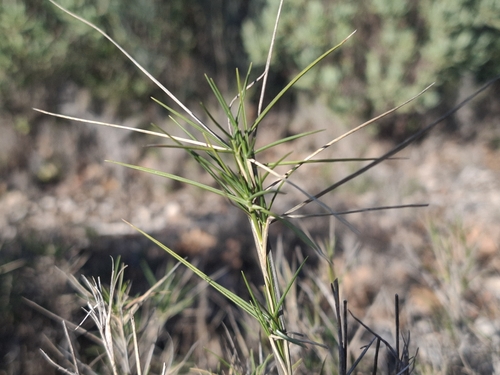
Mediterranean false-brome (Brachypodium retusum) is a perennial Poaceae grass. Narrow leaves grow in two ranks along branched stems in dry Mediterranean habitats.
Read moreMediterranean false-brome
Bromus retusus, Brachypodium ramosum and Brachypodium mucronatum
Place in full sun, with intense direct light all day long.
Sunny open habitats or light pine woodland.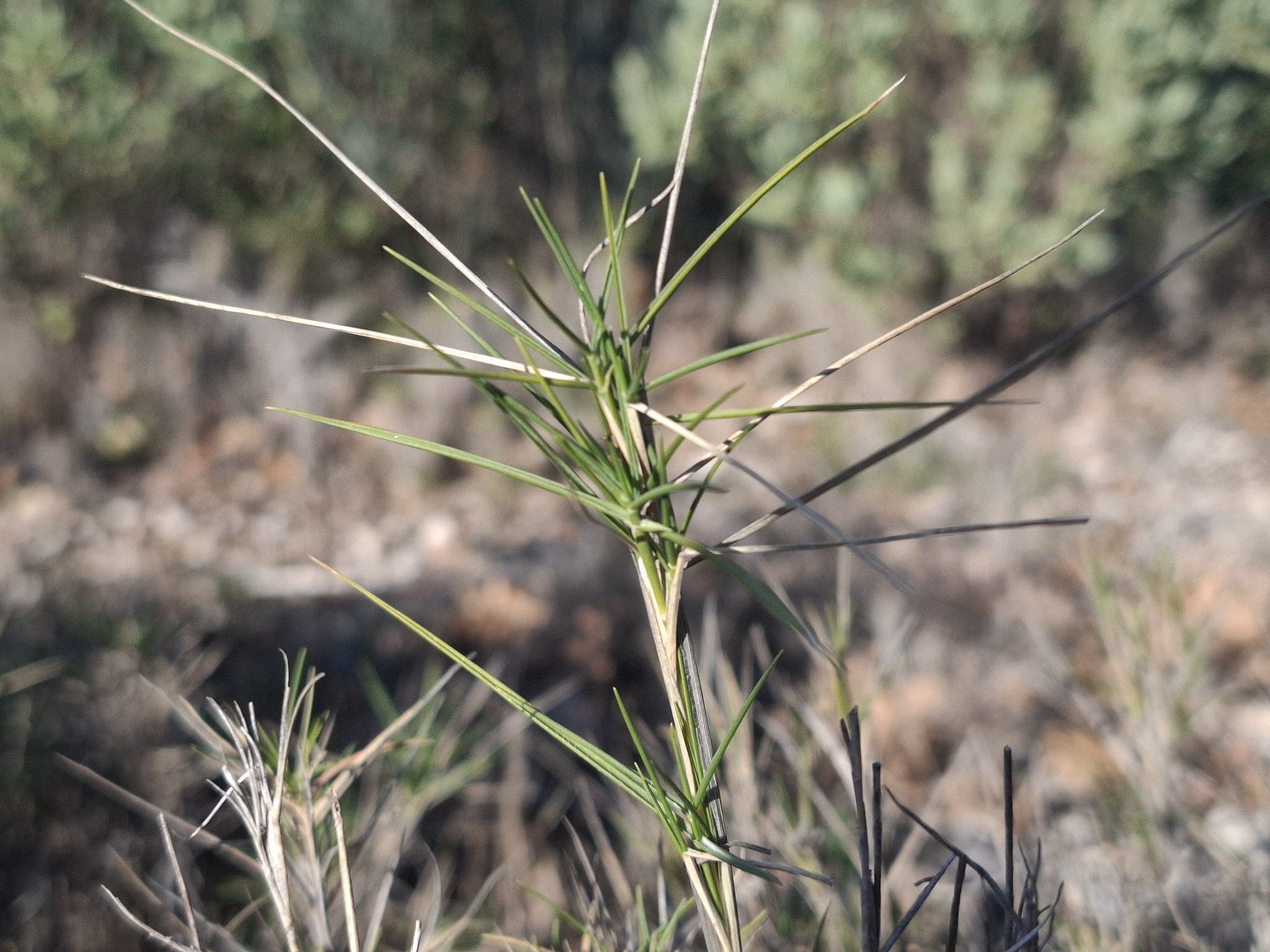



© photo
(c) Patrice D'Onofrio, some rights reserved (CC BY-NC), uploaded by Patrice D'Onofrio · cc-by-nc
Taken May 15, 1998 by Photoflora - Benoit BOCK (©)
Taken Jan 1, 1970 by Photoflora - L'Abbé COSTE (©)
Taken May 15, 2015 by Photoflora - Benoit BOCK (©)
Taken May 12, 2011 by Tela Botanica − Bertrand BUI (cc-by-sa)
Taken Jun 16, 2012 by Tela Botanica − Paul Fabre (cc-by-sa)
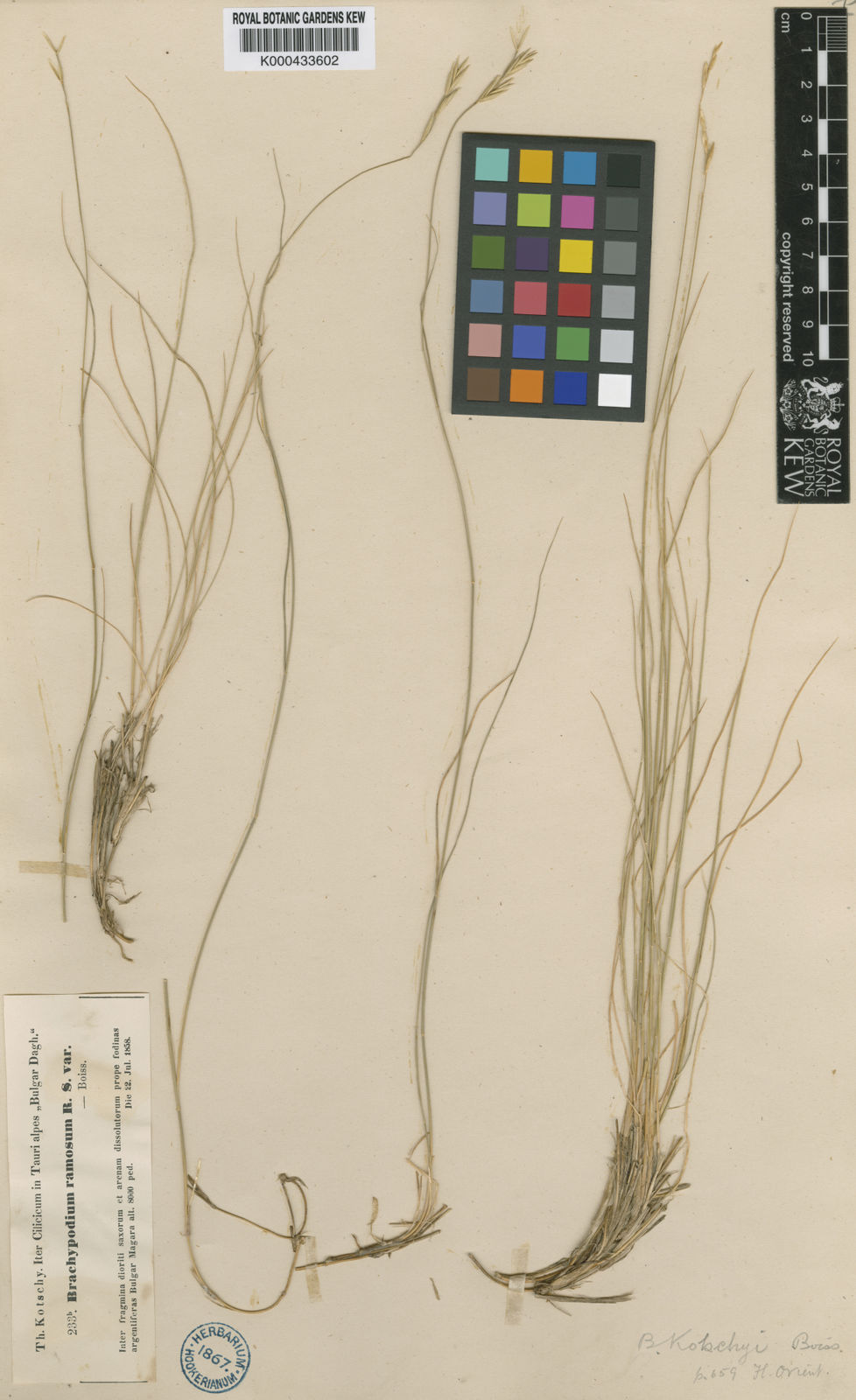
© copyright of the Board of Trustees of the Royal Botanic Gardens, Kew.


Global distribution
Native from the Mediterranean region to the Caucasus, and from Ethiopia to the Arabian Peninsula.
- Native2
- Introduced1
- Mediterranean France
- Corsica
- Germany
Hexagons: regions where the plant occurs. Green dots: native range.1
Identity
Mediterranean false-brome (Brachypodium retusum (Pers.) P.Beauv., 1812) is a perennial Mediterranean grass. 8 Branched stems and leaves in two ranks give it a different outline from grasses whose leaves all cluster at the base. This Poaceae species can form sheets of intermingled green and dry foliage. 35
Aboveground stems arise from a branched rhizome. A continuous patch therefore need not represent many separate seedlings. Plants usually measure 20–60 cm (8–24 in), with stems reaching 70 cm (28 in). Growth habit varies with drought and the openness of surrounding vegetation. 6 3
Recognition
Leaves spread in two ranks, a distichous arrangement visible along a stem: blades alternate from one side to the other. They are narrow, often rolled inward, curved and strongly veined. A short ligule occurs where blade meets sheath. Stems have several nodes and numerous leaves. 65
The inflorescence bears relatively few elongated spikelets, often one to nine. Each can contain 10–18 florets. Glumes enclose the spikelet base, while the floral bracts have only short points or awns. Vegetative habit remains useful before flowering, but spikelets allow characters to be checked instead of relying on foliage color. 67
Useful taxonomy
The accepted name is Brachypodium retusum, a combination published in 1812 in Essai d'une nouvelle agrostographie. Its basionym, Bromus retusus Pers., dates to 1805. Parentheses around Pers. mark the change of genus; P.Beauv. identifies the author of the combination in Brachypodium. 2 1 3
Brachypodium ramosum Roem. & Schult. appears in older floras and horticultural synonym lists, explaining the French name meaning branched false-brome. Another synonym is Brachypodium mucronatum Willk.. These names help retrieve historical descriptions without creating extra species. Check synonymy before comparing characters under an old label. 1 4 3
Habitat and range
Dry grassland, garrigue and open pine woods support extensive patches, between shrubs and beneath their open canopy. Stony ground and dry banks are characteristic. In France its grassland is chiefly associated with base-rich soils; elsewhere it shows less substrate preference. 5 6 7 3
Within France it occupies southern garrigue and arid habitats as far as Drôme, Ardèche, Aveyron and Haute-Garonne, as well as Corsica. It is Least Concern on the French national Red List. 3 8
The native range extends from the Mediterranean region to the Caucasus and from Ethiopia to the Arabian Peninsula. France and Corsica are native territories; Germany is an introduced territory. A natural range can extend beyond Europe's Mediterranean climate. Restricting the account to southern France would hide much of its distribution. 1
Life cycle and reproduction
Spring flowering continues into early summer. May–July is reported both in France and the Ebro valley; these are regional dates. During flowering, hanging anthers become visible beyond the spikelets. The subsequent fruit is a caryopsis, as in other grasses. 7 6 3
Rhizomes sustain and extend the plant, while animal-dispersed seeds also contribute to reproduction. Green and dry leaves can persist together in one patch. Dead foliage alone therefore does not demonstrate that an entire stand has disappeared. New shoots and flowering stems provide monitoring information distinct from the brown appearance of accumulated litter. 6 5 3
Uses and risks
The species is used to protect and stabilize dry, stony banks, consistent with its rhizomes and spreading cover. Its grassland belongs to a Mediterranean habitat of priority Community interest. One isolated tuft is nevertheless insufficient to establish the legal classification of an entire plot: assessment concerns a plant community and its setting. 6
Traditional uses as a blood-pressure-lowering, astringent or diuretic plant are reported. These do not establish efficacy or provide preparations to reproduce. Human and animal safety remains unknown, with an uncertain species-specific toxicological profile. Membership of the grass family or occurrence in pasture does not establish edibility or safety for horses. 6
Varieties, look-alikes and related plants
Brachypodium phoenicoides can resemble it, but generally has longer leaves more nearly parallel to the stems. Its inflorescence contains more than eight spikelets and its stems branch little. Examine these features together: spikelet number varies, and an incomplete stem can distort the comparison. 57
Brachypodium distachyon and B. sylvaticum have longer awns. Short awns combine with two-ranked leaves and a branched habit in B. retusum. Photographing a whole stem, ligule and spikelet permits a firmer check than a distant grassland view. 7
Main sources
The name Brachypodium retusum dates to the combination published in 1812, based on the earlier Bromus retusus. 21
- Kew, Plants of the World Online: Brachypodium retusum
- IPNI: publication of the name
- Tela Botanica: names and French description
- RHS: horticultural synonymy
- University of the Balearic Islands: Virtual Herbarium
- Junta de Andalucía: morphology, habitat and uses
- Javier Blasco-Zumeta: Flora of Pina de Ebro
- INPN, TAXREF: French names and status in France
Frequently asked questions
Do the French names brachypode tronqué and brachypode rameux refer to one plant?
Both name Brachypodium retusum. Brachypodium ramosum is an older scientific name included in its synonymy.
How can Mediterranean false-brome be recognized?
Examine branched stems, narrow leaves in two ranks and an inflorescence with relatively few, short-awned spikelets.
Where does Mediterranean false-brome grow?
In Mediterranean dry grassland and garrigue, between shrubs and beneath open pine woodland.
If you are unsure about a plant’s toxicity, ask a botanist or veterinarian for advice.