
Slender false brome (Brachypodium sylvaticum, )
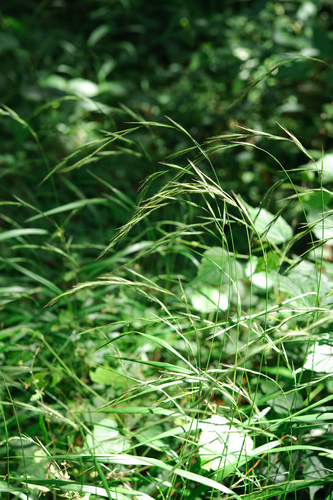
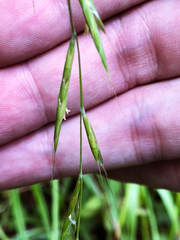
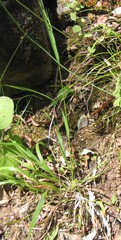
Slender false brome (Brachypodium sylvaticum) is a perennial Poaceae grass of woodland and its margins. Tufts of soft, hair-fringed leaves carry narrow, often drooping inflorescences in summer.
Read moreSlender false brome, False-brome and False brome
Festuca sylvatica, Bromus sylvaticus and Brevipodium sylvaticum
Place in indirect light or in a shaded room.
Partial woodland shade; also grows in open habitats.
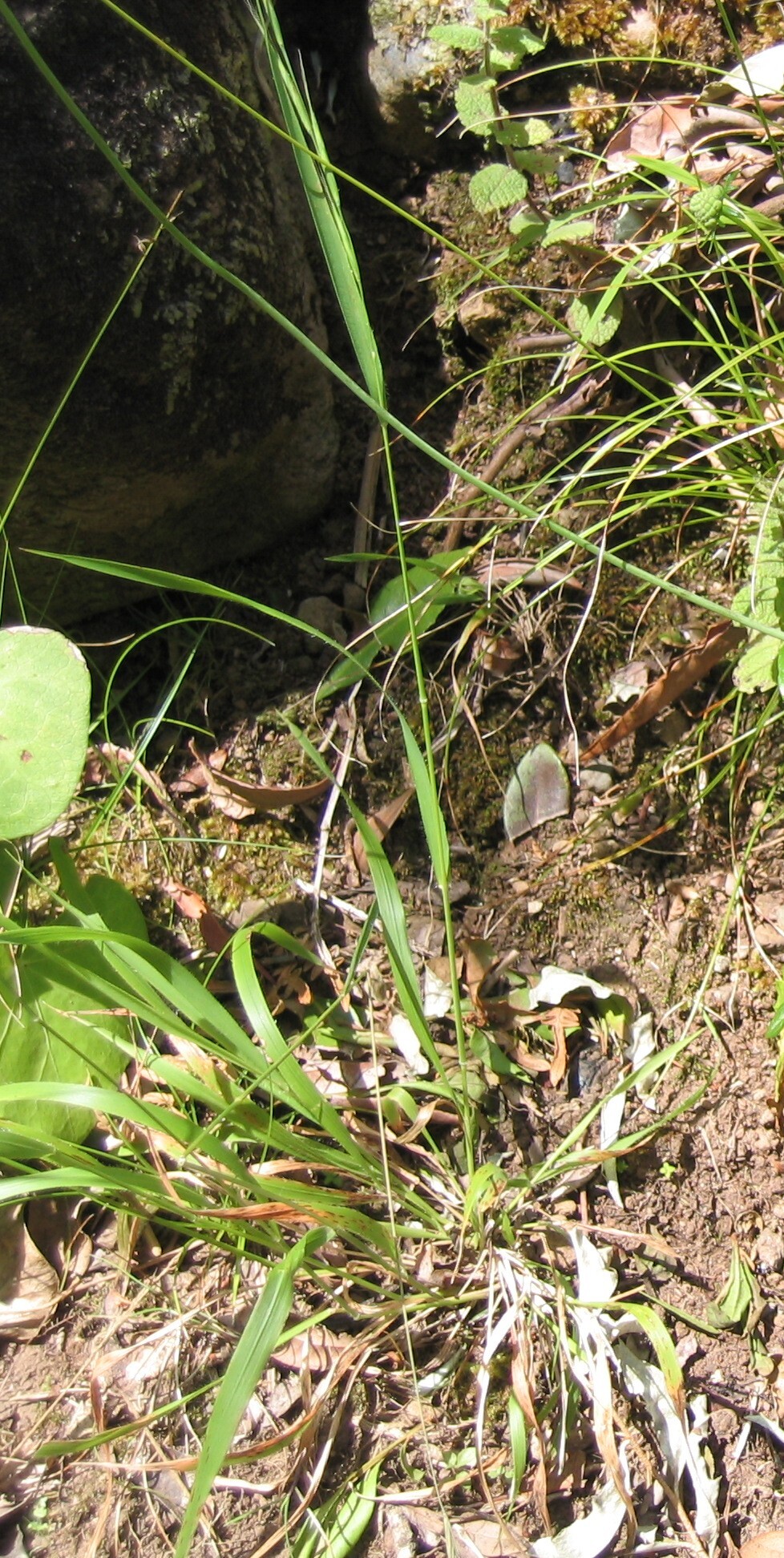


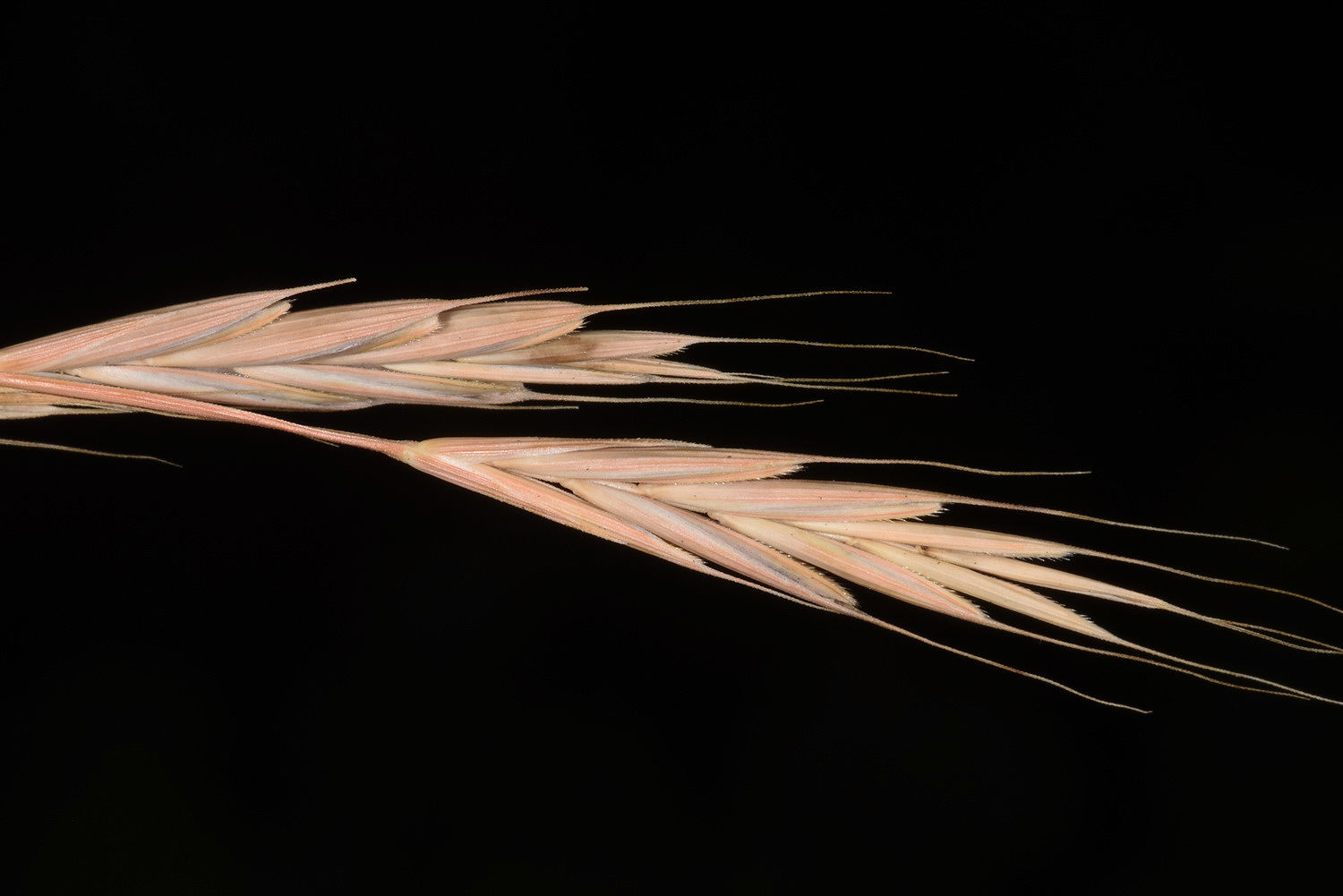


© photo
(c) Cheng-Tao Lin, some rights reserved (CC BY), uploaded by Cheng-Tao Lin · cc-by
Cheng-Tao Lin · cc-by
zebedeugalinha · cc-by
Taken Jul 15, 2017 by Photoflora - Corine OOSTERLEE (©)
Taken Jun 6, 2011 by Tela Botanica − Bertrand BUI (cc-by-sa)
Taken Jul 21, 2022 by Alexander Baransky (cc-by-sa)
Taken Feb 18, 2017 by Yoan MARTIN (cc-by-sa)
Taken Jul 11, 2021 by Alain Bigou (cc-by-sa)
© copyright of the Board of Trustees of the Royal Botanic Gardens, Kew.


Global distribution
Native from Macaronesia to Eritrea and across Eurasia; introduced in parts of the Americas and New Zealand.
- Native2
- Introduced1
- Invasive1
- France
- Japan
- New Zealand
- Oregon
Hexagons: regions where the plant occurs. Green dots: native range.1
Identity
Slender false brome (Brachypodium sylvaticum (Huds.) P.Beauv., 1812) is a tufted perennial grass in the Poaceae, chiefly found in woods and their margins. Soft leaves and drooping inflorescences give it a different appearance from stiff grasses in a mown lawn. Its common name alone does not distinguish it from true bromes. 1 9 4
Culms reach 45 cm–1 m (18–39 in) according to the site. Shoots arise from a compact rootstock, without long creeping rhizomes comparable to couch grass. Nearby tufts can result from successive seedlings: a dense colony need not be one individual extending underground. 5 8 6
Recognition
Hair-fringed leaf margins and hairy nodes are useful clues. Flat blades readily arch outward. Their color ranges from bright to dark green, and their width is about 5.5–14 mm (0.22–0.55 in). New leaves remain soft; a hand lens reveals the marginal hairs independently of color. 2 5 8 6
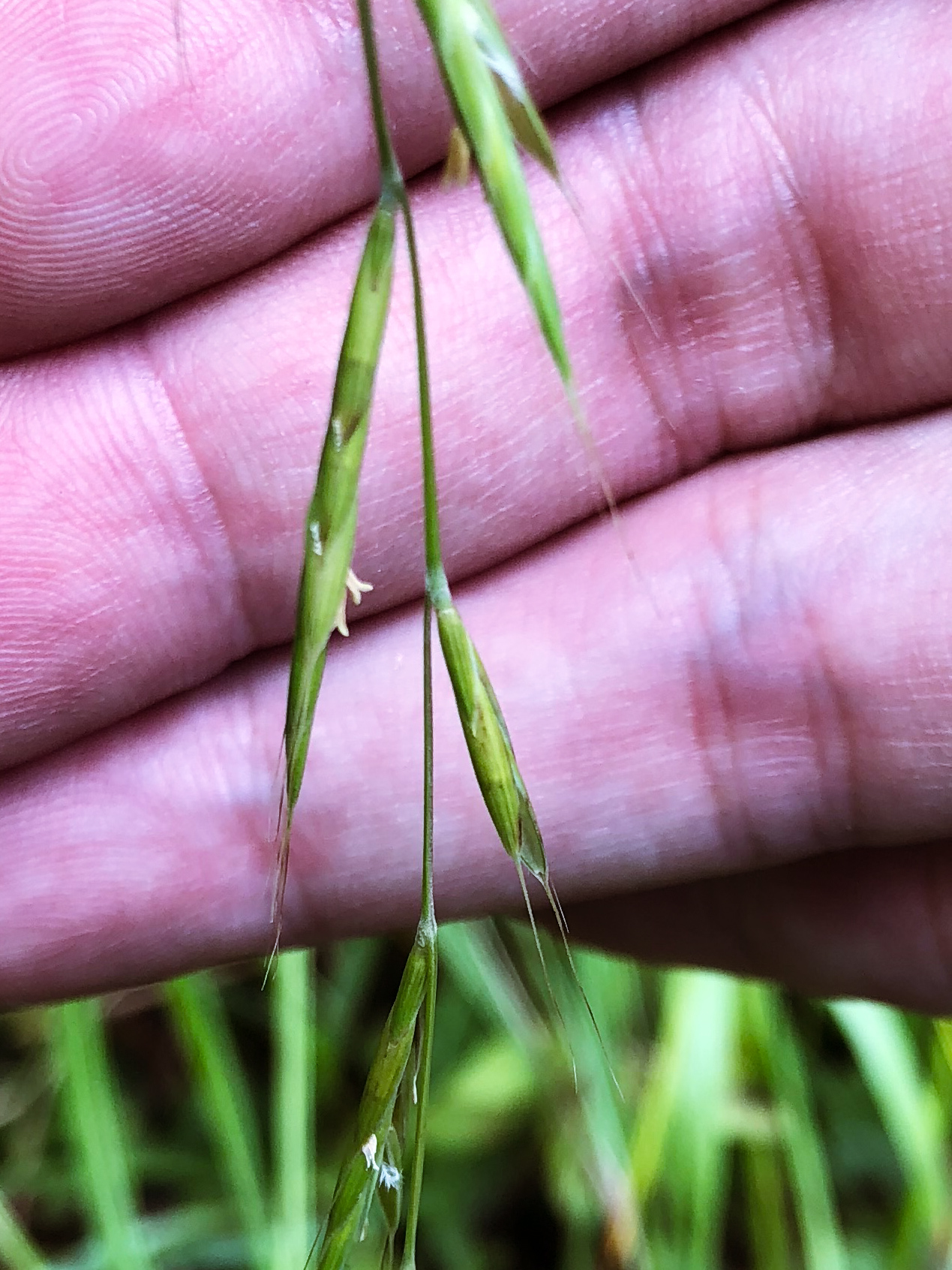
A small, hair-fringed ligule, 1.5–3.5 mm (0.06–0.14 in) long, occurs where blade meets sheath. Sheaths often have long soft hairs, while culm hairs concentrate near nodes. The inflorescence is a narrow, often leaning raceme with spikelets on extremely short pedicels. Awns on upper florets can project beyond the lemma. Photographing these details makes an observation verifiable. 5 2
Useful taxonomy
The accepted combination Brachypodium sylvaticum was published in 1812. Its basionym Festuca sylvatica Huds. dates to 1762. Synonyms also include Bromus sylvaticus (Huds.) Lyons and Brevipodium sylvaticum (Huds.) Á.Löve & D.Löve. Older classifications explain names referring to woodland brome or fescue. 1 4 8
The species includes the nominal subspecies and a Cretan subspecies, Brachypodium sylvaticum subsp. creticum H.Scholz & Greuter. A subspecies is not a cultivar. For an ordinary French observation, retain a species-level identification unless the features needed for a more precise rank have been examined. 1
Habitat and range
Native distribution extends from Macaronesia to Eritrea and across Eurasia, including France, Japan and many intervening regions. Introductions occur in parts of the Americas and New Zealand. Such a broad range prevents generalizing its requirements from one garden population. 1 4
In France it occupies woods and shaded places across almost the entire country, including Corsica. It is Least Concern on the Red List for the flora of metropolitan France and has no protection status there. 8 9
Moist to damp deciduous forests, clearings and forest tracks provide habitat, along with hedges and woodland edges. Fairly nutrient-rich, base-rich soils suit it. Partial shade explains its place beneath trees, but it is not restricted to closed canopy: populations also occupy open settings. 3 7 6
Life cycle and reproduction
Summer flowering occurs in June–September in France, peaking in July and August. Spikelets contain several small florets protected by scale-like parts. Absence of showy petals does not mean an absence of flowers. Each floret can mature into a caryopsis, the typical dry grass fruit. 8 3 5
Seeds drive long-distance spread, traveling with animals, footwear or equipment passing through colonies. In the introduced northwestern United States range, germination occurs in late autumn and spring; most seeds germinate within one or two years. This regional schedule should not be transferred unchanged to France. 6 7
Uses and precautions
A wild grass is not automatically safe forage. Some populations harbor the endophytic fungus Epichloë sylvatica, associated with a risk to grazing animals. This does not establish that every tuft is toxic, but it also prevents guaranteeing forage safety. Identification and health context must precede use as feed. 6 7
No data document effects in cats, dogs or people; this does not justify consumption. In a wooded garden, prioritize monitoring seedlings and retaining other understory plants. Woodland already supporting this grass needs no fertilizer to accelerate its growth. Watch young plants around tufts to distinguish limited renewal from expansion that reduces space for other species. 3 6
Look-alikes and spread outside the native range
Compared with Brachypodium pinnatum, slender false brome has a more flexible, drooping inflorescence and dark-green foliage. Long awns on upper florets add another character. True bromes can also have hanging spikelets, so tuft outline alone is insufficient. Examine a mature inflorescence with a key to avoid confusing a local grass with an introduced species. 2 6
In Oregon, introduced populations can form dense stands that displace understory vegetation. Cleaning footwear and equipment limits seed movement out of colonized areas. Keep this invasive behavior geographically specific: a species native in France can be invasive elsewhere, without those statuses being interchangeable. 7 6 1
Main sources
This grass, native in moist woods across most of France, has hair-fringed leaves and a drooping flower head. In Oregon it forms dense understory stands; that invasive behavior concerns an introduced region. 8 2 7
- POWO, Brachypodium sylvaticum
- Info Flora, Brachypodium sylvaticum
- FloraWeb, Brachypodium sylvaticum
- EPPO, Brachypodium sylvaticum
- Flora of New Zealand, Brachypodium sylvaticum
- Oregon State University, False brome
- Oregon Department of Agriculture, False brome
- Tela Botanica, slender false brome, Coste description
- INPN, TAXREF, Brachypodium sylvaticum
Frequently asked questions
How can slender false brome be recognized?
Look for soft leaves with hairy margins, hairy nodes and a loose, often drooping inflorescence with long spikelets on extremely short stalks.
Is slender false brome invasive in France?
It is native in France. Documented invasions in Oregon concern an introduced region and do not define its French status.
Can it be fed to horses?
Do not assume forage safety. An endophytic fungus associated with some populations warrants caution for grazing animals.
If you are unsure about a plant’s toxicity, ask a botanist or veterinarian for advice.