
Blue sedge (Carex flacca, )
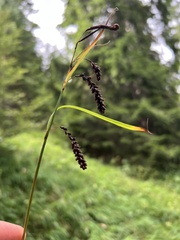
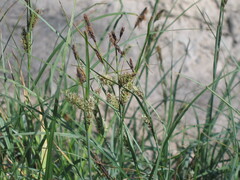
Blue sedge is a perennial with narrow leaves that are especially bluish beneath. Its rhizomes form low colonies, while male and female spikes occupy distinct positions.
Read moreBlue sedge and Glaucous sedge
Carex glauca
Allow a few hours of direct sun per day, preferably morning or evening.
Sun or partial shade.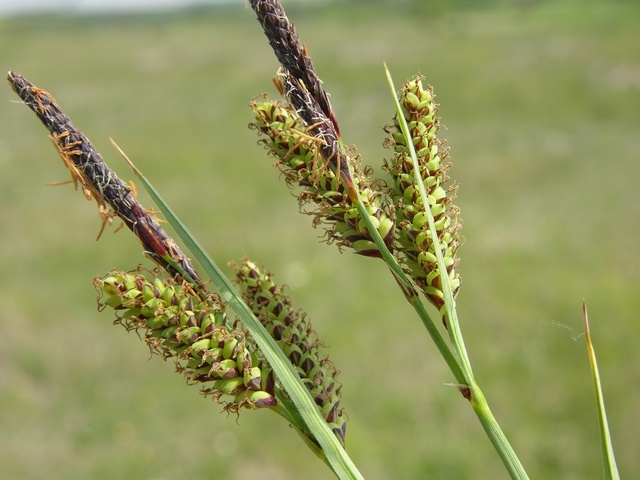
© photo
(c) Biopix, some rights reserved (CC BY-NC) · cc-by-nc
Mirko Ubović · cc0
zebedeugalinha · cc-by
no rights reserved · cc0
(c) zebedeugalinha, some rights reserved (CC BY) · cc-by
Global distribution
Native to Europe and the Mediterranean region eastward to Pakistan. Introduced in parts of North America, Tasmania and New Zealand.
- Native2
- Introduced1
- France
- Pakistan
- Tasmania
Hexagons: regions where the plant occurs. Green dots: native range.1
Identity
Blue sedge (Carex flacca Schreb., 1771) forms a low cover of arching leaves with bluish undersides. This rhizomatous perennial belongs to Cyperaceae, distinct from the grass family. The bluish undersides explain the term glaucous, most evident when a leaf turns over or the clump is seen from the side. 1 4 3
Its standardized French name is laîche glauque; laîche flasque is also used. In metropolitan France it is present, classified as Least Concern on the national Red List, and unprotected. 8 9
Underground rhizomes allow it to form colonies. A newly planted single clump therefore does not indicate its final width. When choosing a planting site, allow for this continuing lateral expansion just as carefully as for the height of the leaves above the ground. The low habit suits groundcover but needs a clear boundary near smaller plants. 3 5
Recognition
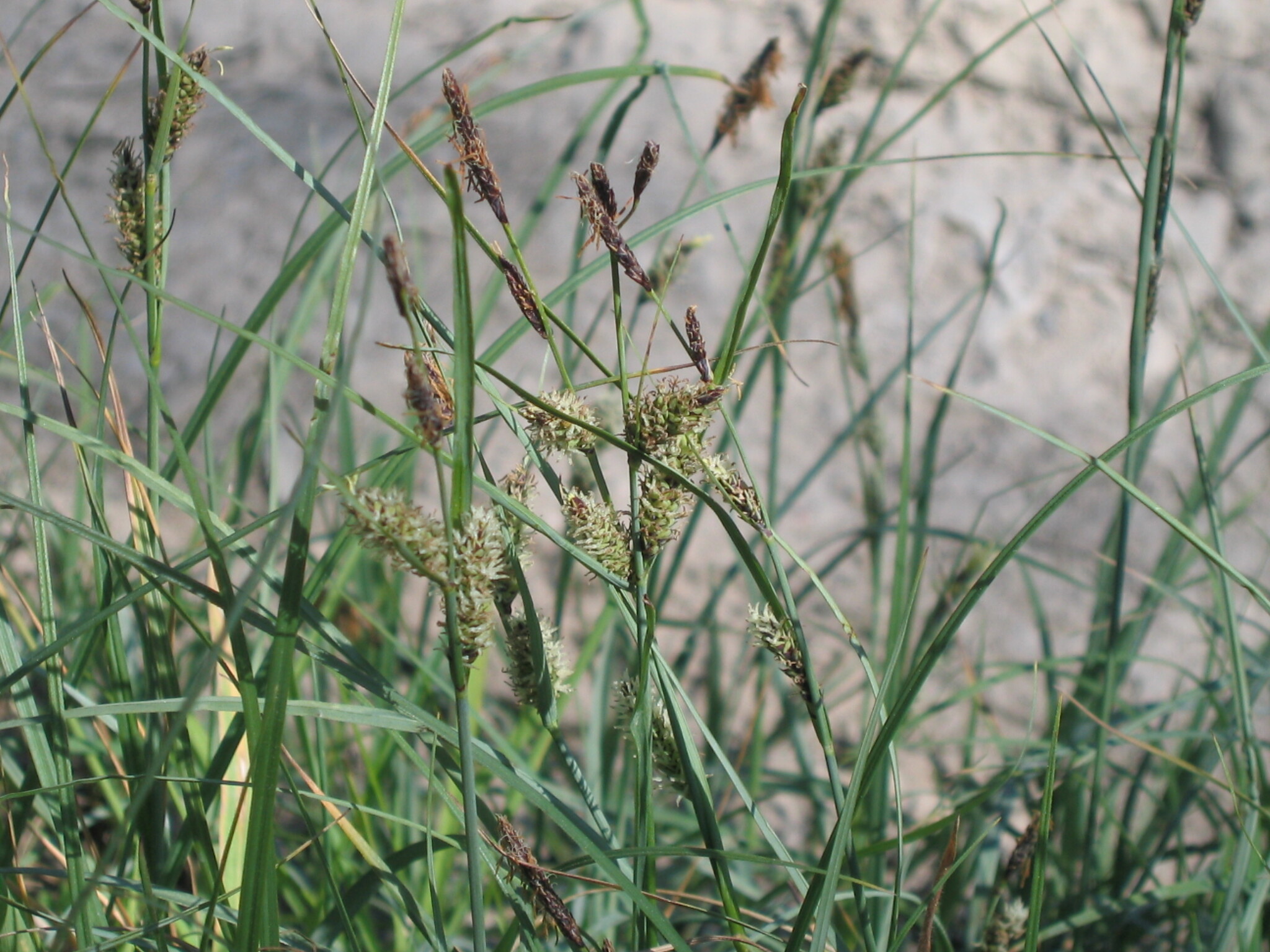
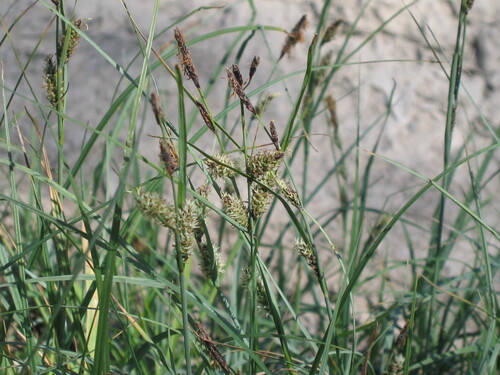
Plants reach 20–80 cm (8–31 in). Stiff, rough leaves are 2–5 mm (0.08–0.2 in) wide, with two longitudinal folds; stems are almost triangular. Blue foliage alone is insufficient for identification: spikes and the envelopes around the fruits offer more precise characters. 4
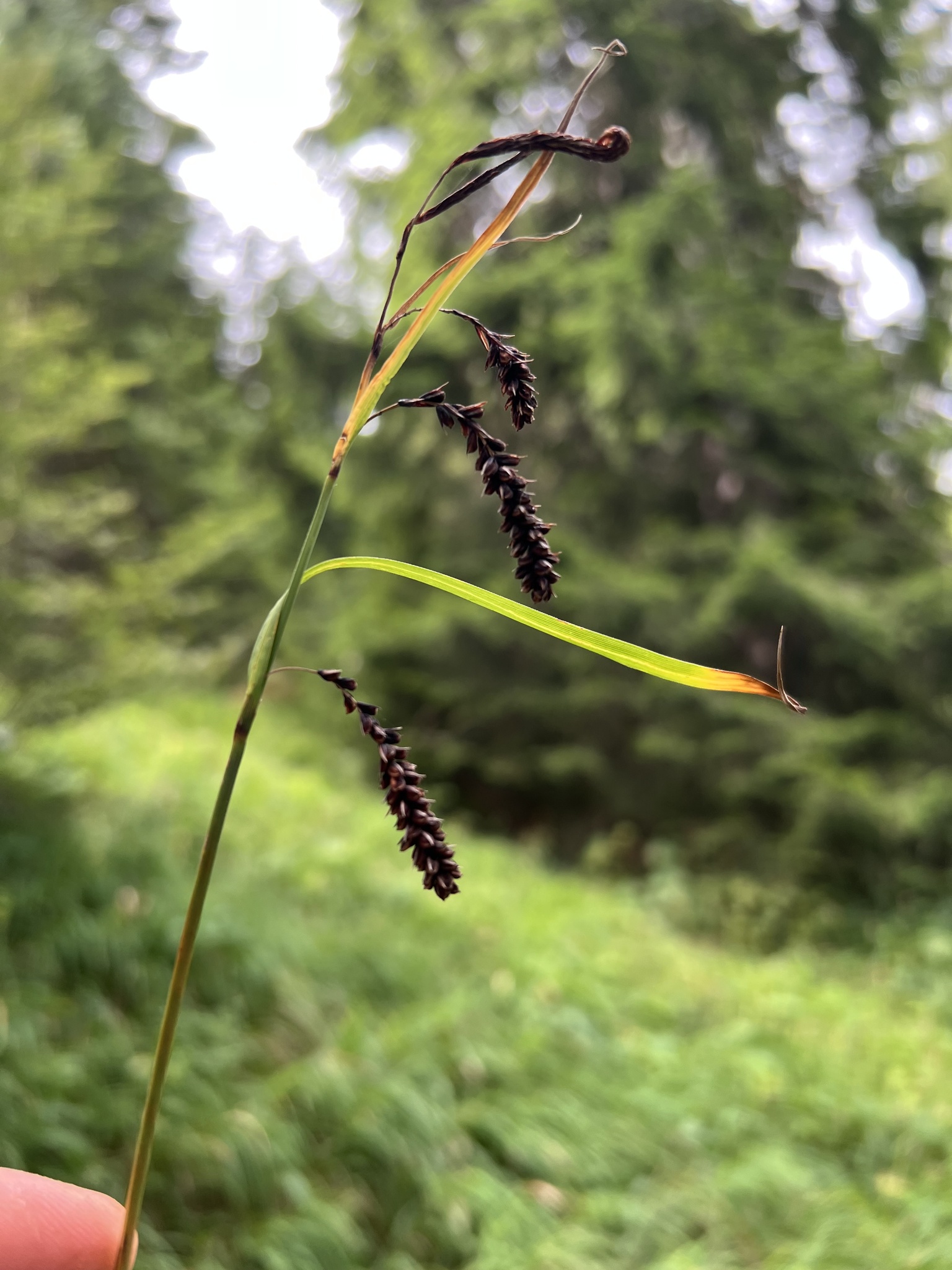
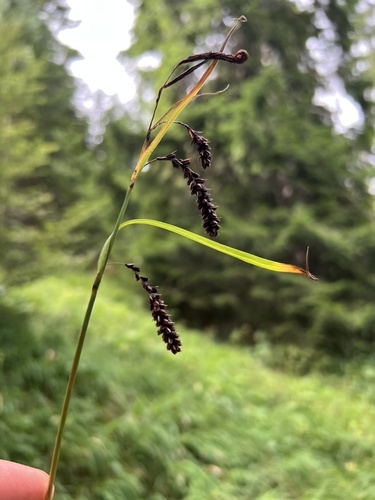
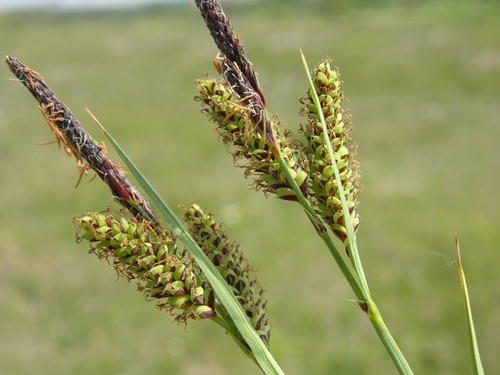
Terminal male spikes stand above female spikes, often on longer stalks. Female spikes can initially nod and later hang at maturity. The small envelopes, called utricles, become dark brown to black and have a short beak. Photograph the whole inflorescence, a leaf underside and a ripe spike. Without developed fruit, identification among similar sedges may remain provisional. 4
Useful taxonomy
Johann Christian Daniel von Schreber published Carex flacca in 1771, in the appendix to Spicilegium Florae Lipsicae, page 178. “Schreb.” identifies him. This date belongs to the history of the name; it does not indicate an introduction to France. 2
Carex glauca Scop., published in 1772, is common in old works and catalogs and is now assigned to Carex flacca. Two subspecies are accepted: flacca and erythrostachys. Some floras still use serrulata for a related subdivision. Check the treatment before interpreting different names as an additional species. 1 9 5
Habitat and distribution
The native range covers Europe and the Mediterranean region eastward to Pakistan, including France and Corsica. Introduced populations occur in eastern North America, Tasmania and New Zealand’s North Island. A record outside Europe therefore does not always indicate local origin. 1
Its habitats have varied water regimes: partly dry grassland, damp meadows, fen margins and dune hollows. Paths, banks and open woodland can also support it, often on calcareous ground. A damp-meadow record does not make it exclusively aquatic; habitat variety helps explain its distribution. 5
Cycle and reproduction
Flowering occurs in spring and early summer, varying regionally; in Germany it runs from May to July. The inconspicuous spikes lack large colorful corollas, but their arrangement helps track the transition to fruit. Utricles remain useful for identification after flowers dry. 5 4
Garden propagation is by seed or division. Spring sowing in a cold frame is suggested, with division in early summer. Division retains a selection’s characters; seedlings need not be identical to the parent. Allow enough room to avoid moving young plants as soon as their rhizomes spread. 3
Uses and risks
Blue sedge is grown for foliage and groundcover. Neutral to alkaline soil retaining some moisture suits it. Drought tolerance applies after establishment, so monitor water after planting. Remove dead leaves in spring while retaining green growth. 3
No specific toxicity is documented. Absence from a general list does not establish safety, since such lists do not cover every plant. Plant ingestion may cause vomiting or other digestive upset in cats and dogs. Grasslike ornamental foliage is therefore not offered as food or forage on appearance alone. 7
Varieties, lookalikes, and related plants
Blue Zinger has strongly glaucous blue foliage, stands about 30 cm (12 in) tall and gradually widens. Sun intensifies its color, though partial shade is possible. Divide from mid-spring to early summer. This horticultural selection is not a wild subspecies or a substitute for identifying a meadow plant. 6
Other bluish sedges can resemble it. Rough, dark brown to black utricles, 3–4.5 mm (0.12–0.18 in) long with a short, truncate beak, together with three stigmas, are more reliable than color. Examine ripe spikes and use a local flora. A blue-themed sales name cannot establish species or provenance. 4
Main sources
Blue sedge (Carex flacca Schreb., 1771) is a rhizomatous perennial Cyperaceae native in France, with leaves especially glaucous beneath. It occupies calcareous grassland, damp meadows, fens and open woodland. 1 4 5
Frequently asked questions
Is blue sedge a grass?
No. It belongs to Cyperaceae, despite its grasslike appearance.
Can blue sedge spread in a garden?
Yes. Its rhizomes allow lateral spread; a bounded site or container may be useful.
Should all the foliage be cut off in spring?
Removing dead leaves is generally sufficient; retain healthy foliage.
If you are unsure about a plant’s toxicity, ask a botanist or veterinarian for advice.