
Sea fig (Carpobrotus edulis, )
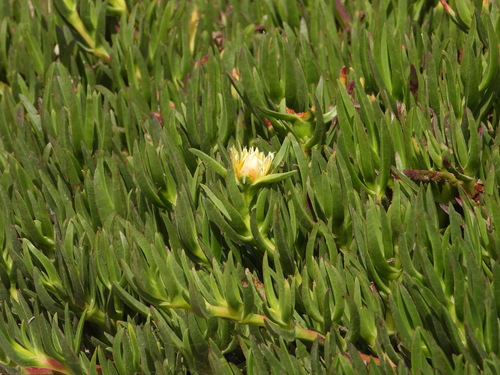
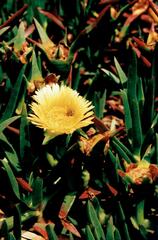
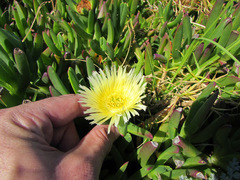
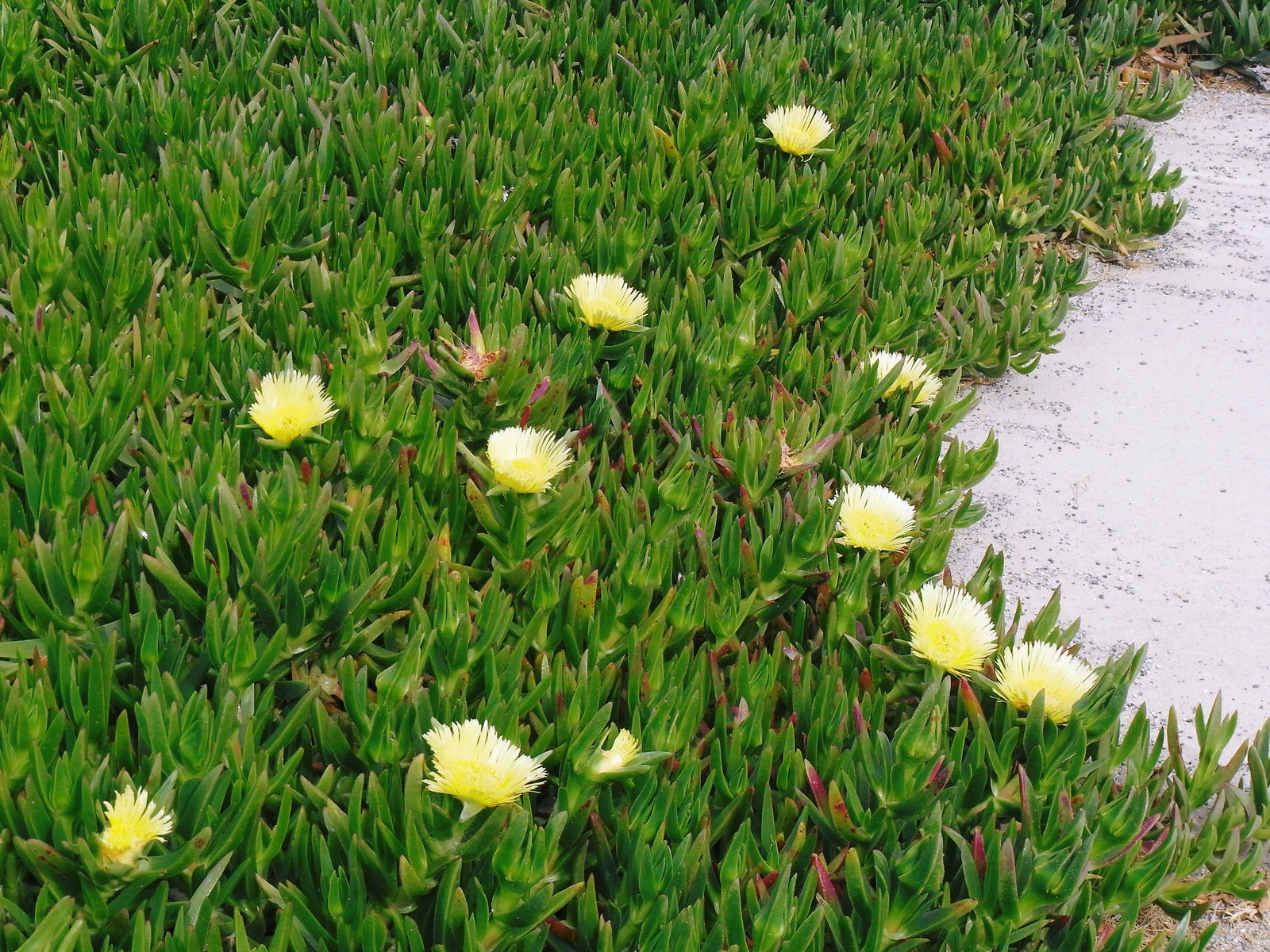
Sea fig is a creeping succulent native to South Africa. Its dense mats colonize dunes and cliffs where the plant has been introduced.
Read moreSea fig, Sour fig and Ice plant
Mesembryanthemum edule and Abryanthemum edule
Place in full sun, with intense direct light all day long.
Full sun; colonizes open coastal habitats.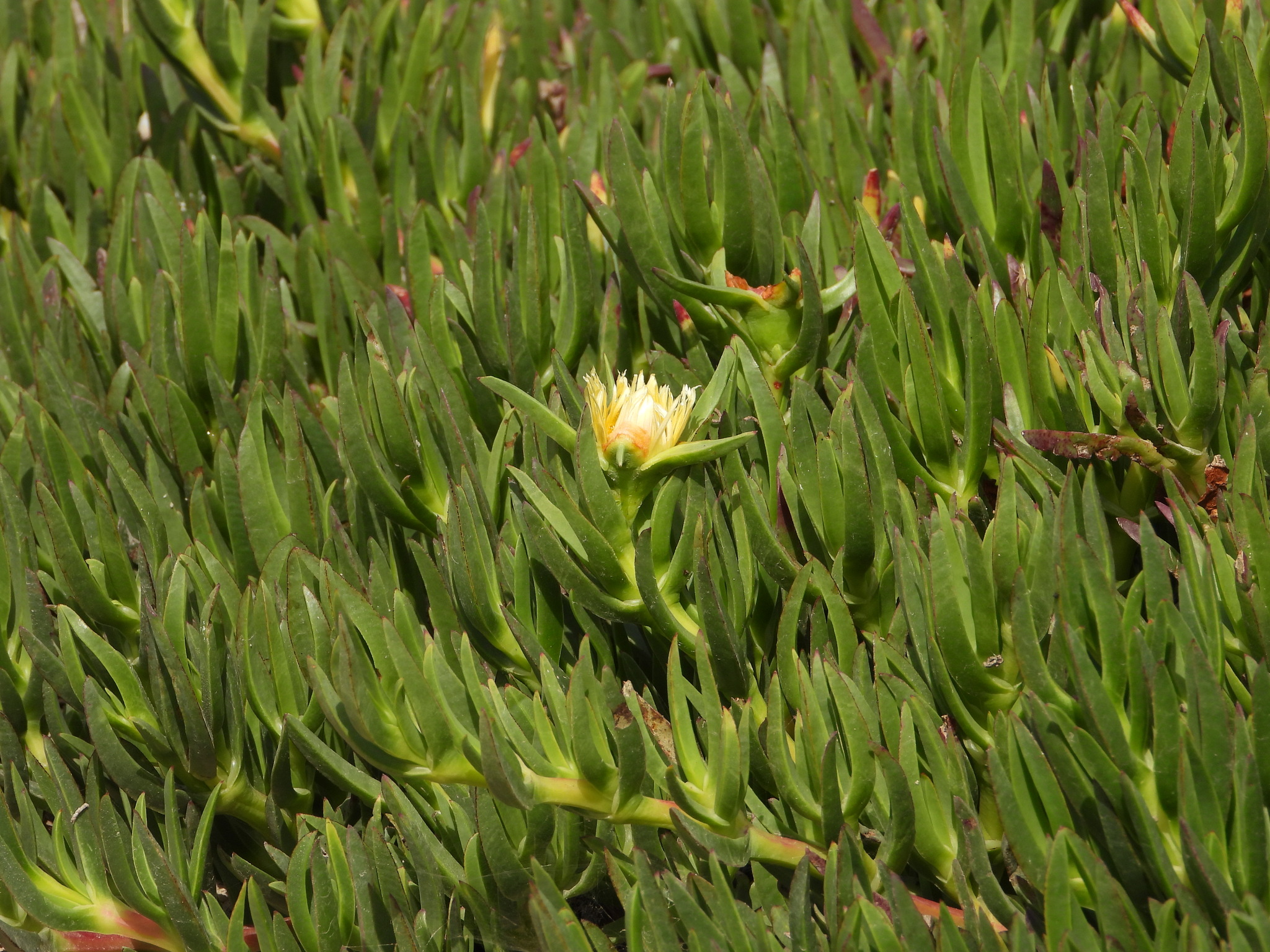


© photo
Duarte Frade · cc-by
zebedeugalinha · cc-by
Justin · cc-by
Taken Mar 18, 2016 by Rlahoz Lahoz (cc-by-sa)
Taken May 3, 2022 by Daniele Pizzato (cc-by-sa)
Taken Mar 18, 2016 by barbara papini (cc-by-sa)
Taken Feb 16, 2016 by nicolas vautravers (cc-by-sa)
Taken Jul 3, 2011 by huy HO (cc-by-sa)
© copyright of the Board of Trustees of the Royal Botanic Gardens, Kew.


Global distribution
Native to South Africa’s Cape provinces; introduced in France, Corsica and many other mild-climate coastal areas.
- Native1
- Invasive2
- South Africa
- Mediterranean France
- Corsica
Hexagons: regions where the plant occurs. Green dots: native range.1
Identity
Sea fig (Carpobrotus edulis (L.) N.E.Br., 1926) is a creeping South African succulent in Aizoaceae, unrelated to true figs. Its historical fig-related names refer to the fleshy, fig-shaped fruit rather than kinship with cultivated figs; French names include griffe de sorcière and ficoïde douce. Thick leaves with a triangular cross-section identify the group year-round. 1 3 8
The main risk on French coasts is ecological: mats spread over dunes and cliffs occupied by native plants. It is considered a major invasive in Provence-Alpes-Côte d’Azur, Occitanie and Corsica. A plant valued for covering a bank can become a problem when fragments reach nearby natural habitat. 3
It also occurs along the Atlantic coast from the Cotentin Peninsula to the Basque Country, with removal campaigns in Brittany. In metropolitan France it is introduced and not nationally regulated: no national ban applies, but planting is discouraged. In the United Kingdom, by contrast, planting it or allowing it to spread into the wild is an offense. 4 8 3 7
Recognition
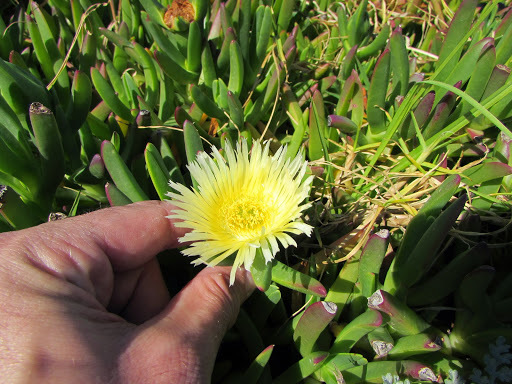
Opposite, fleshy leaves are long and stalkless, with three clear faces. They measure 8–11 cm (3–4.3 in) long and 8–13 mm (0.3–0.5 in) thick. The cross-section is nearly equilateral. Color varies from green to red with conditions; a red tip alone does not identify another species. 3 5
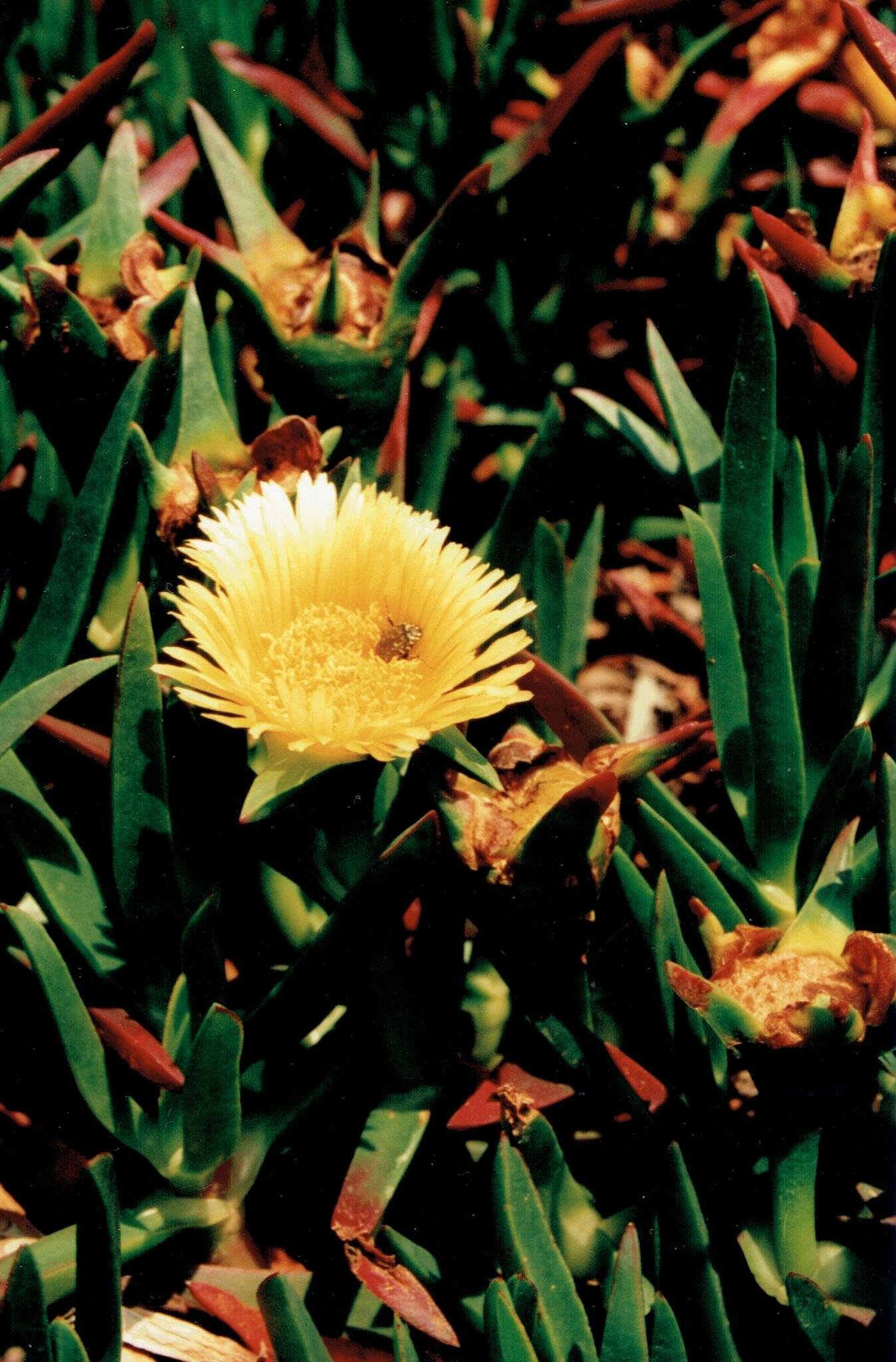
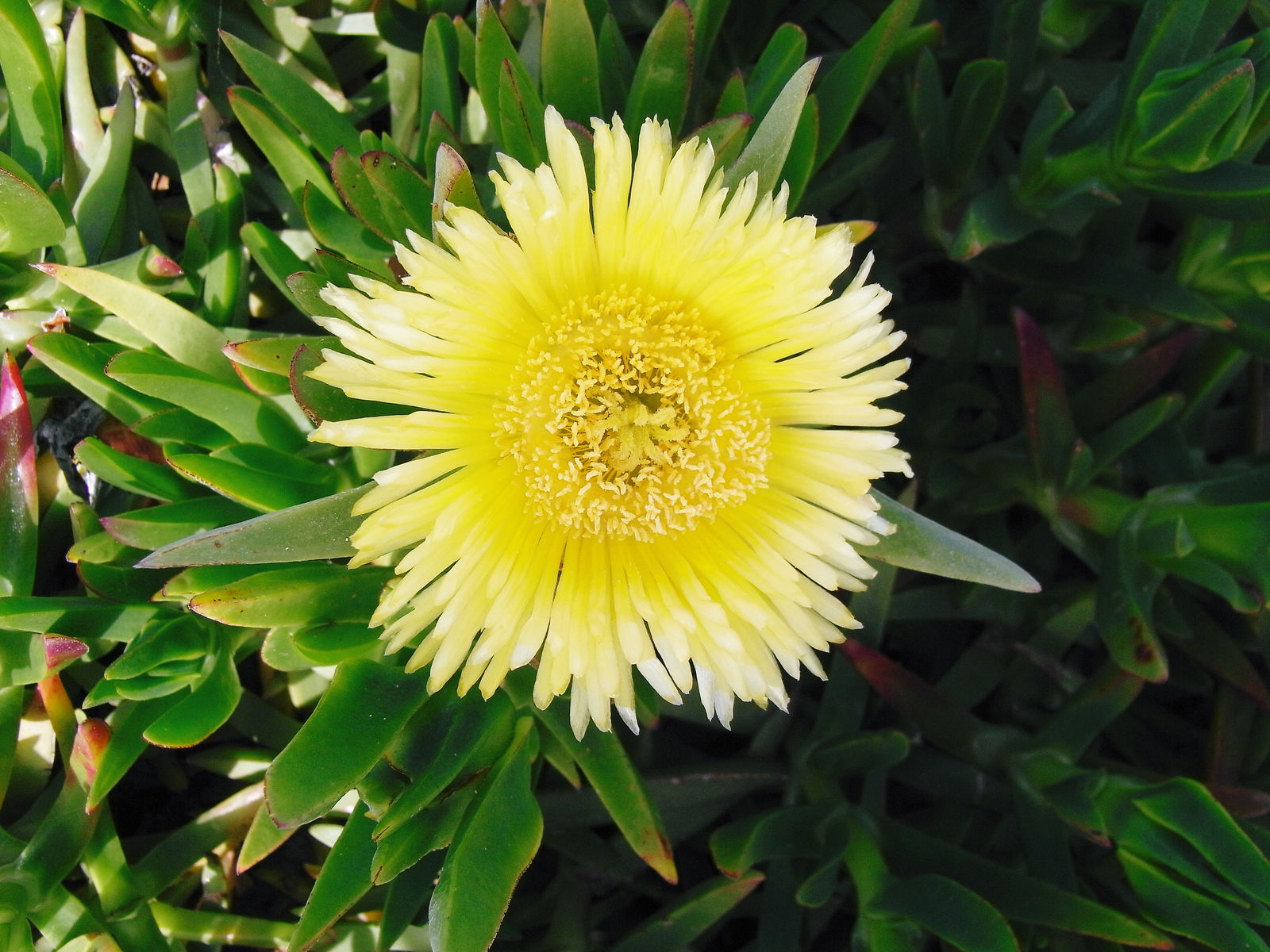
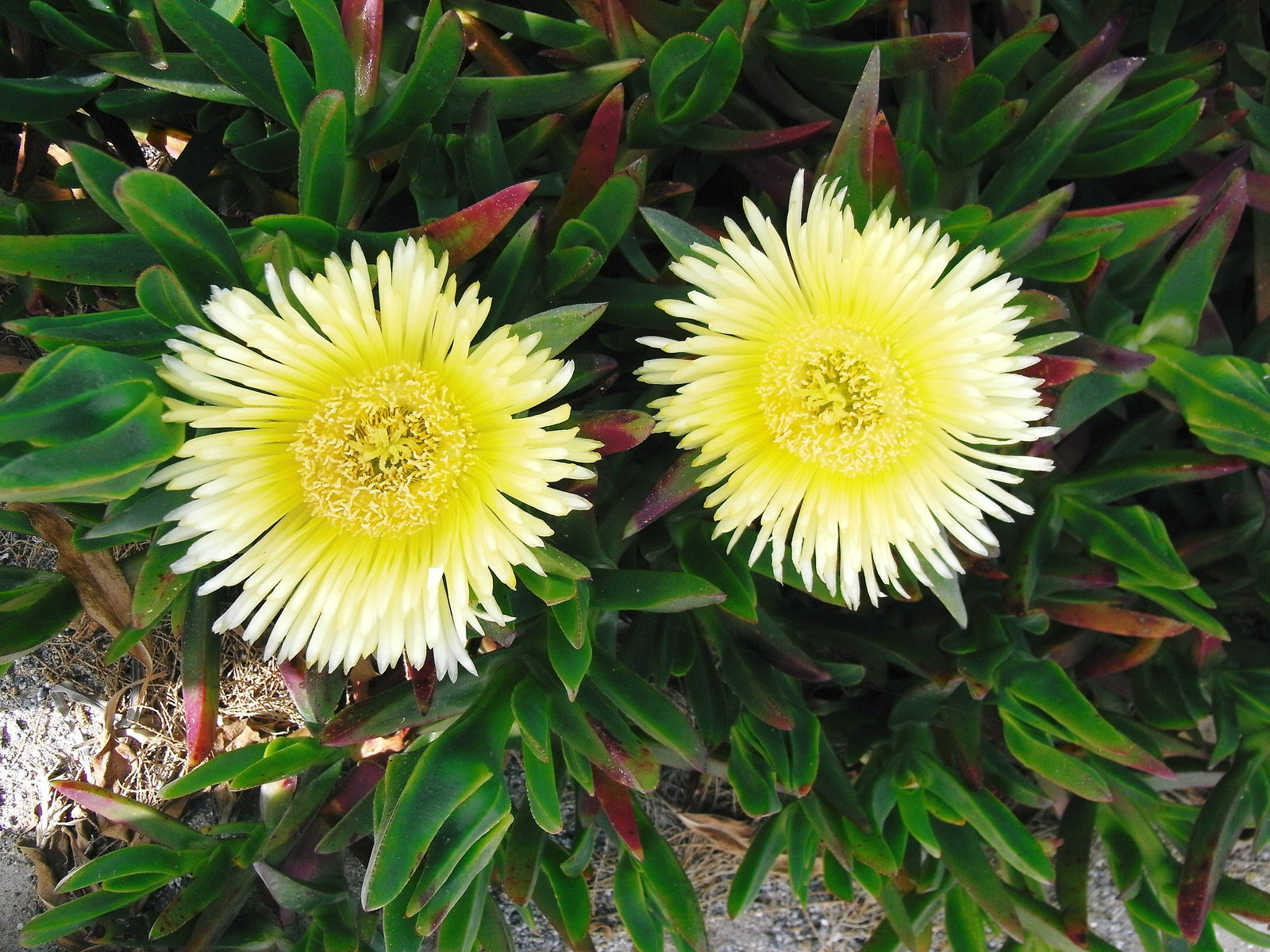
Solitary terminal flowers are usually yellow, with numerous narrow parts surrounding the center. These petal-like structures are modified stamens and may turn pink with age. Fleshy fruits are about 2–3 cm (0.8–1.2 in) long, containing many seeds in mucilage. Examine fresh flowers to avoid overinterpreting faded color. 5
Useful taxonomy
The accepted name is Carpobrotus edulis. Its basionym, Mesembryanthemum edule L., dates to 1759; Nicholas Edward Brown published the transfer to Carpobrotus in 1926. Parentheses around “L.” mark that change of genus. Some works attribute the combination to L.Bolus, but N.E.Br. is the accepted author. 2 1
Abryanthemum edule (L.) Rothm. is another synonym. Old varieties must not automatically become cultivars: chrysophthalmus is assigned to the species in current synonymy. Hybrids also occur, explaining why a field plant may not fit a simplified description exactly. 1 6 3
Habitat and distribution
The strict native range covers South Africa’s Cape provinces. France, Corsica, California, several Australian regions and New Zealand are introductions. Its current presence on a Mediterranean coast therefore does not indicate Mediterranean origin. Mild climates allow introduced plants to persist outside their natural range. 1
Dunes, rocky shores and cliffs are frequently colonized. It tolerates drought and salinity but poorly tolerates moderate or repeated frosts. This explains success on mild coasts rather than in every French garden. Soil-stabilization plantings helped establish populations that later spread spontaneously. 6 4
Cycle and reproduction
Mediterranean flowering is chiefly in spring, described as April to June, followed by fruit from May to August. Australian and European calendars cannot be matched month for month because their seasons are reversed. Flowers produce seeds, while vegetative reproduction also expands established mats. 3 5
Stems root at their nodes, and some segments grow up to 1 m (3.3 ft) annually. Fragments moved with garden waste can establish new populations. Animals eating fruits also disperse seeds. Cutting stems without controlling the fate of the pieces therefore does not stop spread. 5 6
Uses and risks
Sea fig has been grown ornamentally and used to stabilize dunes or banks. Groundcover becomes an impact in natural habitats: mats displace native plants and alter soil properties. French studies on Bagaud Island show marked declines in native plant abundance and diversity in colonized areas. 3 6 4
Fruit is described as edible, but this must not be extended to all parts or all domestic animals. No human health effect is described, which does not prove safety; the toxicological profile for cats, dogs and horses remains unknown. Invasive populations also need follow-up: removal leaves the soil seed bank, requiring repeated work over several years. 3 6 4
Varieties, lookalikes, and related plants
Carpobrotus acinaciformis, another coastal species, is a distinct close relative with pink flowers and more isosceles leaf sections, versus nearly equilateral sections in sea fig. Usually yellow fresh flowers offer another clue, with a qualification: pink-flowered plants have historically been described under the varietal name rubescens. Hybrid forms occur and sometimes require detailed morphological or genetic analysis. 3 6
The color of an aging flower therefore cannot decide between species. Photograph several entire leaves, cross-sections and flowers at different stages. A mat may combine intermediate traits without constituting a named cultivar. A broad common name needs the binomial when identification guides site management. 3 5
Main sources
Sea fig originates in South Africa’s Cape provinces; its presence on French coasts results from introduction. 1
- Kew, Plants of the World Online: Carpobrotus edulis
- IPNI: Carpobrotus edulis
- InvMed: Carpobrotus edulis
- French invasive alien species resource center: Carpobrotus edulis
- Weeds of Australia: Carpobrotus edulis
- MITECO: Carpobrotus edulis biological account
- Royal Horticultural Society: Carpobrotus edulis
- INPN, TAXREF: Carpobrotus edulis
- Tela Botanica, eFlore: Carpobrotus edulis
Frequently asked questions
Is sea fig native in France?
No. Carpobrotus edulis is native to South Africa and was introduced in France, where it colonizes dunes and cliffs among other habitats.
Is Carpobrotus edulis fruit edible?
The fleshy fruits are described as edible. This does not establish safety for every plant part or every animal.
How can the two common coastal Carpobrotus species be distinguished?
Carpobrotus edulis usually has yellow flowers and nearly equilateral triangular leaves; C. acinaciformis has pink flowers and a more isosceles leaf section. Hybrids complicate identification.
If you are unsure about a plant’s toxicity, ask a botanist or veterinarian for advice.