
Golden feather palm (Chrysalidocarpus lutescens, )
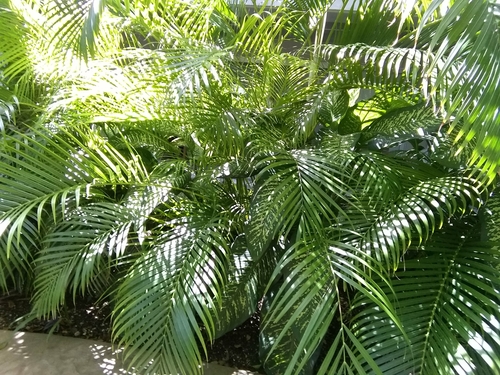

Golden feather palm (Chrysalidocarpus lutescens), also called butterfly palm, carries arching fronds on several ringed stems. Native to eastern Madagascar, this evergreen member of the Arecaceae is grown in bright indoor spaces in temperate climates.
Read moreGolden feather palm, Butterfly palm and Areca palm
Dypsis lutescens, Areca flavescens, Chrysalidocarpus baronii var. littoralis and Chrysalidocarpus glaucescens
Give plenty of ambient light without direct sun on the leaves.
Bright indirect light indoors; partial shade preferred outdoors.


© photo
(c) jerbon, some rights reserved (CC BY-NC) · cc-by-nc
Wikimedia Commons · CC BY-SA or Public Domain
Wikipedia · CC BY-SA
(c) Gabriel, some rights reserved (CC BY) · cc-by
no rights reserved · cc0

Global distribution
Native to eastern Madagascar; cultivated in tropical regions and grown as a houseplant in temperate climates.
- Native1
- Introduced4
- Madagascar
- Comoros
- Réunion
- Bangladesh
- Jamaica
Hexagons: regions where the plant occurs. Green dots: native range.2
Identity
Golden feather palm (Chrysalidocarpus lutescens H.Wendl., 1878) develops several stems from one base, topped by arching fronds. Its clumping habit and yellow-green leaf axes help identify this Madagascan palm in the Arecaceae family. Butterfly palm is another common name for the same species. 1 6 2
The epithet lutescens refers to the yellowish color of the stems, leaf sheaths and veins. In temperate climates, golden feather palm is grown indoors with bright indirect light and humid air. Growth remains limited in a pot, so the outline of an indoor specimen does not indicate its potential size in a tropical climate. 7 6
Recognition
Golden feather palm has smooth, ringed stems that resemble bamboo canes; the rings are scars left by former leaves. Its pinnate fronds carry narrow leaflets on either side of a central axis. The partly upright leaflets form a V along the rachis, a useful identifying feature even without flowers. 7 6
Fronds reach 1.6–2 m (5.2–6.6 ft) long in the tropical description. The horticultural height range is 4–8 m (13–26 ft), with an eventual spread of 2.5–4 m (8–13 ft). These dimensions describe a mature plant in favorable conditions, rather than a promised indoor size. Stems can reach 7.5 cm (3 in) in diameter. 7 5
Useful taxonomy
Chrysalidocarpus lutescens and Dypsis lutescens (H.Wendl.) Beentje & J.Dransf. are two botanical names for the same species. The 2022 phylogenomic revision reinstates the genus Chrysalidocarpus and places this species in it. POWO follows that treatment; the GBIF Backbone consulted retains Dypsis lutescens as the accepted name. The difference concerns the boundaries of the genera, rather than two separate species. 13 2 3
The original name was published in 1878, followed by the combination in Dypsis in 1995. Synonyms also include Areca flavescens Voss and Chrysalidocarpus glaucescens Waby. These names belong to the nomenclatural history of golden feather palm; they do not identify cultivars with different growing needs. 4 2
Habitat and range
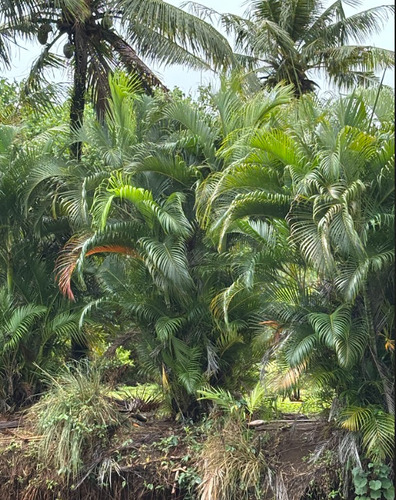
Golden feather palm is native to eastern Madagascar, in the wet tropical biome. Its presence in tropical gardens around the world extends far beyond that native range. The Comoros, Réunion, Bangladesh and Jamaica are among the documented territories of introduction; horticultural cultivation elsewhere does not make a territory part of the native range. 2 6
Behavior outside cultivation depends on location. An assessment in southern Florida recommends managing golden feather palm to prevent escape; central and northern Florida do not receive the same warning. The Florida assessment establishes no regulatory status for France or other countries. Tropical origins and widespread ornamental use are therefore insufficient to predict behavior in every environment. 9
Life cycle and reproduction
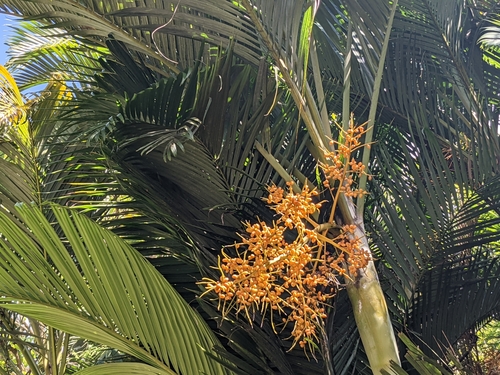
Golden feather palm produces small yellow flowers in panicles beneath the fronds, in summer in the horticultural setting described. Flowers and fruit are rare indoors. The fruits are egg-shaped; a tropical description gives their length as about 1.7 cm (0.7 in) and records a color change from yellow to purple. 5 6 7
Propagation is by seed or division of clumps. Seeds do not store well and should be sown fresh; a germination period of 2–6 months is documented. Dividing an offset means separating a rooted basal shoot, rather than taking a single leaf from the crown. 7
The calendar describes indoor cultivation in mainland France, with a growing season followed by a winter slowdown. Water and growth indices, on a scale from zero to ten, are relative editorial guides rather than measured volumes or growth rates. The projection translates generous watering during growth and reduced watering in winter into a seasonal pattern; feeding depends on the actual production of new fronds. Months marked for feeding do not prescribe a monthly application. 5
NC State recommends repotting every two or three years. The RHS indoor palms guide, which includes this species under Dypsis lutescens, recommends early spring when roots have become cramped. The repotting entry translates that seasonal window into the French calendar without making repotting an annual requirement. Large containers need repotting less often. 6 10
Uses and risks
Golden feather palm is grown for its foliage, indoors in temperate climates or outside where conditions are warm enough. A moist but well-drained substrate meets its need for moisture without leaving the roots in waterlogged soil. For plants under cover, the RHS species entry recommends a balanced liquid fertilizer two or three times during the growing season, provided the plant is actively growing; the advice supplies neither a dose nor a numerical fertilizer formula. 6 5
Golden feather palm is explicitly classified as non-toxic to cats and dogs; it is also listed as non-toxic to horses. For humans, the palm heart, consisting of the meristem and young leaf buds, contains cyanogenic compounds and must not be eaten. Nausea and vomiting are reported after ingestion. The animal classification does not establish human edibility; no particular sensitivity in children has been established, and the risk to other animals remains undetermined. 8 6
Varieties, look-alikes and related plants
Golden feather palm can be confused with Chamaedorea elegans and Chamaedorea seifrizii. Identify Chrysalidocarpus lutescens by the combination of a clumping habit, ringed canes, yellow-green petioles and V-shaped leaflet arrangement. Chamaedorea elegans has a solitary stem, although several seedlings are often planted together in one pot. In Chamaedorea seifrizii, the terminal leaflets are joined at the base and may be larger than the others. 6 11 12
Dwarf and upright selections are mentioned in Thailand, but that description supplies no cultivar names. No named cultivar can therefore be characterized from that statement alone. The name Chrysalidocarpus baronii var. littoralis Jum. & H.Perrier belongs to the species' botanical synonymy: the variety rank in an old name does not identify a current horticultural selection. 6 2
Main sources
The nomenclatural index documents the original publication of Chrysalidocarpus lutescens and its later combination in Dypsis. 4
- EPPO, Chrysalidocarpus lutescens, French names and identity
- Plants of the World Online, Chrysalidocarpus lutescens
- GBIF Backbone Taxonomy, treatment as Dypsis lutescens
- International Plant Names Index, Chrysalidocarpus lutescens
- Royal Horticultural Society, Chrysalidocarpus lutescens
- NC State Extension, Chrysalidocarpus lutescens
- NParks Flora & Fauna Web, Chrysalidocarpus lutescens
- ASPCA, Cane Palm, toxicity to domestic animals
- University of Florida IFAS, assessment in Florida
- Royal Horticultural Society, indoor palms guide
- NC State Extension, Chamaedorea elegans
- NC State Extension, Chamaedorea seifrizii
- Eiserhardt and colleagues, phylogenomic revision of Dypsidinae, 2022
Frequently asked questions
Are golden feather palm and Dypsis lutescens the same plant?
Yes. Dypsis lutescens is another botanical combination for Chrysalidocarpus lutescens. Taxonomic treatments differ in their choice of accepted genus.
How do I identify golden feather palm?
Golden feather palm combines ringed stems clustered at the base with arching pinnate fronds. The leaflets stand up on either side of the central axis to form a V.
Is golden feather palm toxic to cats and dogs?
It is explicitly classified as non-toxic to cats and dogs. That classification does not establish that it is edible for humans: the palm heart contains cyanogenic compounds and must not be eaten.
Does golden feather palm flower indoors?
Flowering and fruiting are rare indoors. The small yellow flowers grow on panicles beneath the foliage.
If you are unsure about a plant’s toxicity, ask a botanist or veterinarian for advice.