
Grey-leaved cistus (Cistus albidus, )
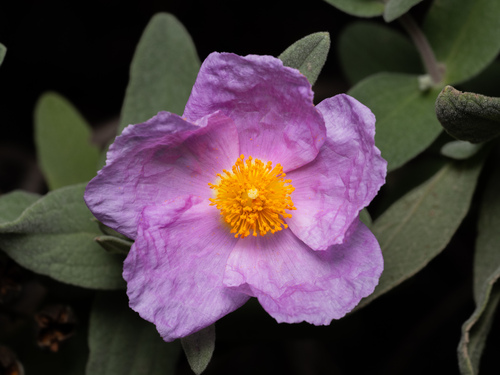
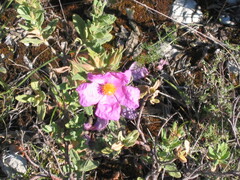
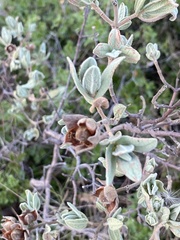
Grey-leaved cistus (Cistus albidus) is a small evergreen Cistaceae shrub of Mediterranean garrigue. Whitish-gray, velvety foliage contrasts with large but short-lived pink flowers.
Read moreGrey-leaved cistus
Anthelis albidus and Cistus tomentosus


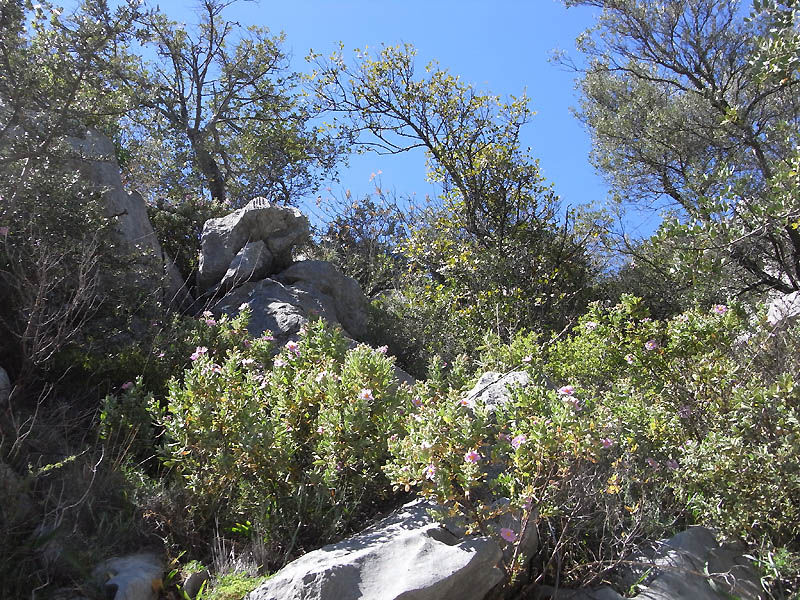
© photo
(c) Borja Fierro, some rights reserved (CC BY), uploaded by Borja Fierro · cc-by
zebedeugalinha · cc-by
Thomas Dreux · cc-by
Taken Apr 6, 2014 by Tela Botanica − Jean Michel FOULETIER (cc-by-sa)
Taken Mar 16, 2021 by Laura GUILLAIN (cc-by-sa)
Taken Oct 26, 2022 by tophe 13 (cc-by-sa)
Taken Mar 21, 2021 by Elisa Castel (cc-by-sa)
Taken Dec 29, 2019 by Anabela Anabela Camelo (cc-by-sa)
© copyright of the Board of Trustees of the Royal Botanic Gardens, Kew.




Global distribution
Native to the western and central Mediterranean.
Identity
Grey-leaved cistus (Cistus albidus L., 1753) bears pink flowers despite French names referring to a white cistus. White describes the leaf hairs visible throughout the year. Pink petals thus combine with gray, compact, evergreen foliage; the various French names refer to one species. 8 4 3
It belongs to Cistaceae, a family distinct from true roses. Linnaeus published the scientific name on page 524 of Species Plantarum in 1753. This dates the botanical description, rather than a horticultural introduction. 2
Recognition
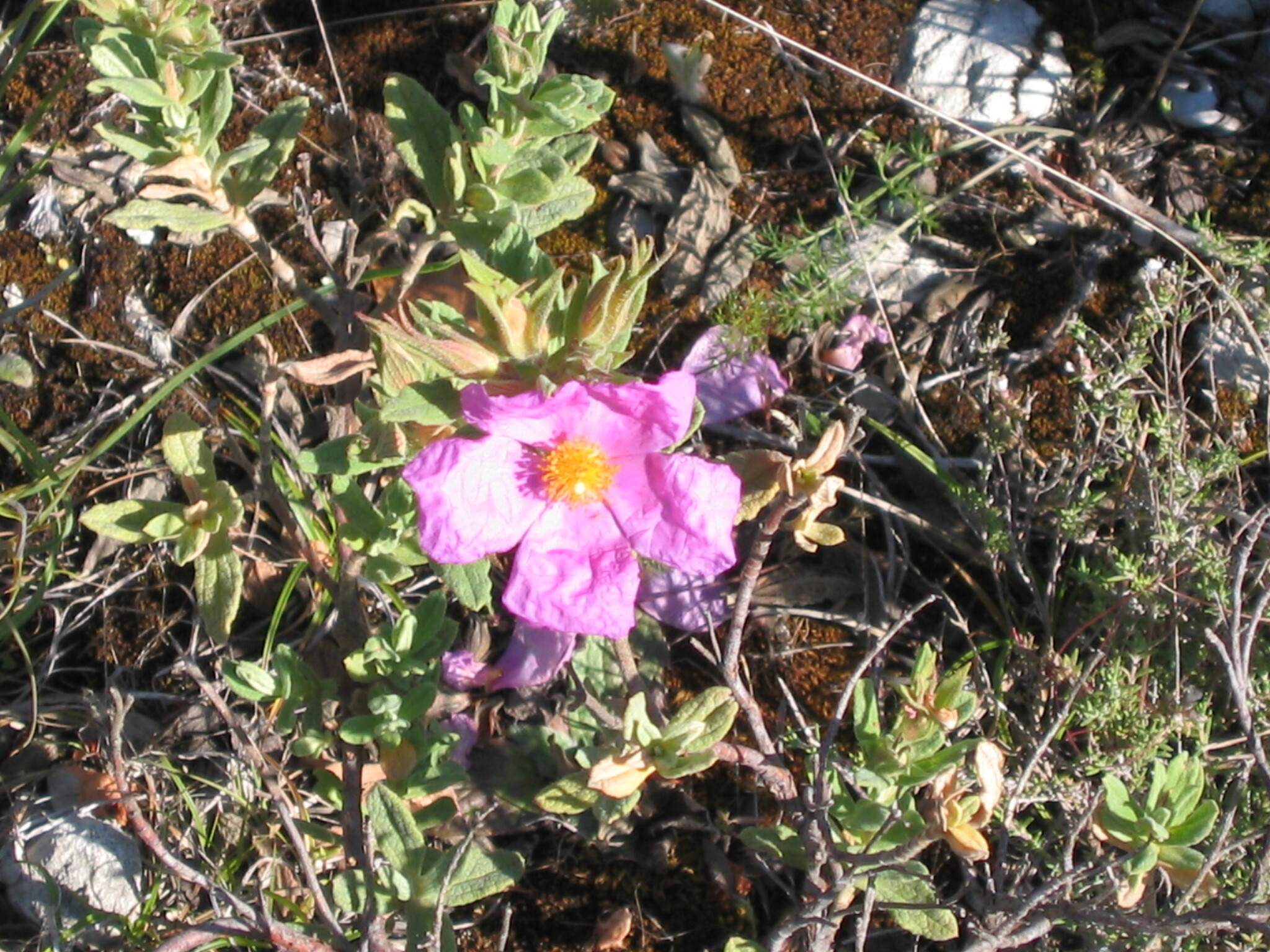
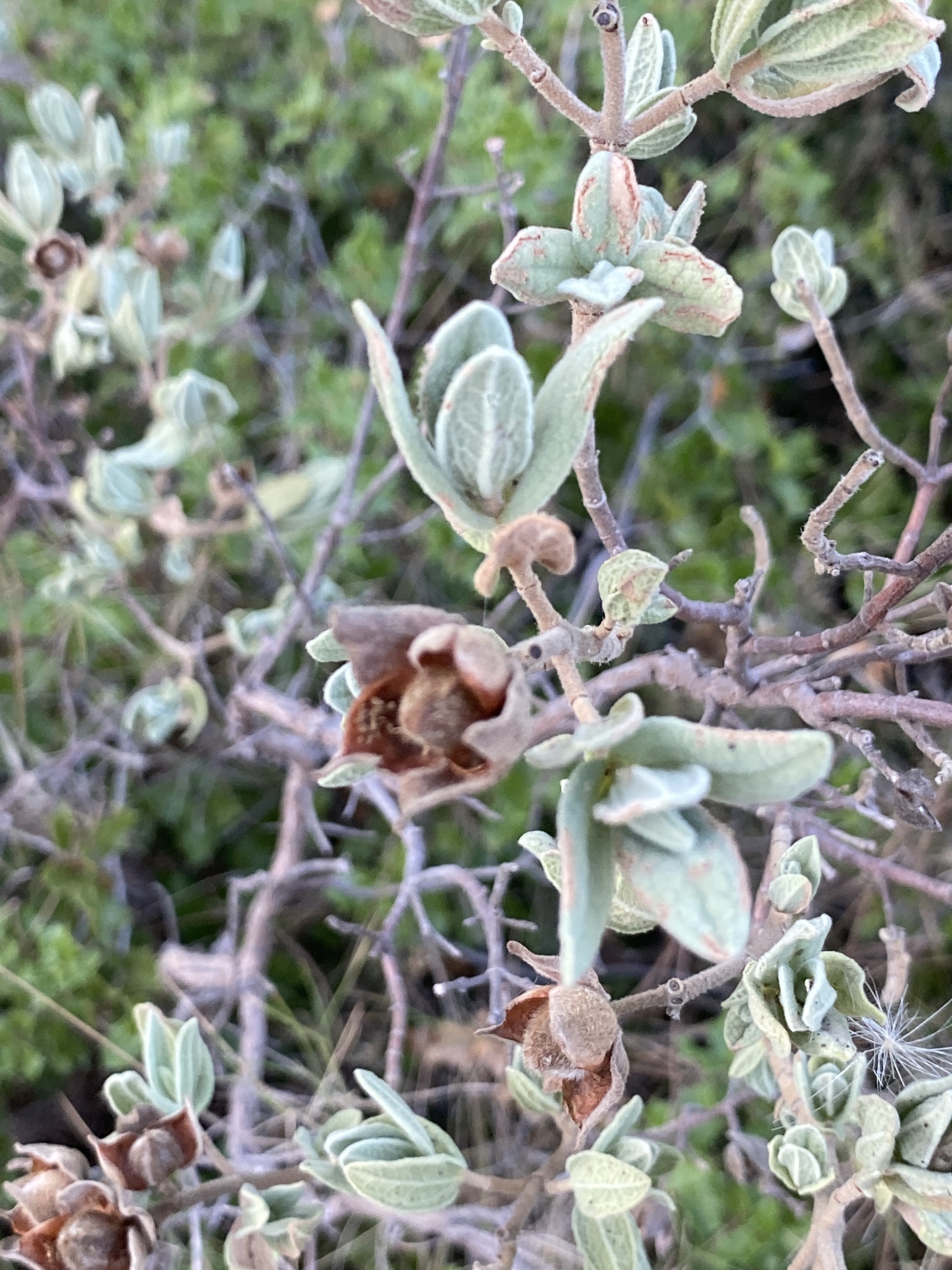
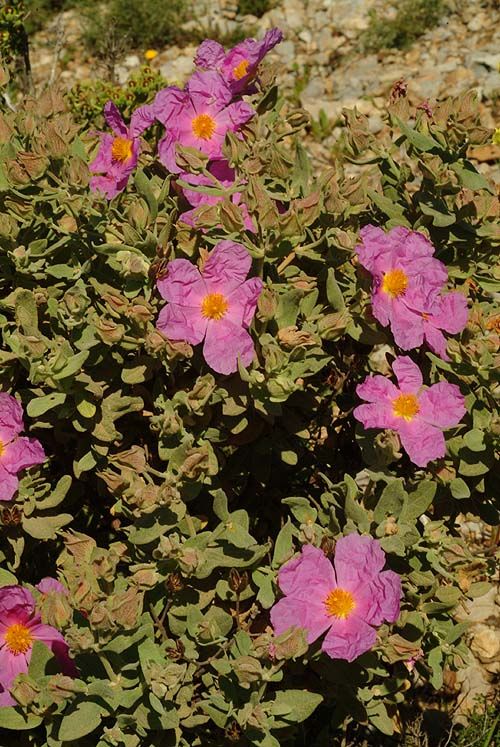
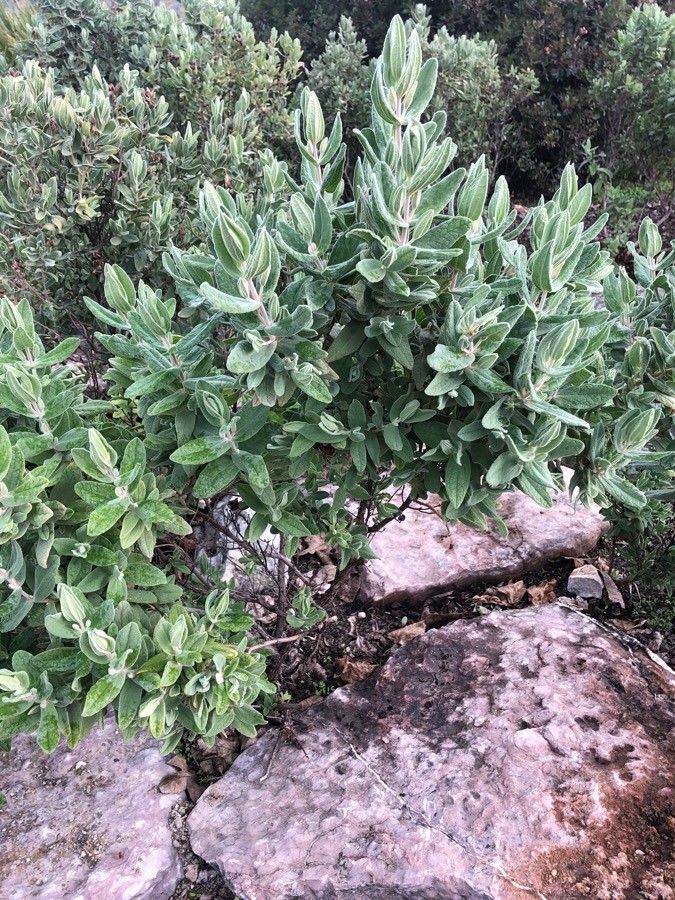
Opposite, stalkless, hairy leaves help identify it before flowering. Blades are oblong to elliptical, entire and usually flat. Whitish hairs cover both surfaces and give the plant a pale-gray color. This hair cover is part of the leaf, unlike dust. Examine several mature leaves so a distorted young shoot is not mistaken for a constant character. 3 5
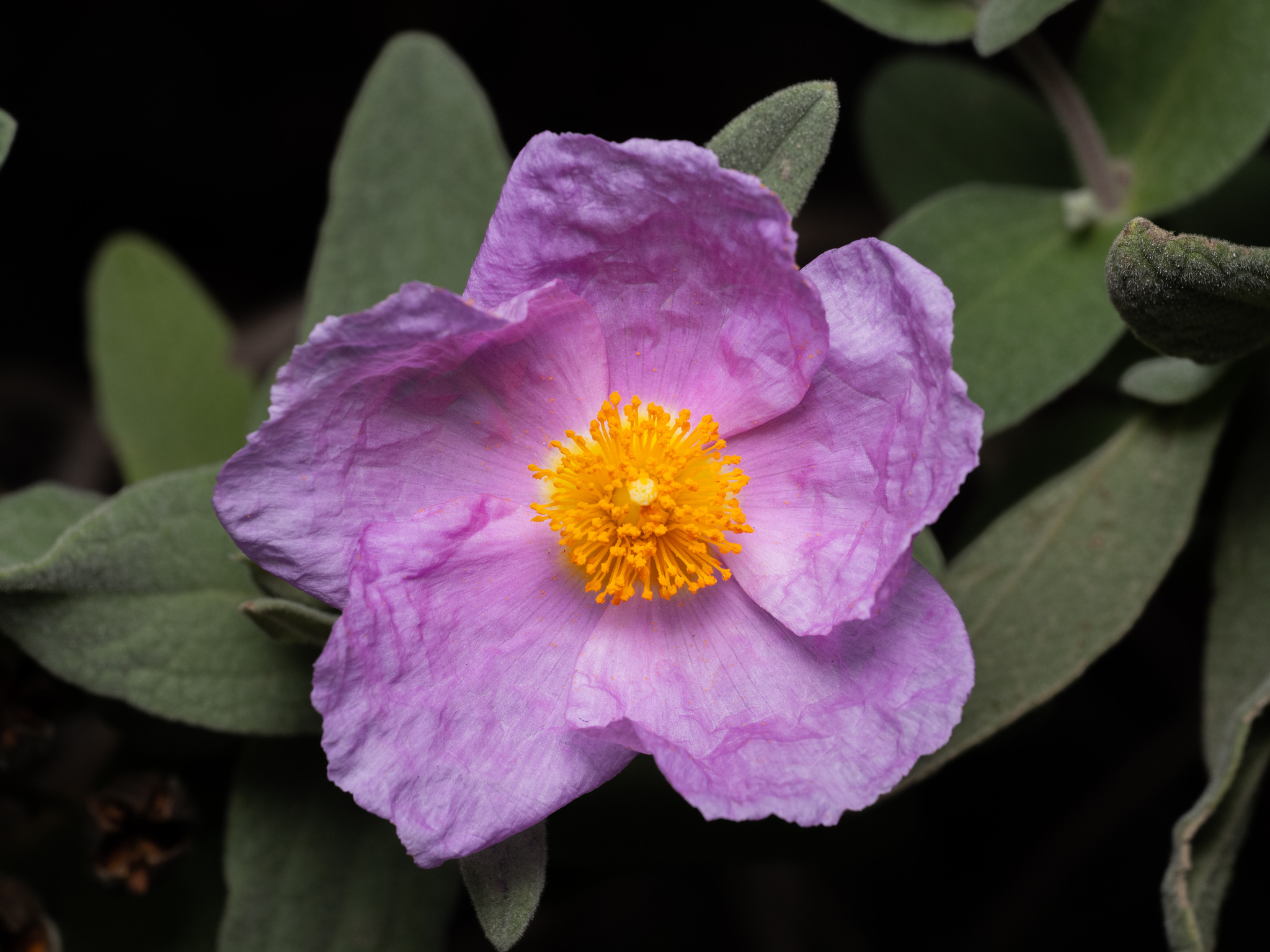
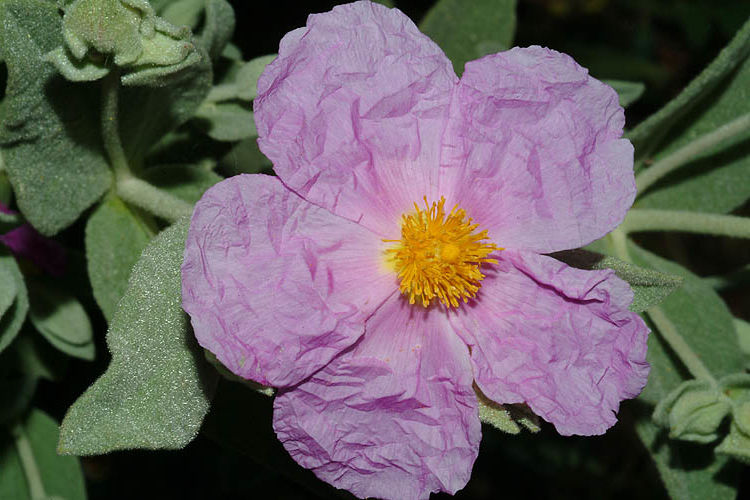
Flowers are about 4–6 cm (1.6–2.4 in) across, with five crumpled pink to lilac-pink petals around yellow stamens. The compact shrub stands 40 cm–1 m (16–39 in) tall. A large flower alone is insufficient for identification: gray foliage and leaf attachment should accompany the observation. 3 5
Useful taxonomy
The accepted name is Cistus albidus. Latin albidus, whitish, refers to vegetative organs. Searching only a translated name such as white cistus can lead to white-flowered species, although this plant normally has pink flowers. Pairing the scientific and common names resolves the ambiguity. 1 3
Older names Anthelis albidus (L.) Raf. and Cistus tomentosus Lam. occur in its synonymy. Catalogs and herbarium sheets may use abandoned names without implying an additional species. The phytosanitary code CSTAL links names in several languages. 3 8 4
Habitat and range
Mediterranean garrigue and hillsides, often on limestone, are characteristic habitat. In France it occurs throughout the Mediterranean region, extending to Drôme, Ardèche and Aveyron, and also in Corsica. Open, bright ground helps explain local occurrence; closed woodland offers very different conditions from a garrigue slope. 3
It is Least Concern on the Red List for the flora of metropolitan France, but Near Threatened on the Rhône-Alpes and Midi-Pyrénées regional lists, near its northernmost sites. These regional assessments do not describe global status. 8 3
The native range covers the western and central Mediterranean, linking the Iberian Peninsula and southern France with Italy and northwestern Africa. In gardens, summer drought tolerance does not predict winter performance: a sunny position can still remain wet or exposed to cold for long periods. 1 6
Life cycle and reproduction
Each flower lasts only one day. Rapid petal fall therefore does not necessarily signal insufficient water. New buds sustain flowering through the season, May–June in the Mediterranean range. 7 3 In cooler cultivation, flowering shifts toward summer. 5
Hairy dry capsules contain many fine seeds. For seed propagation, collect dry capsules and sow between late winter and early spring. Cuttings offer another way to raise plants. Choice depends on the intended result: cuttings reproduce a selected parent exactly, whereas seed does not necessarily preserve its characters. 6 3
Uses and risks
Cultivation suits full sun and rapid drainage. Poor to moderately fertile soil is sufficient. Limestone is generally tolerated, although highly alkaline ground can cause chlorosis. A gravel bed or sunny slope can work where water drains freely; compact, waterlogged ground requires its drainage problem to be addressed first. 5
Established cistus responds poorly to severe pruning into old wood, which rarely reshoots. Light pruning after flowering maintains a compact outline. Excess fertilizer is unhelpful: overly rich soil produces a shorter-lived plant bare at the base. Seed or cutting propagation can prepare a replacement for an aging shrub. 6
Human and domestic-animal toxicology remains insufficiently documented. Ornamental use does not establish safety. Neither herbal tea from the leaves nor edible flowers should be recommended merely because the plant looks attractive.
Varieties, look-alikes and related plants
Compare Cistus crispus when pink flowers look similar. Grey-leaved cistus normally has flat leaves; distinctly wavy margins suggest another identification. Hairiness and leaf attachment, with leaves joined at the base in C. crispus, add useful distinctions. A flower photograph alone omits many identification features. 3
Garden cistus includes many hybrids and cultivars. A trade name associated with pink flowers does not guarantee the botanical species. To preserve a particular selection, cuttings are preferable to seed because they reproduce the parent. No named cultivar is needed to describe the wild species. 6
Main sources
Botanical identity and cultivation address different questions. The accepted name Cistus albidus dates to 1753, and floras provide field characters. Growing guidance complements observation of the whole plant. The genus contains about twenty species as well as numerous garden hybrids. 2 6
- Kew, Plants of the World Online, Cistus albidus
- International Plant Names Index, Cistus albidus
- Tela Botanica, grey-leaved cistus, Coste description
- EPPO Global Database, Cistus albidus
- Royal Horticultural Society, Cistus albidus
- Royal Horticultural Society, growing cistus
- RHS, introduction to Cistus
- INPN, TAXREF: Cistus albidus
Frequently asked questions
Why does the French white cistus have pink flowers?
White refers to the whitish hairs covering the plant, especially both leaf surfaces, rather than the normal petal color.
Does an established grey-leaved cistus need watering?
It tolerates drought. Adjust water to soil conditions and establishment rather than maintaining permanent moisture.
Can an old cistus be cut to ground level?
Established plants recover poorly after severe pruning into old wood. Prefer light pruning after flowering.
If you are unsure about a plant’s toxicity, ask a botanist or veterinarian for advice.