
Silver torch (Cleistocactus strausii, )

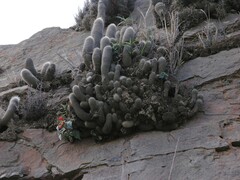
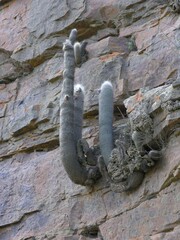
Silver torch (Cleistocactus strausii) forms green columns covered in short white spines. Its pinkish-red tubular flowers stand out against this pale covering. This Bolivian member of the Cactaceae needs sun and a free-draining growing medium.
Read moreSilver torch
Pilocereus strausii, Borzicactus strausii and Echinopsis strausii
Place in full sun, with intense direct light all day long.
Full sun; very bright conditions under cover


© photo
(c) Martin Lowry, some rights reserved (CC BY-NC), uploaded by Martin Lowry · cc-by-nc
Lon Brehmer · cc-by
© copyright of the Board of Trustees of the Royal Botanic Gardens, Kew.
Global distribution
Native to Tarija Department, Bolivia; reported as introduced in the Canary Islands.
- Native1
- Introduced1
- Bolivia
- Canary Islands
Hexagons: regions where the plant occurs. Green dots: native range.1
Identity
Silver torch (Cleistocactus strausii (Heese) Backeb., 1934) is recognizable by its columns covered in short white spines, among which pinkish-red tubular flowers appear. This member of the Cactaceae family comes from Bolivia. 2 1
The French name “cactus cierge,” used for this species in a Mediterranean garden, also describes other upright cacti. A name on a sales label is therefore insufficient for identification. The botanical name specifies which white-covered cactus is meant; when a plant has no flowers, examining its spines is more useful than relying on its common name alone. 5 6
Recognition
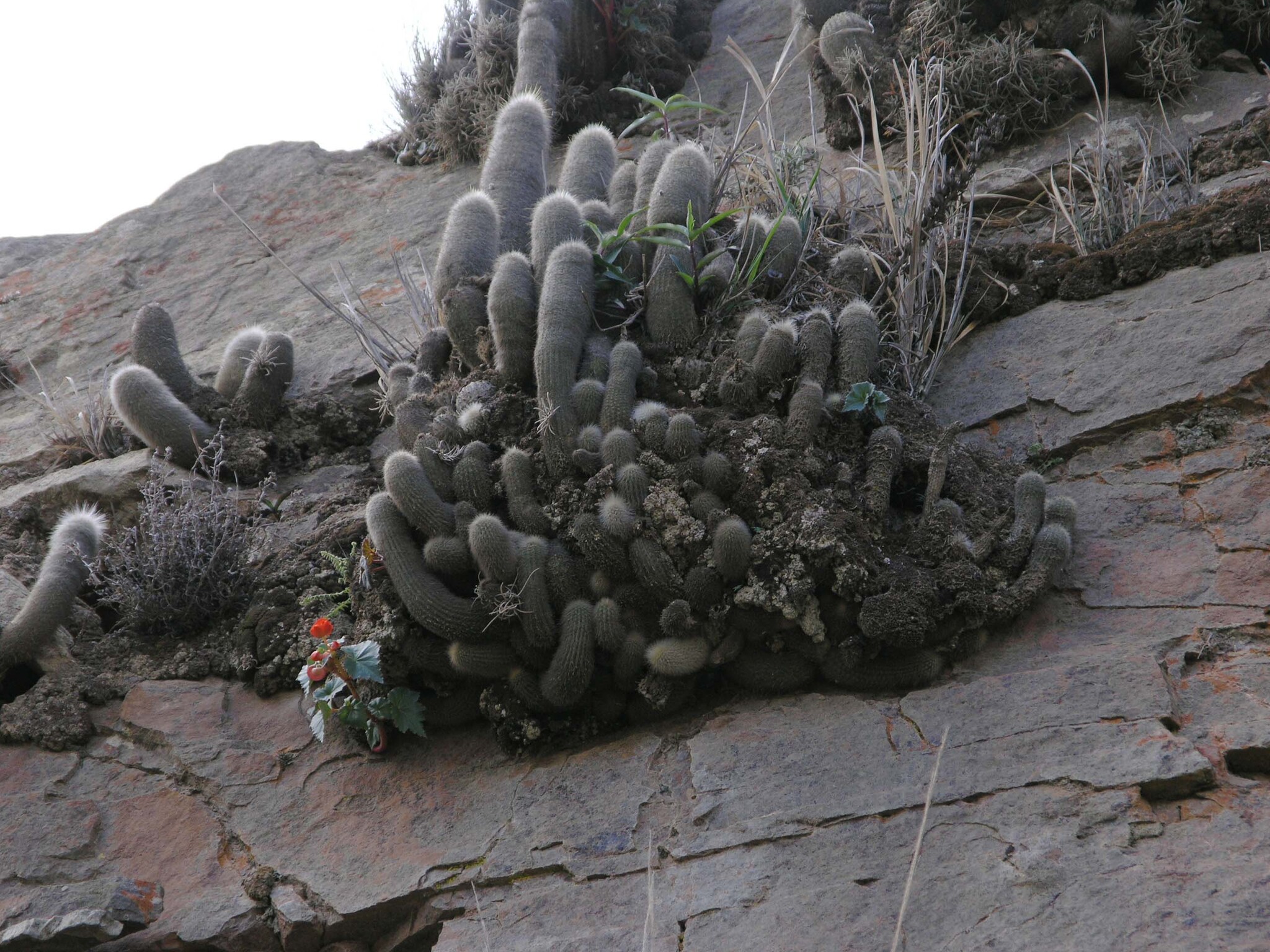
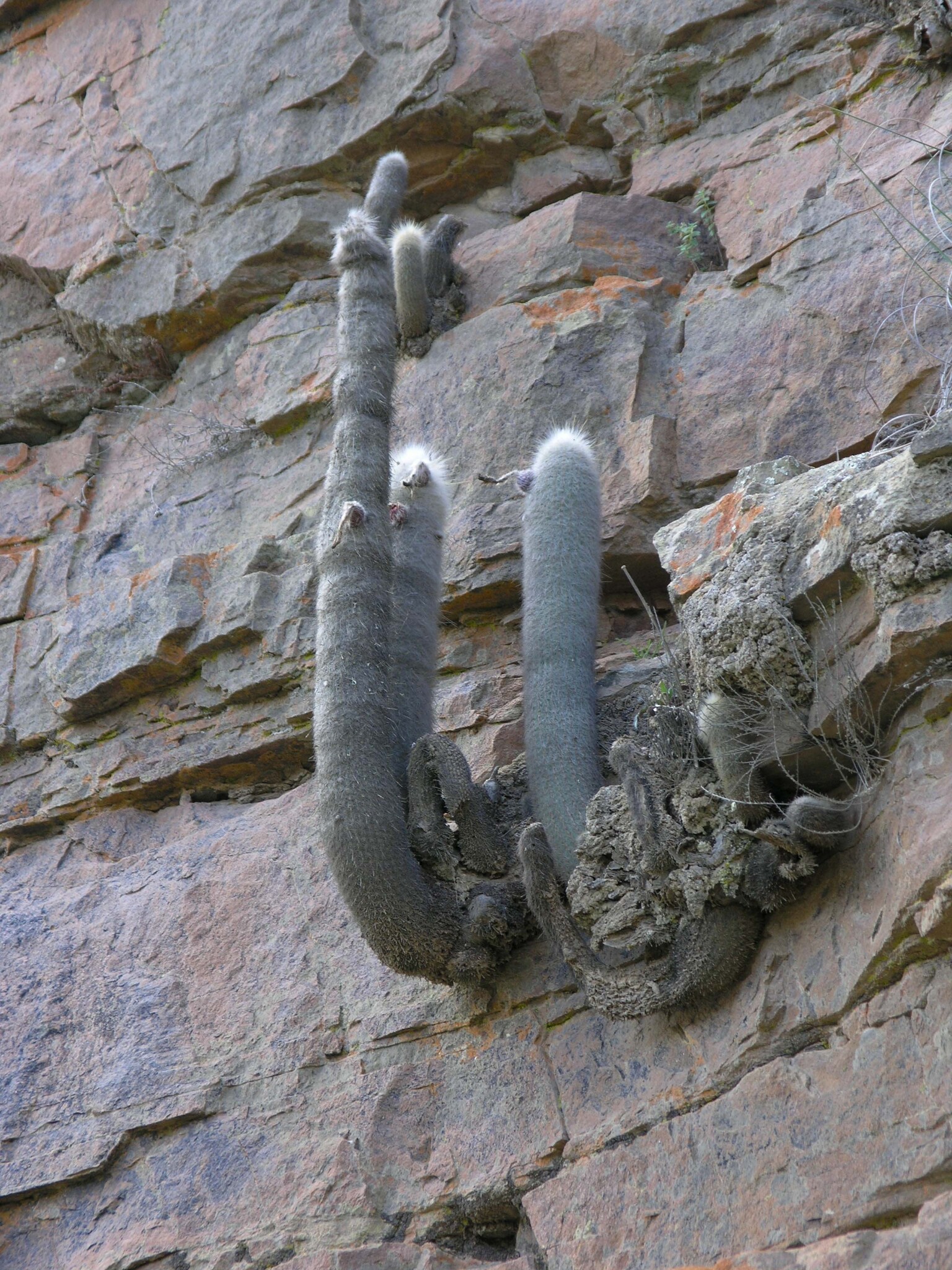
The green stems have numerous shallow ribs beneath their white covering. Short golden spines project beyond it. New stems emerge at the base, so an older plant forms a clump of upright columns rather than a trunk that branches higher up. 5 2
Under cover, the stated dimensions are 1–1.5 m (3.3–4.9 ft) tall and 0.5–1 m (1.6–3.3 ft) across. A Mediterranean garden describes clumps about 2 m (6.6 ft) tall. These horticultural observations do not establish a maximum height measured in the wild. Flowers about 8 cm (3.1 in) long are scattered along the stems, their pinkish-red tubes contrasting with the pale spines. 2 5
Useful taxonomy
The accepted name is Cleistocactus strausii (Heese) Backeb., published in this combination in 1934. The original name, Pilocereus strausii Heese, dates from 1907. The change of genus explains the parentheses around the original author's name in the current botanical authority. 1
The combinations Borzicactus strausii (Heese) A.Berger and Echinopsis strausii (Heese) Anceschi & Magli are among its synonyms. These names can refer to the same taxon in books of different dates; the names alone do not denote cultivars. The classification followed here places the species in the genus Cleistocactus, within the order Caryophyllales. 1
Habitat and distribution
The accepted native range is in Bolivia, in Tarija Department. The species is associated with deserts and dry shrublands. The Canary Islands are listed as an introduced range, distinct from its native range. 1
Horticultural accounts do not all agree: a Mediterranean description extends the origin to Argentina, whereas the taxonomic reference limits the native range to Bolivia. Growing in an acclimatized garden does not establish cold tolerance in every climate. Where frost or winter damp is a concern, a bright, frost-free position under cover with low humidity provides the cautious horticultural setting described for this species. 5 1 2
Life cycle and propagation
The horticultural description for plants grown under cover gives summer as the flowering season; an observation in a California garden places flowering in late spring. These periods depend on growing conditions. A dry winter rest, combined with strong light during growth, is part of the cultivation of cacti from arid habitats. Follow the plant's growth and rest periods rather than assuming that calendar seasons are identical in every climate or hemisphere. 2 4 3
During growth, water and allow excess water to drain away. For this species, keep the growing medium completely dry at other times. Apply a diluted low-nitrogen fertilizer every two weeks in late spring and summer while growth is active. Spring repotting, when the roots fill the pot, follows general advice for cacti. Choosing an oversized container keeps the mix wet for longer. 2 3
Propagation is by seed or stem cuttings. Spring sowing is documented for this species. For columnar cactus cuttings, allowing the cut surface to dry before placing the cutting in a free-draining mix reduces the risk of rot. 5 2 3
Uses and risks
Silver torch (Cleistocactus strausii) suits a greenhouse collection or a very sunny position under cover. A well-drained cactus mix and low atmospheric humidity meet the recommended growing conditions. Mealybugs may infest the plant; excess watering and pots that remain wet expose the roots to rot. 2 3
The white covering is not soft to the touch: small spines can remain embedded in skin. Keep the pot away from routes used by children, cats and dogs, and protect your hands when moving it. These precautions address physical injury. They establish neither safety nor chemical toxicity after ingestion; the status for horses remains unknown. 4
Varieties, look-alikes and related plants
The look-alike Cephalocereus senilis has long, silky, silvery hairs, whereas Cleistocactus strausii has a covering of short white spines. The former's flowers are nocturnal and funnel-shaped; the latter's have a pinkish-red tube. Comparing these structures is more reliable than the general impression of a white cactus. 6 2
The name Pilocereus strausii f. cristatus Dörfl. appears in the botanical synonymy. Its inclusion there does not establish a named horticultural cultivar. The dimensions and outline described here concern the upright-stemmed species; they are not a reference for crested forms or for a possible hybrid sold under a similar name. 1 2
Main sources
The distinction between the two white cacti rests in particular on the length of their covering and the shape of their flowers. 2 6
- Plants of the World Online, Cleistocactus strausii
- Royal Horticultural Society, Cleistocactus strausii
- Royal Horticultural Society, growing cacti and succulents
- University of California Agriculture and Natural Resources, Silver Torch
- Jardin exotique d’Èze, Cleistocactus strausii
- Royal Horticultural Society, Cephalocereus senilis
Frequently asked questions
How do I identify Silver torch?
Its upright stems branch at the base and bear densely packed short white spines. The pinkish-red flowers are tubular.
Should I water Silver torch in winter?
Under-cover cultivation includes a dry rest outside the growing period. Resume watering with spring growth, using a free-draining growing medium.
Can I keep this cactus near children and pets?
Its small spines puncture skin and can remain embedded. Keep the pot away from routes used by children and pets; this physical hazard does not establish toxicity after ingestion.
If you are unsure about a plant’s toxicity, ask a botanist or veterinarian for advice.