
Taro (Colocasia esculenta, )
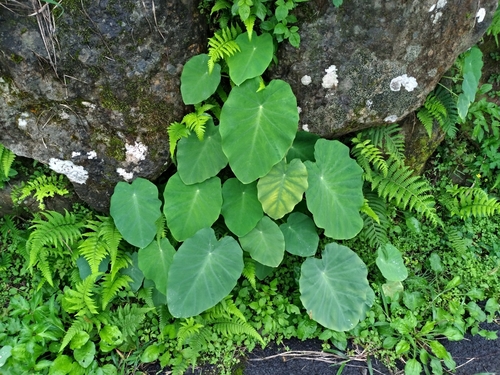

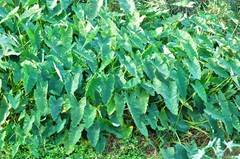
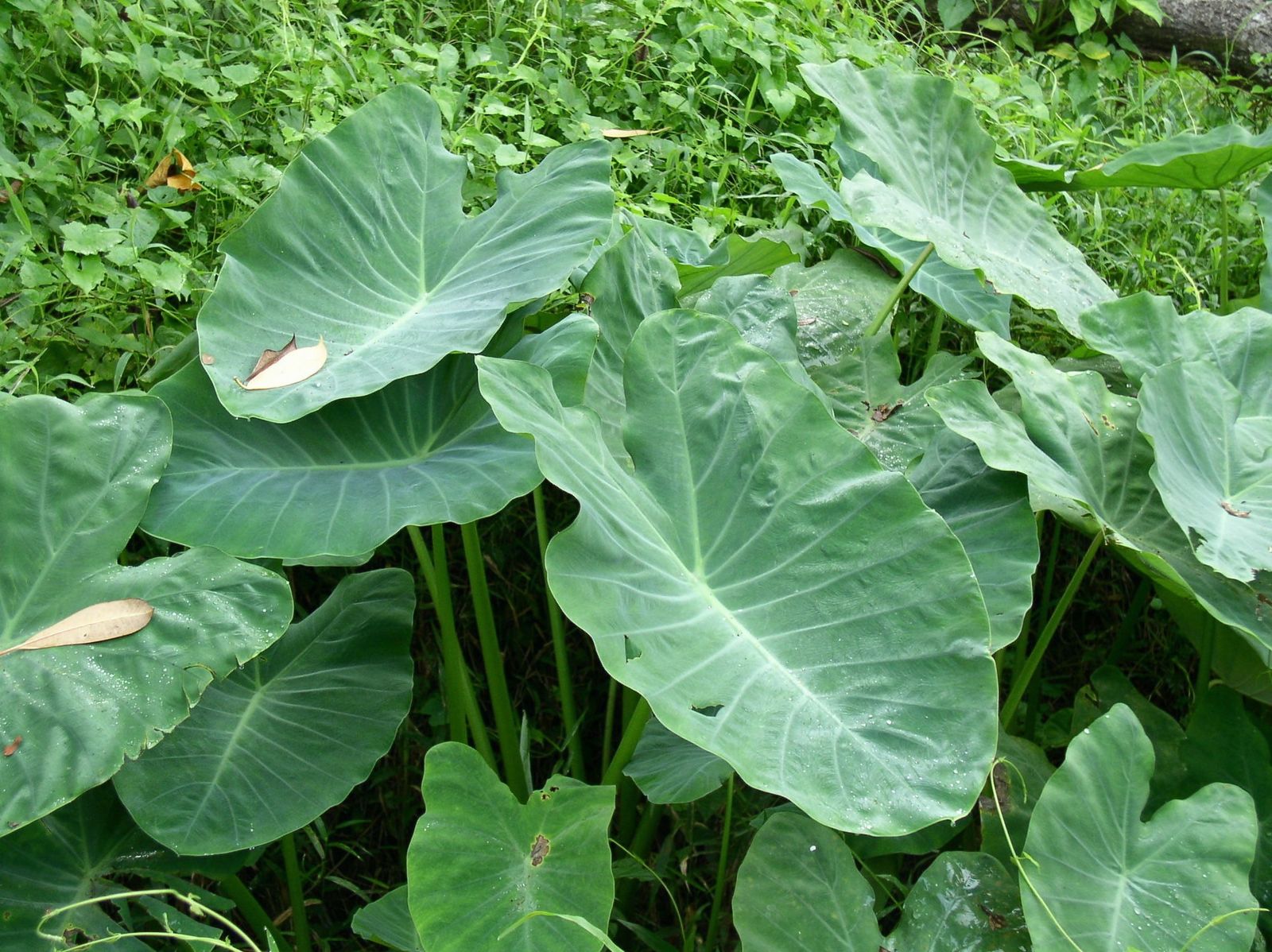
Taro has large leaves with the leaf stalk attached beneath the blade. This tropical perennial produces an edible corm, but its raw tissues are toxic.
Read moreTaro, Dasheen, Eddoe, Cocoyam and Elephant ear
Arum esculentum, Caladium esculentum and Colocasia antiquorum
Give plenty of ambient light without direct sun on the leaves.
Partial shade outdoors; filtered light under cover.


© photo
(c) Kuan-Chieh (Chuck) Hung, some rights reserved (CC BY-NC-SA), uploaded by Kuan-Chieh (Chuck) Hung · cc-by-nc-sa
Tristan Haab · cc-by
Adriana Nelly Correa Sandoval · cc-by
Taken May 31, 2020 by pauline leg (cc-by-sa)
Taken Jan 12, 2022 by Leslie Nava (cc-by-sa)
Taken Apr 21, 2021 by Vaibhav N (cc-by-sa)
Taken Sep 12, 2019 by D Kari (cc-by-sa)
© copyright of the Board of Trustees of the Royal Botanic Gardens, Kew.




Global distribution
Native from India to southern China and Sumatra; introduced in many tropical regions.
- Native3
- Introduced2
- India
- Southern China
- Sumatra
- Hawaii
- Japan
Hexagons: regions where the plant occurs. Green dots: native range.1
Identity
In taro (Colocasia esculenta (L.) Schott, 1832), the leaf stalk joins the underside of the blade toward its center. The peltate leaf is an identification feature worth checking beneath the large, drooping foliage. Taro belongs to the Araceae family, within the order Alismatales. 7 2
The French names songe, madère, chou-chine, and dachine also refer to taro. The species is cultivated for its underground storage organ and leaves, eaten after preparation and cooking. A food crop is not necessarily harmless raw: chewing taro tissues causes mouth irritation. 3 6
Identification
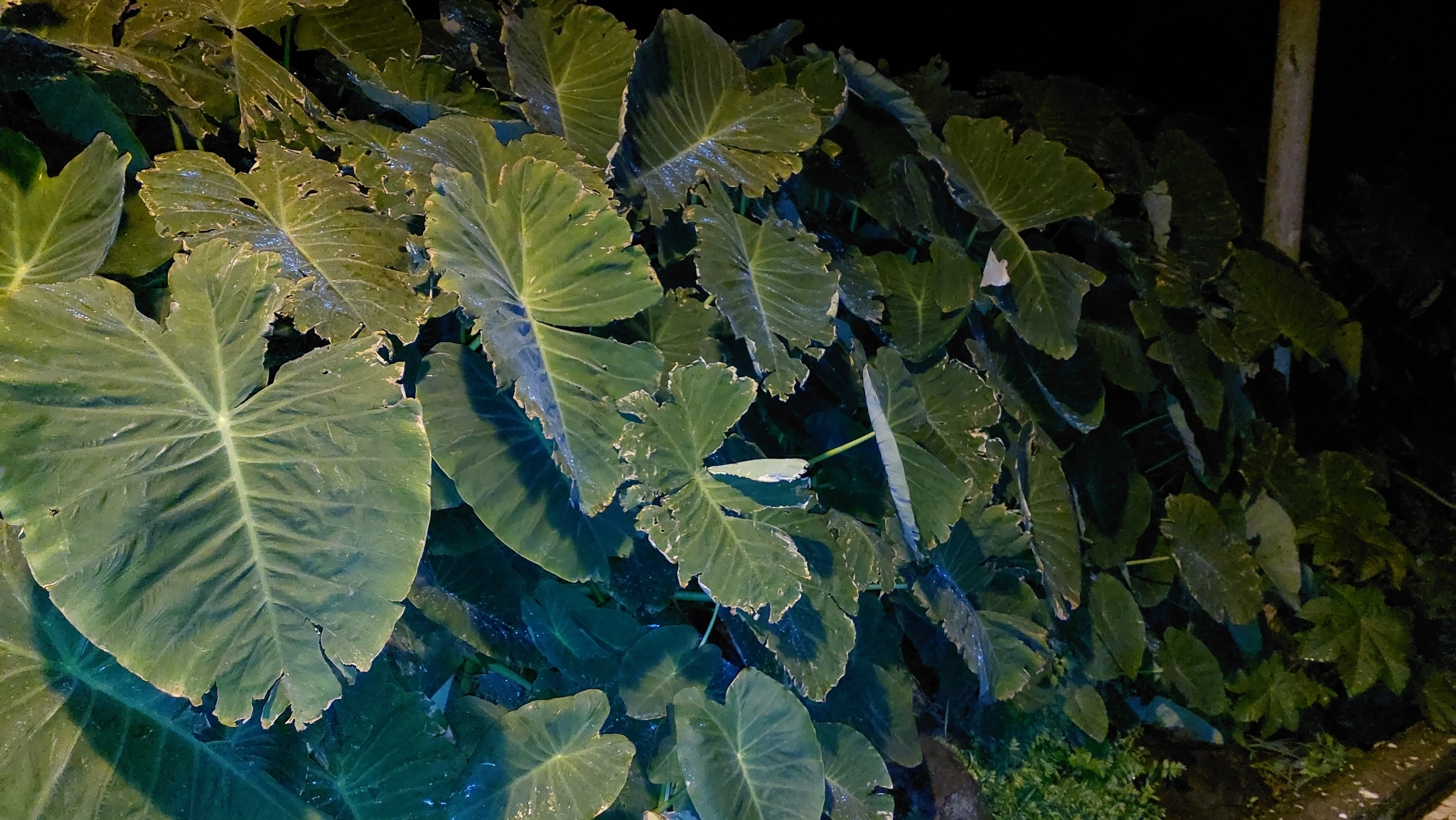
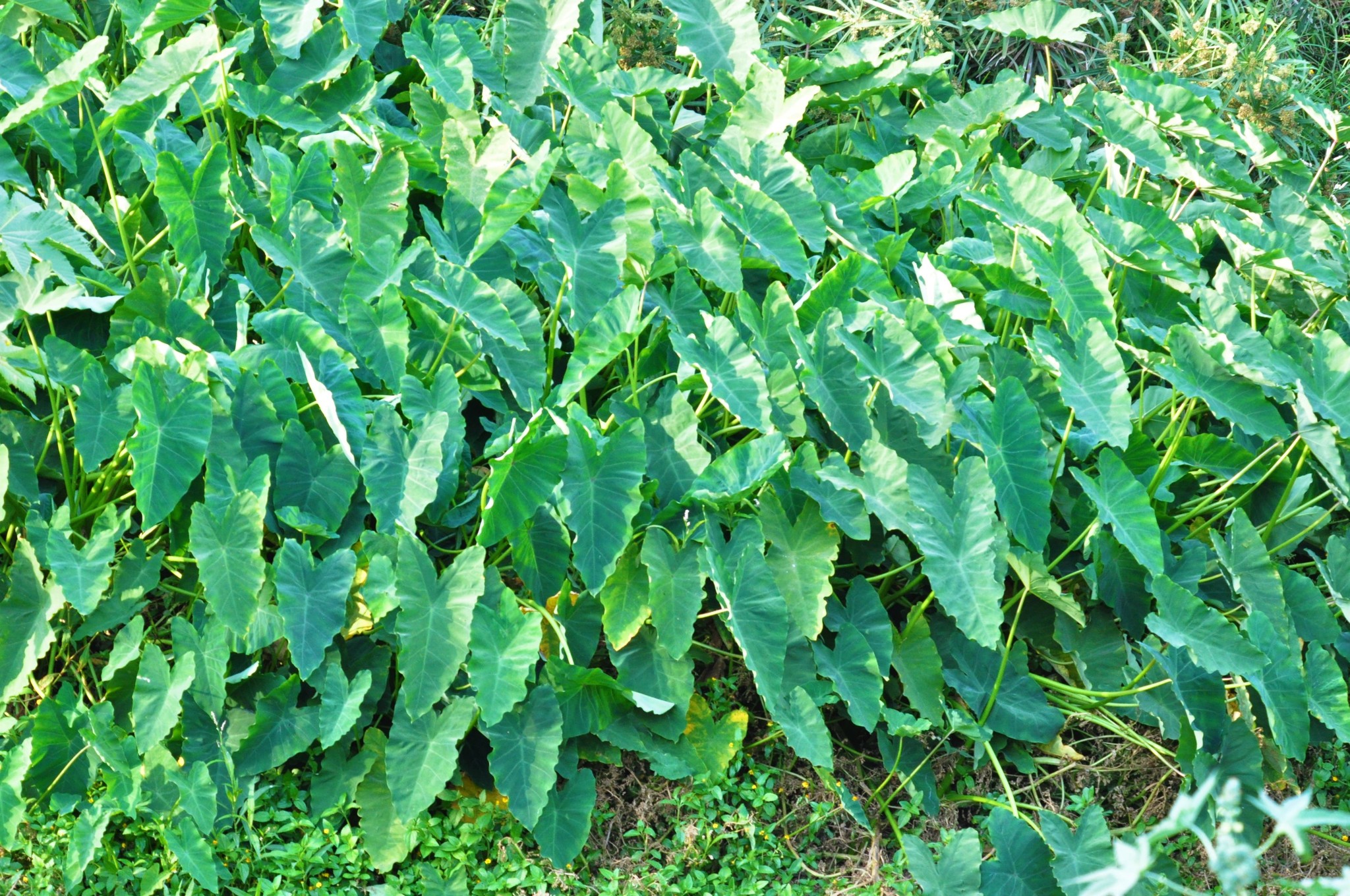
Taro forms a clump of large leaves on fleshy stalks. Ornamental growing descriptions give a height and spread of 1–1.5 m (3.3–4.9 ft). The leaf blade can measure 60 cm (24 in), and its stalk can reach 1 m (3.3 ft). The blade resembles a heart or an arrowhead. 5
Look beneath a taro leaf for a more reliable clue than its outline alone: the stalk attaches inside the blade's perimeter. The smooth leaves droop downward. The underground storage organ has rough, fibrous skin marked with ring-shaped scars, and varies in shape from rounded to cylindrical. 7
Useful taxonomy
The accepted name Colocasia esculenta was published in this combination in 1832. The original name, Arum esculentum L., dates to 1753. Synonyms include Caladium esculentum (L.) Vent. and Colocasia antiquorum Schott. An old label can therefore refer to the same taxon under a different name. 1
The epithet esculenta means “edible” or “good to eat.” The meaning describes the food use of taro without removing the need for proper preparation. Taro is a herbaceous perennial with a corm, the storage organ from which new growth develops. 6
A taro corm is a thickened stem. Its lateral buds produce smaller corms or offsets; the true roots are thin, fibrous, and shallow. Propagation uses a bud-bearing organ because the buds can produce new shoots. The corm and the roots have different roles despite both growing below ground. 3
Habitat and distribution
Taro's recognized native range extends from India to southern China and Sumatra. Long cultivation has spread the species widely: Hawaii, Japan, and Madagascar are among its introduced territories. The place where taro grows today does not necessarily indicate where it originated. 1
Taro grows in moist forests, along riverbanks, and in marshes, as well as roadside ditches and disturbed ground. Its occurrence near water corresponds to its preference for moist soil. Wet habitats help explain the plant's water needs during active growth. 7
Flooded cultivation uses taro cultivars adapted to those conditions. Other taros grow on land that is not flooded, so the choice of planting material matters alongside soil moisture. A flooded growing system should not be assumed suitable for every cultivar. 3
Taro responds well to relatively stable temperatures of 21–27 °C (70–81 °F). The range concerns growth in warm, humid conditions; it does not define frost resistance. A temperature range supporting growth and a limit for surviving cold answer different growing questions. 4
In mild climates, taro can naturalize in wetlands. Taro is considered invasive on the United States Gulf Coast. The classification concerns that region and does not automatically describe every country where taro is cultivated. Check the geographic scope before applying a regional status elsewhere. 8
Growth cycle and propagation
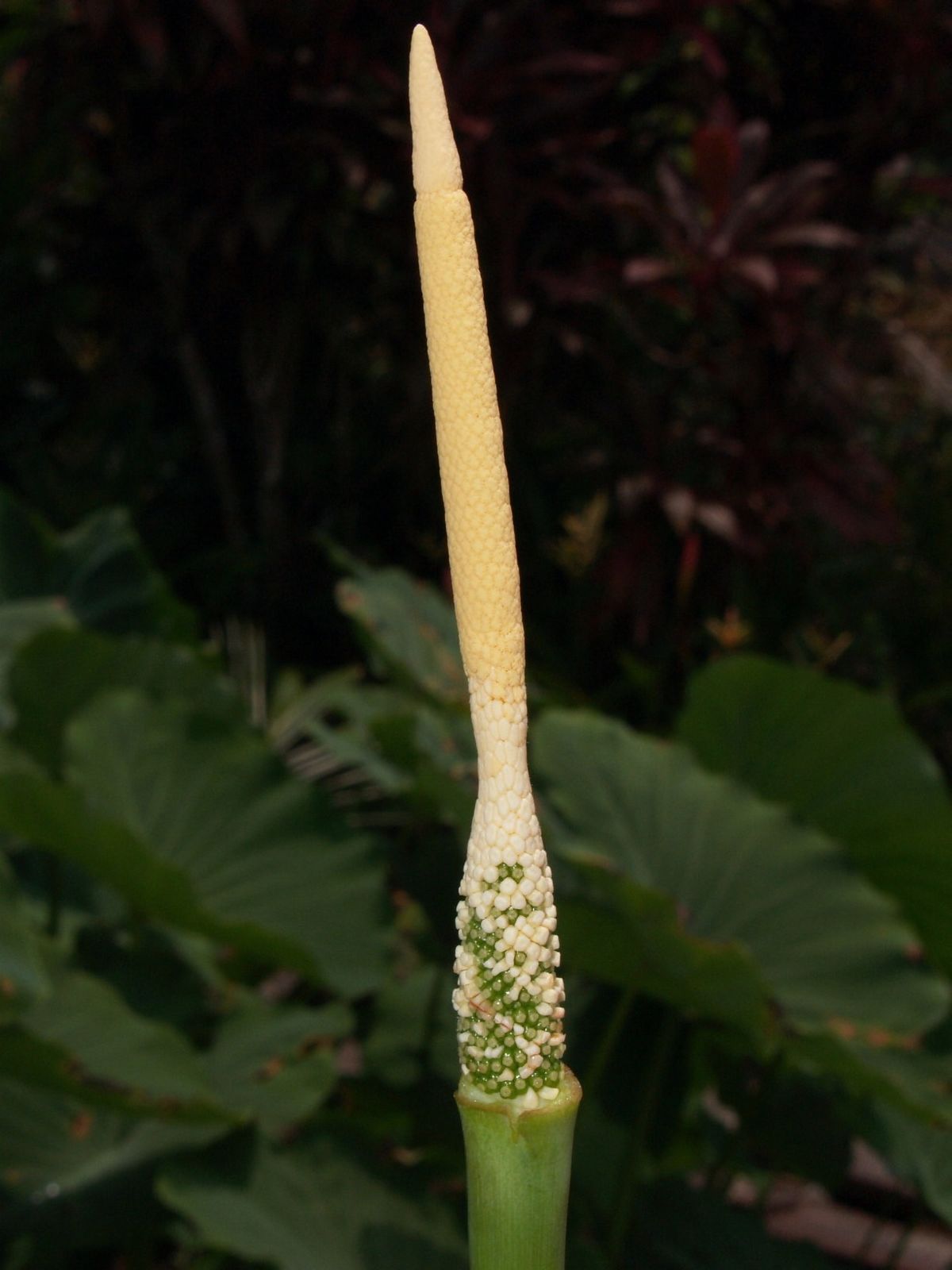
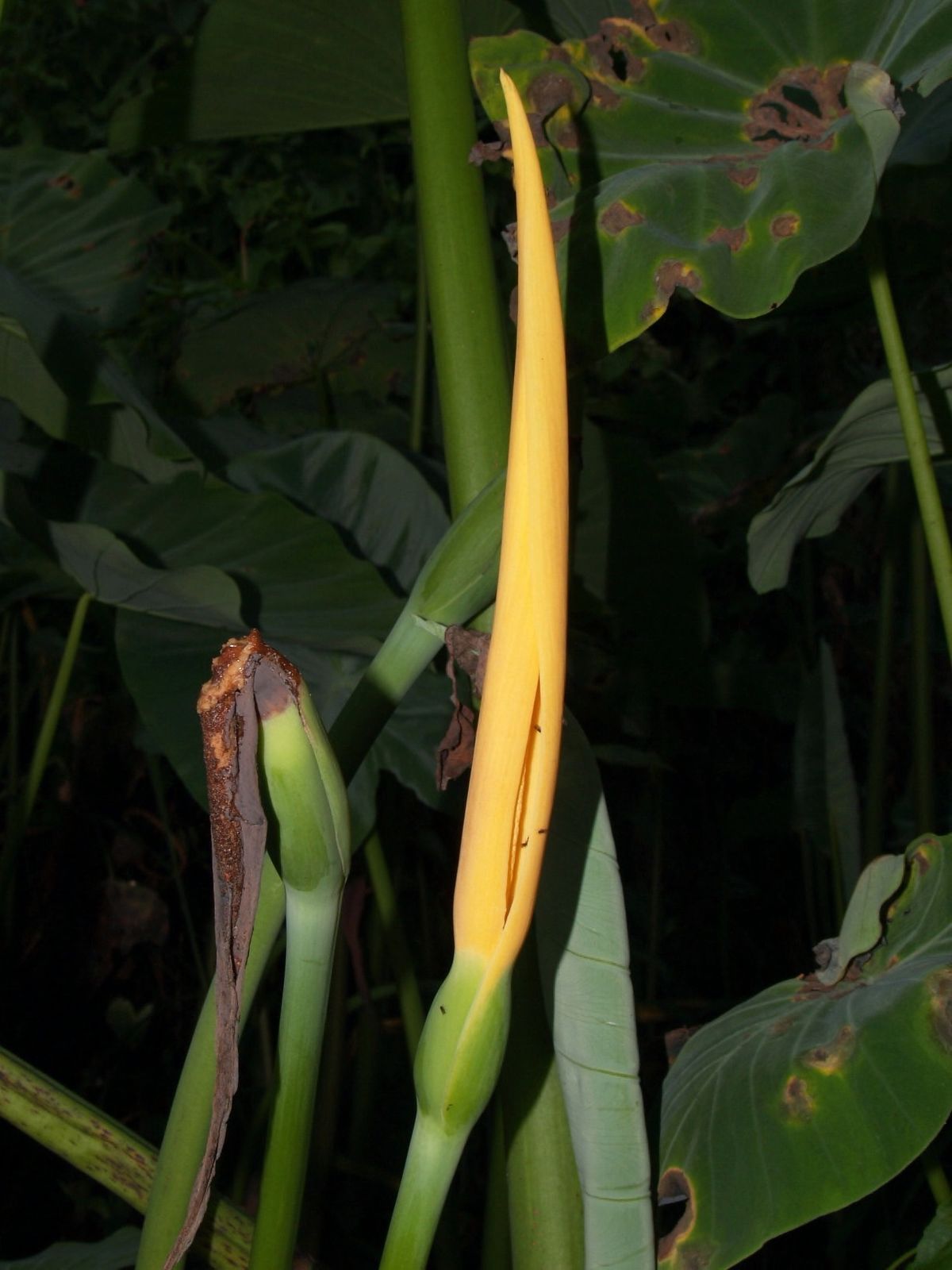
Taro is propagated mainly by division, using its storage organ and offsets. Flowering remains rare in cultivation. When an inflorescence appears, a spadix bears the small flowers, surrounded by a spathe. The visible surrounding structure is therefore not one large flower. 6 7
During growth, taro continually replaces its leaves. Intensive leaf harvesting can reduce corm size and yield. Taking foliage from a food crop consequently affects more than the amount of leaves remaining above ground. 3
For a potted taro moved outside in summer and overwintered under cover in metropolitan France, start the corms in warmth in early spring. Spring potting and moving the plant outdoors once warmth returns follow the seasonal routine for large-leaved tropical plants. 8
Keep the growing medium moist during growth and apply a balanced liquid fertilizer monthly. Reduce watering in winter; store a dormant corm dry and frost-free. The calendar expresses this seasonal rhythm through relative indices, without prescribing a volume of water. A warm, leafy taro needs different monitoring from a resting corm. 5
Uses and risks
Food taro supplies corms and leaves that are eaten cooked. The agricultural groups Dasheen and Eddo differ chiefly in underground production: Dasheen has one large main corm, while Eddo has several large secondary corms. The agricultural groups alone do not describe the ornamental cultivars. 3
Insoluble calcium oxalates make chewing taro dangerous for cats and dogs. Reported signs include intense mouth burning, excessive drooling, vomiting, and difficulty swallowing. Contact a veterinarian promptly after suspected ingestion; the plant's use as a prepared human food does not establish safety for pets. 9
In people, raw taro tissues can cause mouth pain and swelling. Skin and eye irritation are also reported, although references differ on contact dermatitis; wear gloves when handling the plant. 5 Keeping taro out of children's reach prevents exposure through chewing. A risk is also reported for horses, while the status of other animals remains undetermined. 6
Cultivars and similar plants
Taro differs from Alocasia macrorrhizos in its drooping, peltate leaves. In A. macrorrhizos, the stalk attaches near the edge and the leaves remain upright. Examining the attachment underneath a leaf helps more than simply comparing the sizes of two potted plants. 7
Ornamental cultivars chiefly alter foliage color. ‘Black Magic’ has purplish-black leaves; ‘Illustris’ combines a dark blade with bright green veins. The color patterns belong to the named cultivars, while green foliage identifies the ordinary taro form. A dark leaf does not, by itself, indicate a different species. 6 8
Main sources
Taxonomic references establish the name and distribution; horticultural resources describe growing conditions and foliage characters.
- Plants of the World Online, Colocasia esculenta
- GBIF Backbone Taxonomy, Colocasia esculenta
- PROTA, Colocasia esculenta, French version on Pl@ntUse
- PROTA, Colocasia esculenta, ecology and temperatures
- Royal Horticultural Society, Colocasia esculenta
- NC State Extension, Colocasia esculenta
- National Parks Board of Singapore, Colocasia esculenta
- University of Wisconsin Extension, Elephant Ears
- ASPCA, taro toxicity profile, Colocasia esculenta
Frequently asked questions
How can I identify taro?
The leaf stalk attaches beneath the blade, toward its center, and the large leaves droop. The stalk attachment distinguishes taro from Alocasia macrorrhizos, whose leaves remain upright.
Can taro be eaten raw?
No. Raw tissues contain irritating calcium oxalate crystals. Food use concerns correctly identified taro that has been properly prepared and then cooked.
How should I overwinter taro in a pot?
Keep taro under frost-free cover. Reduce watering in winter; keep the corm dry when the plant is dormant.
Is taro toxic to cats and dogs?
Yes. Chewing can cause intense mouth irritation, excessive drooling, vomiting, and difficulty swallowing.
If you are unsure about a plant’s toxicity, ask a botanist or veterinarian for advice.