
Field bindweed (Convolvulus arvensis, )
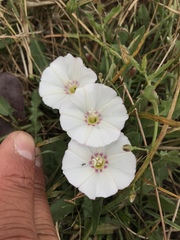
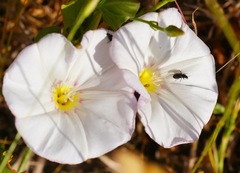
Field bindweed (Convolvulus arvensis) is a creeping or twining perennial in the Convolvulaceae, native to the temperate and subtropical Old World. Small white or pink flowers and arrow-shaped leaves conceal a persistent underground system.
Read moreField bindweed
Convolvulus ambigens
Allow a few hours of direct sun per day, preferably morning or evening.
Sun in open situations.
© photo
(c) vivienratcliffe, some rights reserved (CC BY-NC) · cc-by-nc
Marcus Tamura · cc0
Michael Warner · cc-by
(c) William Stephens, some rights reserved (CC BY) · cc-by
(c) Julia Palmer, some rights reserved (CC BY-SA) · cc-by-sa
Global distribution
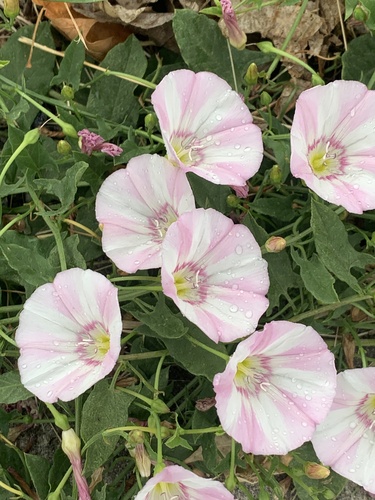
Native to temperate and subtropical parts of the Old World; widely introduced in the Americas and Oceania.
Identity
Field bindweed (Convolvulus arvensis L., 1753) is a herbaceous perennial in Convolvulaceae. Its stems creep over the ground or twine around neighboring plants. This flexible habit allows a low mat in grassland to become a climber within a hedge. Visible foliage is only part of a plant established below ground for the long term. 4 French names also include petit liseron and vrillée. 1110
Stems often reach about 1 m (3.3 ft) long. This measures their extension, not necessarily the height of a ground-level mat. Twining means that the stem itself coils around a support; it does not attach with tendrils. This distinction explains how a shoot works its way through a planted bed. 3
Recognition
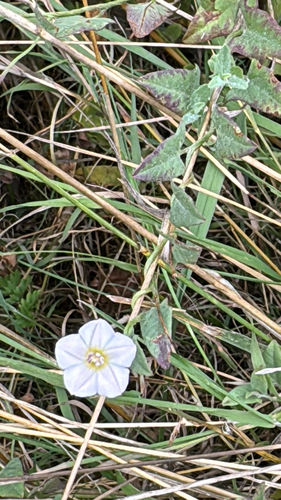
Alternate, arrow-shaped leaves have stalks and two basal lobes. Tips may be pointed or rounder. The generally small leaves vary enough to make an isolated specimen misleading. Examine several successive leaves to establish the plant's usual outline rather than choosing one unusual blade as representative. 53
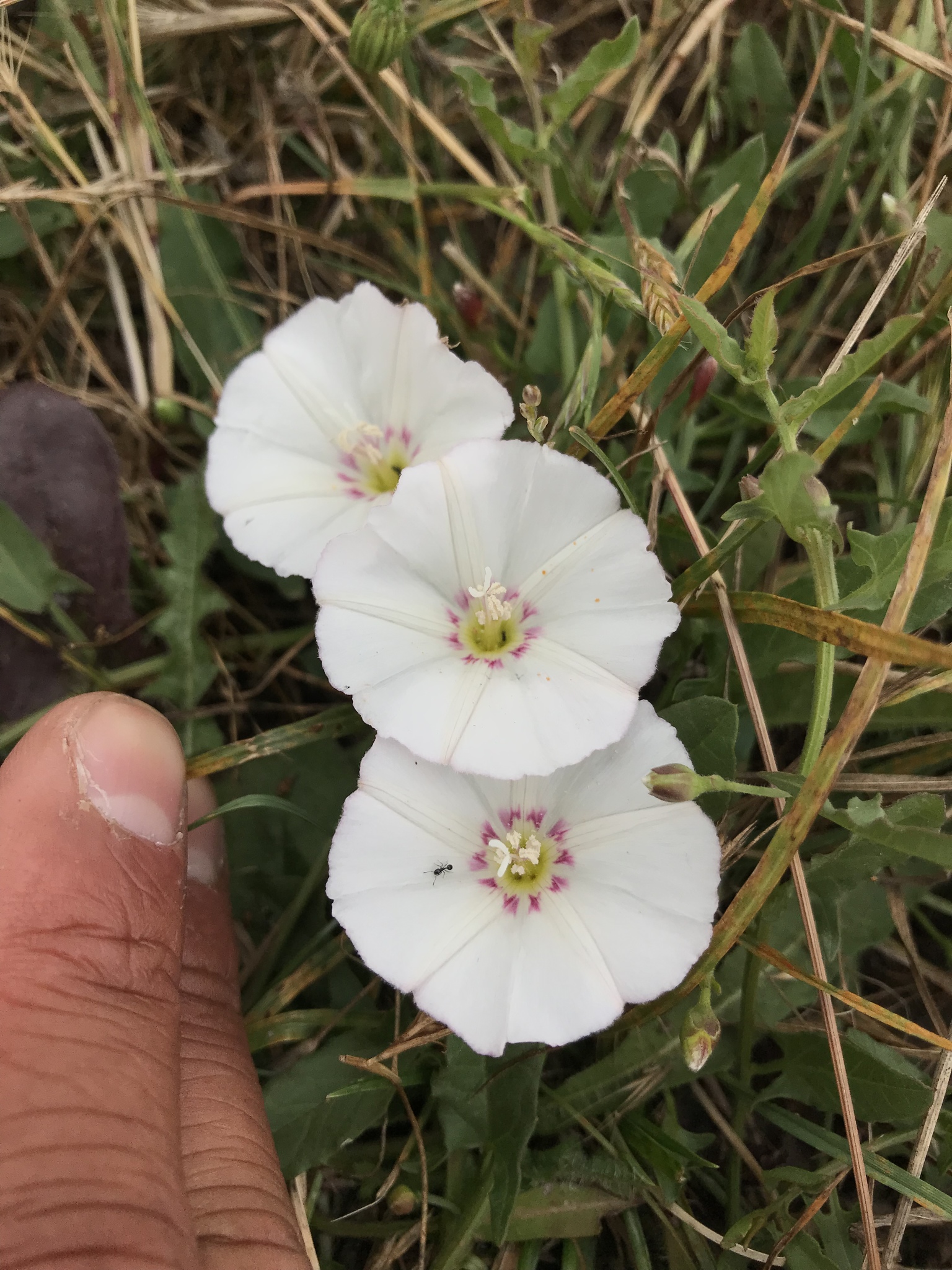
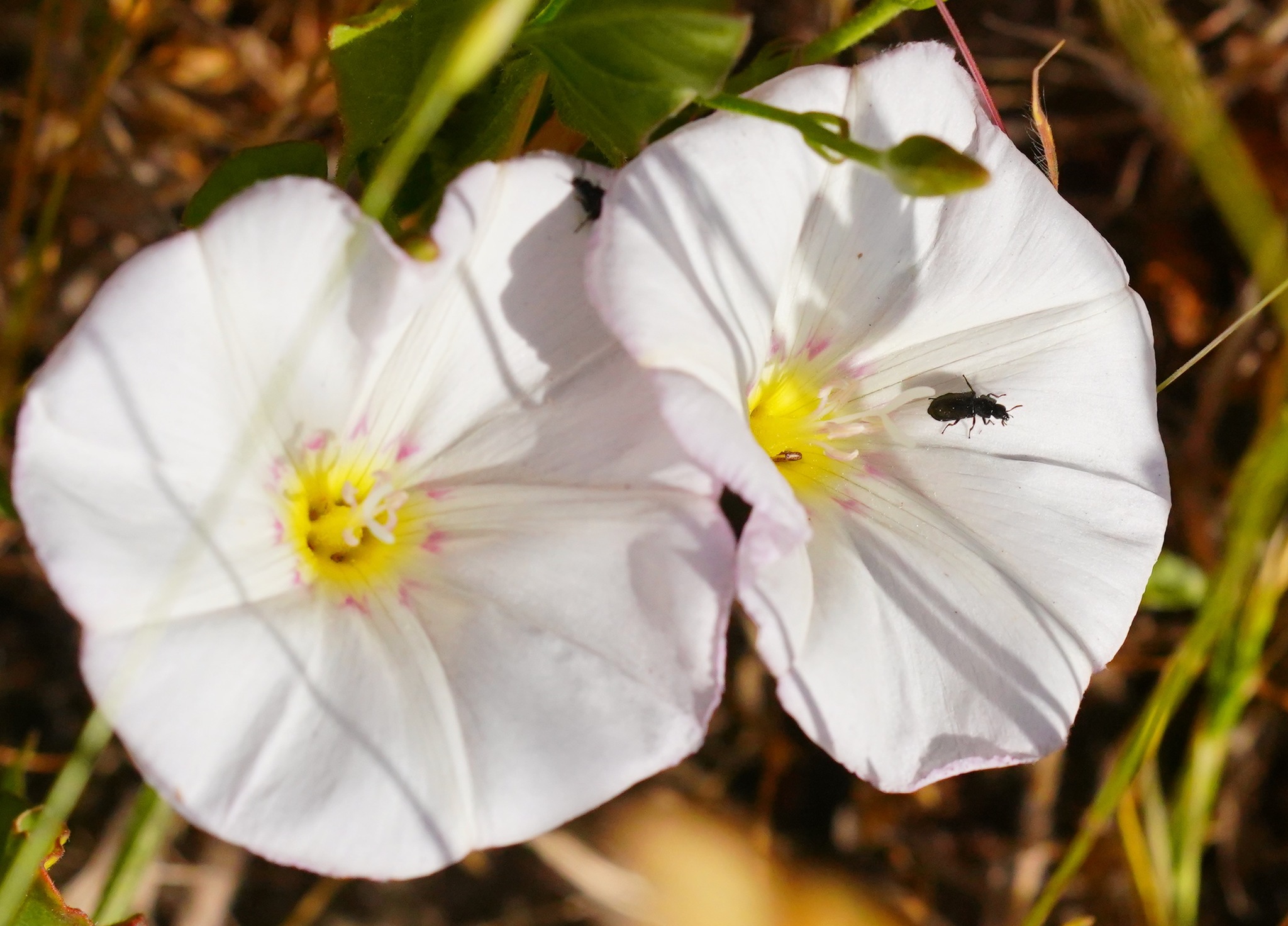
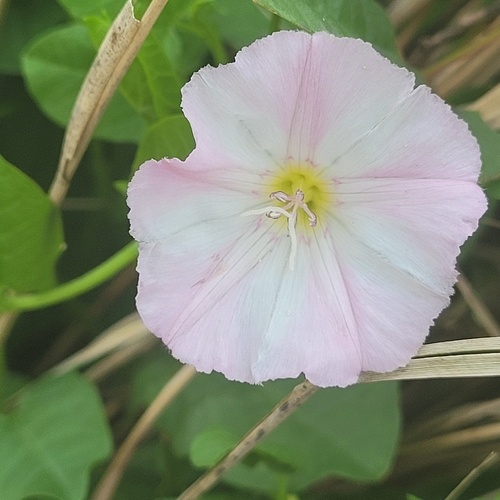
White, pink or striped flowers open into funnels about 2 cm (0.8 in) wide. Two small bracteoles away from the calyx occur on the flower stalk, often near its middle. This distinguishes field bindweed more reliably than color from hedge bindweed, whose large bracts surround the flower's base. 357
Useful taxonomy
Convolvulus arvensis L. is accepted. Linnaeus published it in Species Plantarum in 1753, page 153; L. identifies the author. Its placement in Convolvulus and Convolvulaceae remains current. Occurrence in crops is an ecological characteristic, rather than a separate botanical rank. 21
Many names were proposed for local forms: 63 synonyms are listed, including Convolvulus ambigens House. A difference in hairiness or a pinker flower does not alone justify a variety name. Connecting older records through synonymy avoids counting the same plant several times. 1
Habitat and range
Open, disturbed ground supports it in fields, gardens, waste places and roadsides, as well as vineyards and fences. Watered soil can encourage growth, but established plants also tolerate poor soils and drought. Its arrival therefore cannot, by itself, diagnose a particular soil condition or quality. 46
The native range covers temperate and subtropical parts of the Old World, including Europe, North Africa and much of Asia. It has been introduced to North and South America, Australia and New Zealand. Distinguishing worldwide spread from native status avoids assuming that a French weed is necessarily exotic. 16 It is native throughout France and Corsica, and the national Red List classifies it as Least Concern. 1011
Life cycle and reproduction
Persistent roots enable regrowth after cutting. Reproduction therefore depends on more than seed. Underground fragments can produce new stems, complicating work that moves soil around. Cutting a shoot does not establish that the whole plant has disappeared, particularly where a colony has occupied the site for several seasons. 45
French flowering runs May–October, peaking June–September. Flowers produce oval capsules 5–8 mm (0.2–0.3 in) long. Seeds can remain viable for more than twenty years. Controlling an established colony and watching for fresh seedlings address different reserves: living underground organs and dormant seeds still in the soil. 1036
Uses and risks
Flowers supply pollinators with nectar, but bindweed competes with the plants it covers. Repeatedly removing new shoots and monitoring a colony's edges requires persistence. Management must allow for root regrowth; a single intervention seldom gives lasting results. Avoiding movement of fragments into an unoccupied plot closes another route of spread. 74
Field bindweed is toxic to horses. Repeated consumption is associated with recurrent colic and progressive weight loss, with tropane alkaloids including pseudotropine implicated. Intestinal stasis and disturbed gut motility are also described in horses. These findings do not establish an identical syndrome in cats or dogs, whose status remains insufficiently documented. No food or medicinal use is recommended here. 89
Varieties, look-alikes and related plants
Hedge bindweed has larger flowers and leaves. Its bracts close to the flower cover the calyx, whereas field bindweed's are small and lower down. Both are perennial and can regrow from underground organs. Identifying the correct bindweed avoids transferring one species' dimensions or vigor to the other. 57
Black-bindweed, also loosely called bindweed, has almost heart-shaped leaves but belongs to Polygonaceae. Tiny greenish flowers lack the large funnel-shaped corolla. A membranous sheath surrounds the stem at each leaf base. This annual reproduces by seed; confusing it with perennial bindweed leads to mistaken interpretations of regrowth after weeding. 5
Main sources
The accepted name is Convolvulus arvensis L., published in 1753. Persistent roots and seeds viable for more than twenty years represent two reserves of future growth to monitor. 246
- Plants of the World Online : Convolvulus arvensis
- International Plant Names Index : Convolvulus arvensis
- InfoFlora: field bindweed
- NC State Extension : Convolvulus arvensis
- Cornell University : Bindweed identification
- Canadian Food Inspection Agency : Convolvulus arvensis
- Royal Horticultural Society : Bindweed
- University of Zurich, CliniTox : Convolvulus arvensis
- University of Georgia Extension : plants toxic to horses
- Tela Botanica, eFlore : Convolvulus arvensis
- INPN, TAXREF : Convolvulus arvensis
Frequently asked questions
How does field bindweed differ from hedge bindweed?
Field bindweed usually has smaller flowers, around 2 cm (0.8 in), and two small bracteoles away from the calyx. Hedge bindweed has large bracts surrounding it.
Why does it regrow after pulling?
Its persistent underground system produces new shoots. Removing stems alone does not remove stored reserves or every fragment capable of regrowth.
Is field bindweed toxic to horses?
Yes. Repeated consumption causes colic and intestinal damage in horses. Do not offer it as forage.
If you are unsure about a plant’s toxicity, ask a botanist or veterinarian for advice.