
String of buttons (Crassula perforata, )
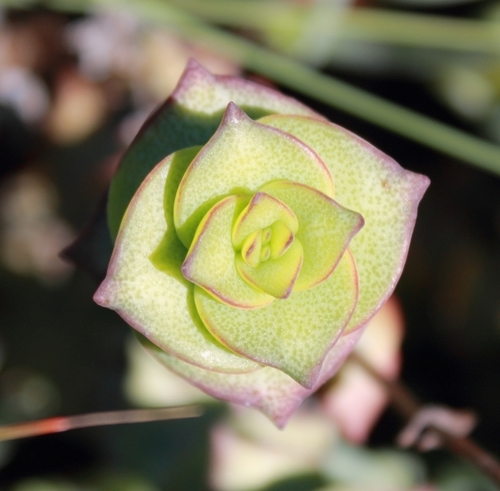

String of buttons is a South African crassula whose opposite leaves appear pierced by the stem. Upright when young, the succulent later develops a spreading or trailing habit.
Read moreString of buttons and Necklace vine
Allow a few hours of direct sun per day, preferably morning or evening.
Sun to partial shade; protect from scorching sun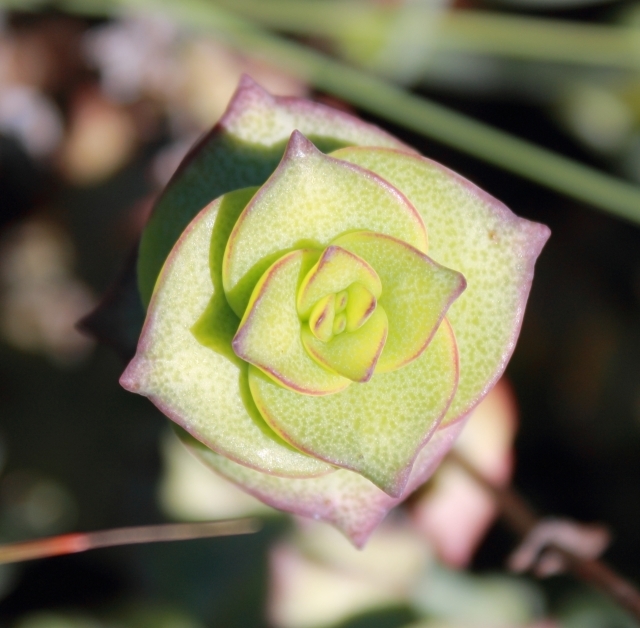


© photo
(c) Marion Maclean, some rights reserved (CC BY-NC), uploaded by Marion Maclean · cc-by-nc
Wikimedia Commons · CC BY-SA or Public Domain
Wikipedia · CC BY-SA
(c) Tony Rebelo, some rights reserved (CC BY-SA) · cc-by-sa
(c) Brian du Preez, some rights reserved (CC BY-SA) · cc-by-sa

Global distribution
Native from the southern Cape region to KwaZulu-Natal in South Africa.
Identity
String of buttons (Crassula perforata Thunb., 1778) stacks triangular leaves around its stems. Its French horticultural name, collier de boutons, evokes the appearance of threaded beads; the botanical name remains the reference for identifying the plant. The species is a succulent subshrub in the Crassulaceae family. A descriptive common name captures its appearance without replacing its botanical identity. 6 1 2
The leaves grow in opposite pairs joined around the stem, with successive pairs facing different directions. The stem consequently appears to pass through the foliage. The Latin perforata refers to this pierced appearance, rather than holes in a leaf blade like those of a monstera. Examine how each pair meets around the stem to see the feature behind the name. 6 4
Recognition
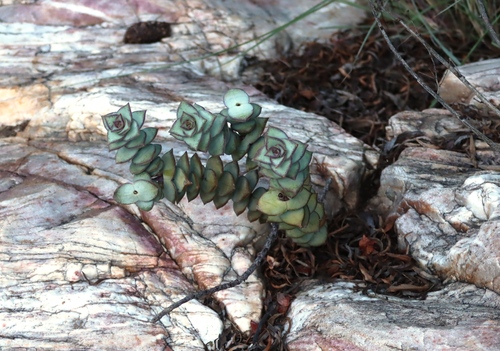
String of buttons has fleshy gray-green leaves, sometimes edged in pink or red. Its stems begin upright, then become prostrate and can trail as they age. The changing habit does not change the plant's identity. A hanging container accommodates the lengthening stems rather than artificially holding every branch upright, so an older plant can look different from a young, erect specimen. 4
French horticultural descriptions give a cultivated size of about 40 cm (16 in) tall and wide. Pot size and the way the branches hang affect the visible space occupied by the plant. A prostrate stem is not measured in the same way as an upright clump: branch length and height above the container are separate observations. The stated dimensions therefore need to be read alongside the plant's habit. 5
Useful taxonomy
Kew accepts the name Crassula perforata. The name was published in 1778, under the authority of Thunberg, abbreviated Thunb. Membership in the Crassulaceae places it alongside other succulents, but does not establish that every species in the family has the same hardiness or safety. 1 2
The name 'Pagoda' appears in horticultural nomenclature associated with the species. Descriptive labels of this kind coexist with the scientific binomial and do not necessarily identify a separate species. Checking the full name helps avoid treating all crassulas with stacked leaves as one plant simply because their sales labels sound similar. 3
Habitat and range
String of buttons is native to South Africa, from the southern Cape region to KwaZulu-Natal. Its listed biome is subtropical. A plant sold in France therefore belongs to an African species, even if its grower has cultivated it for a long time elsewhere. A place of sale or production should remain distinct from the species' native range. 1
In the wild, the plant grows in rock crevices and around boulders. French descriptions also mention sunny slopes and dry scrub. The fleshy leaves store water, which helps string of buttons withstand dry periods. Water stored in the leaves does not remove the roots' need for an airy growing mix; drought tolerance and suitable drainage describe different aspects of cultivation. 4 5
Life cycle and reproduction
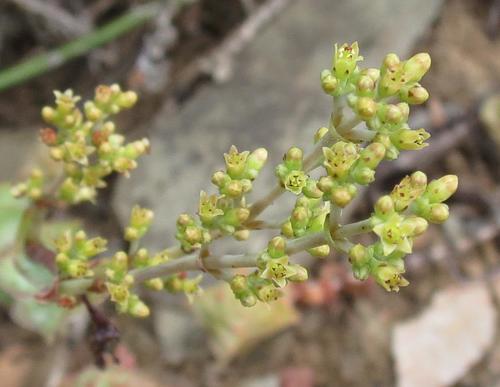
String of buttons is an evergreen perennial. British horticultural documentation describes small pale yellow flowers in spring. French commercial descriptions also report cream to pinkish flowers and flowering extending toward summer. The observed color and flowering period therefore need to be interpreted for the particular cultivated plant, rather than forced into a single account that hides the difference between descriptions. 3 5
Propagation is possible from seeds, offsets or cuttings, particularly in spring. Horticultural advice mentions stem, leaf and root cuttings. The ability to propagate from a leaf does not require dismantling a healthy plant: a stem section available when renewing the plant can also provide propagation material. The choice of material can follow what is already available during cultivation. 3
Repot preferably in early spring when the plant has outgrown its container. Fertilizer for succulents accompanies spring and summer growth. Reduce watering during winter, while allowing the actual drying of the mix to guide the schedule rather than imposing a weekly interval. Seasonal advice describes a growing cycle, not a requirement to water compost that is still wet. 5
Uses and risks
String of buttons suits pots and hanging containers. Cultivation requires a free-draining mix: water, then wait for the compost to dry before watering again. Excess water exposes the roots to rot. In hot climates, protecting the foliage from midday sun limits scorching. Drainage and protection from intense heat remain relevant even though the plant stores water in its leaves. 4
Toxicity after ingestion is reported for humans, cats, dogs and horses. The sap can also irritate skin. Some commercial pages nevertheless describe the plant as non-toxic. Given that disagreement, retain the precaution and keep string of buttons out of reach of children and animals. A commercial claim of safety does not erase the reported ingestion and skin-contact risks. 4 5 6
Varieties, look-alikes and related plants
The names 'Variegata', 'Ivory Towers' and 'Giant Form' appear among the horticultural forms listed for string of buttons. Inclusion in a list does not demonstrate rarity or a stable size. A selection's coloring should be described for that selection, without changing the general description of the species or applying a sales name's implied size to every plant. 4
Crassula perforata subsp. perforata and subsp. kougaensis belong to another taxonomic level: they are presented as subspecies, rather than cultivars. To identify string of buttons, first examine the opposite leaves and their attachment around the stem, then read the complete label. The leaf arrangement and the full name provide complementary identification checks. 4 6
Main sources
Frequently asked questions
Why do the leaves look pierced?
The opposite leaves are joined in pairs around the stem, creating the appearance of threaded buttons.
Can string of buttons trail?
Yes. Initially upright stems become prostrate or trailing with age.
Is string of buttons toxic?
NC State reports toxicity after ingestion in humans, cats, dogs and horses, as well as irritating sap. Keep the plant out of reach.
If you are unsure about a plant’s toxicity, ask a botanist or veterinarian for advice.