
Midland hawthorn (Crataegus laevigata, )
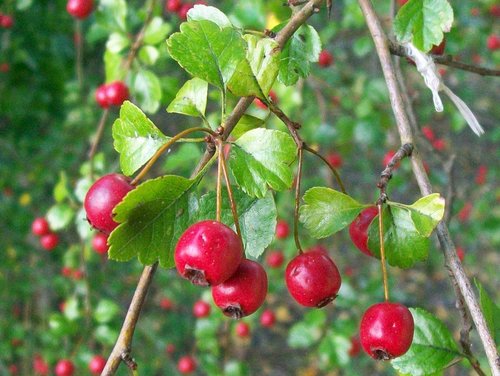
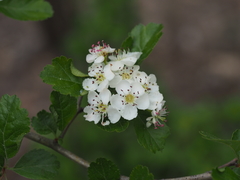
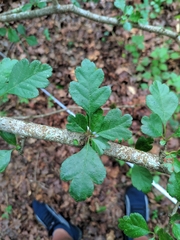
Midland hawthorn (Crataegus laevigata) is a thorny, deciduous European shrub in the Rosaceae. Shallowly lobed leaves and flowers with two, sometimes three styles distinguish it from common hawthorn, with which it hybridizes.
Read moreMidland hawthorn and Smooth hawthorn
Mespilus laevigata and Crataegus oxyacanthoides
Give plenty of ambient light without direct sun on the leaves.
Sun or partial shade.


© photo
(c) anemoneprojectors, some rights reserved (CC BY-SA) · cc-by-sa
iNaturalist User · cc0
Denys Vynokurov · cc-by
Taken Apr 26, 2022 by Alberti Naike (cc-by-sa)
Taken Oct 6, 2022 by Sylvie plattey (cc-by-sa)
Taken Apr 18, 2022 by huy HO (cc-by-sa)
Taken May 12, 2021 by ByteCruncher (cc-by-sa)
Taken May 22, 2021 by Sylvain Piry (cc-by-sa)
© copyright of the Board of Trustees of the Royal Botanic Gardens, Kew.




Global distribution
Native to Europe; introduced or planted in some regions.
Identity
Midland hawthorn (Crataegus laevigata (Poir.) DC., 1825), also called smooth hawthorn, is a deciduous European shrub in Rosaceae. A particularly useful floral character is the presence of two styles, sometimes three. Counting these small structures in a flower's center gives more information than thorns alone. 13109
It grows as a branched shrub or small tree, seldom exceeding 4–6 m (13–20 ft) in the wild, but reaching 4–8 m (13–26 ft) in cultivation. White, less often pink flowers precede red fruit. Leaves fall in autumn: a hawthorn hedge retains its branch framework through winter but does not provide a permanent screen of foliage. 13486
Recognition
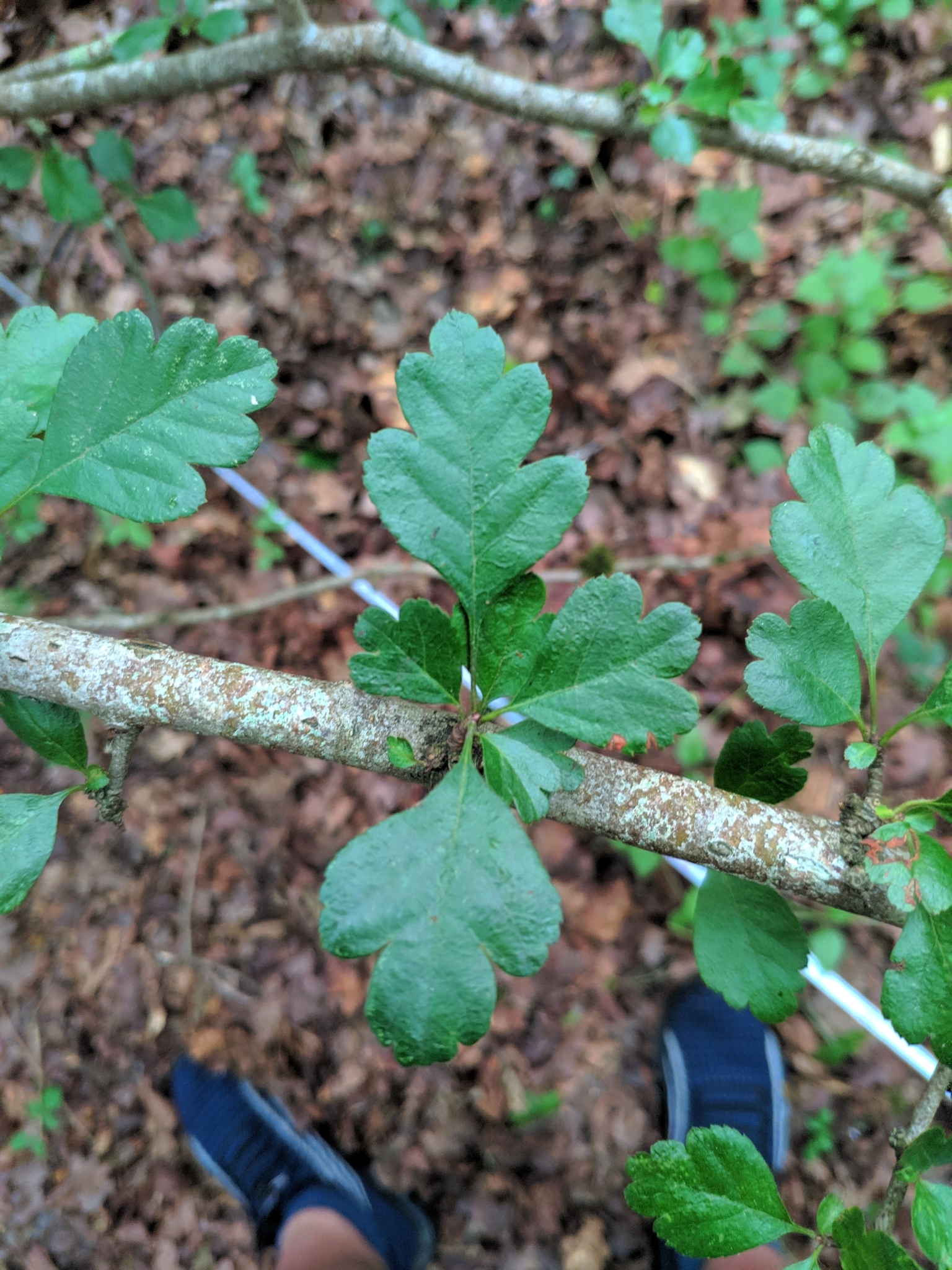
Leaves are shallowly lobed. On short shoots, divisions reach about a third of the blade; rounded lobes point forward. Upper surfaces are glossy dark green. Inspect leaves on a flowering branch rather than basing identification on a vigorous shoot whose foliage may differ. A whole leaf shows the depth and direction of the divisions more clearly than a small fragment. 43
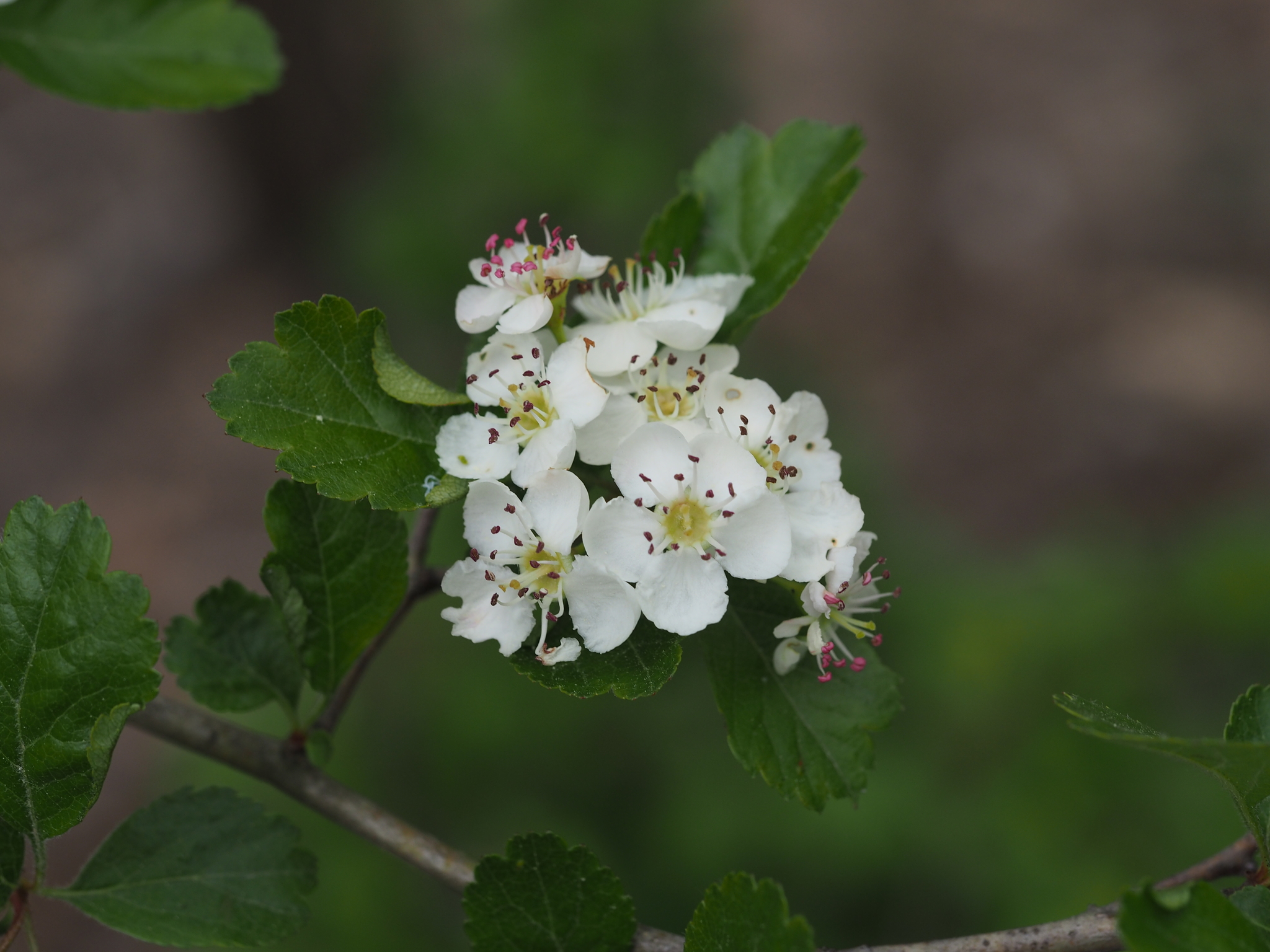
White flowers have purple anthers and two, occasionally three styles. Fruits usually contain several stones. Photograph a flower's center and a complete leaf, returning at fruiting if necessary. Style and stone counts are verifiable characters; a general photograph of white blossom often leaves identification open between several related hawthorns. 38
Useful taxonomy
Augustin-Pyramus de Candolle published the accepted combination Crataegus laevigata in 1825, volume two of the Prodromus, page 630. The original name was Mespilus laevigata Poir., published in 1798. Parentheses around Poir. record the transfer between genera. 2
Crataegus oxyacantha was long applied confusingly to several hawthorns. Interpret an old record through its description rather than mechanically substituting a name in a list. Hybridization creates a real difficulty: Midland hawthorn crosses with common hawthorn to produce Crataegus × media. Intermediate characters do not necessarily reflect a mistaken observation. 18
Habitat and range
Native to Europe, its natural range includes France and much of western and central Europe. European origin does not mean every stand is spontaneous: hawthorns have also been planted in hedges and gardens, sometimes away from natural populations. Local planting history therefore matters when interpreting an isolated tree or an old boundary hedge. 1
Hedges, scrub and deciduous woodland edges are familiar sites. Partial shade is tolerated, so it can occur with woodland vegetation rather than only in sunny hedges. Moist, well-drained garden soil is suitable; avoid permanent waterlogging. An old hedge does not, by itself, establish that a particular shrub arrived naturally. 4398
Life cycle and reproduction
In the European conditions described, flowering occurs in April and May. Insects pollinate the flowers, and red fruit ripens in early fall. Comparing Midland and common hawthorn across several visits is more informative than using a single date: exposure and the course of spring also alter timing. 398
Hawthorn fruits feed birds and may persist after leaf fall. Avoid repeatedly cutting all fruit-bearing shoots if visible fruit is wanted. Less frequent pruning also reduces maintenance and leaves more flowers the following spring. A hedge's ecological role therefore depends on management as well as the species planted. 6
Uses and risks
Midland hawthorn suits a rural hedge or a planting that allows a shrub to develop. Choose sun or partial shade, suitable soil and enough space for mature growth to avoid constant crown reduction. A tree form serves a different purpose from a clipped hedge; compare these uses before buying rather than relying on a young plant's size. 6
The ASPCA classifies hawthorns at Crataegus genus level as non-toxic to cats, dogs and horses. However, seeds contain toxins and should be removed if fruit is consumed; do not offer fruits to pets. This classification also does not remove the mechanical hazard of thorns. Identifying a hawthorn does not establish a cardiac treatment or a home medicinal preparation. 58
Varieties, look-alikes and related plants
Common hawthorn (Crataegus monogyna) normally has one style and one stone per fruit, with more deeply divided leaves. Midland hawthorn combines shallower lobes with several styles. Hybrids sometimes require a cautious identification, particularly in old planted hedges or specimens showing only intermediate features. 83
Slow-growing 'Gireoudii' stays around 4 m (13 ft) and can serve as a large border shrub. 'Paul's Scarlet', with double scarlet flowers, belongs to the hybrid Crataegus × media, rather than the pure species. It derives from crossing Midland and common hawthorn. Double-flowered ornamentals should therefore not be used as the model for identifying simple flowers on wild hawthorns. 671
Main sources
Midland hawthorn is native in France, recognized by flowers with two or three styles and shallowly lobed leaves. 13
Frequently asked questions
How does Midland hawthorn differ from common hawthorn?
Look for two or three flower styles and several stones in the fruit, together with shallowly lobed leaves.
Does the hedge keep its leaves in winter?
No. Midland hawthorn is deciduous and loses its leaves in fall.
Is Paul's Scarlet a cultivar of the pure species?
No. This double scarlet-flowered selection belongs to Crataegus × media, the hybrid between Midland and common hawthorn.
If you are unsure about a plant’s toxicity, ask a botanist or veterinarian for advice.