
String of pearls (Curio rowleyanus, )

String of pearls (Curio rowleyanus) carries almost spherical leaves on thin, creeping or trailing stems. This evergreen succulent in the Asteraceae comes from the Cape Provinces of South Africa. Its leaves store water, but swallowing them poses a risk to people and pets.
Read moreString of pearls
Senecio rowleyanus H.Jacobsen, Kleinia rowleyana (H.Jacobsen) G.Kunkel and Curio rowleyanus f. marmoratus P.V.Heath
Give plenty of ambient light without direct sun on the leaves.
Bright indirect light; protect from scorching midday sun in summer.


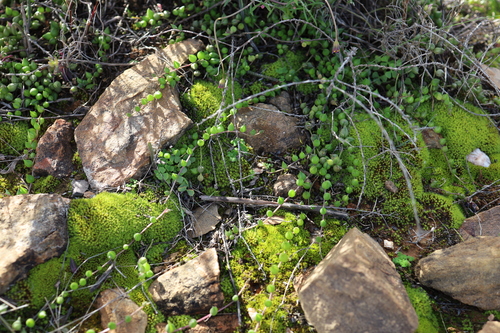
© photo
(c) Tony Rebelo, some rights reserved (CC BY-SA), uploaded by Tony Rebelo · cc-by-sa
Wikimedia Commons · CC BY-SA or Public Domain
Wikipedia · CC BY-SA
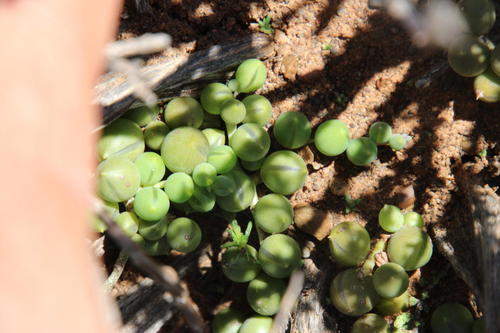
(c) Luc Strydom, some rights reserved (CC BY) · cc-by
Global distribution
Accepted native range: the Cape Provinces of South Africa, according to POWO. Horticultural references to southwestern Africa and Namibia differ in scope.
- Native1
- South Africa, Cape Provinces
Hexagons: regions where the plant occurs. Green dots: native range.2
Identity
String of pearls (Curio rowleyanus (H.Jacobsen) P.V.Heath, 1999) carries almost spherical leaves on thin, creeping or trailing stems. This evergreen succulent perennial belongs to the Asteraceae. The “pearls” are leaves that store water, and swallowing them poses a risk to people and pets. 1 2 3
In a hanging container, string of pearls lets its stems fall over the rim. In the wild, the same stems run along the ground and root where they touch the soil. The trailing habit seen in a pot therefore develops from the plant's creeping growth. 5
Recognition
Each string of pearls leaf has an almost spherical shape, a small pointed tip and a dark, translucent band along one side. The leaves alternate along flexible green stems. The translucent band is an epidermal window that admits light into the leaf's interior. 3
The rounded shape limits the surface exposed to dry air and reduces water loss through evaporation. Compared with a flat leaf, the sphere has less surface available to intercept light; the window partly compensates for that smaller light-catching area. 5
The low-growing clump reaches up to 10 cm (about 4 in) in height in the horticultural description, while trailing stems can reach 90 cm (about 3 ft) in length. Clump height and hanging stem length describe different dimensions. Confusing the two gives a misleading impression of the plant's size. 4 6
Useful taxonomy
The accepted name is Curio rowleyanus, a combination published in 1999. The name Senecio rowleyanus H.Jacobsen, published in 1968, remains in use in horticultural trade and literature. Kleinia rowleyana (H.Jacobsen) G.Kunkel, published in 1988, is another synonym. In POWO's treatment, the combinations under Senecio and Kleinia refer to the same taxon as Curio rowleyanus. 2 5
The name Curio rowleyanus f. marmoratus P.V.Heath is also treated as a botanical synonym. Its rank as a form does not establish that it is the horticultural cultivar “Variegatus.” The epithet rowleyanus honors Gordon Douglas Rowley, a British botanist who specialized in succulents and cacti. 2 3
Habitat and range
The accepted native range of string of pearls covers the Cape Provinces of South Africa, within the subtropical biome. One horticultural description instead mentions southwestern Africa and Namibia. The geographical scopes given for string of pearls differ; combining them would imply a certainty that the sources do not establish. 2 4
In dry habitats, string of pearls grows beneath shrubs or between rocks that soften intense sunlight. String of pearls has a shallow root system. Its stems can root on contact with the ground and form dense mats, allowing the plant to spread horizontally without upright support. 5
In cultivation, a shallow pot with drainage suits this limited root system. A large volume of potting mix can stay wet too long and increase the risk of rot. String of pearls needs bright light with protection from scorching sun; outdoor cultivation requires protection from frost. 5 8
For string of pearls, the RHS species page recommends 21–27 °C (69.8–80.6 °F) in summer and 13–16 °C (55.4–60.8 °F) in winter, with reduced watering in winter. The summer and winter temperature ranges for string of pearls are separate seasonal recommendations for the conditions described by that horticultural source. 4
Life cycle and reproduction
String of pearls produces fragrant white to cream flower heads in summer, with a scent reminiscent of cinnamon. String of pearls rarely flowers indoors. After flowering, the seeds carry a white tuft of hairs that helps the wind disperse them. 4 3
Stem cuttings with nodes use the stems' ability to form roots. Layering keeps a stem against the potting mix until it roots, after which the rooted section is separated from the parent plant. Propagation can also replace older plants that have become bare. 3 6
The calendar translates horticultural trends for indoor cultivation in mainland France, in the Northern Hemisphere. Its scores are relative editorial indices, rather than measurements of water volume or growth rate. The model distinguishes active growth from winter rest; actual light levels and drying conditions remain decisive. 5 6
For repotting string of pearls, the RHS species page links to its indoor succulent guide, which favors spring if the plant has outgrown its pot or the roots have filled it. The calendar uses March–May, following the meteorological definition of spring in France, as a conditional window rather than an instruction to repot annually. Very waterlogged potting mix at purchase can justify immediate repotting outside that window. 4 9 11 6
The British guide to trailing Curio suggests a general liquid fertilizer at half strength, once a month or less during growth, from April to September in its UK setting. String of pearls is explicitly included in the guide. The British recommendation does not establish a universal monthly feeding requirement; its dates describe the local growing season. 6
Uses and risks
String of pearls is grown as an ornamental houseplant or hanging plant. Watering must account for the potting mix: the growing guide recommends letting it dry between waterings and emptying water from the outer pot. Another species profile advises against complete drying, so the sources do not fully agree on that point. 6 3
Swallowing the leaves can cause vomiting or diarrhea; the sap can irritate skin or cause a rash. Toxicity is reported for people and pets, with cats and dogs specifically mentioned. The warning concerning horses gives neither a dose nor a severity. Keeping the plant out of children's reach and wearing gloves when handling it reduces the exposure described. 3 4
Varieties, look-alikes and related plants
String of pearls “Variegatus” is described as having green and cream leaves, but its horticultural name record remains unresolved. The documentation does not establish stable variegation or any particular rarity. 6 7
The striped, egg-shaped leaves of Curio herreanus distinguish that species from the spherical leaves of string of pearls. The spelling herreanus follows POWO; the horticultural guide uses herreianus. Curio radicans has long, curved leaves. English common names can overlap, so leaf shape helps identify a plant beyond its label. Some variegated forms assigned to string of pearls may belong to C. herreanus; variegation alone therefore cannot settle the identity. 6 5 10
Main sources
The botanical references establish the identity and the documented French common name of string of pearls; the horticultural profiles describe its form, cultivation and exposure risks.
- EPPO Global Database, Curio rowleyanus
- Plants of the World Online, Kew, Curio rowleyanus
- NC State Extension, Curio rowleyanus
- Royal Horticultural Society, Curio rowleyanus
- University of Wisconsin Extension, String of Pearls, Curio rowleyanus
- Royal Horticultural Society, How to grow string of beads
- Royal Horticultural Society, Curio rowleyanus ‘Variegatus’
- University of California ANR, Succulents, Senecio section
- Royal Horticultural Society, How to grow houseplant cacti and succulents
- Plants of the World Online, Kew, Curio herreanus
- Météo-France, Spring, meteorological definition of the season
Frequently asked questions
Are the pearls on string of pearls seeds?
The green pearls are succulent leaves that store water. Seeds develop after flowering and carry a white tuft of hairs.
Is Senecio rowleyanus a different species?
Senecio rowleyanus is a botanical synonym of the accepted name Curio rowleyanus. The change of genus does not denote a new horticultural species.
Is string of pearls toxic to cats and dogs?
NC State reports toxicity to people and pets, including cats and dogs. Ingestion can cause digestive upset; the sap can irritate skin.
Why does string of pearls rot in a large pot?
Excess potting mix can remain wet too long around the limited root system. A shallow container with drainage reduces that risk; water must not stand in the outer pot.
How do you propagate string of pearls?
Stem cuttings with nodes root in suitable potting mix. Layering means keeping a stem in contact with the mix, then detaching it after it roots.
If you are unsure about a plant’s toxicity, ask a botanist or veterinarian for advice.