
Hare's Foot Fern (Davallia solida, )


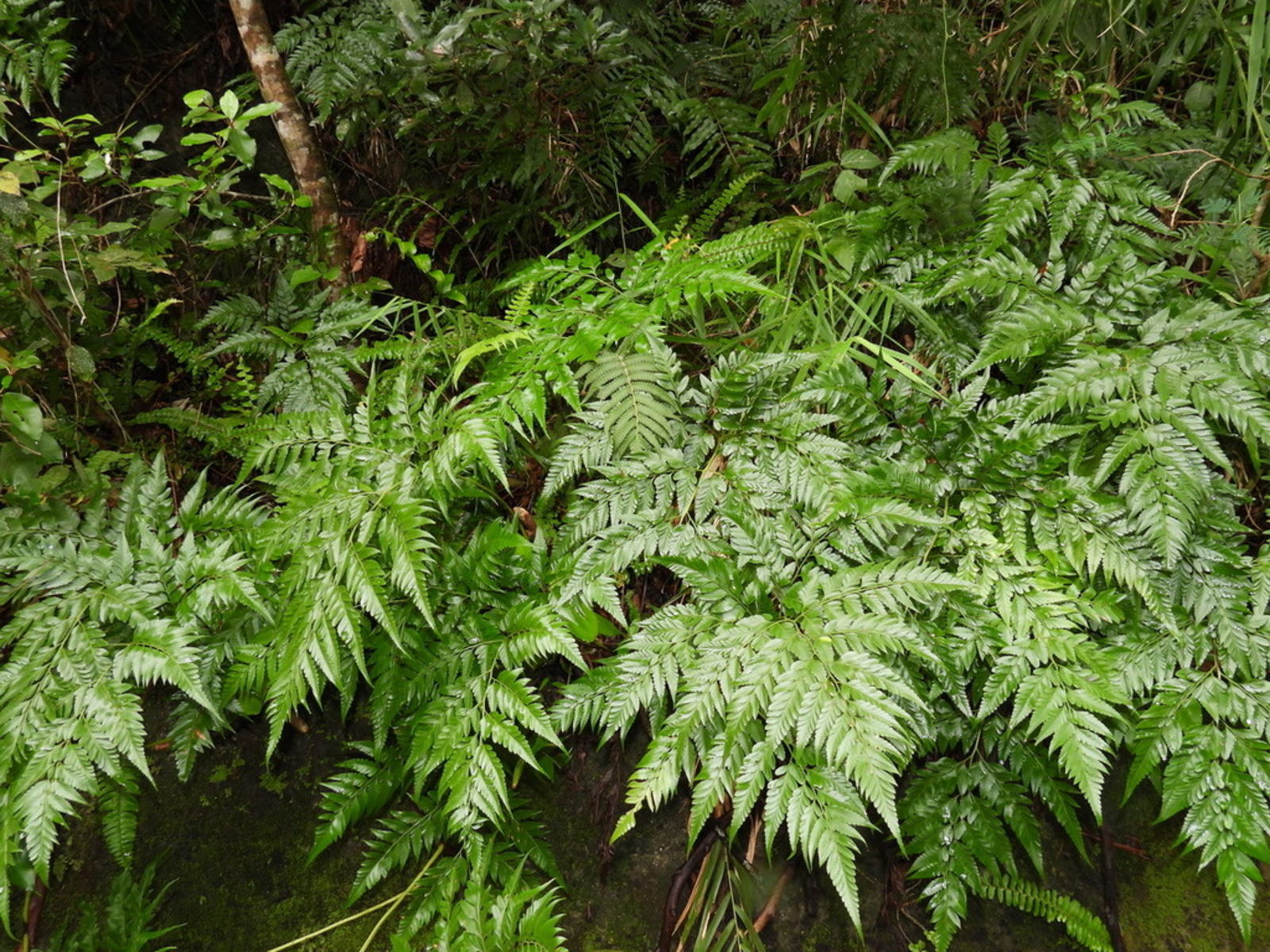
Hare's Foot Fern (Davallia solida) develops creeping, scale-covered rhizomes and triangular fronds. This tropical fern grows on trunks or rocks and is cultivated, among other ways, in hanging baskets.
Read moreHare's Foot Fern
Trichomanes solidum, Humata solida and Stenolobus solidus
Give plenty of ambient light without direct sun on the leaves.
Bright indirect light, following horticultural guidance for epiphytic ferns.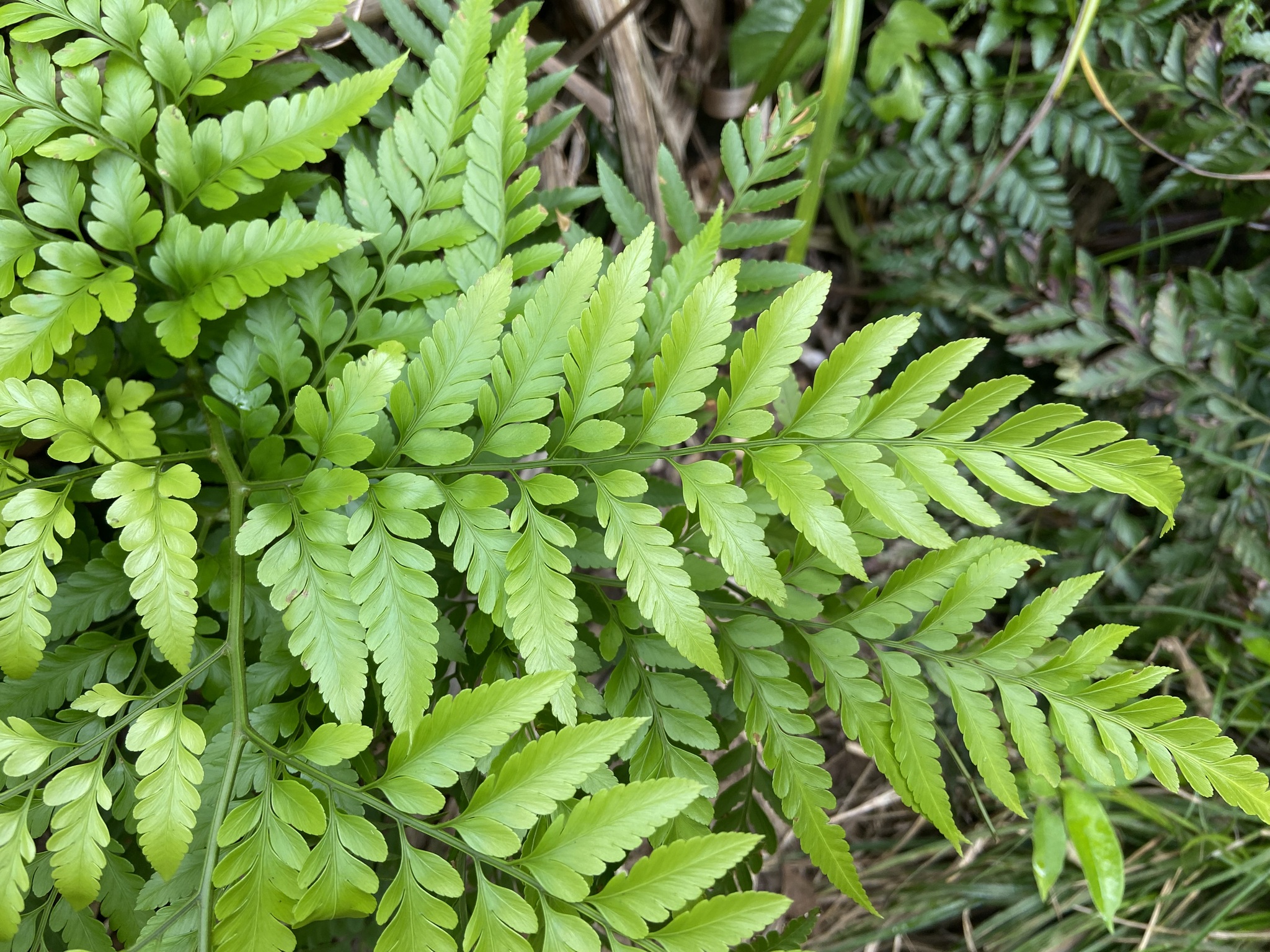



© photo
(c) Gordon Chen, some rights reserved (CC BY-NC), uploaded by Gordon Chen · cc-by-nc
Wikimedia Commons · CC BY-SA or Public Domain
© copyright of the Board of Trustees of the Royal Botanic Gardens, Kew.


Global distribution
Tropical and subtropical Asia to the Pacific, including native occurrence in Queensland according to Kew.
- Native4
- Thailand
- Malaysia
- Queensland
- New Caledonia
Hexagons: regions where the plant occurs. Green dots: native range.1
Identity
Hare's Foot Fern (Davallia solida (G.Forst.) Sw., 1801) spreads scaly rhizomes against its support. Divided fronds rise above this creeping stem. The French names “fougère pied d’écureuil” and “fougère patte de lapin” are both attested for the species in a glossary published by France's Ministry of Culture. 3 6 1
The accepted name is Davallia solida. Kew currently places this perennial fern in the Polypodiaceae, while GBIF and the regional floras consulted retain the Davalliaceae. This difference in family classification does not change the binomial used to identify the species. 1 11
Recognition
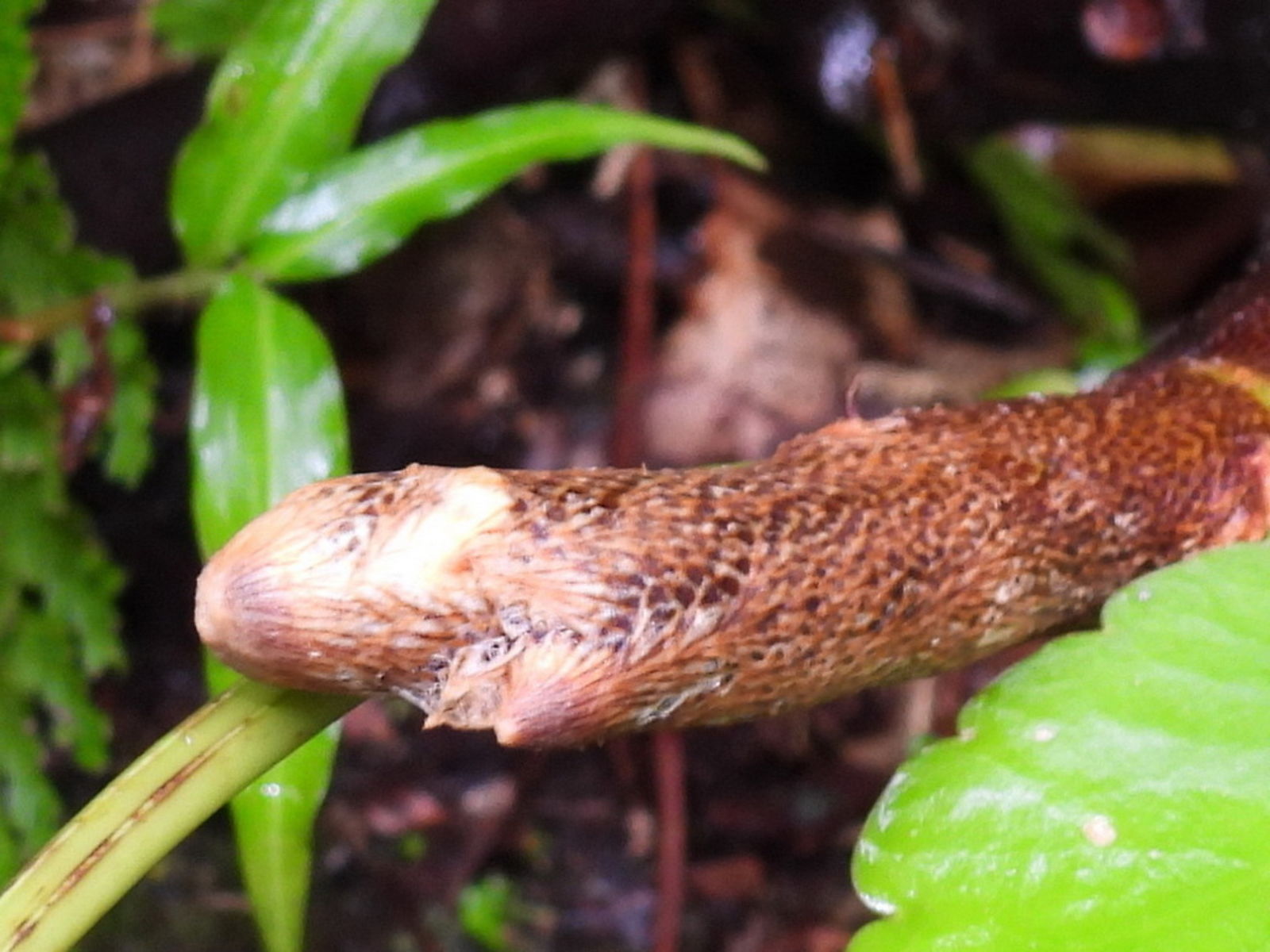
The long-creeping rhizome provides an initial identifying feature. The Southeast Asian flora describes a diameter of 6 to 12 mm (0.24 to 0.47 in) and scales whose pale brown, hairy upper portions eventually fall away. Dark brown to nearly black bases remain on older sections. An old rhizome can therefore have a different covering from a young tip. 2
In tropical Australia, the described fronds measure 50 to 70 cm (19.7 to 27.6 in) long. They bear marginal sori protected by narrow indusia attached laterally to the blade. The Asian flora describes a triangular blade divided three times; sterile fronds are less divided than fertile ones. Light and humidity also alter frond size and division: a single detail of outline is insufficient when comparing two specimens. 3 2
Taxonomy and similar plants
The basionym Trichomanes solidum, published in 1786, precedes the current combination published in 1801. The names Humata solida (G.Forst.) Desv. and Stenolobus solidus (G.Forst.) C.Presl also belong to the species' synonymy at Kew. The synonymy of Davallia solida allows descriptions published under these other genera to be found. 1
The horticultural label Davallia solida var. fejeensis covers a different taxonomic scope. The RHS still uses it, but Kew assigns the name to the distinct species Davallia fejeensis. Its horticultural features therefore do not automatically describe D. solida. There is another complication: NSW Flora Online includes occurrences under var. pyxidata, whereas the tropical Australian flora distinguishes D. pyxidata from D. solida. Comparing the taxonomic scopes applied to Davallia solida avoids artificially combining dimensions and ranges of distinct plants. 10 9 4 3
Habitat and distribution
The native range of Hare's Foot Fern extends from tropical and subtropical Asia to the Pacific. Kew includes Thailand, Malaysia, Queensland and New Caledonia. MyBIS documents its presence in several Malaysian states, including Johore and Pahang. 1 5
In the Southeast Asian flora, Davallia solida grows on trunks or rocks in partly shaded positions and in some dense evergreen forests. Regional observations concern elevations below 300 m (984.3 ft). This limit describes sites in that flora, without setting a worldwide ceiling for the species. The Australian flora also records terrestrial specimens in rainforest. 2 3
Cultivation and seasonal rhythm
Growing in hanging baskets suits the creeping habit of Davallia solida and is explicitly suggested by the Australian flora. For indoor cultivation, RHS guidance on epiphytic ferns provides a framework: bright indirect light, humid air and an airy growing medium that drains excess water. The RHS advice concerns epiphytic ferns as a group. 3 7
Water when the growing medium starts to dry, then avoid leaving the pot standing in water. Humid air and waterlogged potting mix are different conditions: the roots of epiphytic ferns can rot with excessive watering. A brown frond therefore calls for checking the mix before adding more water. 7
The RHS recommends repotting in spring, when roots crowd the container, into a pot only slightly larger. Surface rhizomes remain exposed. A dilute orchid fertilizer can accompany growth from April to October. The calendar for indoor cultivation in France translates this advice into relative seasonal guidance; watering amounts and intervals depend on actual drying. 7
Reproduction and maintenance
The sori of Davallia solida occur at the ends of small veins, along the margins of leaf segments. The Asian flora describes a cup-shaped covering around these reproductive structures. Their arrangement is an identifying feature to examine on a fertile frond. 2
To propagate Davallia with creeping rhizomes, the RHS recommends division. Each section must retain roots and fronds. Propagation from spores remains another possibility in ferns, but requires more skill. Routine maintenance of epiphytic ferns consists of removing dead or browned fronds; no formative pruning is needed. 7
Uses and precautions
Hare's Foot Fern is cultivated as an ornamental plant. The Australian flora notes that it can become invasive in a humid greenhouse: this observation remains tied to that growing environment. It does not establish a French regulatory status. 3
The ASPCA lists Davallia spp. as non-toxic to cats and dogs. This indication concerns the genus collectively, without a species-specific study of D. solida presented on the page. Available data do not establish a conclusion for humans, children, horses or all animals. A veterinary classification of non-toxicity does not demonstrate suitability for human consumption. 8
Main sources
The botanical references clarify identity and identifying features; the RHS guide provides growing advice for epiphytic ferns as a group.
- Kew, Plants of the World Online: Davallia solida
- Royal Botanic Garden Edinburgh, Ferns of Thailand, Laos and Cambodia: Davallia solida
- Australian Tropical Herbarium, Australian Tropical Ferns and Lycophytes: Davallia solida
- Royal Botanic Gardens Sydney, NSW Flora Online: Davallia solida
- Malaysia Biodiversity Centre, MyBIS: Davallia solida
- Ministère de la Culture, Rendez-vous aux jardins 2019, Aude program: glossary of plants and animals
- Royal Horticultural Society: How to grow epiphytic ferns
- ASPCA Poison Control: Rabbits Foot Fern, Davallia spp.
- Kew, Plants of the World Online: Davallia fejeensis
- Royal Horticultural Society: Davallia solida var. fejeensis
- GBIF Backbone Taxonomy: Davallia solida
Frequently asked questions
Should I bury the rhizomes of Hare's Foot Fern?
The creeping rhizomes remain at the surface. The RHS advises against burying the surface rhizomes of epiphytic ferns when repotting.
Are Davallia solida and Davallia fejeensis the same taxon?
Kew accepts two distinct species. The name Davallia solida var. fejeensis, still used in horticulture, is assigned to Davallia fejeensis in that reference.
Is Hare's Foot Fern toxic to cats?
The ASPCA lists Davallia spp. as non-toxic to cats and dogs. This collective indication is not a species-specific study of Davallia solida and establishes no safety as human food.
If you are unsure about a plant’s toxicity, ask a botanist or veterinarian for advice.