
Male fern (Dryopteris filix-mas, )
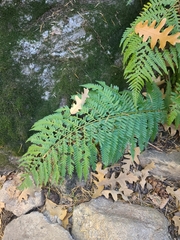
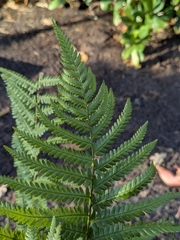
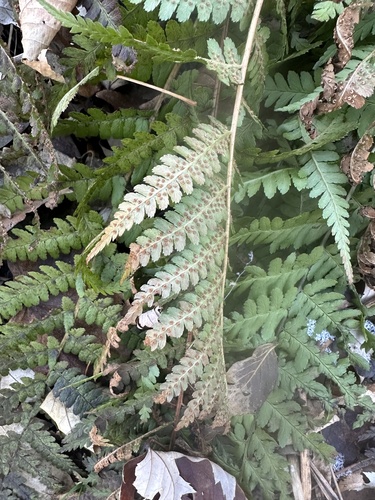
Male fern forms a crown of large, divided fronds in moist woodland. Clusters of sporangia beneath the leaves help identify it; historical use against worms must not obscure its toxicity.
Read moreMale fern
Polypodium filix-mas, Aspidium filix-mas, Polystichum filix-mas and Thelypteris filix-mas
Place in indirect light or in a shaded room.
Shade to partial shade; sun only with sufficient moisture.
© photo
(c) Alexander Baransky, some rights reserved (CC BY-NC), uploaded by Alexander Baransky · cc-by-nc
Daniel · cc0
Jan Philip Göpfert · cc0
(c) Ben Redding, some rights reserved (CC BY-NC) · cc-by-nc
(c) Анна Рыбакова, some rights reserved (CC BY) · cc-by
Global distribution
Native to temperate Northern Hemisphere regions in Europe, Asia, North America and North Africa.
Identity
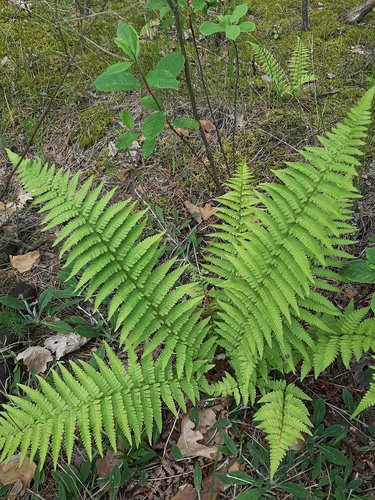
Male fern (Dryopteris filix-mas (L.) Schott, 1834) forms a funnel-shaped crown of fronds around a rootstock. This perennial is native to temperate Northern Hemisphere regions. Mature fronds can reach 1.2 m (4 ft), so allow room before planting it among small perennials. 1 4
Its standardized French names are fougère mâle and dryoptéride fougère-mâle. In mainland France it is present, classified as Least Concern on the national Red List, and unprotected. 10 11
“Male” derives from an old comparison of vigor with lady fern. These names designate different species, not sexes of one species. Lady fern belongs to Athyrium, while male fern belongs to Dryopteris. 5
Recognition
Rounded sori beneath fronds are reproductive structures. They group the sporangia and, when young, are protected by a kidney-shaped membrane called an indusium. Their regular arrangement near veins aids identification; aligned brown spots need not indicate pests. 3
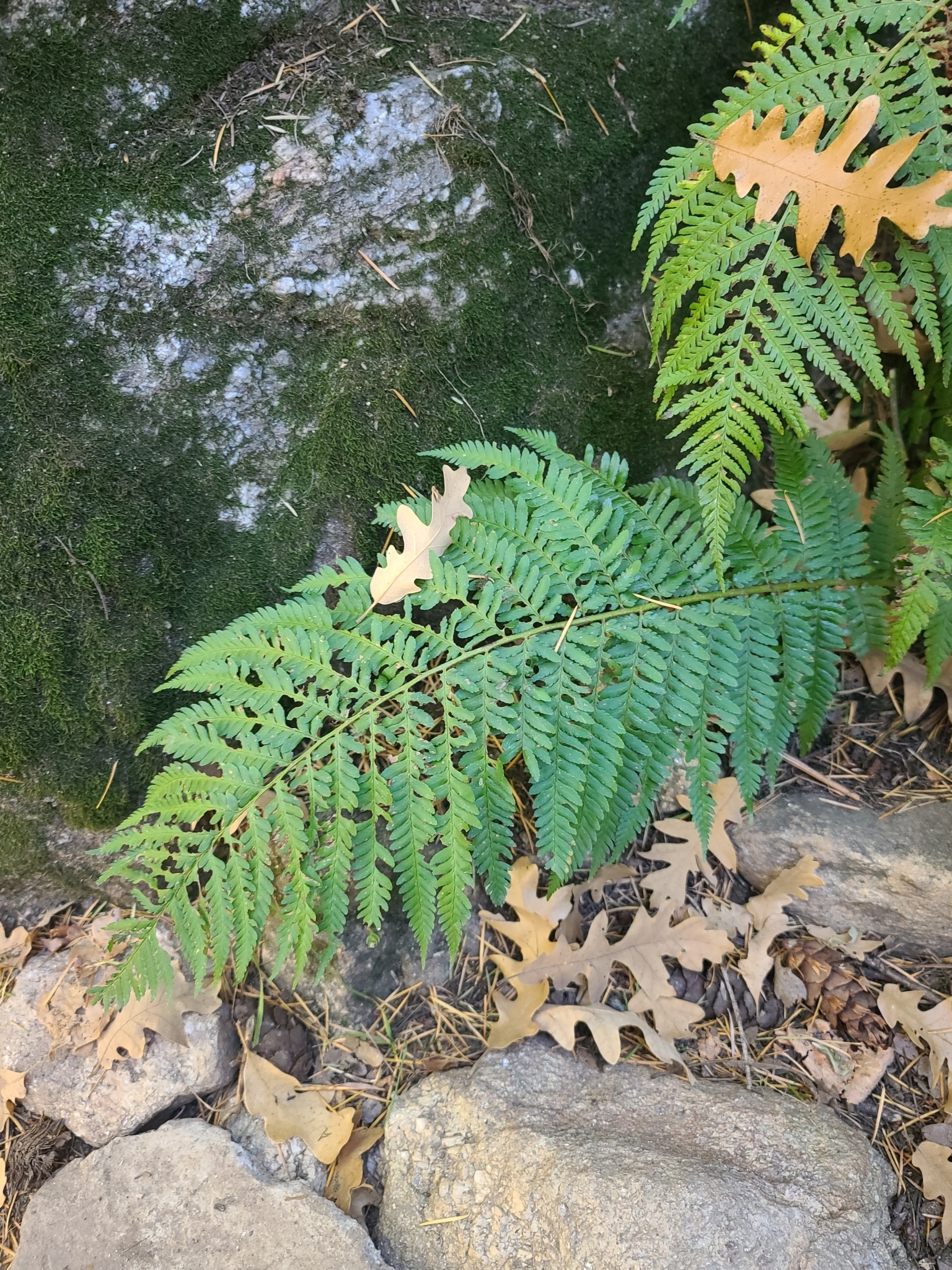
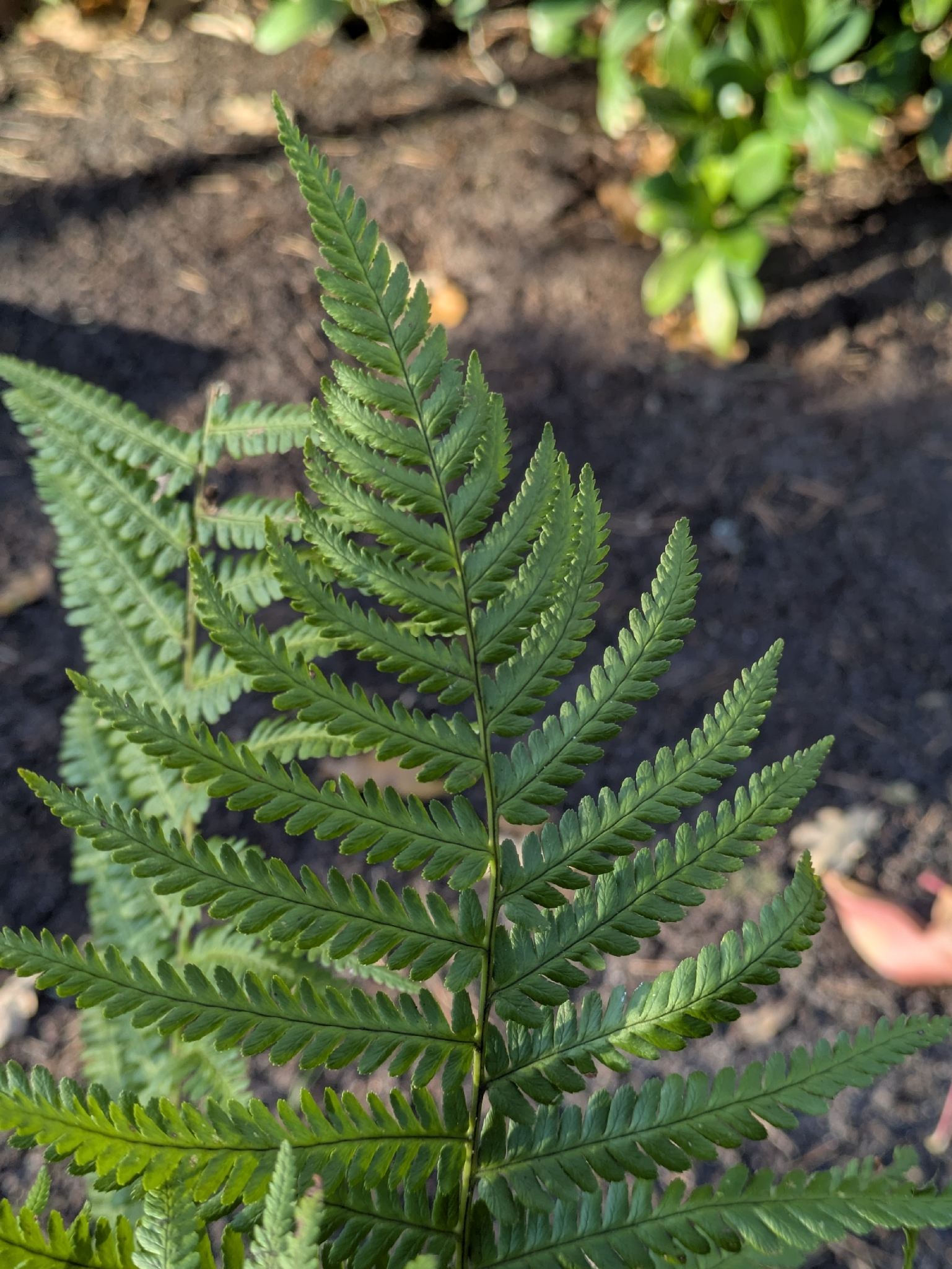
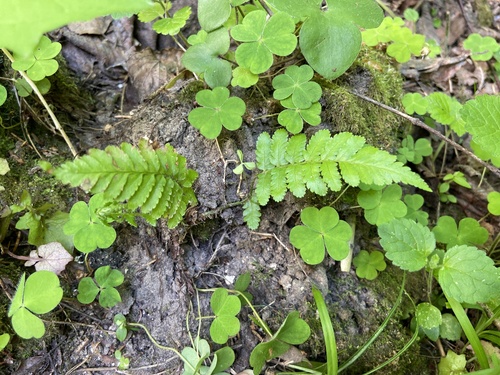
Lance-shaped fronds are divided into pinnae that are themselves deeply cut. Segments are toothed with rounded tips. Pale brown scales chiefly cover the stalk base. Photograph a whole frond, its base and underside: one still-coiled fiddlehead provides too few characters. 3
Garden plants generally lose their fronds in winter, although some can remain green for part of a mild winter. Descriptions as semi-evergreen express this variation rather than guaranteeing foliage retention in every climate. 4 6 5
Useful taxonomy
Schott published the current name in 1834. The basionym is Polypodium filix-mas L., published by Linnaeus in 1753. Parentheses around “L.” indicate the transfer of genus; “Schott” identifies the author of the current combination. 2
Aspidium filix-mas (L.) Sw., Polystichum filix-mas (L.) Roth and Thelypteris filix-mas (L.) Nieuwl. appear in old floras. Family placement varies: the current global treatment places the genus in Polypodiaceae, while others use Dryopteridaceae. Different family boundaries do not change the species described. 1 4
Habitat and distribution
Moist, shaded sites are preferred: forests and woodland, but also tall-herb vegetation and pasture from lowlands to the subalpine belt. Its native range covers much of temperate Europe and Asia and parts of North America and North Africa. Calling it exclusively European would be misleading. 3 6 1 5
Humus-rich garden soil retaining moisture suits these needs. Light or deeper shade is acceptable. Strong winds can damage fronds; shrub cover or a sheltered position reduces tearing. Shelter matters as much as the exposure printed on a label. 5
Established plants can tolerate dry shade, but that does not apply to newly planted root balls. Regular watering in the first season and mulch help roots establish. Sunnier positions require more moisture. 4
Cycle and reproduction
Male fern produces spores, never flowers or fruits. Sori form beneath fertile fronds near the pinnule midveins. In the source-region calendar, spores ripen July to September and release continues into autumn, varying with climate and leaf development. Browning sori must not be confused with drying of the whole frond. 3 5
Propagation uses spores or spring division of the rootstock. Division retains a named cultivar’s characters. Raising plants from spores requires patience and observation of early stages; sowing fern spores differs from sowing ordinary seeds. 4
Winter dormancy is followed by spring growth. Water accompanies new frond development and adjusts to rainfall. Remove dead or damaged fronds as needed without imposing a cut on healthy foliage. 4
Uses and risks
Male fern is toxic if eaten and must not become a home remedy. Its rhizome was formerly used against intestinal worms. Active substances underlying that historical use are also hazardous to people; no home recipe or dose is justified. 6 7
Thiaminase degrades vitamin B1. Acylphloroglucinols associated with filicin can cause digestive irritation and neurological problems; severe poisoning may affect breathing. It is toxic to cats and dogs, and lethal doses are described in cattle and sheep. No horse data are available, which does not establish safety. 7
Fern fiddleheads are not interchangeable in cooking. A historical food-use reference does not make male fern edible; its toxicity requires discouraging consumption. 6 7
Varieties, lookalikes, and related plants
Cristata has crested tips at frond and pinna ends, with fronds about 60 cm (24 in) long. Linearis Polydactyla instead has very narrow, widely spaced pinnae ending in several forks, creating a more open texture. 8 9
Lady fern is a distinct, generally finer-looking species. Identify male fern through its relatively rounded segments and sori protected by kidney-shaped indusia, rather than a general impression of robustness. 5 3
Main sources
Male fern (Dryopteris filix-mas (L.) Schott, 1834) is a temperate Northern Hemisphere perennial recognized by kidney-shaped indusia covering its sori. Its rhizome is toxic if eaten by people or animals. 1 3 6 7
- Kew, Plants of the World Online: Dryopteris filix-mas
- International Plant Names Index: Dryopteris filix-mas
- Info Flora: Dryopteris filix-mas
- Royal Horticultural Society: Dryopteris filix-mas
- NC State Extension: Dryopteris filix-mas
- Plants For A Future: Dryopteris filix-mas
- University of Zurich, CliniTox: Dryopteris filix-mas
- Royal Horticultural Society: Cristata
- Royal Horticultural Society: Linearis Polydactyla
- INPN, TAXREF: Dryopteris filix-mas
- Tela Botanica, eFlore: Dryopteris filix-mas
Frequently asked questions
Does male fern produce flowers?
No. It reproduces through spores produced in sporangia clustered beneath its fronds.
Is male fern edible?
Consumption is discouraged: its rhizome contains toxic substances and historical worm-treatment use was dangerous.
Can it grow in dry shade?
An established plant can tolerate it, but water regularly during the first season and mulch to limit drying.
If you are unsure about a plant’s toxicity, ask a botanist or veterinarian for advice.