
silver spoons (Echeveria runyonii, )
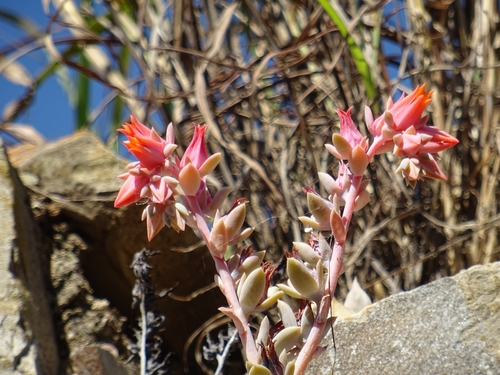

silver spoons (Echeveria runyonii) forms a rosette of fleshy, silvery-gray leaves and bears orange flowers in summer. This succulent in the Crassulaceae comes from Tamaulipas and grows in a freely draining pot, protected from frost.
Read moresilver spoons
Echeveria runyonii var. macabeana
Place in full sun, with intense direct light all day long.
Bright filtered light; summer sun after acclimatization.


© photo
(c) Benigno Gómez Garza, some rights reserved (CC BY-NC), uploaded by Benigno Gómez Garza · cc-by-nc
Wikimedia Commons · CC BY-SA or Public Domain
Wikipedia · CC BY-SA




Global distribution
Species native to Tamaulipas in northeastern Mexico.
Identity
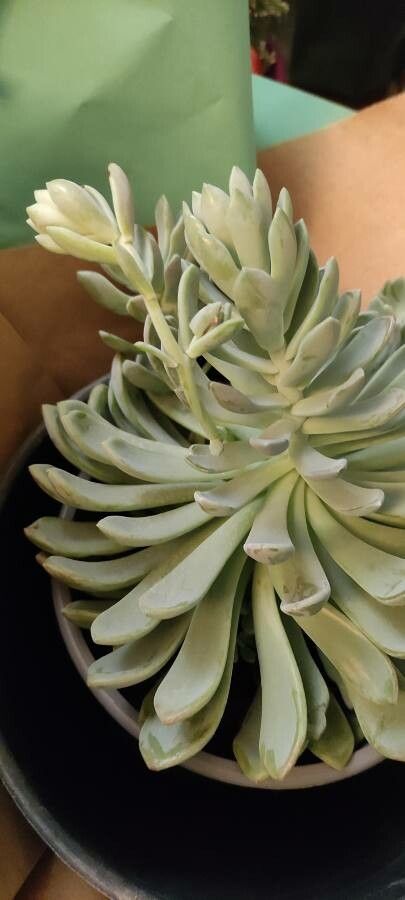
silver spoons (Echeveria runyonii) Rose, 1935 has a silvery-gray rosette of fleshy leaves and orange summer flowers. The evergreen foliage forms a stemless rosette reaching 12 cm (4.7 in) in diameter. Arching flower stems rise above the leaves. 21
This Mexican plant belongs to the Crassulaceae, in the order Saxifragales. Its botanical identity remains that of an accepted species; the name ‘Topsy Turvy’, often associated with Echeveria runyonii, denotes a particular cultivar. That cultivar's strongly recurved leaves therefore do not define every plant of the species. 13
Identification
The horticultural description of the species combines thick silvery leaves with a clump-forming habit. The stated mature size is 0.1 to 0.5 m (0.3 to 1.6 ft) in height and spread. These dimensions describe the whole cultivated plant; they do not replace the diameter given for a rosette. Horticultural maturity is estimated at 2 to 5 years, without specifying the age at first flowering. 2
When distinguishing another bluish rosette, examine the edges and flowers too: Echeveria derenbergii has triangular, blue-gray leaves edged with red and yellow flowers. Echeveria elegans has spoon-shaped, silvery-green leaves and pink flowers. These features help avoid an identification based on gray coloring alone. 5
Taxonomy and names
The name Echeveria runyonii Rose was published in 1935, in the Cactus and Succulent Journal of Los Angeles. The species belongs to the genus Echeveria, within the Crassulaceae. 1
The name Echeveria runyonii var. macabeana E.Walther is listed among its heterotypic synonyms. An old label bearing that name therefore refers here to the accepted species. This botanical variety name should not be read as a cultivar name or as evidence of hybrid origin. 1
Habitat and distribution
The documented native range of Echeveria runyonii lies in Tamaulipas, in northeastern Mexico. Its principal habitat is given as the desert or dry shrubland biome, and the plant is described as a succulent subshrub. 1
The much broader distribution sometimes given for echeverias concerns the genus: its species extend from southwestern Texas to northwestern Argentina. That extent is not the natural range of Echeveria runyonii. Likewise, growing advice for ‘Topsy Turvy’ in Singapore describes a tropical horticultural setting, rather than a newly established wild origin. 56
Life cycle and propagation
The species bears orange flowers in summer. To propagate it, sow seed at 18 °C (64.4 °F) in early spring, separate offsets in spring or take leaf cuttings in early summer. 2
General guidance for succulent cuttings calls for allowing the cut surface to dry before planting. A freely draining mix, kept only slightly moist during rooting, limits rot. An echeveria leaf can produce a new small rosette, so propagation from cuttings does not always require a piece of stem. 75
Repot in spring, if roots have filled the pot or the plant has run out of space. An excessively large container holds more moisture around the roots. For this species, apply a balanced liquid fertilizer once a month during growth. The general April-to-September window for succulents informs the Northern Hemisphere calendar; actual needs follow renewed growth and drying of the growing medium. 72
Uses and risks
Container cultivation suits a greenhouse or conservatory. Under cover, choose bright filtered light; moving the plant into direct sun for summer requires prior acclimatization. Keep it almost dry in winter. Guidance for the genus recommends remaining above 10 °C (50 °F) and never leaving the pot standing in water, since persistent moisture encourages root rot. 24
In winter, guidance for the genus calls for light watering to prevent shriveling and leaf loss. An overly warm atmosphere, combined with frequent watering, encourages weak, elongated growth. Winter rest therefore combines cool conditions with reduced watering. 4
Watch for mealybugs, aphids and vine weevils, which can affect the species in cultivation. Regular pruning is not required. 2
The veterinary entry “Mexican Rosettes” lists a generic taxon, spelled “Echevaria”, as non-toxic to cats, dogs and horses. The binomial Echeveria runyonii does not appear there. The species-specific status therefore remains unknown for these animals, as well as for other animals, children and adults. This general indication demonstrates neither human safety nor the species' edibility. 8
Varieties, lookalikes and related plants
‘Topsy Turvy’ forms rosettes about 10 cm (3.9 in) across, with spoon-shaped leaves curled downward along their length. Their tips turn upward toward the center of the plant. Its arching 20 cm (7.9 in) flower stems bear pink and orange flowers in summer and fall. This description applies to the cultivar, with a flowering period distinct from the summer-only indication given for the species. 3
Light recommendations also vary with location: for ‘Topsy Turvy’ in Singapore, an air-conditioned interior with bright indirect light and low humidity is advised. This choice addresses local growing difficulties; it does not universally replace the species' guidance on sun exposure after acclimatization. 62
Main sources
Species profiles establish identity and mature size; genus guides supplement seasonal care. References devoted to ‘Topsy Turvy’ describe that cultivar alone.
- Plants of the World Online, Echeveria runyonii
- Royal Horticultural Society, Echeveria runyonii
- Royal Horticultural Society, Echeveria runyonii Topsy Turvy
- Royal Horticultural Society, Echeveria genus guide
- North Carolina Extension Gardener Plant Toolbox, Echeveria
- National Parks Board, Echeveria runyonii Topsy Turvy
- Royal Horticultural Society, How to grow houseplant cacti and succulents
- ASPCA, Mexican Rosettes
Frequently asked questions
How can I distinguish Echeveria runyonii from Topsy Turvy?
Topsy Turvy is a cultivar of the species. Its leaves curl downward along their length, with their tips turned upward toward the center of the rosette.
Should I water silver spoons in winter?
Keep the growing medium almost dry. Guidance for the genus calls for only light watering to prevent excessive shriveling.
Is silver spoons non-toxic to cats?
A general veterinary entry lists Mexican Rosettes as non-toxic to cats, dogs and horses, but does not name this species. Its species-specific safety therefore remains unestablished.
If you are unsure about a plant’s toxicity, ask a botanist or veterinarian for advice.