
Southern globe-thistle (Echinops ritro, )
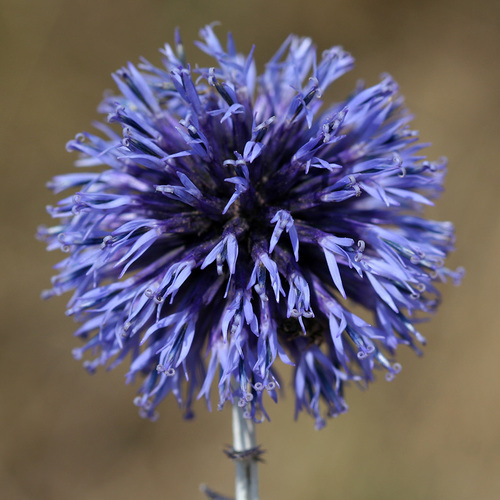
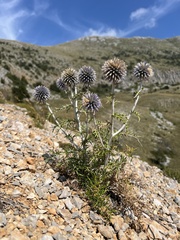
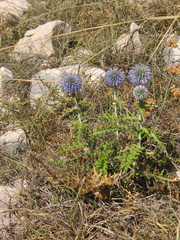
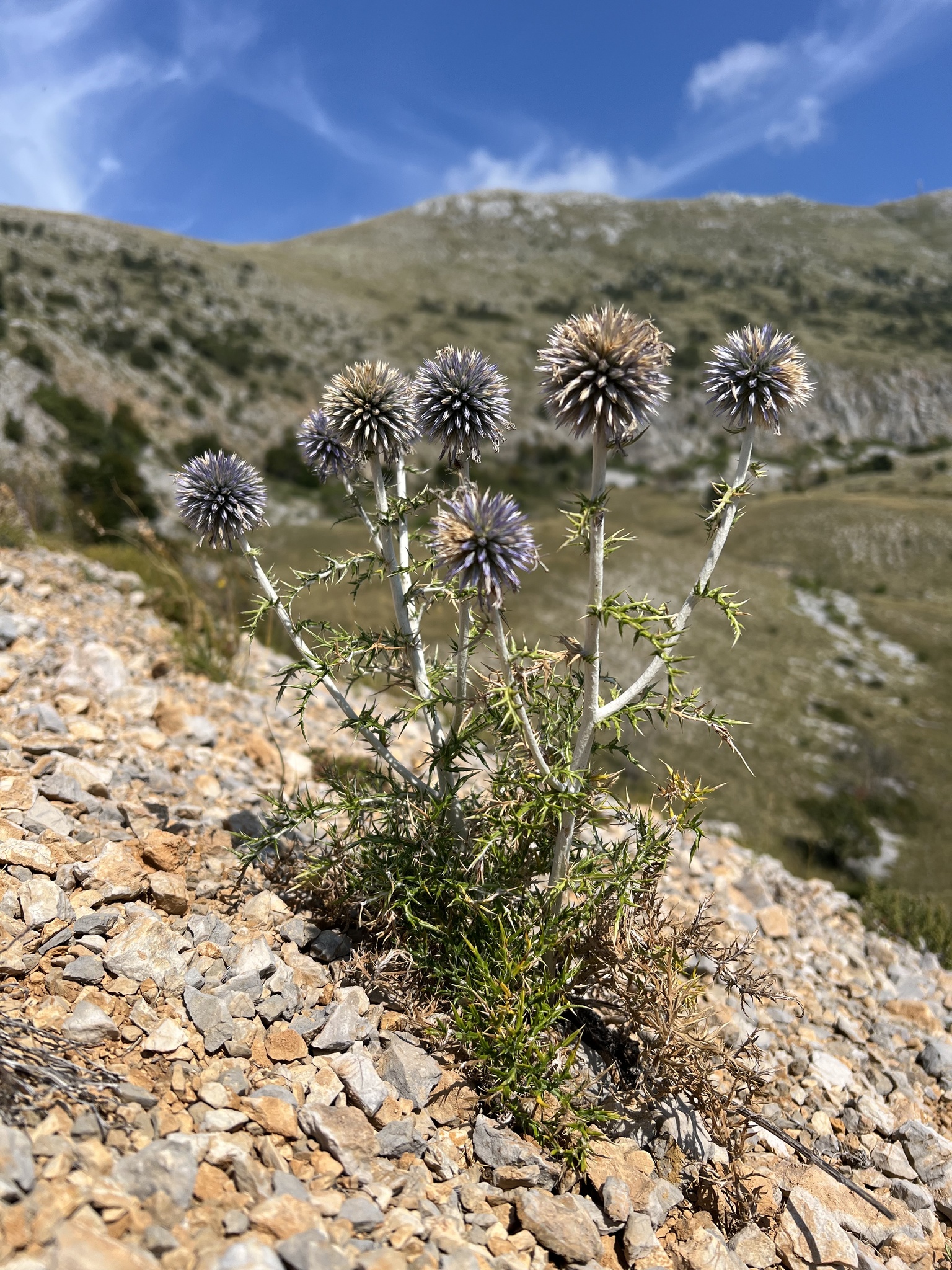
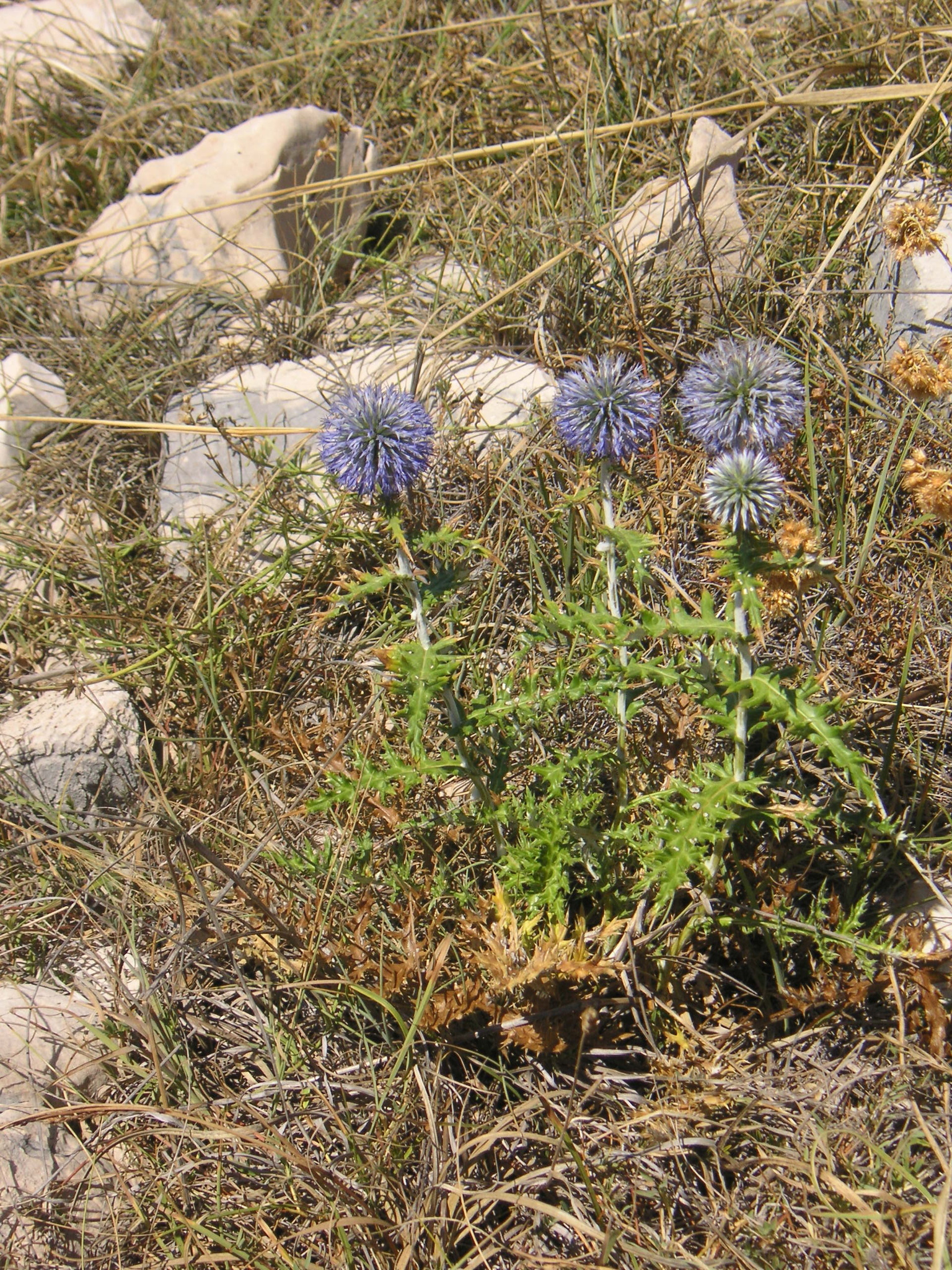
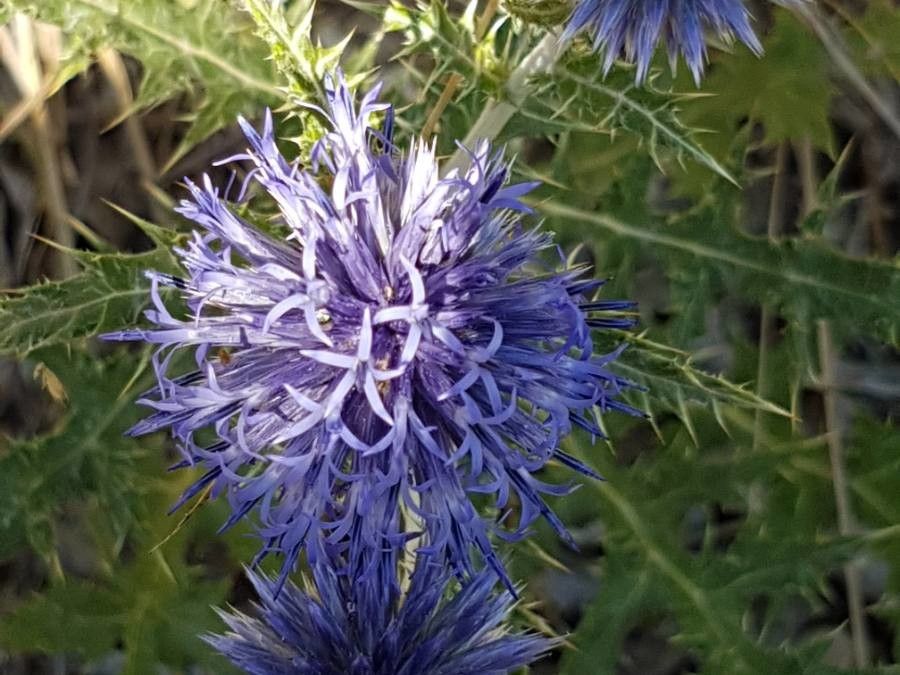
Southern globe-thistle is a clump-forming perennial with spherical blue-violet inflorescences. Deeply divided leaves are green above and white beneath; sun and drained soil encourage firm stems.
Read moreSouthern globe-thistle
Echinopus ritro
Place in full sun, with intense direct light all day long.
Full sun; partial shade tolerated, but stems may be weaker.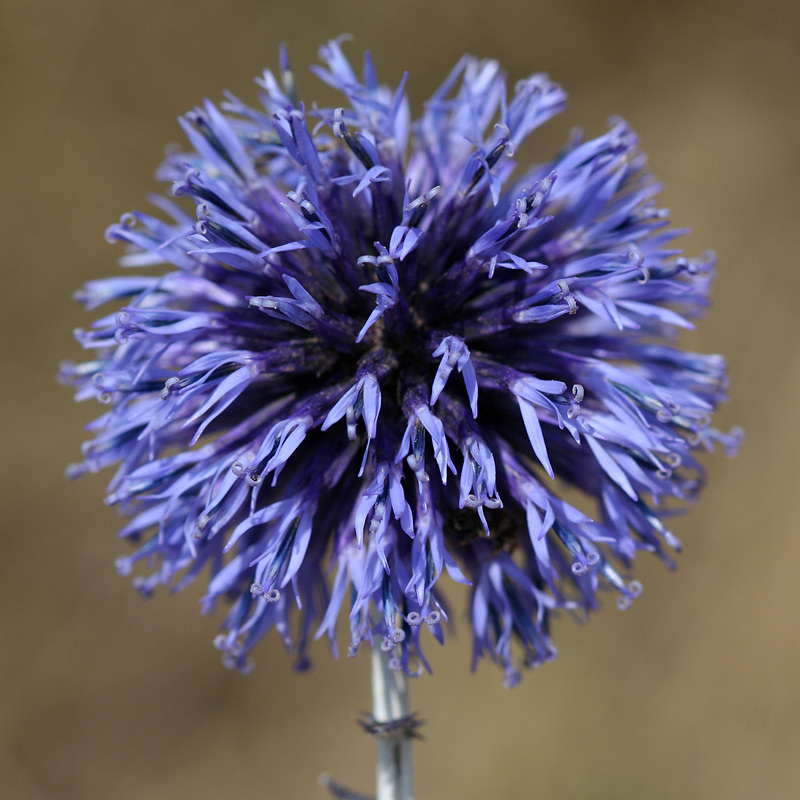



© photo
(c) Vadim Prokhorov, some rights reserved (CC BY-NC), uploaded by Vadim Prokhorov · cc-by-nc
Mirko Ubović · cc0
Michael Andresek · cc-by
Taken May 15, 1997 by Tela Botanica − Liliane Roubaudi (cc-by-sa)
Taken Jul 10, 2022 by Ольга Ихсанова (cc-by-sa)
Taken Aug 8, 2022 by Fabrice Bourriquet (cc-by-sa)
Taken Jul 30, 2022 by Mandalorian (cc-by-sa)
Taken Sep 25, 2021 by Dieter Wagner (cc-by-sa)
© copyright of the Board of Trustees of the Royal Botanic Gardens, Kew.




Global distribution
Native from Europe to Mongolia and Turkey; introduced in Germany and some US states.
- Native3
- Introduced1
- France
- Spain
- Mongolia
- Germany
Hexagons: regions where the plant occurs. Green dots: native range.1
Identity
Southern globe-thistle (Echinops ritro L., 1753) is a clump-forming perennial with rounded inflorescences in Asteraceae, the daisy family. Its French names include chardon bleu, azurite, oursin bleu and échinops ritro. General blue-thistle names can cover several plants, so use the binomial when ordering seed or comparing descriptions. 1 5 8 7
Typical garden height is 50 cm–1 m (20 in–3.3 ft) with upright, branched growth. Deeply divided leaves grow at the base and along stems. Blue-violet globes stand above them in summer, visible across a border, while individual tiny flowers need closer examination. 2
Recognition
White leaf undersides complement the blue heads in identification. Blades are green above, deeply divided, leathery and edged with points. Lower leaves are longer than upper ones. Hairs on pale stems contribute a silvery appearance, but lighting changes color and color alone cannot establish identity. 6 7
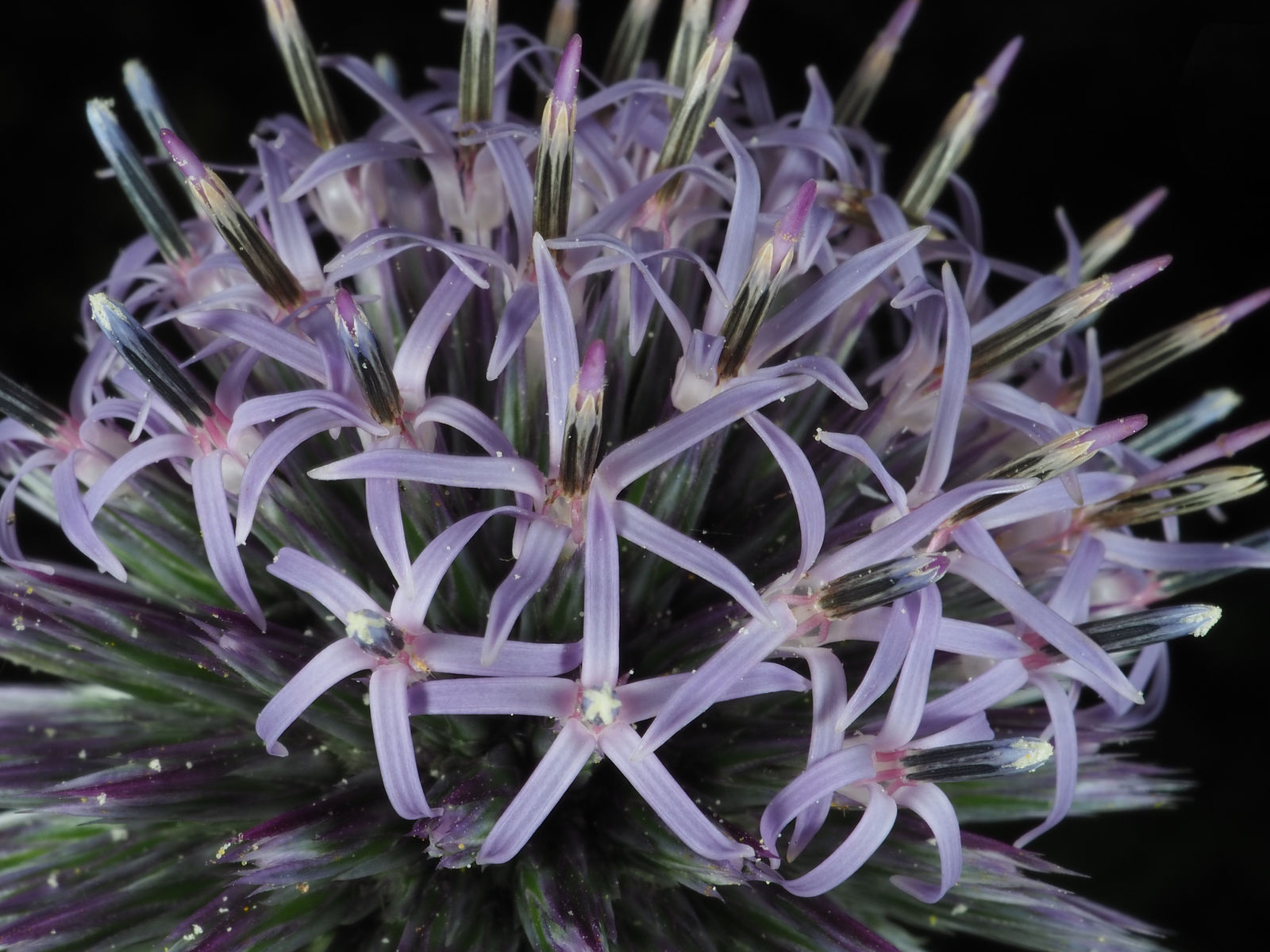
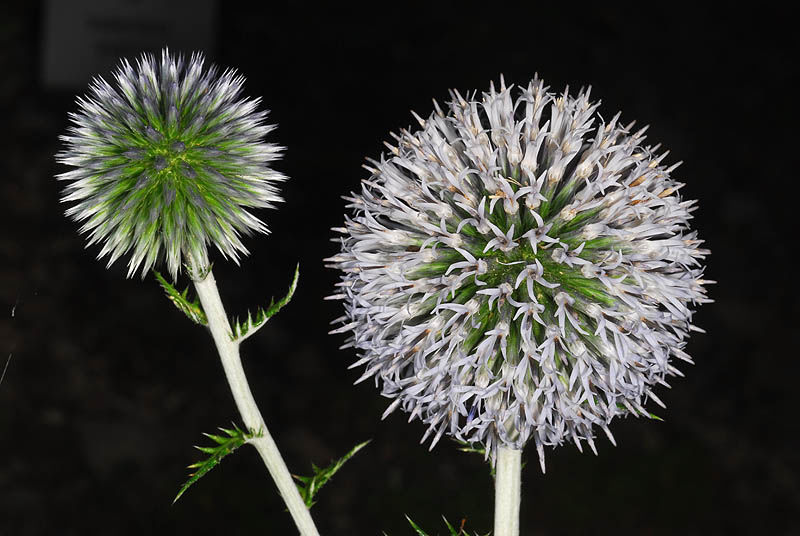
Wild spherical, prickly heads measure about 3–3.5 cm (1.2–1.4 in) across, sometimes more in cultivation. Each globe contains numerous small star-shaped flowers; a branched stem bears four to ten heads. The genus name evokes a hedgehog. Compare a head in bud and one open to understand the change. 7 6
Useful taxonomy
Echinops ritro is an accepted species published in 1753. Echinopus ritro (L.) Scop. is a synonym. A one-letter difference in the genus can reflect old nomenclature, but verify it before combining records from several sources. 1
Several subspecies are recognized, including Echinops ritro subsp. ruthenicus (M.Bieb.) Nyman, along with botanical variety elbursensis. A subspecies is not a cultivar. Veitch’s Blue is reported as misapplied to some plants assigned to this species: a commercial label does not replace taxon verification. Horticultural names therefore need a different reading from botanical ranks: a named selection and a subspecies do not denote the same category. 1 2
Habitat and distribution
The native range spans Europe to Mongolia and Turkey, including France, Spain and Italy and many eastern European and Central Asian territories. Germany and the US states of New York and Washington are introductions. These records distinguish natural origin from presence arising from cultivation. 1
Stony slopes and dry grassland explain its preference for soil that drains rather than remains waterlogged. Different textures can suit it if drainage is good. Full sun is preferable; light shade is tolerated but can produce weaker stems. 4 6
In France it grows on uncultivated land in the south, extending to Hautes-Alpes, Isère, Lozère, Aveyron and Gironde, and is absent from Corsica. It is nationally Least Concern, regionally Vulnerable in Aquitaine, and has no regulatory protection in that French context. 7 8
Cycle and reproduction
Summer flowers support bees and butterflies. Timing varies with climate and cultivated form, chiefly June to September in the source-region calendar and July to September in southern France. The species is hermaphroditic and insect-pollinated. 4 6 7
Seeds renew plants, including seedlings from fallen seeds. Remove heads before maturity to limit self-sowing. A taproot makes moving an older plant less convenient, so choose its site early. Winter root cuttings provide another propagation method, distinct from roughly splitting the crown. 6 2
Cultivation and precautions
Overly fertile soil can produce flopping stems. Poor to ordinary, dry to moderately moist but drained soil suits it. Established plants tolerate drought; young plants still need water according to soil drying. Adult tolerance does not imply a permanent absence of water needs. 4 6
Wear gloves when cutting prickly foliage. Echinops are classified as non-toxic to dogs, cats and horses. No toxic effect is reported for people, which does not prove safety, and no food use is established. Reported medicinal root uses establish neither a home dose nor a validated self-treatment; retain its ornamental role. 9 4
Related forms and garden choices
Subsp. ruthenicus shares the main drainage requirements. Shiny, lobed leaves are white beneath; bright blue heads rise on long white stems to 1 m (3.3 ft). Differences concern foliage and flowers without promising a complete change in cultivation requirements compared with the species as a whole. 3
When choosing a plant for a particular border, compare its final dimensions and botanical identity before giving priority to the particular shade of blue shown in a photograph. French names evoking blue balls or sea urchins vary among catalogs. A label saying only blue thistle cannot reliably distinguish Echinops from another ornamental genus. 5
Main sources
Southern globe-thistle, Echinops ritro L., is a perennial ranging from Europe to Mongolia. These references cover its name, range, French status, cultivation and related forms.
Frequently asked questions
Why do southern globe-thistle stems flop?
Partial shade or overly fertile soil can produce longer, weaker stems. Favor full sun and drained soil.
Does southern globe-thistle tolerate drought?
Yes, once established. Young plants need water to establish, while mature roots dislike waterlogging.
Can Echinops ritro be propagated from seed?
Yes. Spring sowing is used; self-sown plants may appear if heads ripen on the plant.
If you are unsure about a plant’s toxicity, ask a botanist or veterinarian for advice.