
Common tree euphorbia (Euphorbia ingens, )
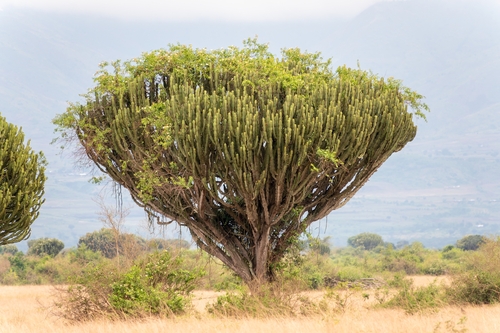

Common tree euphorbia (Euphorbia ingens) is an African succulent tree with upright, spiny green branches. Grown in pots in cold climates, it needs plenty of light, a free-draining growing medium and a dry winter rest. Its latex requires care when handling.
Read moreCommon tree euphorbia
Euphorbia bilocularis N.E.Br., Euphorbia candelabrum var. bilocularis (N.E.Br.) S.Carter, Euphorbia confertiflora Volkens, Euphorbia reinhardtii Volkens, Euphorbia reinhardtii var. bilocularis (N.E.Br.) Oudejans, Euphorbia similis A.Berger and Euphorbia tozzii Chiov.


© photo
(c) Julian Gums, some rights reserved (CC BY-NC), uploaded by Julian Gums · cc-by-nc
Suvarna Parbhoo Mohan · cc-by-sa
Wikimedia Commons · CC BY-SA or Public Domain
Taken Feb 2, 2021 by Haslev Knut Helge (cc-by-sa)
Taken Feb 15, 2016 by Photoflora - Benoit BOCK (©)
© copyright of the Board of Trustees of the Royal Botanic Gardens, Kew.




Global distribution
Native from Eritrea to South Africa, across eastern, central and southern Africa.
- Native18
- Eritrea
- Ethiopia
- Somalia
- Kenya
- Uganda
- Rwanda
- Burundi
- Tanzania
- Democratic Republic of the Congo
- Angola
- Zambia
- Malawi
- Mozambique
- Zimbabwe
- Botswana
- Namibia, Caprivi Strip
- Eswatini
- South Africa, northern areas and KwaZulu-Natal
Hexagons: regions where the plant occurs. Green dots: native range.1
Identity
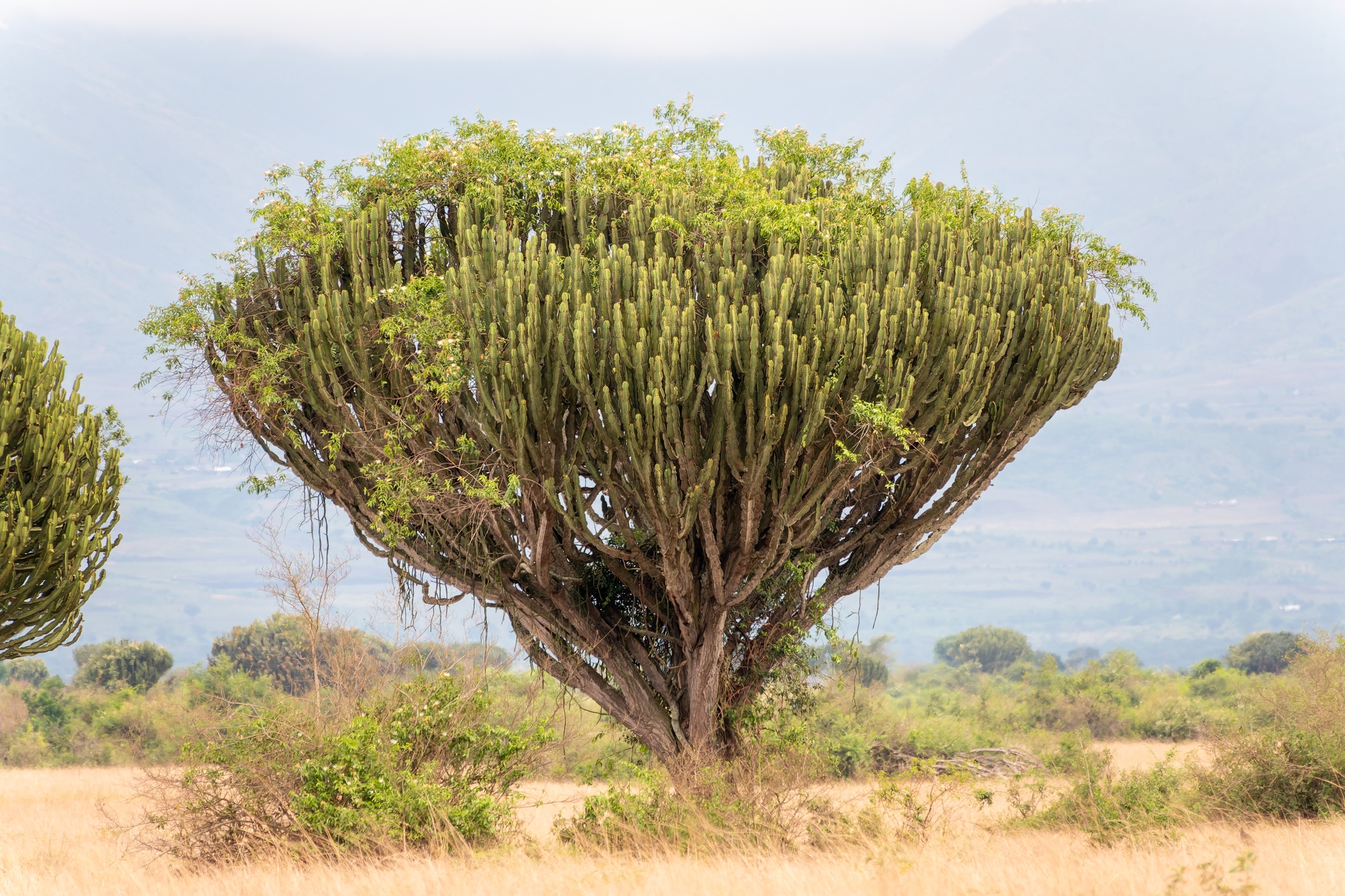
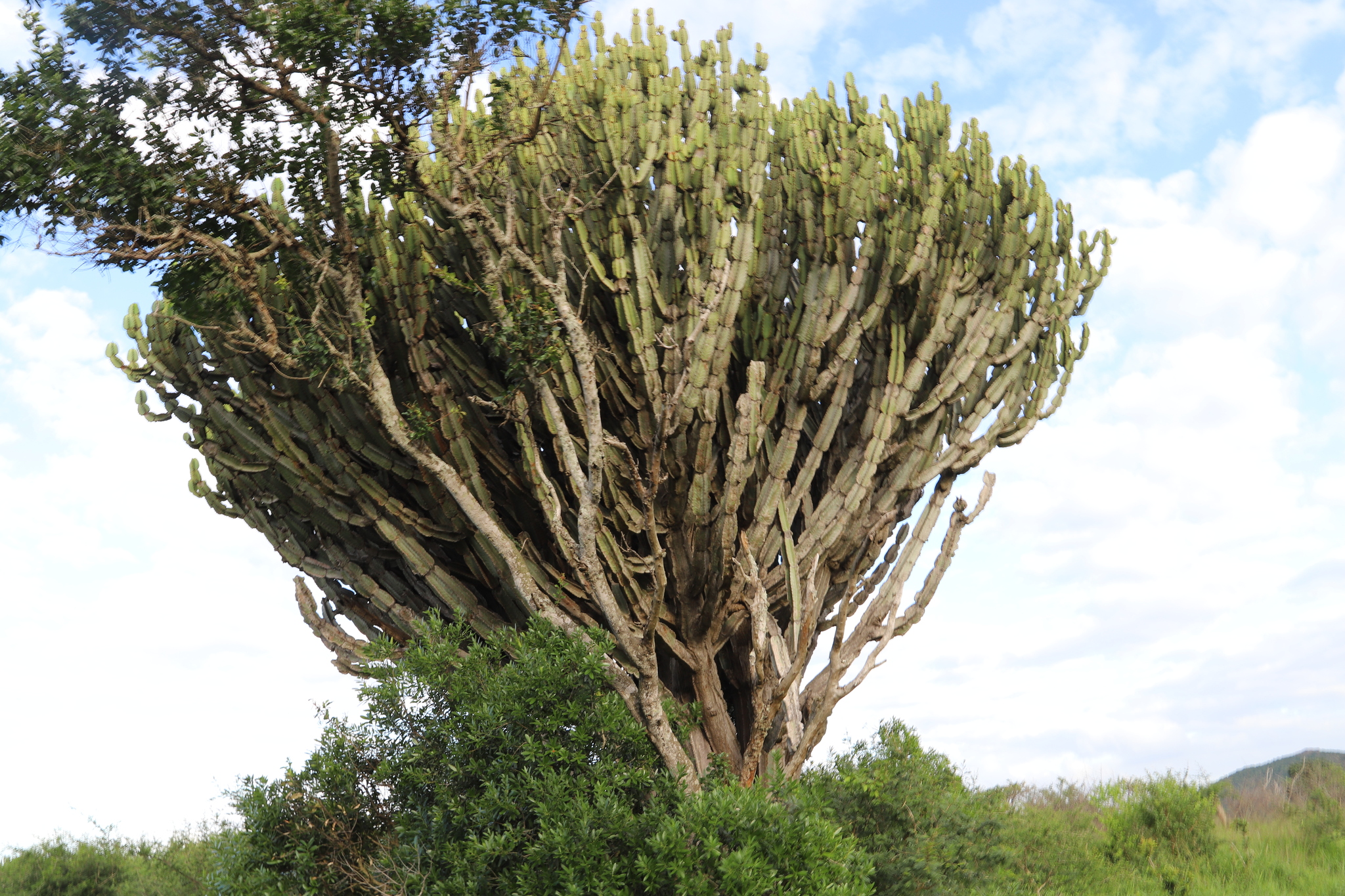
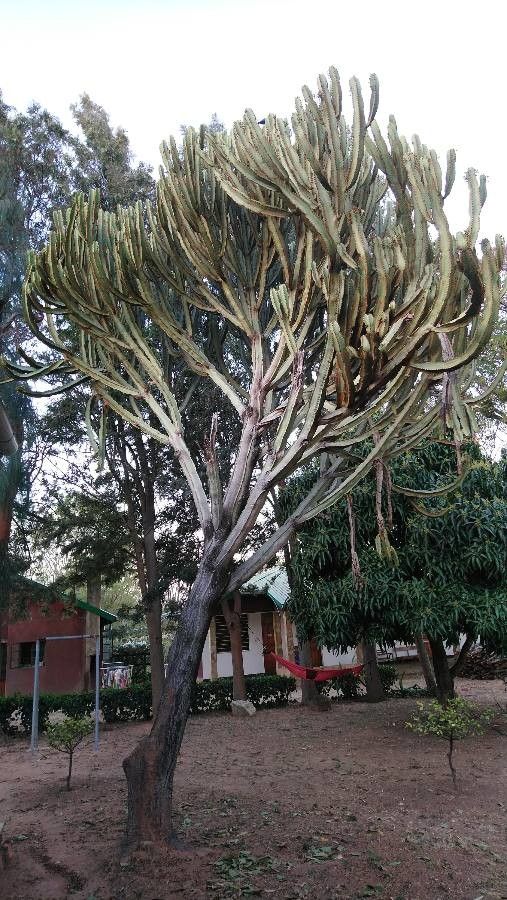
Common tree euphorbia (Euphorbia ingens) is a succulent tree in the Euphorbiaceae family. Its French name, “arbre candélabre,” refers to its thick, upright, branching stems, which store water. The outline resembles a candelabrum, while the leaves present on young plants disappear in adults. 3
The species can reach 15 m (49 ft) when conditions allow it to develop, yet it is commonly grown in pots. This potential height describes a fully developed tree, rather than the usual size of a houseplant. Indoors, the main requirement is a bright position with enough room for the branches to spread. 2
Recognition
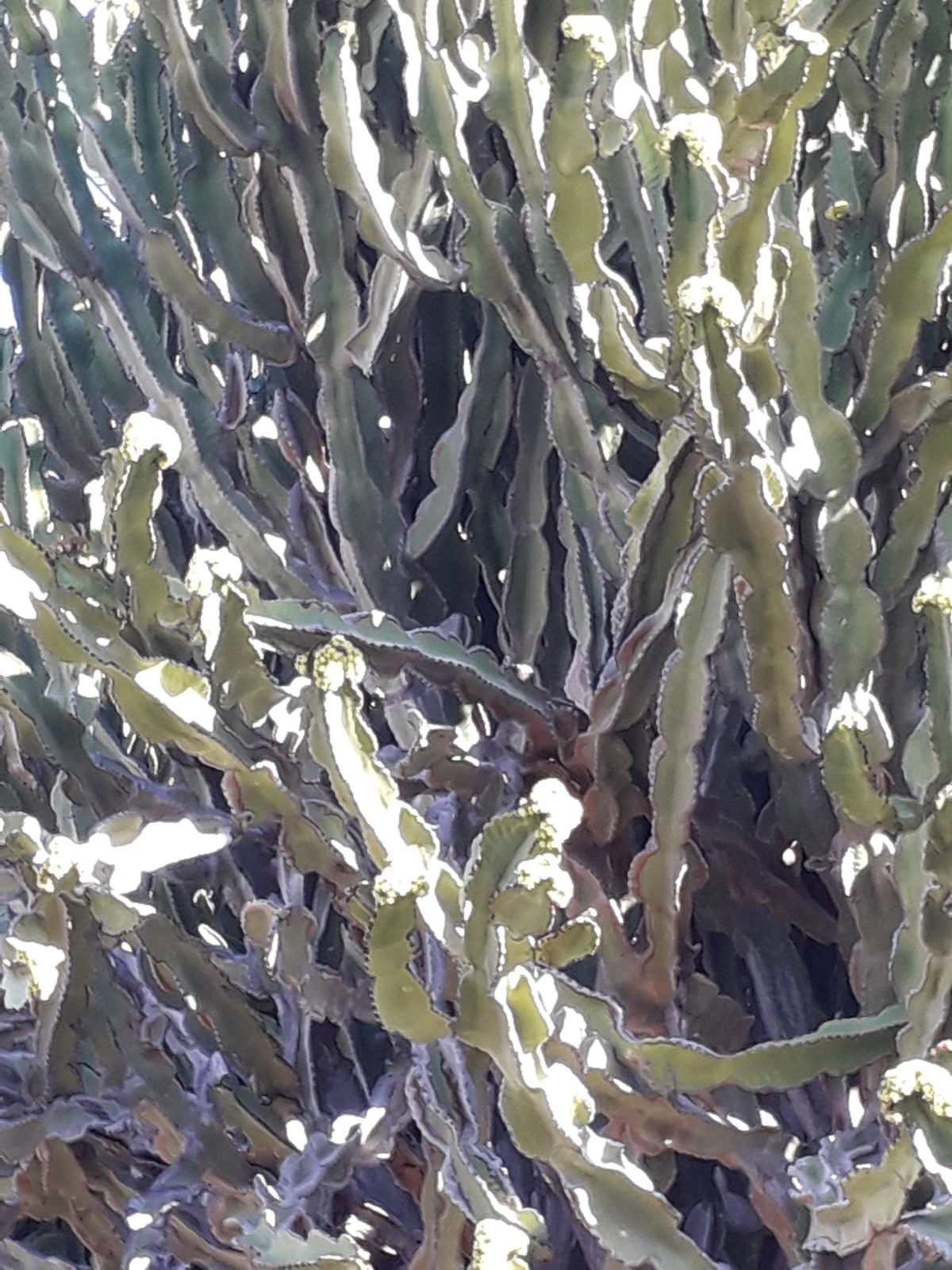
The green branches have four or five vertical ribs, lined with small spines. Adult plants have stems that are generally leafless. On mature plants, small greenish-yellow flowers may appear at the branch tips, followed by dark red to purple fruits. 2
To distinguish a euphorbia from a cactus, examine where the spines grow: in succulent euphorbias they may be paired on a spine shield, without an areole. Areoles are the small cushions characteristic of cacti. White latex is another feature of the genus, but do not wound a stem to look for it: this liquid is irritating. 4
Useful taxonomy
The accepted name is Euphorbia ingens E.Mey. ex Boiss., published in 1862. The species belongs to the genus Euphorbia, the family Euphorbiaceae and the order Malpighiales. These taxonomic references help identify the same plant despite variations in commercial labels. 1
The names Euphorbia similis, Euphorbia confertiflora and Euphorbia bilocularis are synonyms of this species. Euphorbia candelabrum var. bilocularis is also included in its synonymy. When identifying a plant for purchase, retain that complete combination rather than shortening it to the binomial alone. A botanical synonym does not denote a cultivar. 1
Habitat and distribution
The native range of Common tree euphorbia extends from Eritrea to South Africa. It includes Ethiopia, Kenya, Uganda, Tanzania, Angola, Mozambique and Zimbabwe, among other countries. Describing its origin only as South African therefore leaves out much of its African distribution. 1
The species grows mainly in the seasonally dry tropical biome. Its fleshy branches store water, consistent with that seasonal alternation. In cultivation, this adaptation does not justify keeping the potting mix constantly wet: drainage remains essential for the roots. 132
Life cycle and propagation
In a pot, give Common tree euphorbia full light and a mix of equal parts peat-free, loam-based potting mix and horticultural grit. Water moderately during growth, then keep it dry during winter rest. The species cannot tolerate frost; where cold weather occurs, a protected conservatory suits it better than an exposed garden. 2
For indoor cultivation in a temperate Northern Hemisphere climate, the seasonal rhythm favors spring and summer. In other climates and hemispheres, relate this guidance to local seasons and actual growth. Repot succulents in spring when roots fill the container or the plant outgrows its pot. An oversized pot retains more moisture, which encourages rot. 6
Fertilizing this species is limited to two or three applications of low-nitrogen liquid fertilizer during growth. Sow in early spring at 15–18 °C (59–64 °F); take stem cuttings in spring or early summer. Cutting requires protection against the latex. 2
At Marimurtra, flowering is recorded in fall and winter. This observation from a Mediterranean garden does not establish a universal season for plants in apartments. The largest specimen described in that garden measures 4 m (13.1 ft), a different context from the species' potential height. 3
Uses and risks
Common tree euphorbia is grown as a houseplant, in greenhouses or conservatories, and in containers. Cutting can limit its size, but regular pruning is not required. Watch for mealybugs, whiteflies and greenhouse mites; drought tolerance does not protect the plant from every pest. 2
The latex irritates skin and eyes, and the species is harmful if ingested by humans or pets. Wear gloves and protect your eyes when handling it. Keep the plant out of reach of children, cats and dogs. 24
At genus level, the latex contains diterpene esters; contact with the eyes can cause temporary or permanent corneal damage. This eye hazard explains the extra precautions, even though effects on the skin vary. The susceptibility of horses and other animals cannot be inferred from statements about pets. 4
Varieties, look-alikes and related plants
Euphorbia trigona differs in its triangular stems and teardrop-shaped leaves. Euphorbia tirucalli has thin, pencil-like branches. These species share a branching outline with Common tree euphorbia, but their stems provide more precise identification features than the overall growth habit. 4
Euphorbia lactea has green branches marbled with white lines and paired black spines. 'Cristata' and 'White Ghost' are selections of that other species: the first has fan-shaped branches, while the second is pale and sensitive to direct sun. These cultivar traits do not apply to Common tree euphorbia and do not establish any hybrid origin for it. 5
Main sources
Frequently asked questions
Is Common tree euphorbia a cactus?
It belongs to the Euphorbiaceae family. Its succulent stems resemble those of cacti, but its spines do not grow from areoles.
Should I water Common tree euphorbia in winter?
Cultivation of this species includes a dry winter rest and moderate watering during growth. The growing medium must drain freely.
Is Common tree euphorbia dangerous to pets?
It is harmful if ingested, and its latex irritates skin and eyes. Keep it out of reach of cats, dogs and children.
When should I repot Common tree euphorbia?
Spring is suitable for repotting succulents. Repot when roots fill the container or the plant outgrows its pot, without choosing an oversized replacement.
If you are unsure about a plant’s toxicity, ask a botanist or veterinarian for advice.