
Madagascar jewel (Euphorbia leuconeura, )
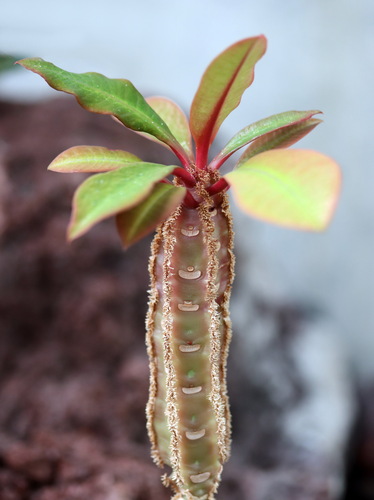

Madagascar jewel (Euphorbia leuconeura) is a semi-succulent shrub from Madagascar. Its young leaves show a white network of veins that turns green with age, while its capsules shoot seeds around the plant.
Read moreMadagascar jewel
Euphorbia fournieri


© photo
(c) Rudolphous, some rights reserved (CC BY-SA) · cc-by-sa
Wikimedia Commons · CC BY-SA or Public Domain
Wikipedia · CC BY-SA
Taken Sep 10, 2021 by Magnus Onu (cc-by-sa)
Taken Feb 3, 2007 by Andrzej Konstantynowicz (cc-by-sa)
Taken Jan 18, 2021 by Johannes Dirwehlis (cc-by-sa)
© copyright of the Board of Trustees of the Royal Botanic Gardens, Kew.




Global distribution
Endemic to Madagascar, with its native range in the north of the island.
Identity
Madagascar jewel (Euphorbia leuconeura Boiss., 1862) is a semi-succulent shrub native to Madagascar. Its French name, “euphorbe à nervures blanches,” refers to the pale network visible on young leaves. The French nickname palmier cracheur, literally “spitting palm,” evokes the way it shoots out its seeds, but the plant belongs to the Euphorbiaceae, in the order Malpighiales. It is therefore not a palm. 7 1 3
The species is grown as a houseplant for its foliage and upright outline. Self-sown seedlings explain how it is passed around among enthusiasts: a mature plant can produce new plants in neighboring pots without the gardener having sown any seeds. 3 8
Identification
The white, fishbone-like network of veins is most visible on young leaves; it turns green as they age. A plant with entirely green leaves is therefore not necessarily another species. Mature leaves are leathery and can reach 15 cm by 6.5 cm (6 in by 2.6 in) indoors. In strong light, the leaf stalk and sometimes the edge of the blade develop a reddish tint. 8
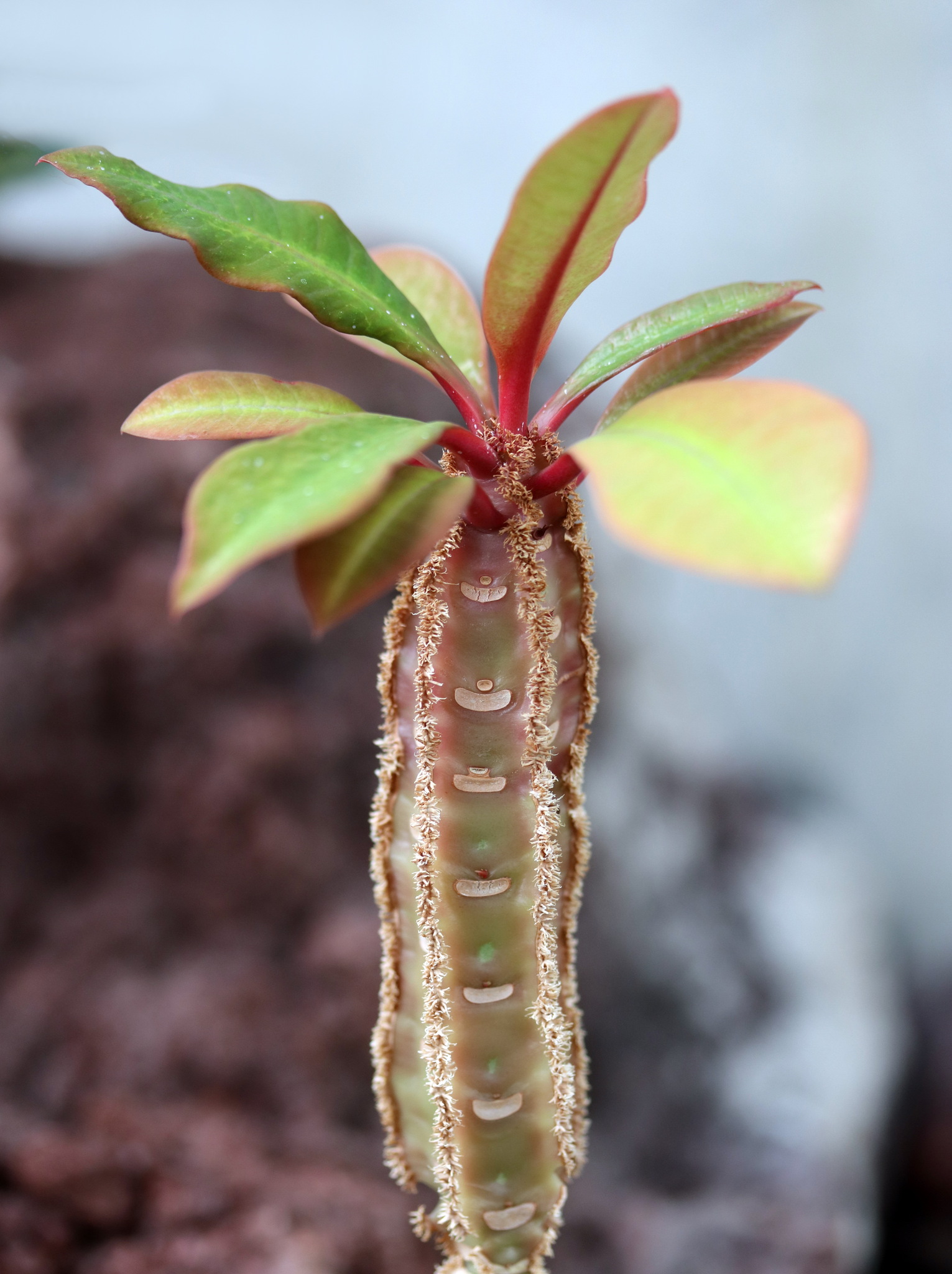
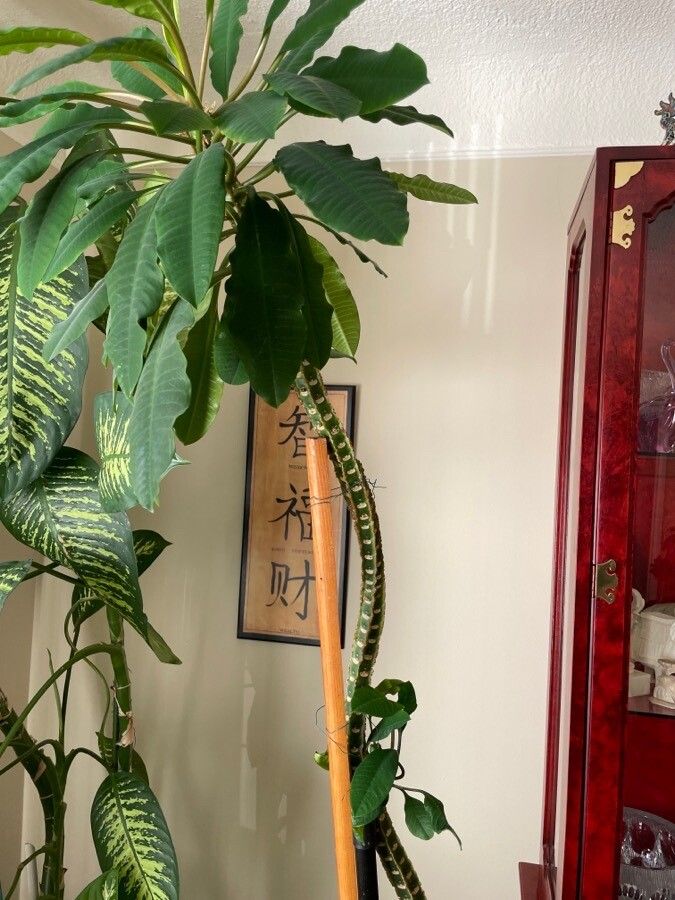
The stem, cylindrical in young plants, becomes thick and develops four to five angles edged with brown bristles. Old leaves leave crescent-shaped marks. Indoors or in a warm greenhouse, the horticultural guidelines for mature size are 1.5–2.5 m (5–8 ft) tall and 0.5–1 m (1.6–3.3 ft) wide. They describe an established plant, rather than the size of a seedling in a small pot. 8 2
Useful taxonomy
The accepted name is Euphorbia leuconeura Boiss. It was published in late January 1862, in A. P. de Candolle’s Prodromus, volume 15, part 2.1, page 78. The abbreviation Boiss. accompanies the botanical name; it does not denote a horticultural variety or a cultivar. 4
The name Euphorbia fournieri Rebut, published in 1893, appears in the species’ current synonymy. A label bearing this older name may therefore refer to the same botanical identity. The distinction between a scientific synonym and a common name must be maintained: “euphorbe à nervures blanches” is a French name, while Euphorbia fournieri belongs to its nomenclatural history. 1 7
Habitat and distribution
Its native range lies in northern Madagascar. The species is endemic to the island: its presence in homes, greenhouses, or botanical collections elsewhere in the world is a result of cultivation. Its main habitat is tropical, with a seasonal dry period; the conservation assessment also describes rocky sites. 1 3 5
The global assessment dated April 30, 2004, classifies the species as Vulnerable, under criterion D2. It lists plant collection and fire-related changes among the threats. The population trend remains unknown in that assessment, and an update is flagged as necessary. This older classification must be read with its date: plentiful seedlings in a living room reveal nothing about wild populations. 5
Growth cycle and reproduction
The small, white, petal-free floral structures appear in the leaf axils near the stem tips. The plant can then form capsules that burst open when ripe. This shooting action disperses the seeds over a distance; it explains the French nickname palmier cracheur and the young euphorbias found at the base of other plants. 2 7
To limit self-seeding, remove the capsules before they open. Seedlings that have already emerged can also be collected and potted separately. In horticultural sowing, the seeds are lightly covered with potting mix kept slightly moist; germination in about one month at 22–25 °C (72–77 °F) is described. This temperature concerns germination, rather than a constant requirement for a mature plant. 8
Cultivation and uses
Indoors, choose a very bright position and a pot that allows water to drain. Water when the potting mix begins to dry, rather than imposing a long drought on this leafy plant. A prolonged shortage of water can cause loss of the lower leaves, or even more complete defoliation in winter. That response does not justify leaving the roots in a waterlogged growing medium. 8 2
Large specimens become heavy; a stable pot helps prevent them from tipping over. Under temperate indoor growing conditions, light feeding during active growth is sufficient. Pruning reduces the plant’s size and may be followed by branching. It does, however, require protection, because every cut exposes the handler to flowing latex. 8
Latex and precautions
The latex irritates the skin and eyes, and the plant is harmful if ingested by humans, including children. Wear gloves and protect your eyes when making cuts; keep the plant out of reach of children and pets. The warning for pets remains general: it gives neither a toxic dose nor a degree of sensitivity specific to cats or dogs. Risk to horses and other animals outside the scope of this warning is not established here. 2 8
Ingenol derivatives have been identified in cultivated plants. A study published in 1999 analyzed 22 selections of Euphorbiaceae and tested a response in a cell system; the two E. leuconeura selections studied produced the strongest response. This experimental result does not measure a cancer risk in people who keep the plant at home. It reinforces the reason to avoid contact with the latex, without establishing a household exposure threshold. 6
Main sources
- Kew, Plants of the World Online: Euphorbia leuconeura Boiss.
- RHS, Euphorbia leuconeura: morphology, cultivation, and risks
- EPPO Global Database, Euphorbia leuconeura (EPHLK)
- International Plant Names Index, Euphorbia leuconeura
- Haevermans, IUCN, Euphorbia leuconeura: 2004 global assessment
- Vogg et al., 1999, Tumor promoters in commercial indoor-plant cultivars of the Euphorbiaceae
- Zurich Zoo, white-veined euphorbia
- Larry Hodgson, 2020, Madagascar jewel: a succulent to share
Frequently asked questions
Why do the white veins turn green?
The white pattern is most visible on young foliage. Older leaves become entirely green: this change is part of the plant’s normal development.
Why do seedlings appear in nearby pots?
Ripe capsules burst open and shoot out their seeds. These can germinate in the potting mix of nearby pots; removing the capsules before they open limits self-seeding.
Is it a palm or a cactus?
No. Despite its French nickname palmier cracheur, meaning “spitting palm,” and its succulent stem, Euphorbia leuconeura belongs to the Euphorbiaceae family.
What precautions are needed when pruning?
Wear gloves and eye protection to avoid splashes of latex. The sap is irritating and the plant is harmful if ingested by adults or children; keep it out of reach of children and pets.
Is the species threatened in the wild?
The global assessment dated April 30, 2004, classifies it as Vulnerable under criterion D2. This older assessment is flagged as needing an update and gives an unknown population trend.
If you are unsure about a plant’s toxicity, ask a botanist or veterinarian for advice.