
Indian Spurge Tree (Euphorbia neriifolia, )
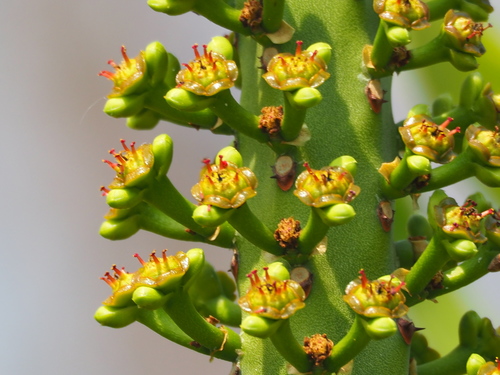


Indian Spurge Tree (Euphorbia neriifolia), a tropical shrub in the Euphorbiaceae, combines almost cylindrical succulent branches with large fleshy leaves. Its latex calls for precautions, especially to protect the eyes.
Read moreIndian Spurge Tree, Hedge Euphorbia and oleander spurge
Elaeophorbia neriifolia, Euphorbia complanata, Euphorbia edulis and Tithymalus edulis
Allow a few hours of direct sun per day, preferably morning or evening.
Sun or partial shade per NParks; very bright light under cover.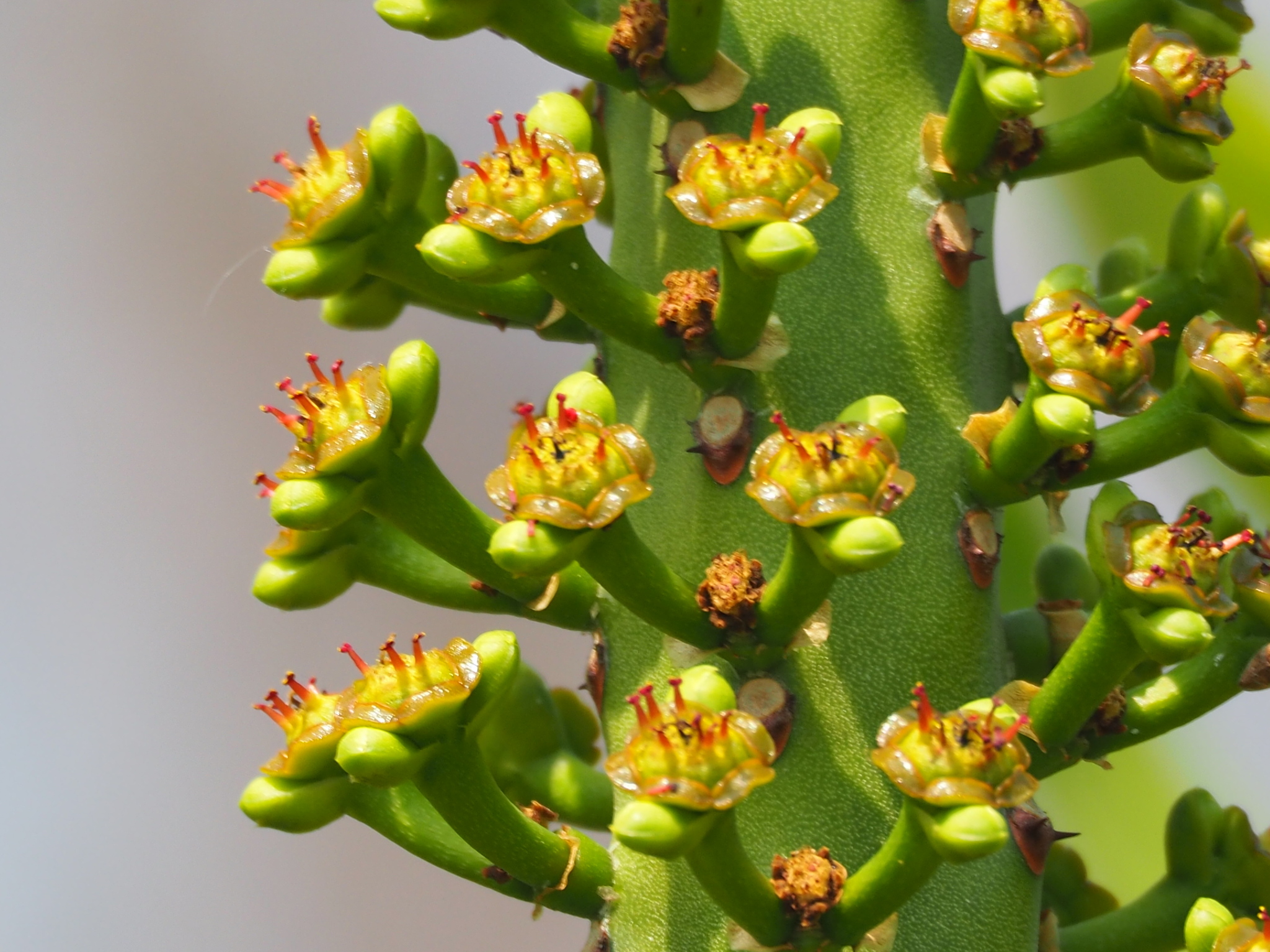


© photo
no rights reserved, uploaded by 葉子 · cc0
Dinesh Valke · cc-by-sa
Taken Jul 23, 2021 by pedrogc -- (cc-by-sa)
Taken Feb 20, 2021 by Sudhanshu Kumar (cc-by-sa)
Taken Feb 15, 2015 by Photoflora - Benoit BOCK (©)
© copyright of the Board of Trustees of the Royal Botanic Gardens, Kew.


Global distribution
POWO recognizes northeastern New Guinea as the native range. The Flora of Thailand and NParks give different Asian origins; this discrepancy remains explicit.
- Native1
- Introduced3
- New Guinea
- Thailand
- Philippines
- Vietnam
Hexagons: regions where the plant occurs. Green dots: native range.1
Identity
Indian Spurge Tree (Euphorbia neriifolia L., 1753) bears large fleshy leaves on succulent branches with five indistinct angles. The shrub belongs to the Euphorbiaceae; POWO accepts the name published by Linnaeus in Species plantarum. 3 1
The binomial was retained in French because no French common name was attested in the references consulted. NParks gives the English names “Indian Spurge Tree” and “Hedge Euphorbia”, among others. The epithet neriifolia likens the leaves to those of the genus Nerium, which includes oleander. Freely translating a common name could introduce confusion. 2
Identification
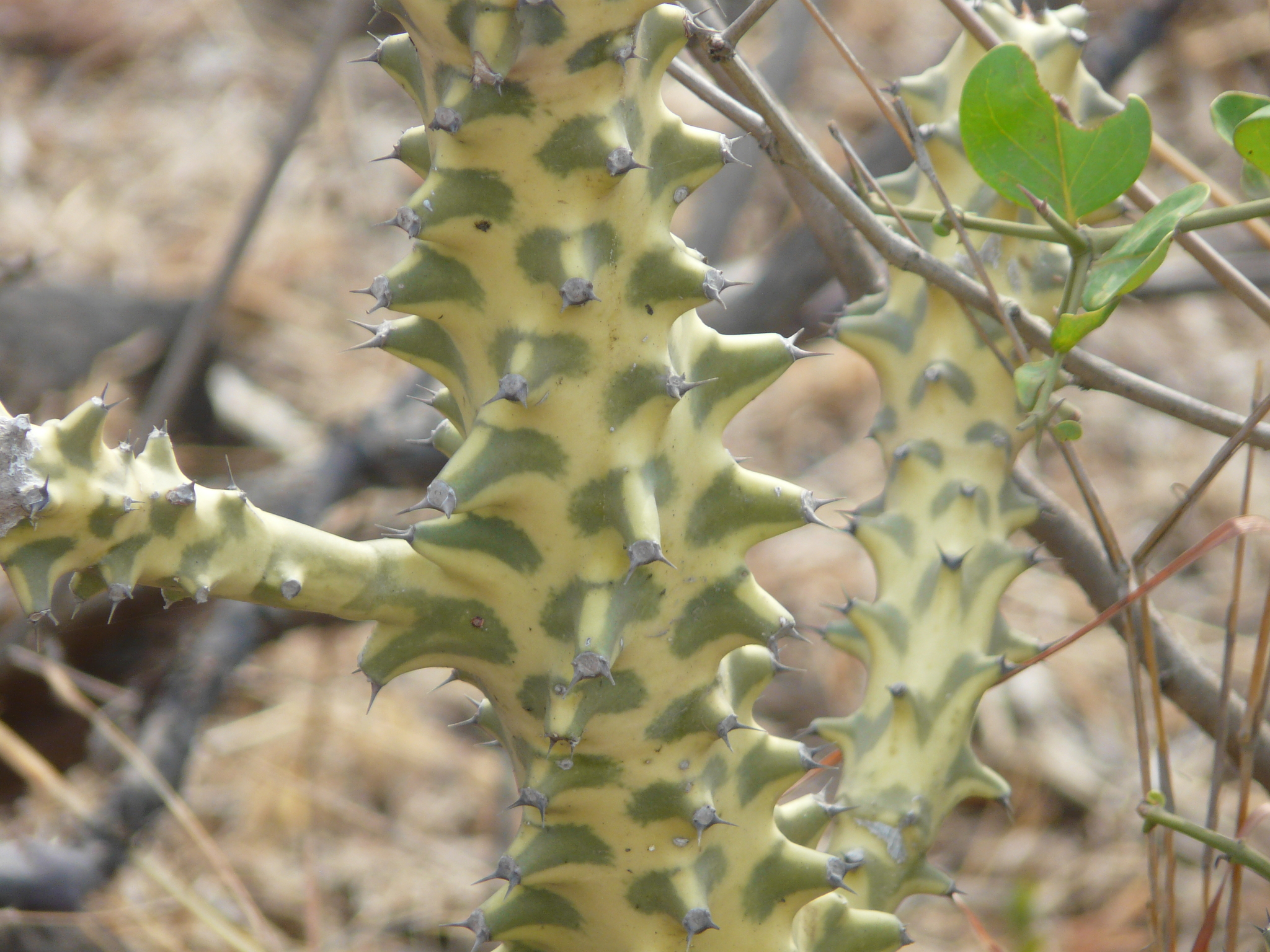
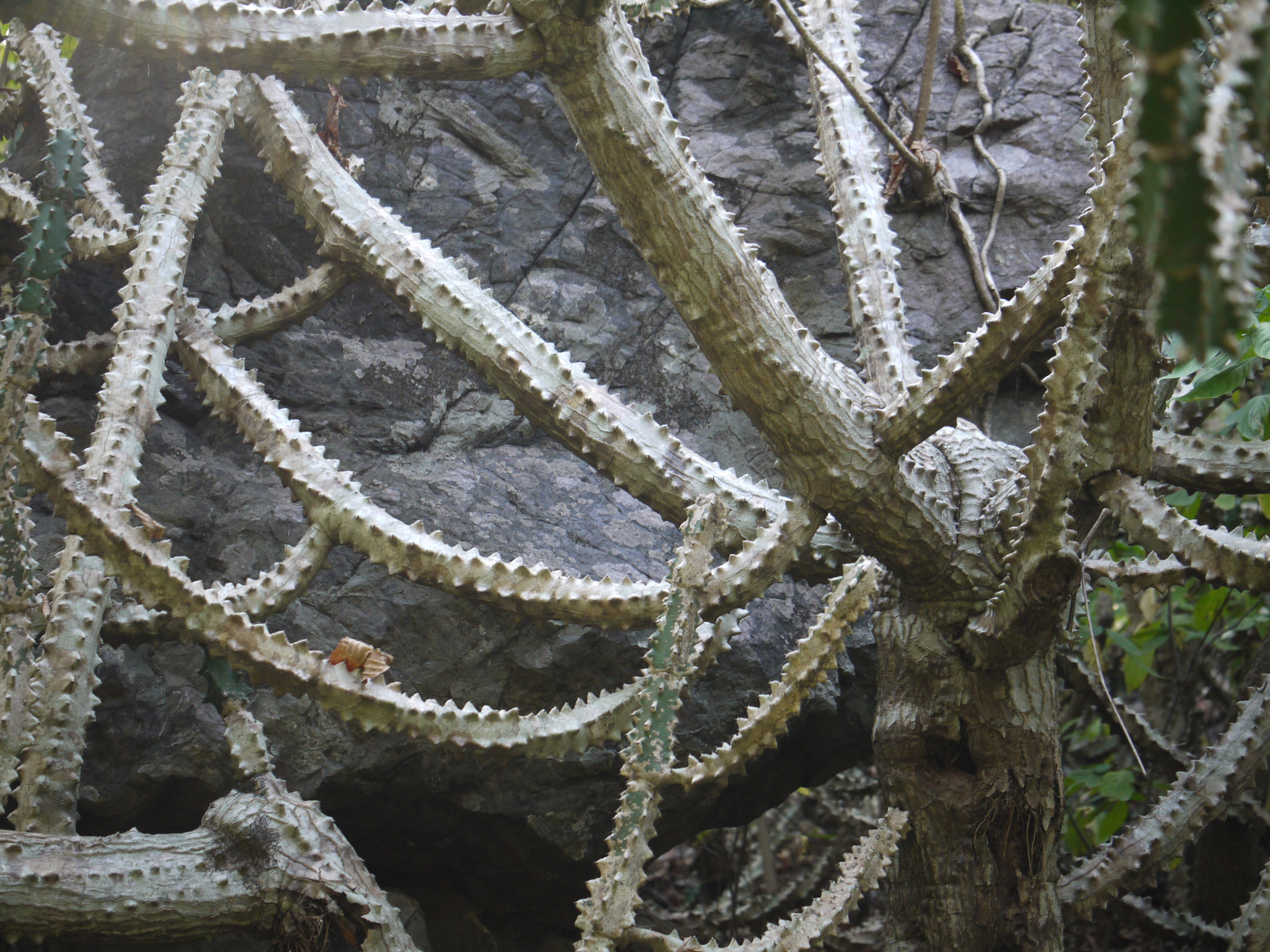
Young branches of Indian Spurge Tree have five indistinct angles, without wings. The Thai flora describes paired spines 2 mm (0.08 in) long and obovate leaves 10 to 18 cm (3.9 to 7.1 in) by 3 to 4 cm (1.2 to 1.6 in), mostly near the branch tips. “Obovate” means that the broad part is toward the top of the leaf blade. 3
The flora describes a shrub reaching 4 m (13.1 ft). NParks gives a horticultural height of 3 to 5 m (9.8 to 16.4 ft); these tropical dimensions do not predict the size of a potted specimen in a home. The leaves are green and can fall during drought: a leafless branch alone is therefore not a sign of thirst to be corrected with more water. 3 2
Taxonomy and names
Elaeophorbia neriifolia (L.) A.Chev. is a synonym of the accepted name. POWO also assigns Euphorbia edulis Lour. and Tithymalus edulis (Lour.) H.Karst. to Euphorbia neriifolia. These names help locate older descriptions; they do not denote cultivars to seek separately. 1
Succulent spurges resemble cacti, but their spines do not arise from areoles. The RHS explains this distinction: areoles are the small cushions characteristic of cacti. A spiny outline is therefore insufficient to determine the family of a collection plant. 4
Habitat and distribution
POWO currently places the native range of Indian Spurge Tree in northeastern New Guinea, in the seasonally dry tropical biome. The same database distinguishes numerous introductions, including Thailand, the Philippines and Cuba. Presence in a tropical garden does not demonstrate local origin. 1
References nevertheless disagree on its origin: the Flora of Thailand indicates the dry tropical regions of southern India, while NParks gives an Asian range extending from Iran to Myanmar, among other areas. The flora also records widespread cultivation in hedges and gardens in tropical Asia. The distribution adopted here follows POWO without erasing these differing accounts. 3 2
Life cycle and propagation
Indian Spurge Tree is perennial; NParks describes unisexual flowers grouped into cyathia, on a monoecious plant. The Thai flora had observed neither flowers nor fruits for this species in its treatment, so no local flowering period is inferred from it. 2 3
For a potted plant in a temperate climate, seasonal guidance follows RHS advice for indoor spurges: plenty of light, less water in winter, and good summer ventilation to prevent rot. The calendar synthesizes this group-level advice for the Northern Hemisphere; its indices are relative. 4
For succulents, the RHS recommends repotting in spring, if the pot has become too small, and monthly liquid fertilizer during growth, from April to September in its British context. NC State mentions seeds and cuttings for the genus, without a species-specific protocol. 5 6
For a potted succulent spurge, the growing medium must drain water: guidance for the genus favors a cactus mix and drying between waterings to prevent root rot. The RHS advises against an excessively large pot, whose volume of potting mix remains moist too long. This advice provides a practical repotting criterion without keeping a drought-tolerant plant in constantly moist conditions. 6 5
Uses and risks
The latex of Indian Spurge Tree can cause serious eye injuries. Basak and colleagues describe injury to the corneal epithelium with edema and uveitis after exposure to this species. The authors recommend eye protection when handling spurges; NC State recommends gloves. 7 6
For children, cats and dogs, NC State advises keeping plants out of reach at genus level: this precaution does not measure their specific sensitivity to Euphorbia neriifolia. Species-specific data remain insufficient for horses and other animals. Historical medicinal and food uses recorded by the flora demonstrate neither effectiveness nor safety; the latex must not be used for self-medication. 6 3 7
Varieties, lookalikes and related plants
‘Cristata’ is a horticultural form with crested stems, described separately by NParks. Its stated height of 2 to 3 m (6.6 to 9.8 ft) applies to that form in a tropical setting; it does not replace the dimensions of the species' typical form. This designation does not prove hybrid origin. 8
To distinguish Euphorbia neriifolia from Euphorbia trigona, examine young branches: the flora describes those of Euphorbia trigona as distinctly triangular, with small leaves, compared with the indistinct angles and large leaves of Euphorbia neriifolia. Older branches become more rounded, so comparing a recent shoot and its foliage is preferable. 3
Main sources
POWO supplies the accepted name; the flora details morphology. RHS guides concern the cultivation of horticultural groups.
- Kew, Plants of the World Online: Euphorbia neriifolia L.
- NParks, Euphorbia neriifolia
- Flora of Thailand, Euphorbia, section 26: E. neriifolia
- RHS, indoor and greenhouse euphorbias
- RHS, growing houseplant cacti and succulents
- NC State Extension, Euphorbia: genus-level care and toxicity
- Basak et al., Keratouveitis caused by Euphorbia plant sap
- NParks, Euphorbia neriifolia 'Cristata'
Frequently asked questions
Is Indian Spurge Tree a cactus?
It is a spurge in the Euphorbiaceae family. Succulent spurges lack the areoles characteristic of cacti, as the RHS explains.
Does leaf loss indicate a lack of water?
NParks describes foliage as semi-deciduous or deciduous under drought. Leaf loss alone therefore does not justify increasing watering.
Does the latex pose a risk to the eyes?
Yes. Basak and colleagues report corneal injury and uveitis after exposure to this species' latex and recommend eye protection when handling spurges.
If you are unsure about a plant’s toxicity, ask a botanist or veterinarian for advice.