
Purple spurge (Euphorbia peplis, )
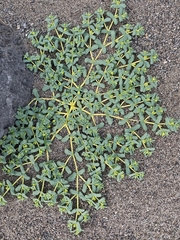
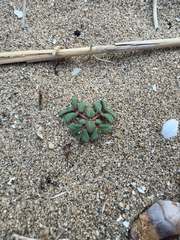
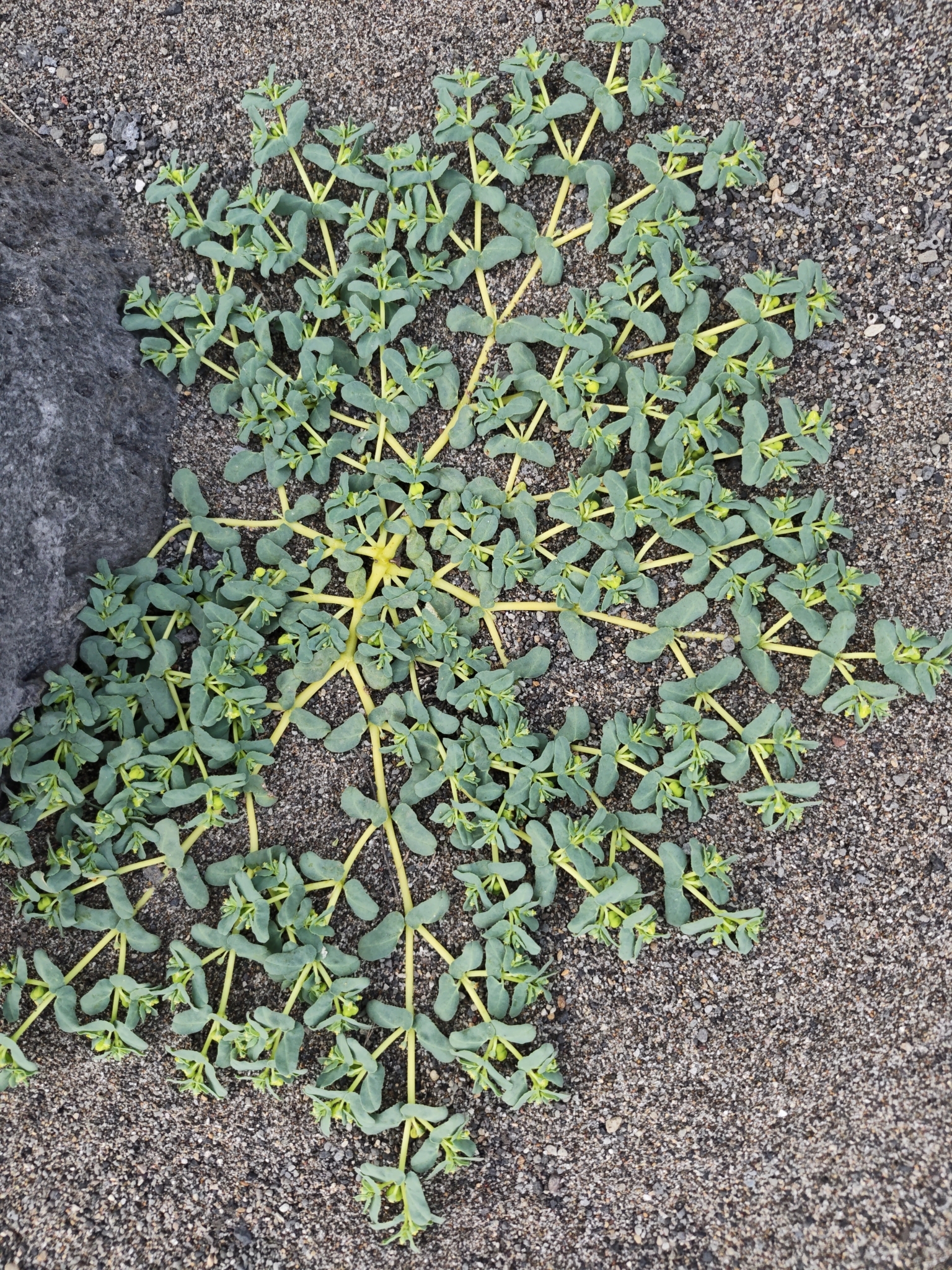
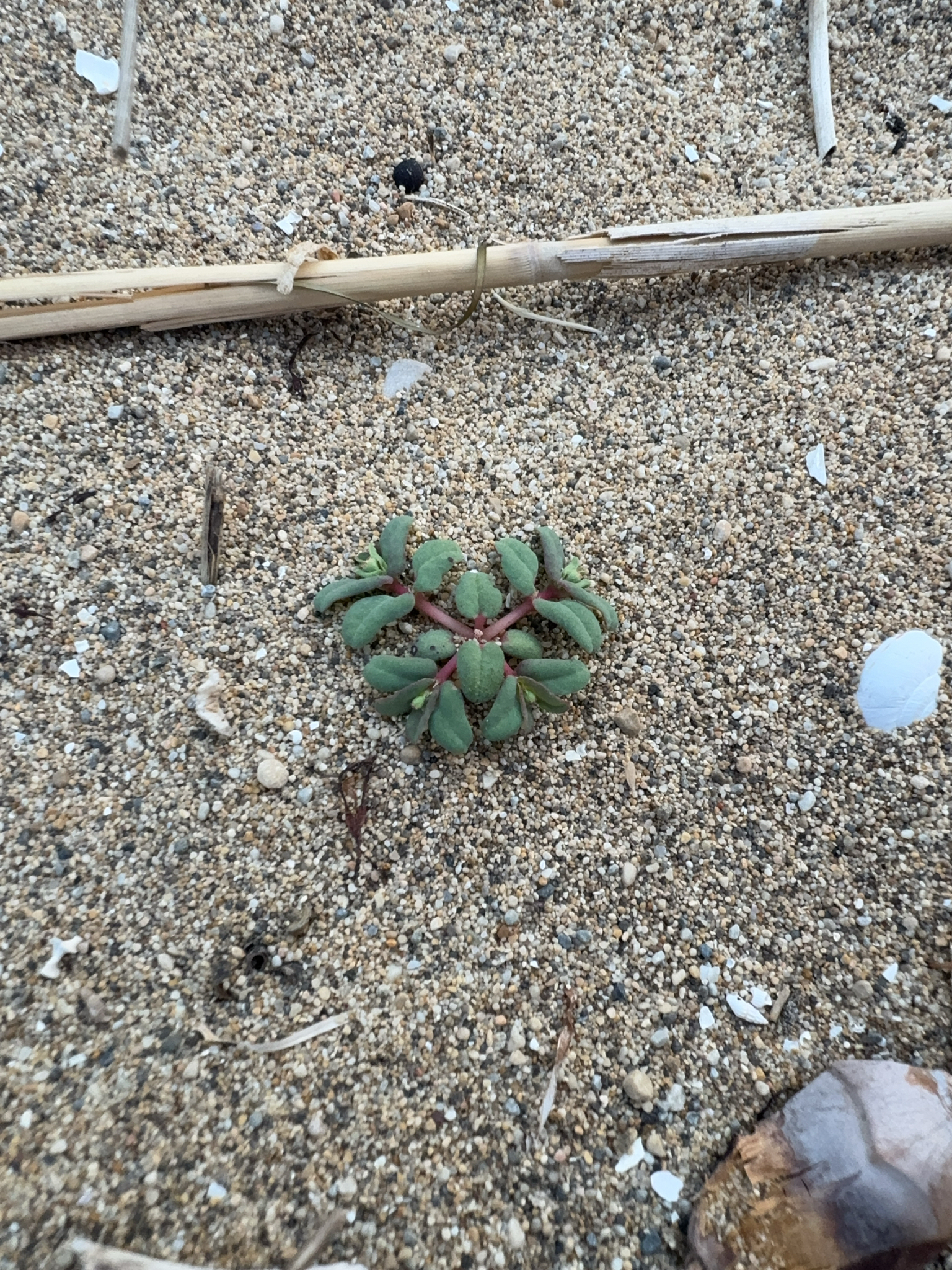
Purple spurge (Euphorbia peplis) is a small beach annual in the Euphorbiaceae, native to European and Mediterranean coasts and neighboring regions. Reddish stems spread in a circle over sand, with opposite fleshy leaves and strongly asymmetric bases. Its latex requires caution.
Read morePurple spurge
Anisophyllum peplis, Chamaesyce peplis and Tithymalus peplis

© photo
(c) Duarte Frade, some rights reserved (CC BY), uploaded by Duarte Frade · cc-by
Dimitri Brosens · cc0
iNaturalist User · cc0
(c) Anton Popovich, some rights reserved (CC BY) · cc-by
(c) Юрий Данилевский (Yuriy Danilevsky), some rights reserved (CC BY) · cc-by
Global distribution
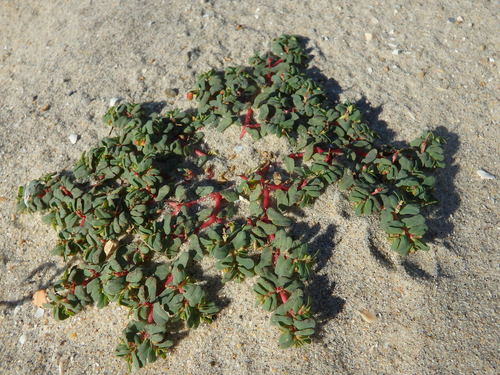
Native to Macaronesia, Europe and the Mediterranean east to Iran; chiefly coastal.
Identity
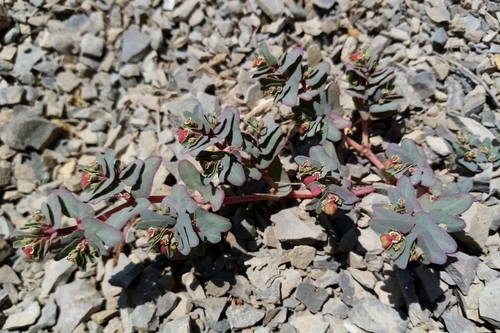
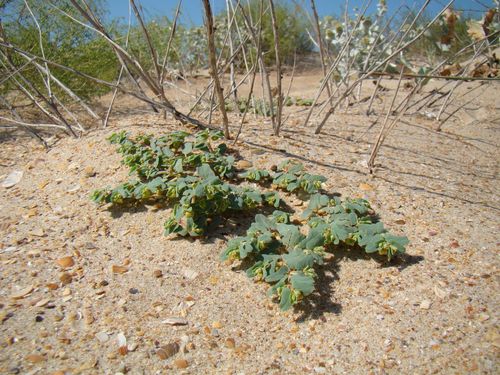
Purple spurge (Euphorbia peplis L., 1753) is a small creeping coastal annual. Reddish branches radiate around a taproot. Thick, opposite, gray-green leaves stand out on pale sand even when floral structures remain inconspicuous. The species belongs to Euphorbiaceae, like large garden spurges, but its habit and life cycle differ considerably from those familiar ornamentals. 2 4
Plants measure 5–20 cm (2–8 in), with prostrate stems 5–30 cm (2–12 in) long. These measurements should not suggest an upright stem: much of the plant extends close to the ground. Look first for leaves and branches, then examine capsules, allowing identification even when the tiny floral structures are overlooked. 2 4
Recognition
Asymmetry at the leaf base is decisive. One side slopes toward the stalk, while the other forms a small ear-like lobe. Leaves are oval to oblong, entire and hairless. Tips are rounded, sometimes slightly notched. Small stipules occur at their bases, easier to examine with a hand lens. The difference between the two sides should be checked on several leaves. 2 4
Smooth, hairless, three-parted capsules measure 4–5 mm (0.16–0.2 in). Smooth pearl-gray seeds are about 3 mm (0.12 in) long. Fleshy leaves help retain water in a rapidly drying habitat. A photograph at ground level reveals the radiating habit better than a distant overhead view. 2 4
Useful taxonomy
Euphorbia peplis remains the accepted name, described by Linnaeus in 1753. Tithymalus peplis (L.) Scop., Anisophyllum peplis (L.) Haw. and Chamaesyce peplis (L.) Prokh. derive from the same original name. Generic transfers explain differences between older publications and current floras. 1
Chamaesyce maritima Gray also appears in synonymy. Start distribution searches from the accepted binomial, then check synonyms in each reference. A precise species name matters because spurge alone can identify plants with very different dimensions, habitats and cycles. Shared generic membership does not make their garden requirements interchangeable. 1 3
Habitat and range
The native range extends from Macaronesia through Europe and the Mediterranean to Iran. French records concern maritime sands along the English Channel, Atlantic and Mediterranean, including Corsica. Its association with maritime sand means a map spanning many countries does not imply an even distribution throughout their interiors. 1 3 2
Upper-beach sand receives organic debris from strandlines, releasing nutrients as it decomposes. Sand remains freely drained, exposed to spray and disturbance. Fleshy leaves and rooting help survival in this shifting habitat. Mechanical beach cleaning can therefore destroy both the plants and the conditions supporting their development. 4
Life cycle and reproduction
Seed renews the population each year. In France flowering runs May–September. Solitary floral structures occupy leaf axils. As in other spurges, the true flowers are tiny, unisexual and without a perianth; small rounded glands are associated with the floral structures rather than a corolla of large colored petals. 2 4 6
One plant bears male and female flowers. Developing capsules first lie beneath leaves; their stalks straighten at maturity to release seed. Fruit position therefore changes as capsules ripen. Disappearance of adult stems late in the season need not mean local loss of the species: seed carries the annual cycle into the next generation. 4 1
Latex and precautions
Spurge latex can irritate skin and eyes. Do not break a stem to test for white sap: foliage and fruit provide enough observational characters. Creeping growth does not reduce exposure from a crushed stem. These precautions concern the genus, rather than a measured species-specific toxicity assessment. 5
Ingesting spurge can cause blisters on lips and oral mucosa, nausea or vomiting. The genus presents risks to children, cats and dogs. Protect eyes particularly carefully, since latex can cause temporary or lasting corneal injury. Keep children and animals away from broken fragments to avoid unnecessary exposure. Purple spurge must not be eaten. 6 5
Observation and conservation
Observation in place protects the habitat better than collection. Low plants are vulnerable to trampling and upper-beach work. Recent Breton sites are few and concentrated in Morbihan. Local decline differs from global extinction: a species may be severely threatened in one region while persisting elsewhere. 4
Purple spurge is protected throughout mainland France: destroying wild plants is prohibited, and collection, transport or transfer requires ministerial authorization. Nationally Least Concern, it is Critically Endangered in Aquitaine and Poitou-Charentes, Endangered in Brittany and Provence-Alpes-Côte d'Azur, Vulnerable in Pays de la Loire, and regarded as extinct in Basse-Normandie. It has also disappeared from Great Britain and Ireland. 7 1
Conservation depends on retaining strandlines and limiting disturbance. Stay on paths to avoid crossing the small sand-colonizing plants. For identification, photograph habit, a leaf pair and a capsule without detaching them. Repotting or fertilizer has no place at a natural site. 4
Main sources
Names, morphology, ecology and protection concern this species; latex precautions apply across spurges.
Frequently asked questions
Where does purple spurge grow?
Mainly on sandy upper beaches where strandline material accumulates, along the English Channel, Atlantic and Mediterranean coasts of France and in Corsica.
How can I identify purple spurge?
Look for a small hairless annual with reddish stems lying in a circle and fleshy opposite leaves with asymmetric bases.
Can I touch its latex?
Avoid contact: spurge latex irritates skin and eyes. Observe without breaking stems or collecting fragments; the species is protected in France and destroying wild plants is prohibited.
If you are unsure about a plant’s toxicity, ask a botanist or veterinarian for advice.