
Ficus retusa


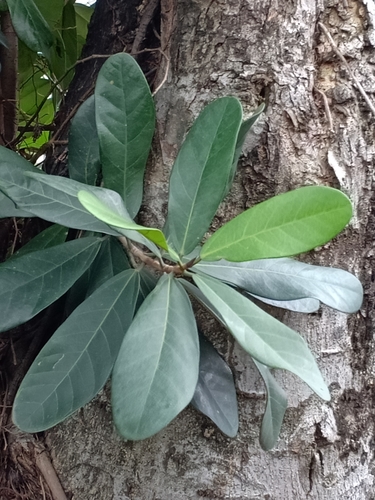
Ficus retusa L. is a lowland forest fig with leathery leaves often broader toward the tip and small orange to dark red figs. Its identity is distinct from Ficus microcarpa, frequently called retusa in bonsai cultivation.
Read morePerula retusa and Urostigma retusum
Give plenty of ambient light without direct sun on the leaves.
Bright indirect light, following general guidance for ornamental figs


© photo
Wikimedia Commons · CC BY-SA or Public Domain
Global distribution
Native range documented in Java and the southern part of Borneo, Indonesia.
- Native2
- Java, Indonesia
- Southern Borneo, Indonesia
Hexagons: regions where the plant occurs. Green dots: native range.↗
Identity
Ficus retusa L., described in 1767, is a fig tree from Java and southern Borneo. The botanical name does not automatically identify a bonsai sold as "retusa": that plant is often Ficus microcarpa. Keep the species distinct when describing their origins, foliage or figs. A familiar sales label alone does not establish which of the two species is present. 3 2 5
The species belongs to the Moraceae, the fig family. Botanical references recognize Ficus retusa L. as an accepted species. The letter L., referring to Linnaeus, is useful on a label or in a search: it distinguishes the actual botanical name from misapplications recorded in catalogs. Including the author helps clarify which use of the name a reference intends. 4 2
Recognition
Spirally arranged, leathery leaves characterize Ficus retusa. The blade can be oblong or obovate, meaning broader toward the tip than near the stalk. The tip is rounded, and the base obtuse to rounded. In the botanical description, leaves usually measure 4 to 15 cm (1.6 to 5.9 in) long and 1.5 to 6 cm (0.6 to 2.4 in) wide. Leaf shape and dimensions should be considered together. 1
The midrib is sunken on the upper surface, at least in its lower part. Small dark brown hairs pressed against the surface can occur, especially along the veins beneath the leaf. The midrib and hair details matter: a description limited to "small, smooth, glossy leaves" does not confirm this species. Examine the lower surface as well as the outline visible from above. 1
Orange to dark red figs grow in the leaf axils, singly or in pairs, directly on the branch. The flora describes the receptacle's apex as flat to slightly convex. Field observations also report a depression around the ostiole, the small opening at the end. Leaves and figs together allow a firmer identification than the silhouette of a pruned tree, which does not show all these characters. 1 5
Useful taxonomy
The name Ficus retusa was published in Linnaeus's Mantissa Plantarum. Older combinations such as Perula retusa (L.) Raf. and Urostigma retusum (L.) Gasp. refer to the same taxon in the flora's treatment. The older combinations can help interpret an older reference without changing the species being discussed. 3 1
The notation Ficus retusa auct. means something different: it marks a name used by authors in an incorrect sense. The American entry carrying that notation points to Ficus microcarpa. The entry therefore does not justify treating the true Ficus retusa L. as a synonym of that species. 6 2
Habitat and range
Ficus retusa is described from lowland forests in Java and southern Borneo. The American agricultural reference confirms Java and Kalimantan as native territories. The documented range is more precise than a general label such as "Asian fig," which covers numerous species. Geographic information attached to another fig should not automatically be transferred to this one. 1 2
The botanical treatment gives a height reaching 10 m (33 ft). The tree is described as a hemiepiphyte, with observations of a shrubby or small-tree habit as well. The height concerns a plant in its natural setting; it does not predict the height of a container specimen or a regularly pruned tree. A cultivated outline and a wild-tree measurement describe different conditions. 1 5
Life cycle and reproduction
Small figs of Ficus retusa turn orange and then dark red as they mature. Measurements from a dried specimen should not be interpreted as fresh-fruit dimensions: the flora gives a diameter of 0.6 to 0.9 cm (0.24 to 0.35 in) on dry material. The basal bracts persist around the receptacle. The dry condition of the measured material is part of the botanical observation. 1
For indoor cultivation, seasonal guidance follows general recommendations for ornamental figs. Water regularly in spring and summer, allowing the mix to dry slightly, then keep it less moist in winter. Repot in spring and feed during growth through late summer. The genus-level guidance provides a cultivation calendar without turning winter months into a demonstrated botanical dormancy for this species. Readers in other growing conditions should retain that distinction between seasonal care and species biology. 8
Semi-ripe cuttings in spring or summer also appear in recommendations for ornamental figs. First confirm the parent plant's name: propagating a mislabeled bonsai reproduces the plant itself, not the identity printed on its pot. Successful rooting does not resolve an identification error, so the parent plant needs the same botanical checks as the resulting cutting. 8 5
Uses and risks
Uses of the latex and traditional medicinal applications are recorded for Ficus retusa. An ethnobotanical record describes a use; it establishes neither effectiveness nor a safe dose. The ethnobotanical reports do not provide a home-treatment recipe. 2
Horticultural warnings for figs recommend gloves during pruning because their sap can irritate skin or aggravate an allergy. The genus-level precaution supports avoiding contact with eyes and skin. The general warning does not provide a species-specific ingestion assessment for Ficus retusa in every domestic animal. Unknown animal statuses therefore remain unknown rather than being replaced by a general claim of safety. 8
Varieties, look-alikes and related plants
Horticultural guides describe ginseng bonsai as a form of Ficus microcarpa. Its swollen roots and commercial presentation should not automatically be assigned to Ficus retusa L. Confusion also occurs in ornamental-tree literature, where the name retusa has sometimes been applied to microcarpa. A reference's use of the word retusa consequently needs to be read alongside the plant it describes. 8 7
The old variety Ficus retusa var. borneensis is treated as a separate species, Ficus kochummeniana, in the flora. Figs such as F. spathulifolia and F. tristaniifolia also have similar obovate leaves. Examine the figs and other characters before reaching an identification; an obovate leaf alone does not distinguish all these related plants. 1 5
Main sources
- Berg and Corner, Flora Malesiana, Ficus retusa
- USDA GRIN, Ficus retusa L.
- IPNI, publication of the name Ficus retusa
- GBIF, Ficus retusa L.
- The Figs of Borneo, identifying Ficus retusa
- ITIS, misapplication of Ficus retusa auct.
- University of California, confusion with Ficus microcarpa
- RHS, growing ornamental figs
Frequently asked questions
Is Ficus retusa the ginseng fig?
Commercial ginseng figs generally belong to Ficus microcarpa. Ficus retusa L. is a distinct species; a retusa label alone is not enough to identify the plant.
Where does the true Ficus retusa come from?
The flora and the GRIN reference document its native range in Java and southern Borneo, Indonesia.
When should a container-grown Ficus retusa be repotted?
Spring is the general reference season recommended for ornamental figs. The condition of the roots and growing mix also needs to be considered.
If you are unsure about a plant’s toxicity, ask a botanist or veterinarian for advice.