
Bates gasteria (Gasteria batesiana, )
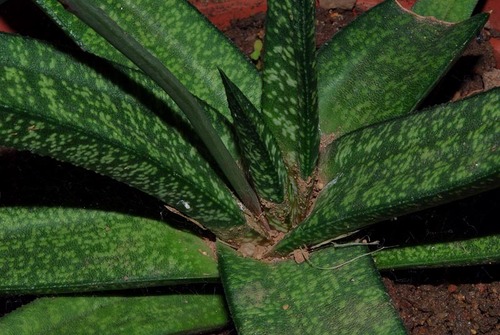

Bates gasteria (Gasteria batesiana) forms compact rosettes of fleshy, rough, dark green leaves dotted with white. This Asphodelaceae succulent is native to northeastern South Africa and Eswatini. Its pink tubular flowers hang along arching flower stalks.
Read moreBates gasteria
Give plenty of ambient light without direct sun on the leaves.
Bright filtered light under cover; tolerates partial shade.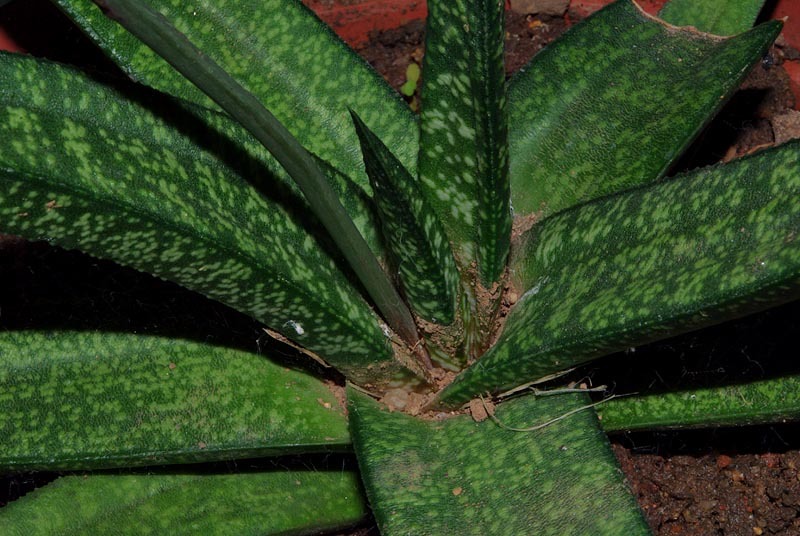


© photo
(c) Linda Loffler, some rights reserved (CC BY-NC), uploaded by Linda Loffler · cc-by-nc
Wikimedia Commons · CC BY-SA or Public Domain
Wikipedia · CC BY-SA



Global distribution
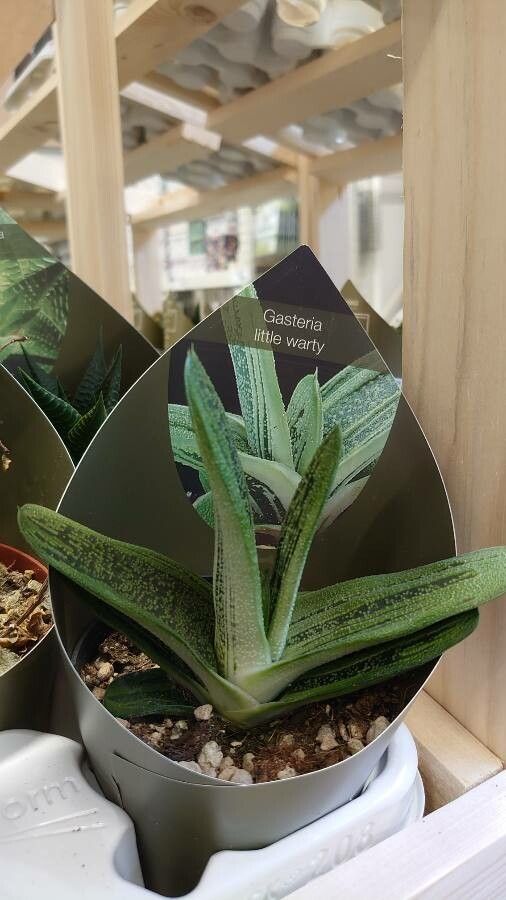
Native to Eswatini and northeastern South Africa, in KwaZulu-Natal and the Northern Provinces according to Kew.
Identity
Bates gasteria (Gasteria batesiana G.D.Rowley, 1955) is a small succulent recognizable by its thick, rough, dark green leaves covered with small white spots. The pale markings form irregular transverse bands. The plant stays compact and develops groups of rosettes with age. Its foliage provides identification characters even outside the flowering season. 3 1
Kew accepts this species name in the Asphodelaceae family, within the Asparagales. The epithet batesiana honors John T. Bates, a collector of South African succulents who worked in London transport. The name therefore commemorates a person; it does not indicate a region of origin. 1 6
Recognition
Young plants carry their leaves in two opposite rows. As they age, the leaves take on a rosette arrangement. The fleshy, triangular to lance-shaped leaves stay green throughout the year. Their rough surface and white spots complement the overall shape when identifying the species. 3 5
The RHS gives a height of up to 10 cm (4 in), a spread of 10 to 50 cm (4 to 20 in) and a time to maturity of 2 to 5 years. Arching flower stalks carry hanging pink tubular flowers. Their tips are described as pale yellow by the RHS and soft green by Chicago Botanic Garden: flower-tip color alone therefore cannot settle an identification. 3 5
Useful taxonomy
The name Gasteria batesiana was published in 1955, in the National Cactus and Succulent Journal, volume 10, page 32. IPNI documents this publication under the historical family Aloaceae; Kew and the RHS now use Asphodelaceae. These different family placements do not identify two separate species. 2 1 3
Kew recognizes two botanical varieties: Gasteria batesiana var. batesiana and Gasteria batesiana var. dolomitica van Jaarsv. & A.E.van Wyk. A botanical variety is distinct from a horticultural cultivar. Huntington also notes that crosses between Gasteria and Aloe are named ×Gasteraloe and are generally sterile. This sterility concerns the hybrids described, rather than the pure species. 1 6
Habitat and distribution
The native range includes Eswatini and northeastern South Africa. Kew specifies KwaZulu-Natal and the "Northern Provinces" and associates the species with dry, desert or shrubland biomes. Chicago Botanic Garden describes sites on north- and east-facing cliffs, along with shade tolerance. A dry habitat therefore does not necessarily mean constant exposure to full sun. 1 5
The provenance of a cultivated plant needs a different interpretation. The plants presented by Huntington in 2025 passed through a nursery near Robertson in the Western Cape, but originated from seed collected near Barberton in Mpumalanga. A nursery's address does not extend the natural range. 6
Life cycle and propagation
Bates gasteria is an evergreen perennial. The RHS places flowering in spring in its British horticultural setting. The flowers produce nectar and attract sunbirds, according to Chicago Botanic Garden. A season reported by one garden does not establish a universal flowering calendar. 3 5
Seed and leaf cuttings are the propagation methods the RHS gives for this species. Its general succulent guide advises letting a cutting's wound dry before placing it in growing medium. Huntington also shows several seed-grown forms with different leaf patterns: plants of a shared provenance can vary in appearance. 3 4 6
Growing in pots
Under cover, choose bright filtered light and a very free-draining cactus mix. The RHS recommends moderate watering during growth and keeping the plant dry during rest. Keep it frost-free. The fleshy leaves store water; a continuously damp growing medium exposes roots to rot. 3 4
The general RHS guide advises letting the surface of the mix dry between waterings, then draining away all excess water. It calls for liquid cactus fertilizer once a month from April to September. Repot in spring, only when roots fill the pot: an oversized container dries more slowly. The calendar provides a seasonal synthesis for indoor cultivation in the Northern Hemisphere; its scores express relative intensity. 4
Uses and risks
Bates gasteria is grown as an ornamental in pots, greenhouses or conservatories. Huntington notes its tolerance of low light, while stating that brighter exposure may turn the foliage red. This coloration concerns certain conditions and cultivated forms; it is not a necessary character of every plant. 3 6
The horticultural references used do not establish that the species is safe. The descriptions document its appearance and cultivation without toxicological assessments specific to cats, dogs, horses, children or adults. Status remains unknown for these groups. Ornamental use and the presence of nectar do not demonstrate suitability as food. 3 5 6
Main sources
- Kew, Plants of the World Online: Gasteria batesiana
- International Plant Names Index: Gasteria batesiana
- Royal Horticultural Society: Gasteria batesiana
- Royal Horticultural Society: growing indoor cacti and succulents
- Chicago Botanic Garden: Gasteria batesiana
- Huntington, International Succulent Introductions 2025: Gasteria batesiana
Frequently asked questions
Are the white spots on Bates gasteria normal?
Small white spots, often arranged in irregular bands on the dark green leaves, are part of the species description.
Why do the leaves not form a rosette yet?
Young plants have leaves in two opposite rows. Older plants develop a rosette habit.
Can Gasteria batesiana tolerate frost?
The RHS recommends frost-free cultivation. In cold climates, grow the plant under cover in a very free-draining mix.
How can I propagate Gasteria batesiana?
The RHS lists seed and leaf cuttings for this species.
If you are unsure about a plant’s toxicity, ask a botanist or veterinarian for advice.