
Barberton daisy (Gerbera jamesonii, )
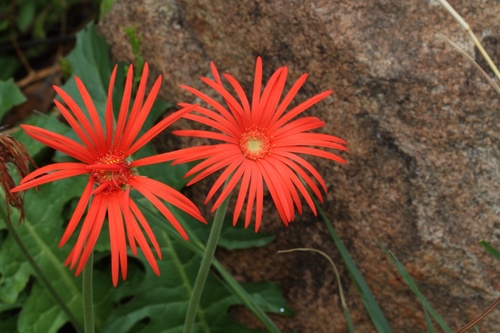

Barberton daisy (Gerbera jamesonii) is a southern African perennial in the Asteraceae family with a rosette of leaves and solitary flowerheads. Gerberas sold commercially are often hybrids descended from this species.
Read moreBarberton daisy and Transvaal daisy
Place in full sun, with intense direct light all day long.
Sun outdoors; bright light sheltered from scorching sun behind glass.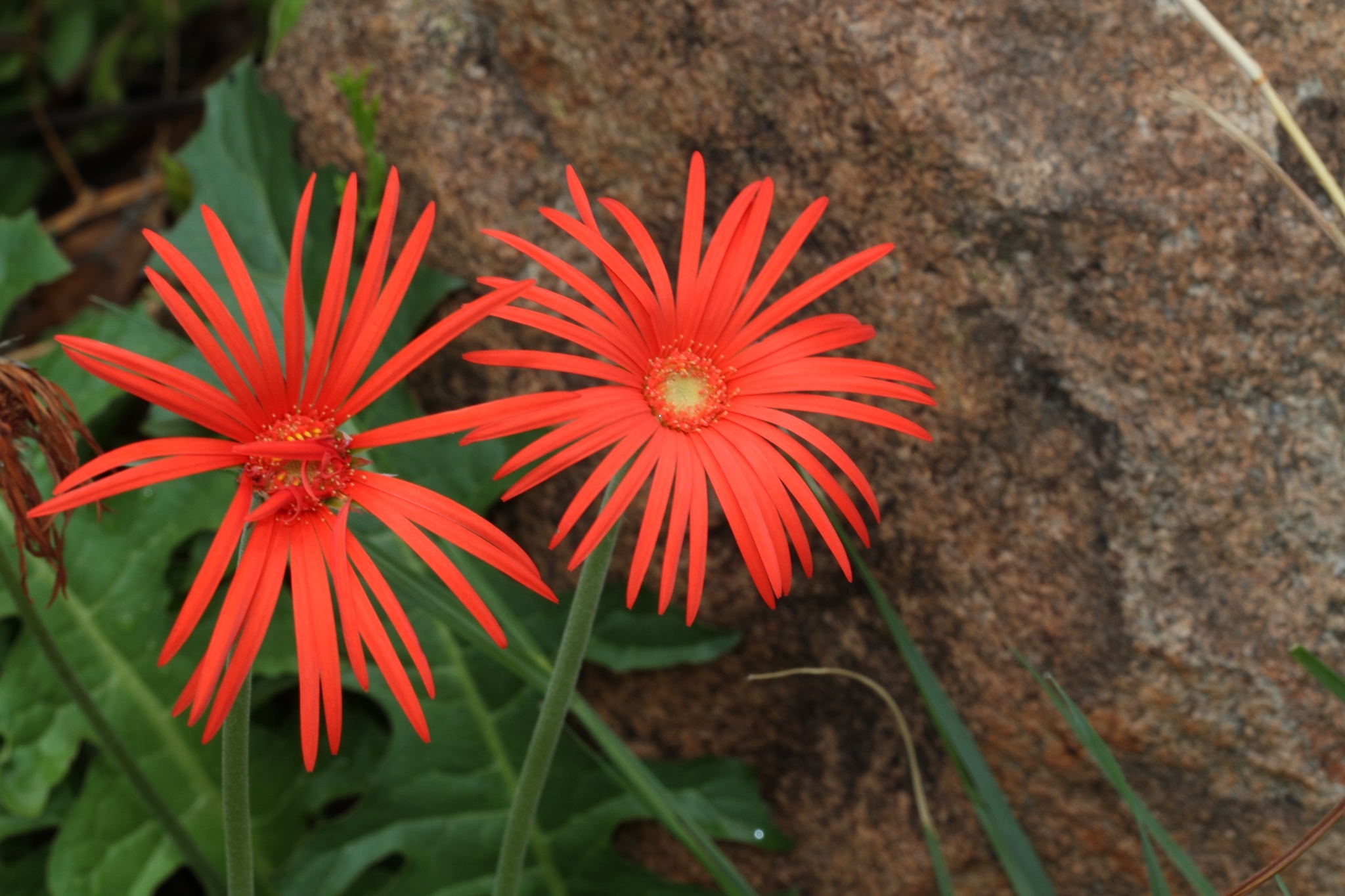


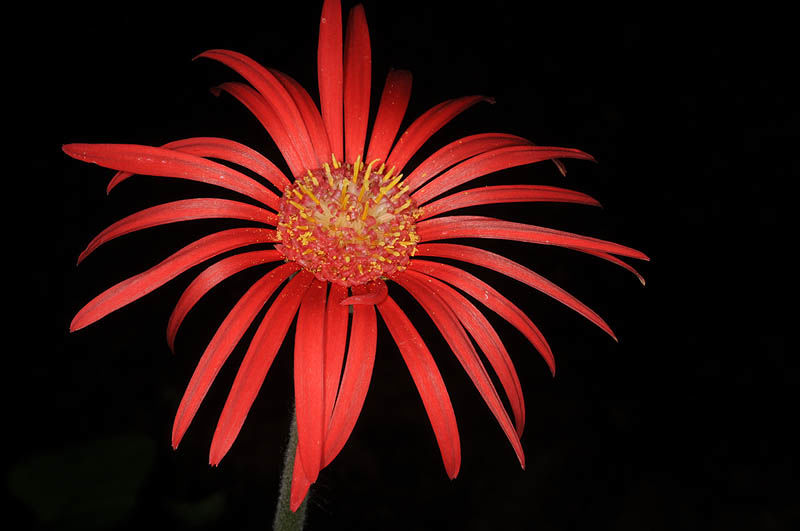


© photo
(c) Joan Faiola, some rights reserved (CC BY-NC), uploaded by Joan Faiola · cc-by-nc
Wikimedia Commons · CC BY-SA or Public Domain
Wikipedia · CC BY-SA
Taken Apr 15, 2022 by Miguel Zamarro (cc-by-sa)
Taken May 14, 2022 by Annemarie Ahrens-Stehle (cc-by-sa)
Taken Sep 21, 2020 by Irene (cc-by-sa)
Taken Feb 8, 2022 by Annemarie Ahrens-Stehle (cc-by-sa)
© copyright of the Board of Trustees of the Royal Botanic Gardens, Kew.


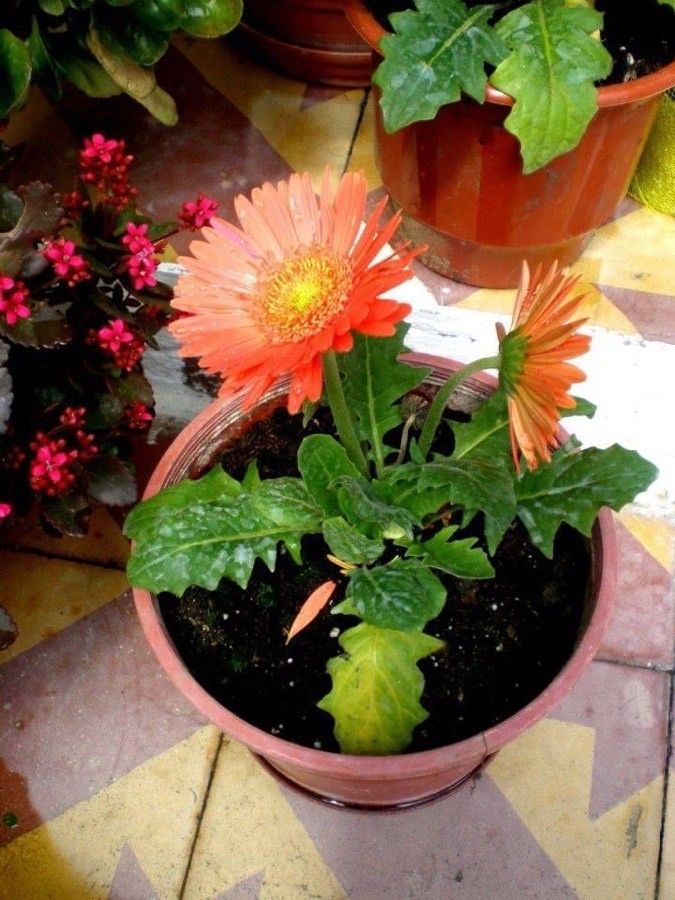


Global distribution
Native from northern South Africa to Eswatini; introduced in several tropical regions.
- Native2
- Introduced1
- South Africa
- Eswatini
- Réunion
Hexagons: regions where the plant occurs. Green dots: native range.1
Identity
Barberton daisy (Gerbera jamesonii) is a perennial whose leaves form a rosette at ground level, beneath long stalks that each carry a single flowerhead. Its French name, “gerbéra de Jameson,” is attested in botanical literature; both “gerbera” and “gerbéra” are also used in French. 26
The species belongs to the Asteraceae, the daisy family. Its accepted name is Gerbera jamesonii Adlam, published in 1888. It remains a distinct botanical species, although its name often accompanies horticultural plants of hybrid origin. 12
Recognition
The dark green, deeply lobed leaves have woolly undersides. They arise from the base, while the upright flower stalk carries no leafy branches. The species’ horticultural profile describes leaves reaching 45 cm (18 in) long and flowerheads up to 12 cm (5 in) across; these maximum dimensions do not describe every wild plant. 3
Each flowerhead contains many small flowers. The outer florets produce the colored rays, while the central florets form the disc. Wild forms have a single ring of ray florets. Double forms and those with very narrow rays belong to horticultural selections; their appearance alone cannot establish that a plant is the pure species. 2
Useful taxonomy
The genus name Gerbera honors the physician and botanist Traugott Gerber. The epithet jamesonii commemorates Robert Jameson, who collected the plant near Barberton. This history explains the name, but does not by itself identify the gerberas sold today. 2
Most horticultural gerberas descend from crosses between Gerbera jamesonii and Gerbera viridifolia. Breeding began in England in the late 19th century. The name Gerbera × hybrida refers to this hybrid material and should not be treated as a botanical synonym of G. jamesonii. A commercial label saying only “jamesonii” therefore leaves the plant’s ancestry uncertain. 2
Habitat and range
Gerbera jamesonii is native from northern South Africa to Eswatini. This perennial belongs to a subtropical flora. Its presence in a European garden represents cultivation rather than part of its native range. Introductions are documented in several tropical regions, including Réunion, so a record of its presence does not necessarily mean it is native there. 1
In the wild, the species occupies bushveld, mixed woodland and steep slopes, on stony or clay soils associated with dolomite. It can also appear on burned ground. These habitats describe the wild species; they are not a potting recipe that can be transferred without adjustment to a container indoors. 2
Life cycle, propagation and cultivation
In cultivation, flowering extends from late spring to late summer. Removing faded flowerheads encourages further flowering. Divide plants in early spring; basal cuttings can be taken in summer. 3
The following advice concerns gerberas grown in pots. Choose a deep container and a well-drained, peat-free potting mix, keeping the crown slightly above the surface. Water the mix without wetting the center of the rosette, then let the excess drain away. A persistently wet crown encourages rot, making both planting depth and watering technique relevant. 4
In summer, keep the mix moist but let it dry partly between waterings; reduce watering in winter. Divide crowded clumps in spring and replant them in fresh mix. Apply a general-purpose liquid fertilizer in spring and summer at the manufacturer’s rate and frequency; a high-potassium formula can support summer flowering. The calendar expresses this guidance as relative scores for cultivation in mainland France. 4
A bright window is suitable, with protection from scorching sun through glass in summer. For tender gerberas, provide well-ventilated conditions between 10 and 20 °C (50–68 °F) during flowering and bring them indoors in fall. Hybrid seedlings do not faithfully reproduce their parent’s characteristics; division preserves a selected plant. 4
Uses and risks
Gerberas are grown for bouquets and flowering pots. Their long cut-flower stems can be brittle. When displaying them in a vase, clean the container and replace the water to limit bacterial buildup. Bacteria reduce water movement through the stems, so clean vase water serves a practical purpose beyond its appearance. 62
Gerbera jamesonii is listed as non-toxic to cats, dogs and horses. That classification concerns these particular animals; it establishes neither safety for every animal nor edibility for people. The selected references do not establish safety for children or adults. The overall toxicity level therefore remains unknown without canceling the documented classifications for the named animals. 5
Varieties, look-alikes and related plants
The Garvinea and Everlast series include horticultural gerberas that are hardier than the usual tender types. Their response to cold cannot be used to assign the same tolerance to the botanical species Gerbera jamesonii. Double forms and selected colors likewise need to be described at the level of the particular cultivar or hybrid, rather than attributed to the wild species. 42
The English name “African daisy” is also used for Osteospermum and Arctotis. A daisy-like outline is therefore insufficient for identification: examine the basal rosette, leaves and leafless flower stalk, then check the botanical name. To distinguish the pure species from its horticultural hybrids, documented plant provenance is more useful than flower color alone. 2
Main sources
The taxonomic references establish the species’ identity; the cultivation guide concerns horticultural gerberas.
- Kew, Plants of the World Online : Gerbera jamesonii Adlam
- Ernest Small, Top Canadian Ornamental Plants. 21. Gerbera, CBA/ABC Bulletin, 2018
- Royal Horticultural Society : Gerbera jamesonii
- Royal Horticultural Society : How to grow gerberas
- ASPCA : African Daisy, Gerbera jamesonii
- Office québécois de la langue française : gerbera
Frequently asked questions
Is Barberton daisy toxic to cats?
Gerbera jamesonii is explicitly listed as non-toxic to cats, dogs and horses. This classification does not establish whether it is safe for people to eat.
Why is my gerbera rotting in the center?
A buried or frequently wet crown encourages rot. Position the crown slightly above the potting mix and allow excess water to drain away.
Can gerberas stay outdoors through winter?
The species needs protection from cold. Hardier horticultural series such as Garvinea have their own requirements and do not establish the hardiness of Gerbera jamesonii.
Will seeds produce the same color as the gerbera I bought?
Horticultural gerberas raised from seed may differ from their parent. Division preserves the characteristics of the plant being propagated.
If you are unsure about a plant’s toxicity, ask a botanist or veterinarian for advice.