
Elegant calathea (Goeppertia concinna, )
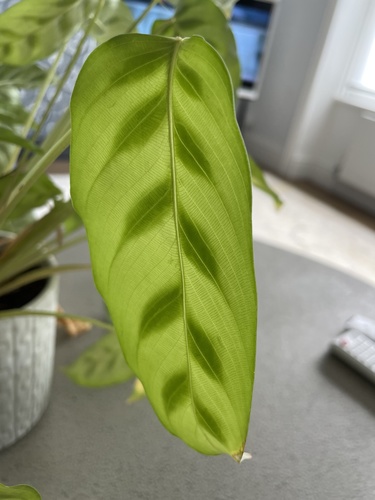


Elegant calathea (Goeppertia concinna) forms a clump of lance-shaped leaves with dark green markings. This Brazilian perennial grows in indirect light with warmth and humid air.
Read moreElegant calathea
Maranta concinna, Calathea concinna, Calathea leopardina, Maranta leopardina and Phyllodes leopardina
Place in indirect light or in a shaded room.
Indirect light in a shaded position.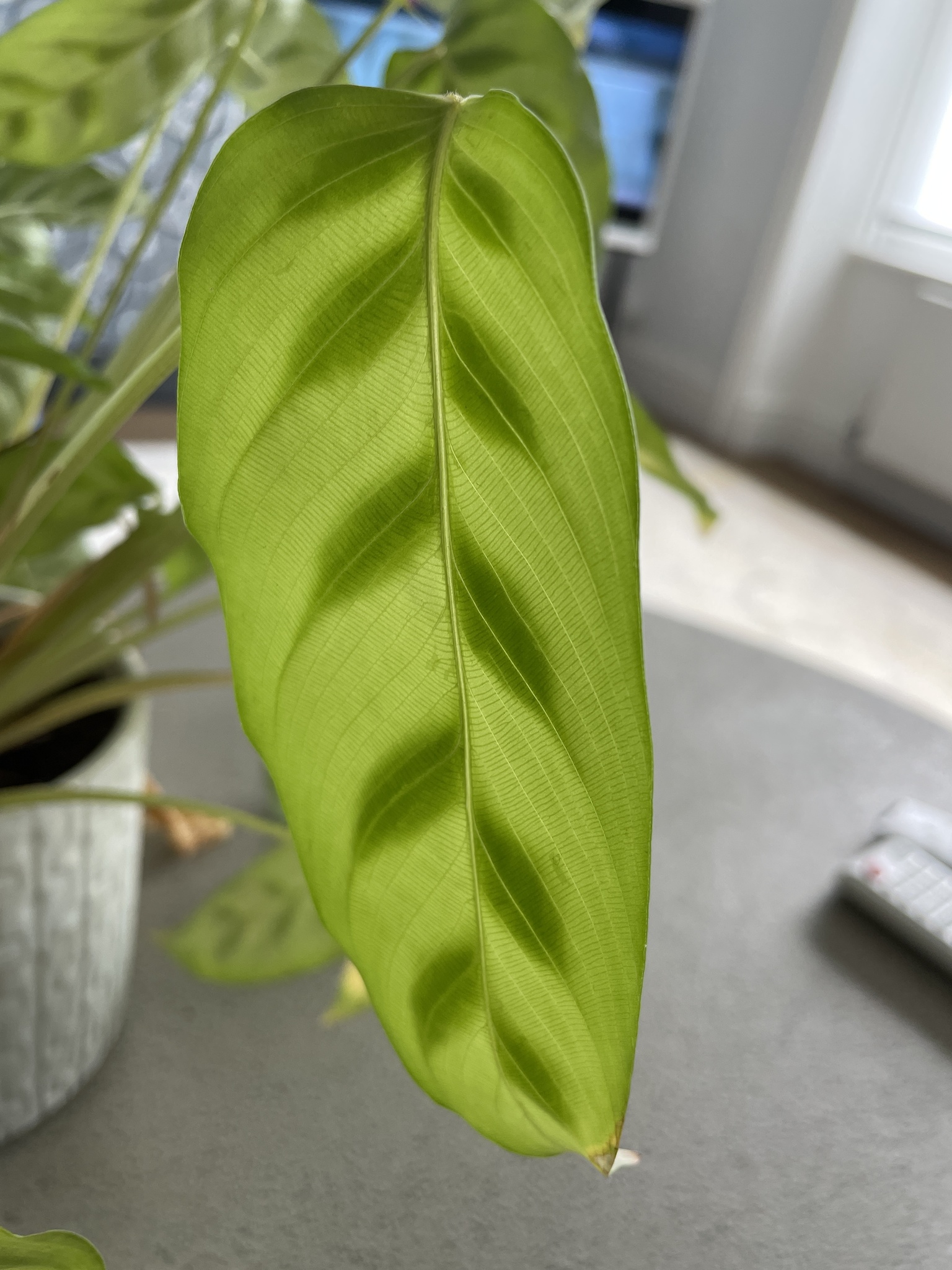


© photo
(c) willkuhl, some rights reserved (CC BY-NC) · cc-by-nc
Wikimedia Commons · CC BY-SA or Public Domain


Global distribution
Native and endemic to Brazil, recorded in the states of Espírito Santo and Minas Gerais.
Identity
Elegant calathea (Goeppertia concinna (W.Bull) Borchs. & S.Suárez) has pale green leaves patterned with broad dark green markings. Narrow, lance-shaped blades point upward on leafstalks that grow together in a clump. In French, Pl@ntNet records the shared name “Calathea” for this particular species; that French usage should be distinguished from its English common name. 1 8
This Brazilian perennial belongs to the Marantaceae family, in the order Zingiberales. Its accepted name is Goeppertia concinna; the continued use of “calathea” in everyday language does not alter its current botanical genus. The full binomial helps distinguish the species when identifying a plant or looking up growing advice under an older name. 2 3
Recognition
Elegant calathea forms an upright clump and keeps its leaves year-round. The British horticultural description emphasizes dark green bands across a pale blade. The Brazilian flora describes oval blotches on a glossy upper surface and a gray-green underside. Leaf shape and the color beneath the blade therefore need to be considered alongside the pattern above. 1 6
Published heights describe different contexts. Flora do Brasil gives 0.2–0.3 m (8–12 in) for these herbs, while the British horticultural account gives 0.5–1 m (1.6–3.3 ft) in height and 0.1–0.5 m (4–20 in) in spread. Combining those figures into one continuous range would conceal a difference between the treatments. Size alone cannot confirm the identity of a cultivated specimen. 6 1
Useful taxonomy
The original name, Maranta concinna W.Bull, was published in 1874. The transfer to Goeppertia dates from 2012. The dates record separate naming acts, rather than two successive discoveries of elegant calathea. The author in parentheses is the author of the basionym: the earlier name on which the current combination is based. 4
Calathea leopardina (W.Bull) Regel is a synonym of the same species in Saka and Lombardi's treatment. In 2015, those authors selected an illustration by Regel as the neotype of Maranta concinna, because no specimen or illustration associated with the original description was available. Typification establishes a reference for applying a botanical name; it does not create a cultivar. 5
Habitat and range
Elegant calathea is endemic to Brazil, according to Flora do Brasil, with confirmed occurrences in Espírito Santo and Minas Gerais. Espírito Santo and Minas Gerais form its documented native range in the wet tropical biome. The Brazilian flora places the species in the Atlantic Forest and describes it as a terrestrial herb, growing on the ground. 6 2
For cultivation, the horticultural advice calls for an open, moisture-retentive but well-drained substrate, in a shaded position lit by indirect light. Keep temperatures above 15 °C (59 °F). Moisture and drainage are simultaneous requirements: a moist substrate should still allow water to drain away rather than remain standing around the roots. 1
Life cycle and reproduction
Elegant calathea is propagated by dividing its rhizomes in summer, in the British horticultural setting described. The Brazilian flora records green bracts, a white calyx and a yellow corolla. The floral characters supplement the leaf characters used to identify elegant calathea; they do not establish a universal flowering season indoors. 1 6
The calendar represents indoor cultivation in mainland France, using a British seasonal scenario. The calathea growing guide includes Goeppertia, so its repotting and feeding advice is applied here to elegant calathea. Repotting in spring or summer, shown as March through August in that Northern Hemisphere setting, applies to a clump that has filled its pot, at intervals of several years. Other months fall outside this preferred window. Watering and growth scores are relative editorial indices, rather than measurements: watering decreases slightly in winter, while growth follows an active April–September scenario and slows outside it. The scores do not record the actual growth of an individual plant. 1 11
Species-specific advice recommends regular liquid houseplant fertilizer during growth. The calendar uses the group guide's April–September window, with a pause from October through March in its Northern Hemisphere context. Even within the feeding window, elegant calathea should receive fertilizer only when actively growing. If slow-release fertilizer was incorporated at repotting, the same guide normally dispenses with regular liquid feeding during the first year. The species advice supplies neither a dose nor a numerical frequency, so it does not establish a species-specific dilution. 1 11
Uses and risks
Elegant calathea is grown for its foliage indoors or under heated cover. Whiteflies and glasshouse red spider mites are reported as possible pests. A damp cloth is recommended for cleaning the leaves; distilled water or rainwater is also advised to prevent white marks and chemical damage to the foliage. 1
The Veterinary Poisons Information Service explicitly lists Goeppertia concinna among plants considered safe for households with pets. The list also warns that eating any plant material can cause mild gastrointestinal upset. The VPIS qualification accompanies a classification that does not assess cats, dogs or horses separately. Safety for adults and children remains unknown; a pet-focused list does not establish that the plant is safe for people to eat. 7
Varieties, look-alikes and related plants
The horticultural name ‘Freddie’ is assigned to Goeppertia concinna by the Florida Museum, whereas the British horticultural catalog lists it only under the genus Goeppertia. Institutional use attests the name but does not establish its parentage or registration. Dimensions and care advice for ‘Freddie’ should therefore not automatically be applied to the species as a whole. 9 10
A label reading Calathea leopardina (W.Bull) Regel carries a botanical synonym rather than a cultivar name. The distinction between synonyms and cultivar names matters when comparing plants: a different binomial can refer to the same species, while a horticultural name needs separate verification. Saka and Lombardi's treatment explicitly links Calathea leopardina with Goeppertia concinna. 5
Main sources
Kew documents the accepted name and native range of elegant calathea, while Flora do Brasil describes its morphology. Growing recommendations come from the RHS; the qualification about eating plant material comes from the veterinary service VPIS. 2 6 1 7
- Royal Horticultural Society, Goeppertia concinna
- Plants of the World Online, Goeppertia concinna
- EPPO Global Database, Goeppertia concinna
- International Plant Names Index, Goeppertia concinna
- Saka and Lombardi, Nomenclatural notes on Goeppertia, 2015
- Jardim Botânico do Rio de Janeiro, Flora do Brasil 2020, Marantaceae
- Veterinary Poisons Information Service, Pet safe plants, 2023
- Pl@ntNet, Goeppertia concinna, French common names
- Florida Museum, Goeppertia concinna ‘Freddie’
- Royal Horticultural Society, Goeppertia ‘Freddie’
- Royal Horticultural Society, How to grow calatheas, including Goeppertia
Frequently asked questions
Are Calathea leopardina and Goeppertia concinna the same species?
Yes. Saka and Lombardi and the Brazilian flora list Calathea leopardina as a synonym of Goeppertia concinna.
What light does elegant calathea need?
Grow it in indirect light in a shaded position, with humid air and temperatures above 15 °C (59 °F).
Is elegant calathea safe for pets?
VPIS lists Goeppertia concinna among plants considered safe for households with pets, but notes that eating any plant material can cause mild digestive upset. Animal groups are not assessed separately.
If you are unsure about a plant’s toxicity, ask a botanist or veterinarian for advice.