
Network prayer plant (Goeppertia kegeljanii, )
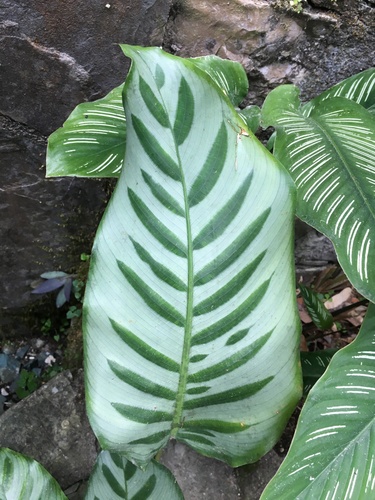

Network prayer plant (Goeppertia kegeljanii) has a fine dark green grid on light green leaves. This Brazilian perennial, still sold as Calathea musaica, needs filtered light and a moist but well-drained growing medium.
Read moreNetwork prayer plant and Mosaic calathea
Calathea musaica, Calathea bella, Goeppertia bella, Maranta kegeljanii and Maranta musaica
Give plenty of ambient light without direct sun on the leaves.
Bright indirect or filtered light; direct sun can burn the leaves.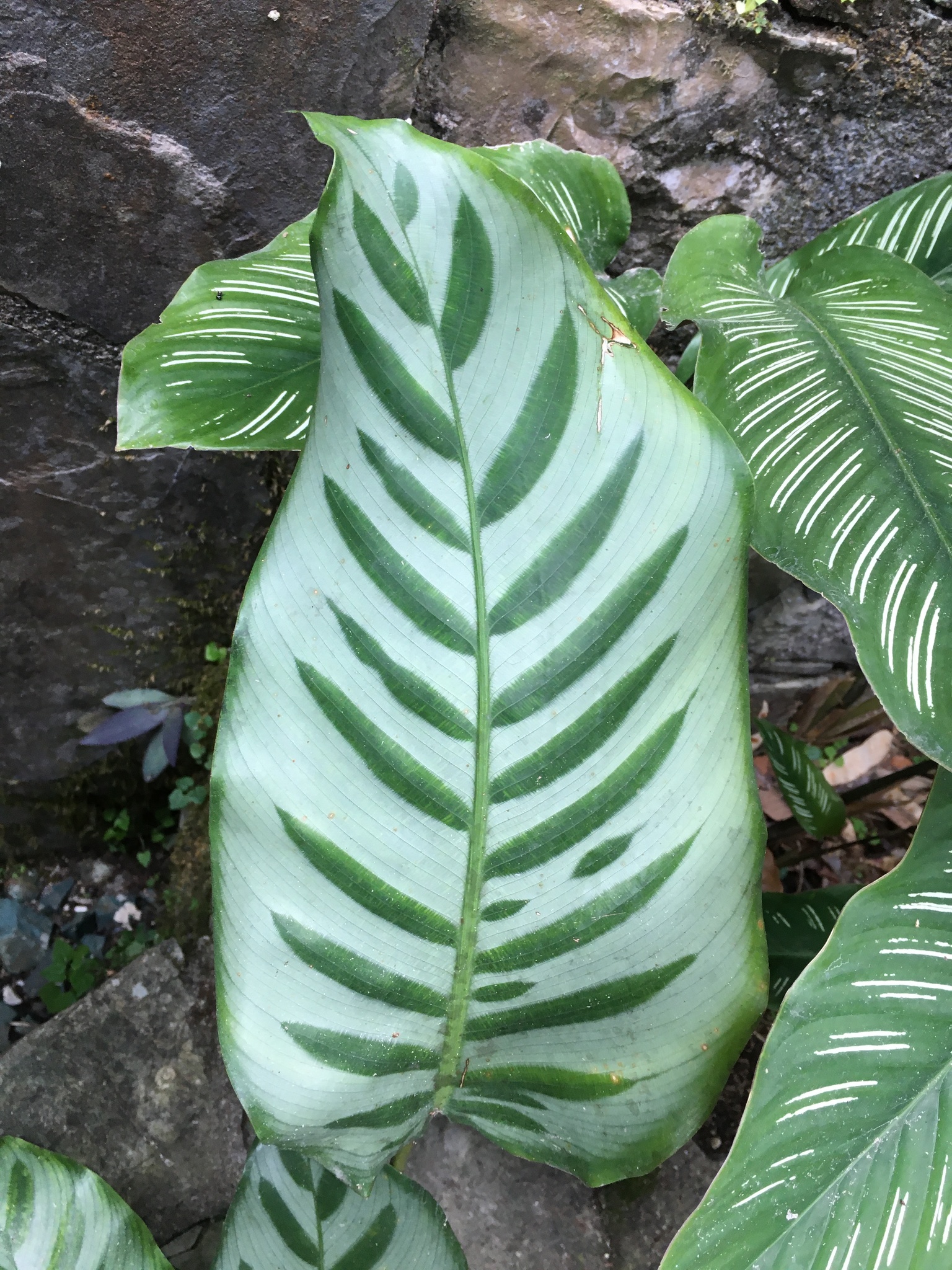


© photo
(c) Adriana García Ramírez, some rights reserved (CC BY), uploaded by Adriana García Ramírez · cc-by
Wikimedia Commons · CC BY-SA or Public Domain
Wikipedia · CC BY-SA
Global distribution
Native to the state of Espírito Santo in southeastern Brazil; grown as an indoor ornamental.
Identity
Network prayer plant (Goeppertia kegeljanii) (É.Morren) Saka, 2017 is recognized by the fine dark green grid on its light green leaves. This evergreen perennial belongs to the Marantaceae. The name still common on labels, Calathea musaica (W.Bull) L.H.Bailey, is a botanical synonym of the species. 1 7
The name’s history begins with Maranta kegeljanii É.Morren, published in 1875; the combination in Goeppertia dates from 2017. The epithet honors Ferdinand Kegeljan, a philanthropist associated with horticulture in Namur. The older names Calathea bella and Goeppertia bella are also synonyms. 1 7
Recognition
The leaves of Goeppertia kegeljanii are thick and glossy, with a heart-shaped base and wavy edges. Their dark lines form a tight mesh across the entire surface. Long leaf stalks arise from an upright clump supported by a system of rhizomes. 7
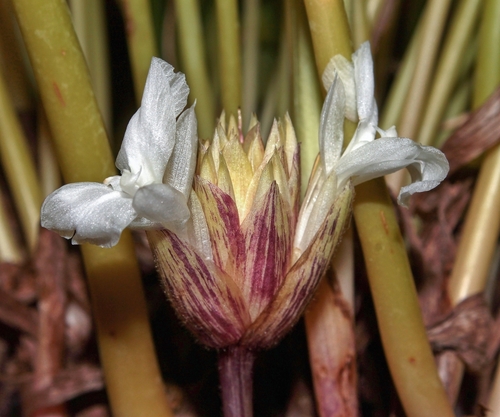
The horticultural description gives a height of about 60 cm (23.6 in); mature height and spread ranges may extend from 0.5 to 1 m (1.6 to 3.3 ft). These cultivated dimensions do not describe a wild population. Flowers are small and inconspicuous: ornamental interest lies mainly in the leaves. 2 7
The leaves may rise at night and reopen at daybreak. This movement, called nyctinasty, responds to changes in light and temperature; an upright nighttime posture is therefore part of the plant’s normal behavior. 7
Habitat and distribution
The native range of Goeppertia kegeljanii lies in Espírito Santo, Brazil, within the wet tropical biome. Horticultural descriptions associate the species with Brazilian rainforests. The broader wording “southeastern Brazil” refers to the same geographical area with less precision. 1 7
In temperate climates, this frost-sensitive plant is grown mainly indoors or under heated cover. A bright, humid room suits it better than a position exposed to direct sun or drafts. Its need for warmth and humidity continues through winter. 2 7
Care through the seasons
For Goeppertia kegeljanii, choose bright filtered light and potting mix that retains moisture without staying waterlogged. Added perlite or vermiculite helps drainage. Rainwater or distilled water avoids exposure to fluoride in some tap water, which can brown the leaf edges. 7
Temperature guidance for the horticultural calathea group is 16 to 21 °C (60.8 to 69.8 °F), away from heaters and sudden fluctuations. For the species, atmospheric humidity of at least 60% is recommended. A humidifier can help in a dry room. 3 7
The seasonal guidance here concerns indoor growing in the Northern Hemisphere. In spring and summer, keep the potting mix consistently moist. In fall and winter, let its surface dry before watering without drying the entire root ball. Empty the outer pot after watering: standing water can rot the roots. 3
For calatheas, the recommended feeding is a balanced liquid fertilizer once a month from April to September. The calendar expresses this advice as relative trends; its scores are neither water volumes nor measured growth rates. Feeding needs adjustment if the potting mix already contains fertilizer. 3
Life cycle and reproduction
Clump division is the recommended propagation method for Goeppertia kegeljanii, in late spring. Group guidance specifies keeping several leaves on each portion and maintaining divisions in warm, humid conditions until growth resumes. 2 3
Repot when the clump fills its container, in spring or summer, rather than automatically changing the pot every year. The horticultural interval given for the species is two to three years. Choosing a slightly larger container and a free-draining mix reduces problems associated with an excessive volume of potting mix. 2 3
Uses and risks
Goeppertia kegeljanii is an ornamental for homes or offices. Watch for mites and scale insects; speckled leaves with fine webbing may indicate mites. Brown edges can also result from insufficient water or dry air: the symptom alone cannot identify its cause. 7 3
The group Calathea spp. is classified as non-toxic to cats, dogs and horses. 6 The cultivar ‘PP0005’ is described separately in its patent; the veterinary classification concerns the horticultural group. 4 For humans, the species description states that the sap can irritate skin and recommends gloves. This precaution also concerns children, without any demonstrated particular sensitivity; the status of other animals remains undetermined. 7
Cultivar and lookalikes
Network is the trade name of the cultivar ‘PP0005’, a selection of Calathea musaica. It is more compact than the species, with stronger leaf contrast. The cultivar description reports stable traits through micropropagation; it does not present it as an interspecific hybrid. 5 4
Greenhouse measurements of ‘PP0005’, about 28.4 cm (11.2 in) tall and 67.4 cm (26.5 in) in spread on a plant about one year old, concern this cultivar under the conditions described. They do not replace the species’ general horticultural dimensions. 4
To distinguish Goeppertia kegeljanii from Goeppertia orbifolia, examine the leaf pattern: the former has a fine dark green network, while the latter has large, round leaves with silvery-green bands. A “calathea” label alone is insufficient to decide. 7 8
Main sources
- Plants of the World Online, Goeppertia kegeljanii
- Royal Horticultural Society, Calathea musaica
- Royal Horticultural Society, How to grow calatheas
- Adrianus Dekker, patent USPP20487P2, cultivar PP0005
- Costa Farms, description and care of the Network Calathea cultivar
- ASPCA, Calathea spp., toxicity by animal group
- NC State Extension, Goeppertia kegeljanii
- Royal Horticultural Society, Goeppertia orbifolia
Frequently asked questions
Are Calathea musaica and Goeppertia kegeljanii the same species?
Yes. Calathea musaica is a synonym of the accepted name Goeppertia kegeljanii. Network, however, denotes a horticultural selection, the cultivar ‘PP0005’.
Why are the leaf edges turning brown?
Overly dry air, insufficient water or water containing fluoride can brown the edges. Check moisture in the growing medium before increasing watering, because excess water can rot the roots.
Is this plant toxic to cats?
The group Calathea spp. is classified as non-toxic to cats, dogs and horses. This group classification is not a specific study of the cultivar ‘PP0005’; Goeppertia kegeljanii sap can irritate human skin.
If you are unsure about a plant’s toxicity, ask a botanist or veterinarian for advice.