
Furry feather calathea (Goeppertia rufibarba, )
Furry feather calathea (Goeppertia rufibarba) has long, wavy leaves, green above and green or purple beneath, with reddish hairs along the leaf stalks and veins. This Brazilian woodland perennial in the Marantaceae family grows indoors in indirect light and humid air.
Read moreFurry feather calathea and Velvet calathea
Calathea rufibarba Fenzl and Phyllodes rufibarba (Fenzl) Kuntze
Give plenty of ambient light without direct sun on the leaves.
Bright indirect or filtered light; avoid direct sun.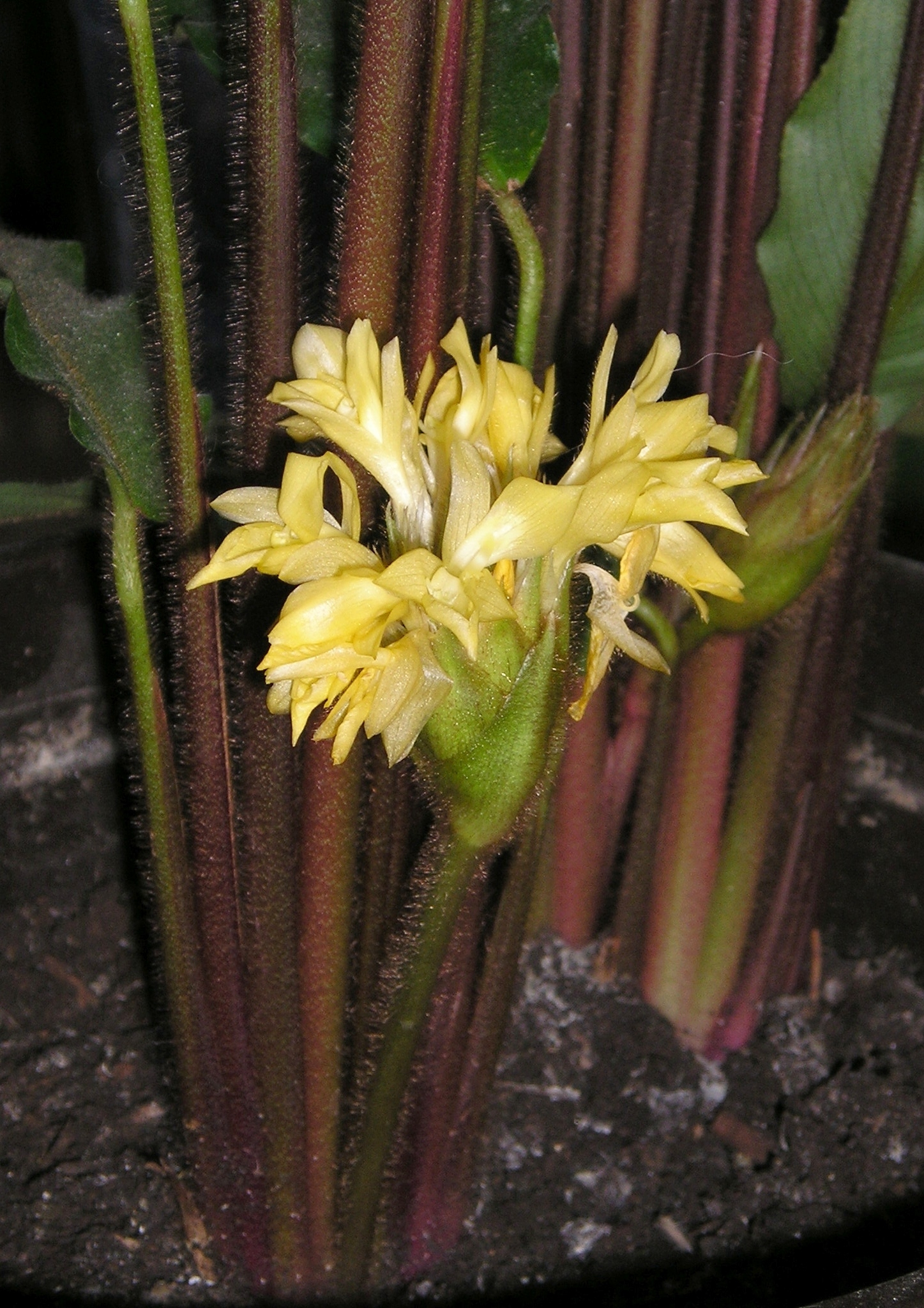
© photo
(c) Maja Dumat, some rights reserved (CC BY) · cc-by
Global distribution
The accepted native range is Bahia in northeastern Brazil. A botanical inventory also lists Espírito Santo.
Identity
Furry feather calathea (Goeppertia rufibarba (Fenzl) Borchs. & S.Suárez, 2012) has reddish hairs on its leaf stalks and leaves. This evergreen perennial in the Marantaceae family forms an upright clump. In French horticulture, the name "Calathéa velours" is documented under the older scientific name Calathea rufibarba Fenzl. 2 1 8 9
The epithet rufibarba combines the Latin rufus, red, and barba, beard: it describes the reddish hairs. The genus honors Heinrich Göppert, a German botanist and paleontologist. The common name "velvet calathea" likewise points to an observable feature, the texture of the foliage. 4
Recognition
Narrow leaves with wavy edges and reddish hairs help distinguish furry feather calathea from other calatheas grown for their foliage. NC State describes cultivated plants with green upper leaf surfaces and purple undersides. The Brazilian flora also records green undersides, so that color does not rule out the species. Reddish hairs cover the leaf stalks, midribs and undersides of the blades. 2 10
Horticultural descriptions give a height of 0.5–1 m (about 1.6–3.3 ft) and a spread of 0.1–0.5 m (about 4–20 in). A tropical description places the clump at around 50–70 cm (about 20–28 in) tall, with leaf blades up to 25 cm by 8 cm (about 10 in by 3 in). The height and spread figures describe different growing settings. The width of one leaf blade is a separate measurement from the spread of the whole plant. 3 4
Useful taxonomy
A change of genus explains the different scientific names on labels for furry feather calathea. The accepted name, Goeppertia rufibarba, is a combination published in 2012. The original name, or basionym, Calathea rufibarba Fenzl, was published in 1879. Another synonym, Phyllodes rufibarba (Fenzl) Kuntze, dates to 1891. All refer to the same taxon. 1 5
A label that still reads "Calathea rufibarba" can therefore identify this species. Horticultural names such as ‘Blue Grass’ have a different function: they distinguish cultivated plants and remain separate from botanical synonymy. A horticultural selection does not become another botanical synonym merely because its name appears on a nursery label. 1 6
Habitat and range
Brazilian tropical rainforest understory is the native habitat of furry feather calathea. The accepted native range is Bahia in northeastern Brazil; another botanical inventory also includes Espírito Santo. The inventories differ in their geographic limits, without supporting an origin across all tropical America. In Singapore, the species is recorded as cultivated and non-native. 1 5 4
Indoors, furry feather calathea needs indirect or filtered light. Direct sun can scorch the leaves. Humid air and a free-draining potting mix suit its woodland origins, but air humidity and soil moisture need separate attention. The roots should not remain in a soggy mix simply because the plant needs humid surroundings. 3 2
Life cycle and reproduction
Division of the rhizomatous roots in late spring is the recommended propagation method for furry feather calathea. NParks describes small yellow flowers in a compact spike; NC State notes that indoor flowering is rare. The Brazilian flora describes a yellow or white calyx and corolla. NC State also lists orange flowers in its horticultural account, whereas Flora do Brasil describes only yellow or white for those floral parts. The discrepancy does not establish that the plants belong to different taxa. Foliage still allows identification when a cultivated plant has no flowers. 3 2 4 10
The calendar describes indoor cultivation in mainland France, in the Northern Hemisphere. Its water and growth scores are relative editorial indices, rather than watering volumes or measured growth rates. Higher spring and summer scores reflect the documented growing period; lower winter scores accompany advice to keep the mix just moist. The spring repotting window follows Au Jardin's advice to repot when the plant outgrows its pot. Other months fall outside that suggested window. Late spring is also recommended separately for division. 3 2 9
The RHS recommends a balanced liquid fertilizer monthly during growth; NC State specifies spring and summer. Fall feeding assumes continued growth. Months without feeding represent winter conditions without active growth: adjust feeding to the plant's actual activity and local seasons. No dose or NPK ratio follows from this advice. The RHS recommends repotting every two to three years, so a spring window does not mean changing pots every spring. 3 2
Uses and risks
As an ornamental houseplant, furry feather calathea is explicitly classified as non-toxic to cats and dogs. The broader veterinary classification for calatheas includes horses, but does not establish a horse-specific classification for this species. The status for humans and children remains unknown, as does the status for other animals. 2 7
Brown leaf tips can result from dry air or fluoride in tap water. Distilled water or rainwater is recommended. Overwatering can cause root rot, while curled leaves can indicate low humidity or too little water. Checking both the surrounding air and the potting mix helps distinguish these possible causes of leaf damage. 2
Varieties, look-alikes and related plants
‘Blue Grass’ has a compact habit and wavy blue-green leaves. Its horticultural name is documented, but its nomenclatural status remains unresolved and the name alone establishes no varietal stability. ‘Tropistar’ has narrow dark green leaves with burgundy undersides; ‘Wavestar’ has narrow light green leaves. The foliage differences describe cultivated forms of furry feather calathea. 2 6
Color Full® Elger Grass, Color Full® Soft Kitty™ and Color Full® Xena™ are also horticultural trade labels. Soft Kitty has fine light green markings on a dark background. A brand or trade name alone establishes neither a separate species nor commercial rarity. To identify furry feather calathea, examine the reddish hairs together with the wavy leaves rather than relying on a single color shown on a label. 2
Main sources
Botanical references establish the accepted name and native range of furry feather calathea; horticultural accounts describe identification and cultivation.
- Kew, Plants of the World Online, Goeppertia rufibarba
- NC State Extension, Goeppertia rufibarba
- Royal Horticultural Society, Goeppertia rufibarba
- NParks Singapore, Goeppertia rufibarba
- USDA ARS GRIN Taxonomy, Goeppertia rufibarba
- Royal Horticultural Society, Goeppertia rufibarba ‘Blue Grass’
- ASPCA, Calathea spp., genus-level classification
- La Jardinerie de Pessicart, documentation of the French name Calathéa velours
- Au Jardin, Calathéa velours: French name and spring repotting
- Flora do Brasil 2020, Marantaceae, Goeppertia rufibarba, p. 152–153
Frequently asked questions
How do I identify furry feather calathea?
The lance-shaped leaves have wavy edges and reddish hairs on the leaf stalks, midribs and undersides. Purple undersides are described in horticulture, but are not essential: the Brazilian flora also records green undersides.
Are Calathea rufibarba and Goeppertia rufibarba different species?
No. Calathea rufibarba Fenzl is the original name; Goeppertia rufibarba is the accepted combination, published in 2012.
Is furry feather calathea toxic to cats?
The species is explicitly classified as non-toxic to cats and dogs. Its status for humans and children remains unknown.
Why are the leaf tips turning brown?
Low humidity or fluoride in tap water can turn the tips and edges brown. Waterlogged potting mix can also damage the plant.
How do I propagate furry feather calathea?
The recommended method is to divide the rhizomatous roots in late spring.
If you are unsure about a plant’s toxicity, ask a botanist or veterinarian for advice.