
Dwarf chin cactus (Gymnocalycium baldianum, )
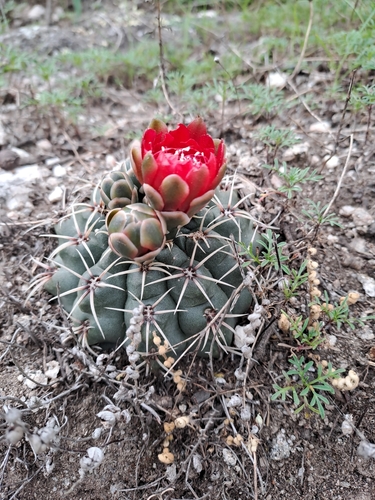
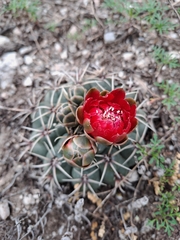

Dwarf chin cactus (Gymnocalycium baldianum) combines a flattened, rounded stem, tubercled ribs and pink to crimson flowers. This cactus from northwestern Argentina grows in pots in bright filtered light, with moderate watering during growth and an almost dry winter.
Read moreDwarf chin cactus
Echinocactus baldianus Speg., Echinocactus sanguiniflorus Werderm., Gymnocalycium baldianum var. albiflorum C.A.L.Bercht, Gymnocalycium baldianum subsp. marianae (Perea, O.Ferrari, Las Peñas & R.Kiesling) V.Gapon, Gymnocalycium baldianum var. raineri (H.Till) Milt, Gymnocalycium baldianum subsp. sanguiniflorum (Werderm.) C.A.L.Bercht, Gymnocalycium baldianum var. schreiteri (H.Till) Milt, Gymnocalycium marianae Perea, O.Ferrari, Las Peñas & R.Kiesling, Gymnocalycium raineri H.Till, Gymnocalycium rosae H.Till, Gymnocalycium sanguiniflorum (Werderm.) Werderm., Gymnocalycium schreiteri H.Till and Gymnocalycium venturianum Backeb.
Allow a few hours of direct sun per day, preferably morning or evening.
Bright filtered light under cover; sun to partial shade depending on exposure.


© photo
(c) Gabriel Reinoso Franchino, some rights reserved (CC BY), uploaded by Gabriel Reinoso Franchino · cc-by
Gabriel Reinoso Franchino · cc-by
Wikimedia Commons · CC BY-SA or Public Domain
Taken May 16, 2021 by Eva B.S. (cc-by-sa)
© copyright of the Board of Trustees of the Royal Botanic Gardens, Kew.




Global distribution
Native to northwestern Argentina.
Identity
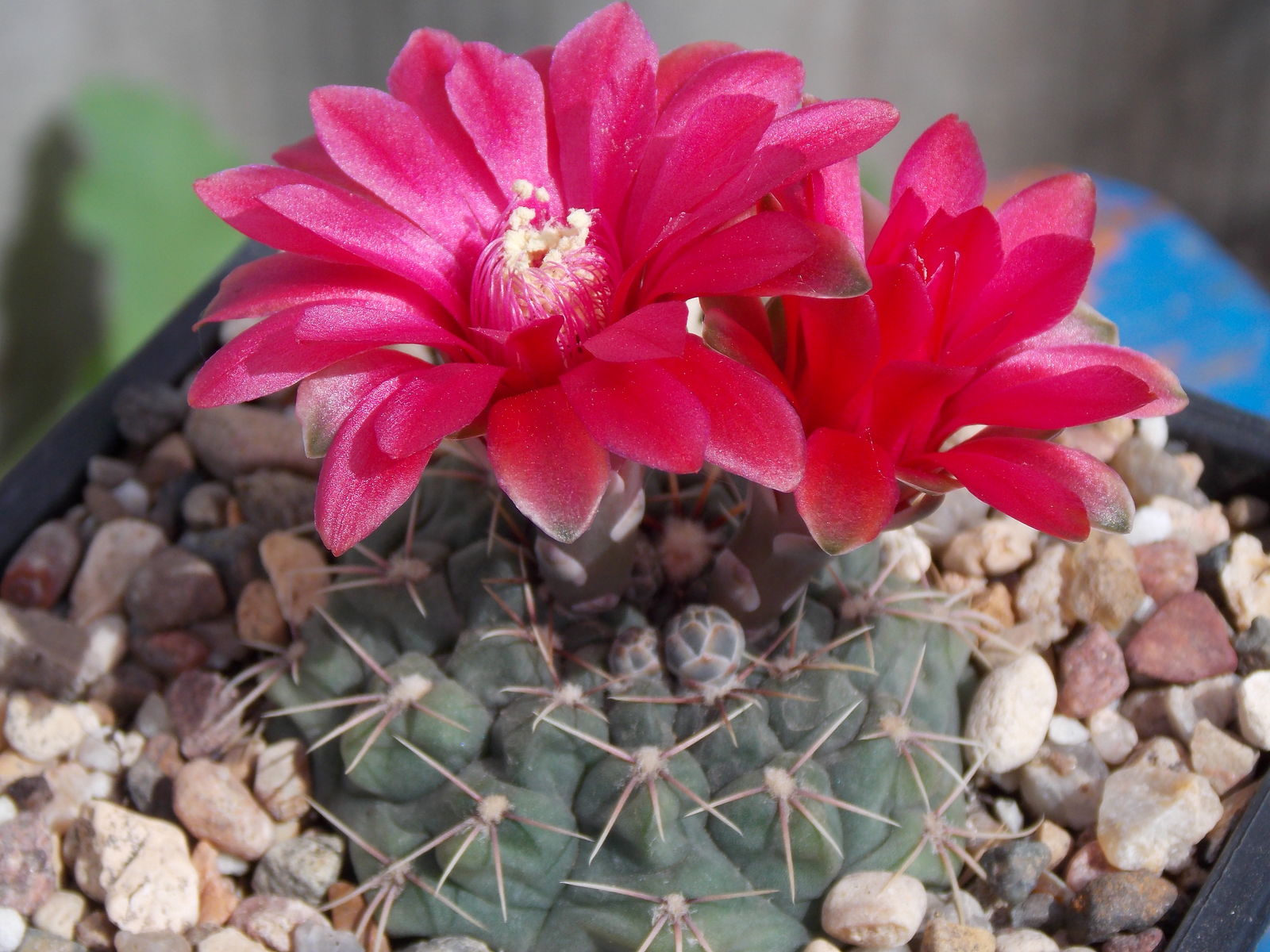
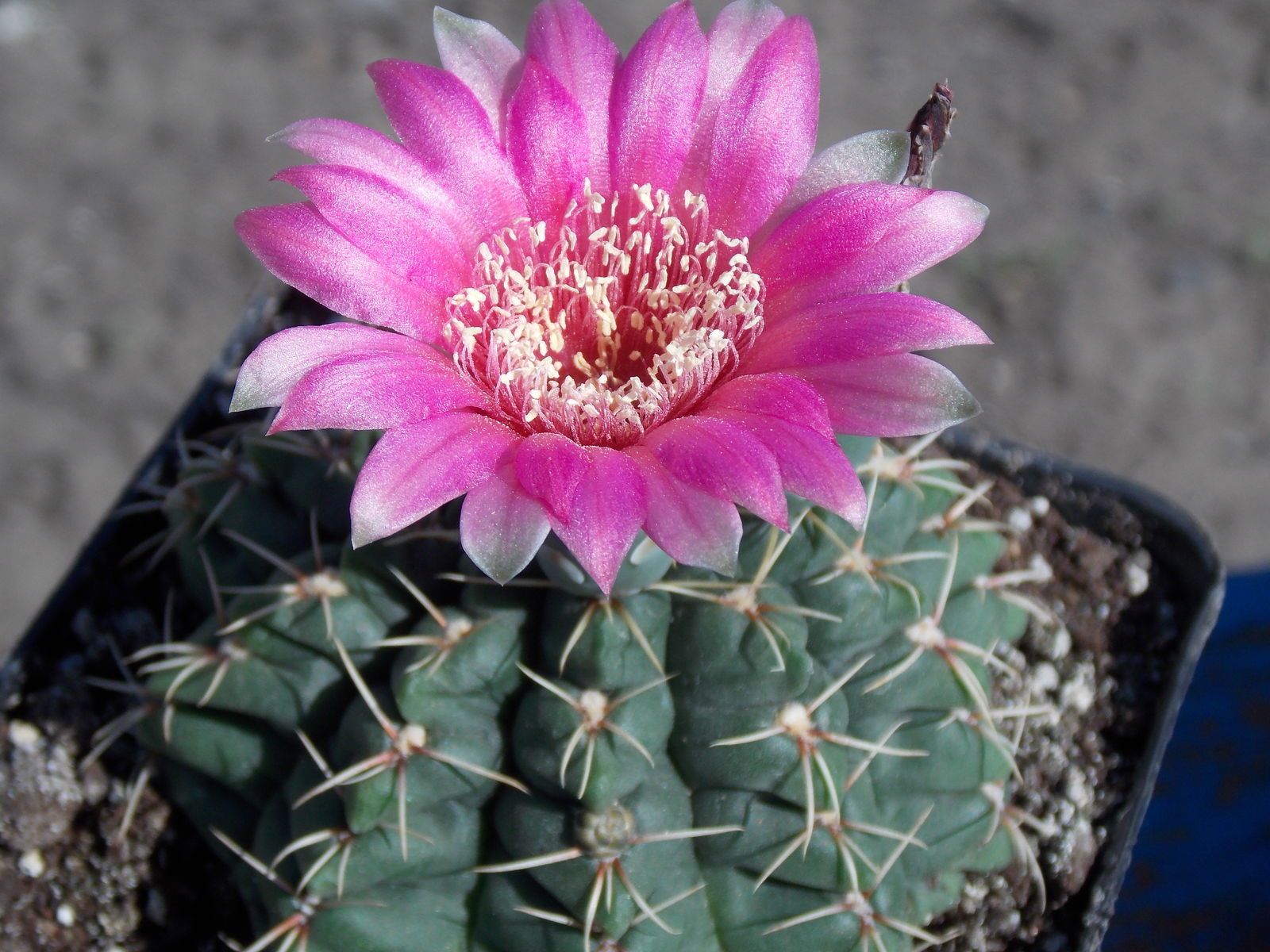
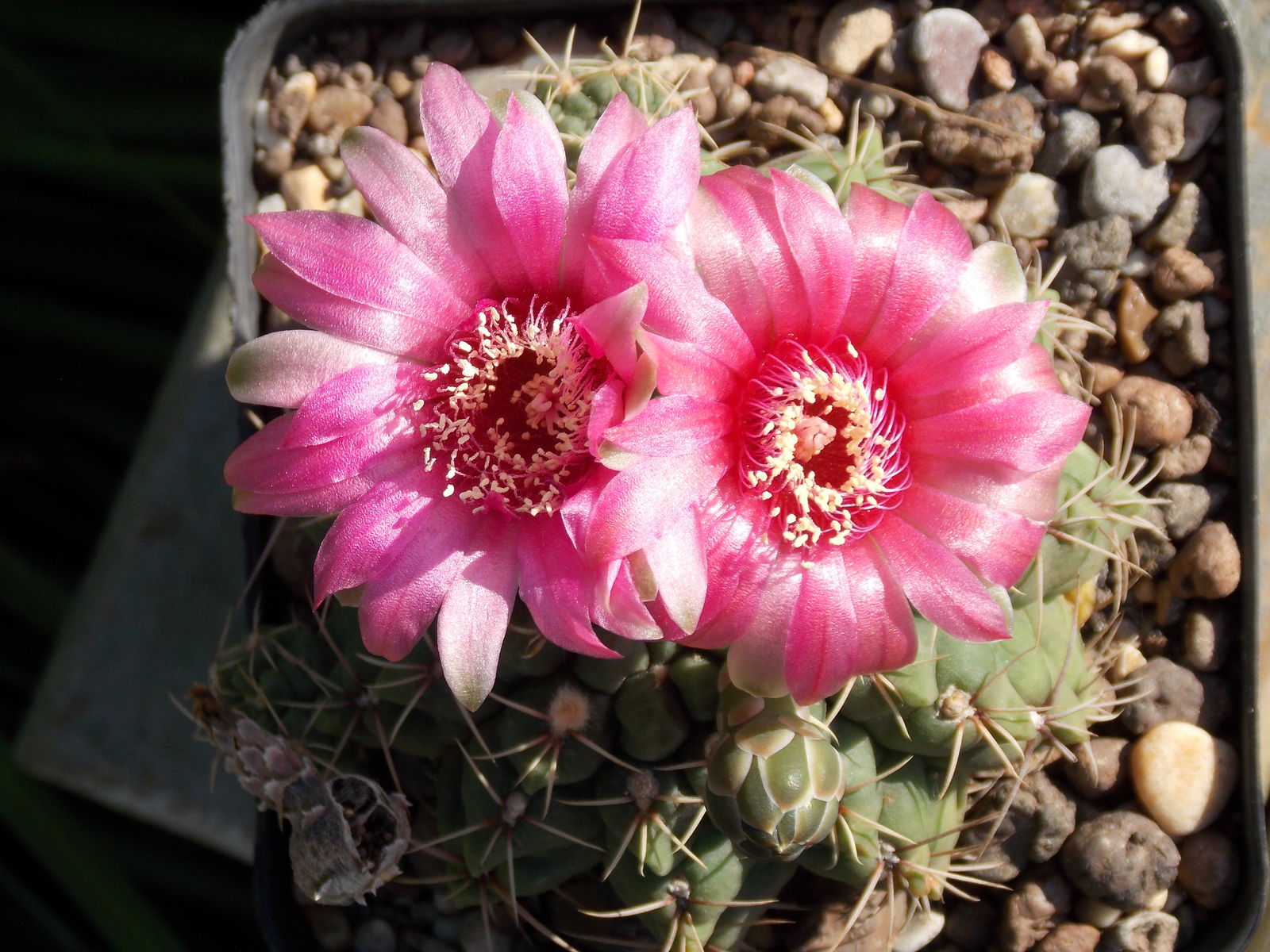
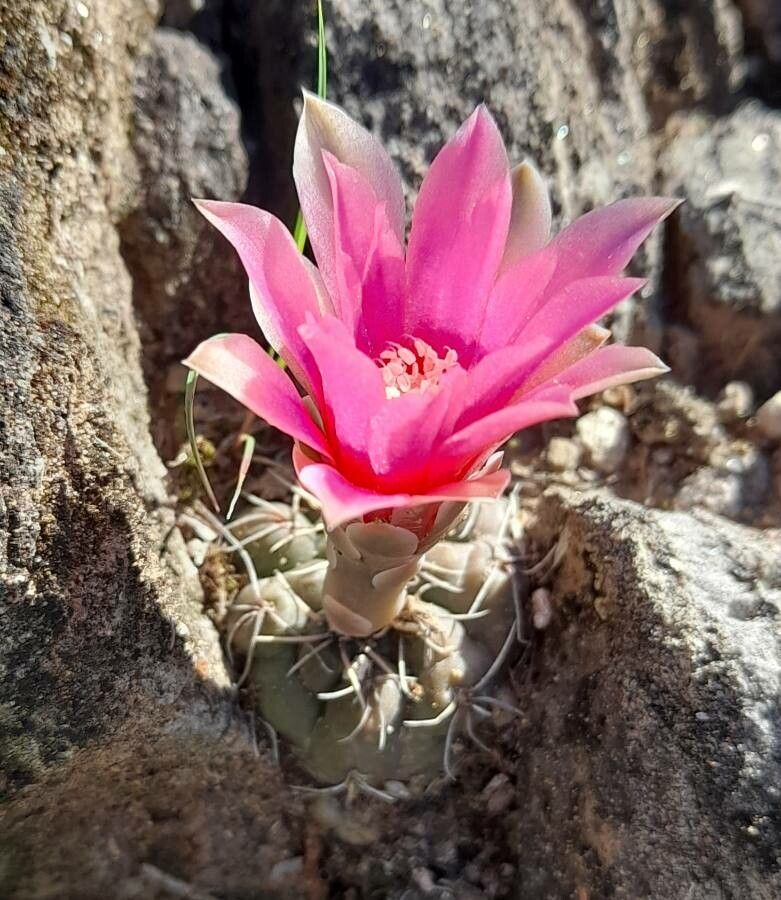
Dwarf chin cactus (Gymnocalycium baldianum) bears large pink to crimson flowers on a small, flattened, rounded stem. Gymnocalycium baldianum is a solitary cactus that stays compact: horticultural dimensions give a maximum height of 10 cm (3.9 in). Its funnel-shaped flowers reach 4 cm in diameter (1.6 in), enough to noticeably change the plant’s outline when they open. 2
The species belongs to the Cactaceae, in the order Caryophyllales. It is native to northwestern Argentina and has a succulent stem. The scientific name provides a precise way to find this plant among the many small, rounded cacti sold without a full identification. 1
Recognition
The stem of Gymnocalycium baldianum has 9 to 11 tubercled ribs: the raised areas form successive bumps rather than uniformly smooth lines. The bristle-like radial spines spread around their point of attachment. These ribs, together with the flattened top, help identify a plant without flowers. 2
In summer, flowers range from deep pink to crimson. This color describes the corolla, rather than a red or yellow stem. When identifying a plant bought in an assortment, examining its body and flowers separately avoids confusing the species with a colored horticultural form of another Gymnocalycium. 25
Useful taxonomy
The accepted name, Gymnocalycium baldianum (Speg.) Speg., was published in 1925. The earlier name Echinocactus baldianus Speg., published in 1905, is its basionym: the change of genus explains why the first author appears in parentheses. 1
Gymnocalycium venturianum Backeb. and Gymnocalycium sanguiniflorum (Werderm.) Werderm. are among the synonyms assigned to the species. The name Gymnocalycium baldianum var. albiflorum also belongs to this botanical synonymy. These names are neither a list of selected cultivars nor evidence of hybrid origin. 1
Habitat and distribution
Gymnocalycium baldianum is native to northwestern Argentina, in the desert and dry shrubland biome. This distribution describes the species’ natural range; it differs from the countries where the cactus is grown in collections. Its classification as a succulent reflects its ability to store water. 16
The global assessment reported in Argentina’s biodiversity system is Least Concern. Argentine lists of endemic plants nevertheless report a restricted distribution and populations that are scarce or exposed to threats. These assessments use different frameworks: global status does not mean every local population is secure. 4
Life cycle and reproduction
Under cover, place Gymnocalycium baldianum in bright filtered light, with good ventilation. Use a free-draining cactus mix. During growth, water moderately and apply a balanced liquid fertilizer every two or three weeks; in winter, keep the growing medium almost dry. 2
The calendar for indoor growing in mainland France follows increased spring and summer activity, then a winter slowdown. Its scores indicate relative trends. For potted cacti, spring repotting is suitable when roots fill the container; an oversized pot stays wet longer, increasing the risk of rot. 6
Sowing in early spring, at 19 to 24 °C (66.2 to 75.2 °F), is the propagation method given for the species. This temperature concerns germination, rather than a permanent growing requirement. Seedling needs therefore cannot be inferred from the almost dry winter conditions advised for established plants. 2
Uses and risks
The compact size of Gymnocalycium baldianum suits small pots and collections under glass. The species needs no pruning. A sheltered position makes moisture easier to control; the cactus tolerates cool temperatures but must not freeze. Mealybugs are among the pests to watch for. 2
Exposure can range from sun to partial shade, but filtered light is preferred under glass. Adjust the choice to the position rather than exposing every plant to scorching sun. Low water needs and drought tolerance do not justify leaving water in the saucer. 326
The spines call for protected handling during repotting: a folded strip of thick paper can help hold a cactus. The toxicity of Gymnocalycium baldianum after ingestion remains unknown for adults, children, cats, dogs, horses and other animals. The absence of an explicit classification is not a guarantee of safety. 6
Cultivars, lookalikes and related plants
Gymnocalycium mihanovichii is a different species, whose usual flowers are greenish to yellowish-brown. Its colored horticultural forms, including ‘Hibotan’, may have a red, orange or yellow head grafted onto a green cactus. Plants without chlorophyll depend on this rootstock for nourishment. 5
In Gymnocalycium baldianum, look for pink to crimson flowers on a flattened stem. A graft joins two plants without turning them into a hybrid; the cultivar ‘Hibotan’ therefore does not describe this species. Keeping the full botanical label allows synonyms to be tracked without confusing advice specific to grafted plants. 25
Main sources
- Plants of the World Online, Gymnocalycium baldianum
- Royal Horticultural Society, Gymnocalycium baldianum
- National Parks Board, Gymnocalycium baldianum
- Parques Nacionales Argentina, Gymnocalycium baldianum
- NC State Extension, Gymnocalycium mihanovichii
- Royal Horticultural Society, growing houseplant cacti and succulents
Frequently asked questions
How large does dwarf chin cactus grow?
Horticultural dimensions give a maximum height of 10 cm (3.9 in). Its stem is rounded and flattened, with tubercled ribs.
When does dwarf chin cactus flower?
In temperate horticultural conditions, pink to crimson flowers appear in summer. They measure about 4 cm (1.6 in) across.
How should I water dwarf chin cactus?
Water moderately during growth, in a well-drained cactus mix. Keep the plant almost dry in winter.
Is dwarf chin cactus a red grafted cactus?
The colored grafted balls sold as ‘Hibotan’ belong to Gymnocalycium mihanovichii. In Gymnocalycium baldianum, the pink to crimson colors described concern the flowers.
If you are unsure about a plant’s toxicity, ask a botanist or veterinarian for advice.