
Japanese garden juniper (Juniperus procumbens, )


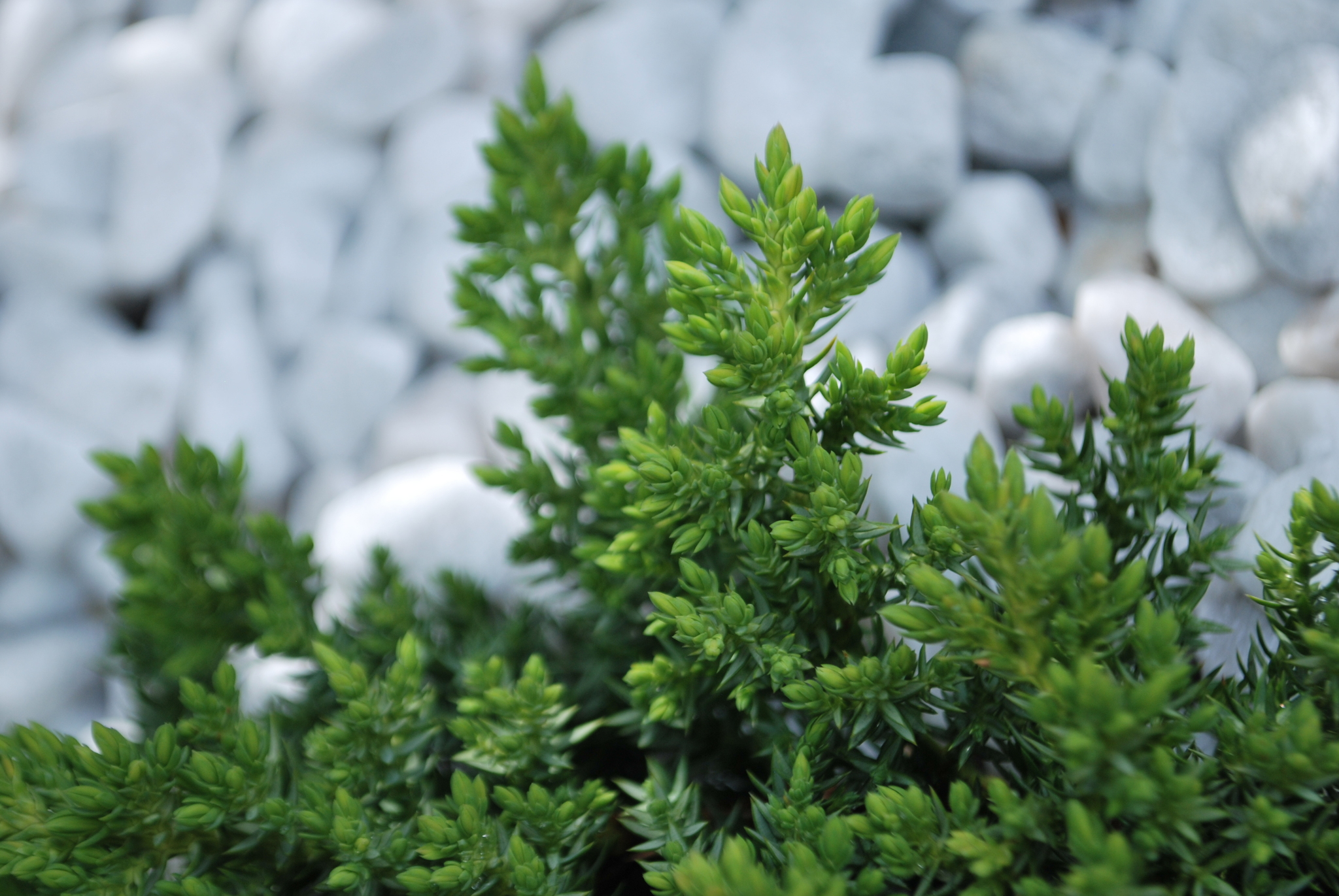
Japanese garden juniper (Juniperus procumbens) is a creeping conifer with blue-green needles grouped in threes. Its spreading branches have upturned tips.
Read moreJapanese garden juniper and Japanese juniper
Juniperus chinensis var. procumbens
Place in full sun, with intense direct light all day long.


© photo
(c) anonymous, some rights reserved (CC BY-SA) · cc-by-sa
Wikimedia Commons · CC BY-SA or Public Domain
© copyright of the Board of Trustees of the Royal Botanic Gardens, Kew.


Global distribution
The stated native range covers western and southern Korea and southern Japan.
Identity
Japanese garden juniper (Juniperus procumbens (Siebold ex Endl.) Miq.) forms a carpet of creeping branches with upturned tips. Its stiff, prickly needles grow in threes and remain through winter. This conifer belongs to the Cupressaceae family; its woody base and evergreen foliage accompany a perennial life cycle. 14
The French name “genévrier nain du Japon” appears in the Agence de l’eau Rhin-Meuse list of ground-cover plants. Here, “nain,” meaning dwarf, describes the species' low habit: it does not make every plant a member of the cultivar ‘Nana’. That horticultural selection has its own characteristics. 83
Recognition
The needles have a concave upper surface, a sharp tip and two white marks at their base. Their blue-green color accompanies stiff branches spreading almost parallel to the ground. These foliage features help identify the plant alongside its overall shape; a carpet of branches alone is not enough to recognize the species. 37
In cultivation, height generally stays below about 0.6 m (2 ft), while spread can reach about 4.6 m (15 ft). Growth is slow: reaching its maximum spread may take more than ten years. Allowing this space avoids confusing low height with a small footprint. NC State also notes possible confusion with Juniperus conferta, another juniper used as ground cover. 1
Name and botanical history
The Royal Horticultural Society recognizes Juniperus procumbens as the correct name. Juniperus chinensis var. procumbens is among its synonyms: this earlier combination classified it as a botanical variety, a rank distinct from a cultivar designation. The epithet procumbens refers to its prostrate habit. 51
Its horticultural history predates publication of the current combination. Bean's account mentions a name given by Siebold in 1844, an entry in his catalog in 1856, then valid publication by Miquel in 1870, in the posthumous continuation of the Flora Japonica. These dates document the plant's circulation and naming in Europe. 7
Habitat and distribution
The native range given by the Royal Horticultural Society covers western and southern Korea and southern Japan. EPPO lists Japan, specifying Kyushu and the Bonin Islands. These geographical accounts therefore do not provide exactly the same level of detail. 54
For its wild habitat, Bean's dendrological account reports the plant on the coasts of Kyushu, citing Ohwi's Japanese flora. Plants grown in European rock gardens should be distinguished from these native populations. Its horticultural use in France is documented by the Rhin-Meuse list; inclusion does not establish naturalization or invasive behavior. 78
Life cycle and propagation
Japanese garden juniper is dioecious: male and female structures grow on separate individuals. Pollen is released in spring. The female cones become fleshy and black when ripe, about eighteen months after pollination. They are often absent from cultivated plants; this observation does not establish that the species is sterile. 31
Propagation by cuttings is documented for this species. For timing, the RHS general conifer guide recommends semi-ripe cuttings from late summer to early fall. Vegetative propagation preserves the characteristics of the selected parent; seedlings from a cultivar may differ from it. 36
Growing through the seasons
Plant Japanese garden juniper in full sun and well-drained soil. It tolerates poor soil and drought once established. Cornell also lists moist, well-drained soil, from acidic to alkaline. Avoid standing water, as waterlogged ground encourages root rot. 12
The following seasonal advice comes from the RHS general conifer guide. Plant from fall to early spring, avoiding frozen or waterlogged ground. Water new plantings during their first two years, especially in hot, dry weather. Plants in pots need regular monitoring, including during dry spells in winter. 6
In the ground, no routine fertilizer is needed. For pots, the guide recommends liquid fertilizer from early spring to late summer. If pruning is necessary, stay within green growth: the old brown wood of most conifers does not sprout again. 6
Cultivars, uses and precautions
The spreading habit suits rock gardens, slopes and trailing over low walls. ‘Nana’ produces more compact, denser growth with a slight purple tint in winter. ‘Variegata’ has cream streaks. These features belong to the named cultivars and do not describe the species uniformly. 13
Contact dermatitis is reported for Japanese garden juniper. This finding warrants precautions against skin contact in humans. A report of dermatitis does not provide enough information about ingestion effects or the specific risks to children, cats, dogs or horses. The absence of evidence specific to these groups does not establish that Japanese garden juniper is harmless. 1
Main sources
- NC State Extension: Juniperus procumbens
- Cornell University, Woody Plants Database: Juniperus procumbens
- University of Connecticut, Plant Database: Juniperus procumbens
- EPPO Global Database: Juniperus procumbens
- Royal Horticultural Society: Juniperus procumbens
- Royal Horticultural Society: How to grow conifers
- International Dendrology Society, Trees and Shrubs Online: Juniperus procumbens
- Agence de l’eau Rhin-Meuse and FREDON Alsace: List of ground-cover plants, municipal copy
Frequently asked questions
How can I identify Japanese garden juniper?
Its creeping branches have upturned tips. The stiff, prickly needles grow in threes and bear two white marks at their base.
Does Japanese garden juniper tolerate damp soil?
It tolerates moist soil if it drains well. Persistently waterlogged soil encourages root rot.
Does Nana refer to the whole species Juniperus procumbens?
No. Nana is a more compact, denser cultivar; its slight purple winter tint does not describe every member of the species.
If you are unsure about a plant’s toxicity, ask a botanist or veterinarian for advice.