
Red pancakes (Kalanchoe luciae, )
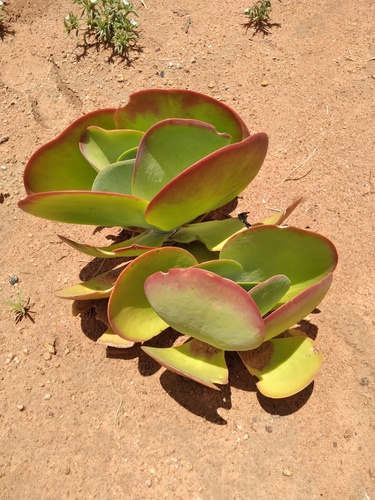


Red pancakes (Kalanchoe luciae) has upright, fleshy leaves whose edges turn red with light or cool temperatures. This southern African succulent in the Crassulaceae family grows in well-drained pots, protected from frost, and is difficult to distinguish from K. thyrsiflora without flowers.
Read moreRed pancakes
Kalanchoe albiflora H.M.L.Forbes
Place in full sun, with intense direct light all day long.
Full light; protect from scorching sun behind glass.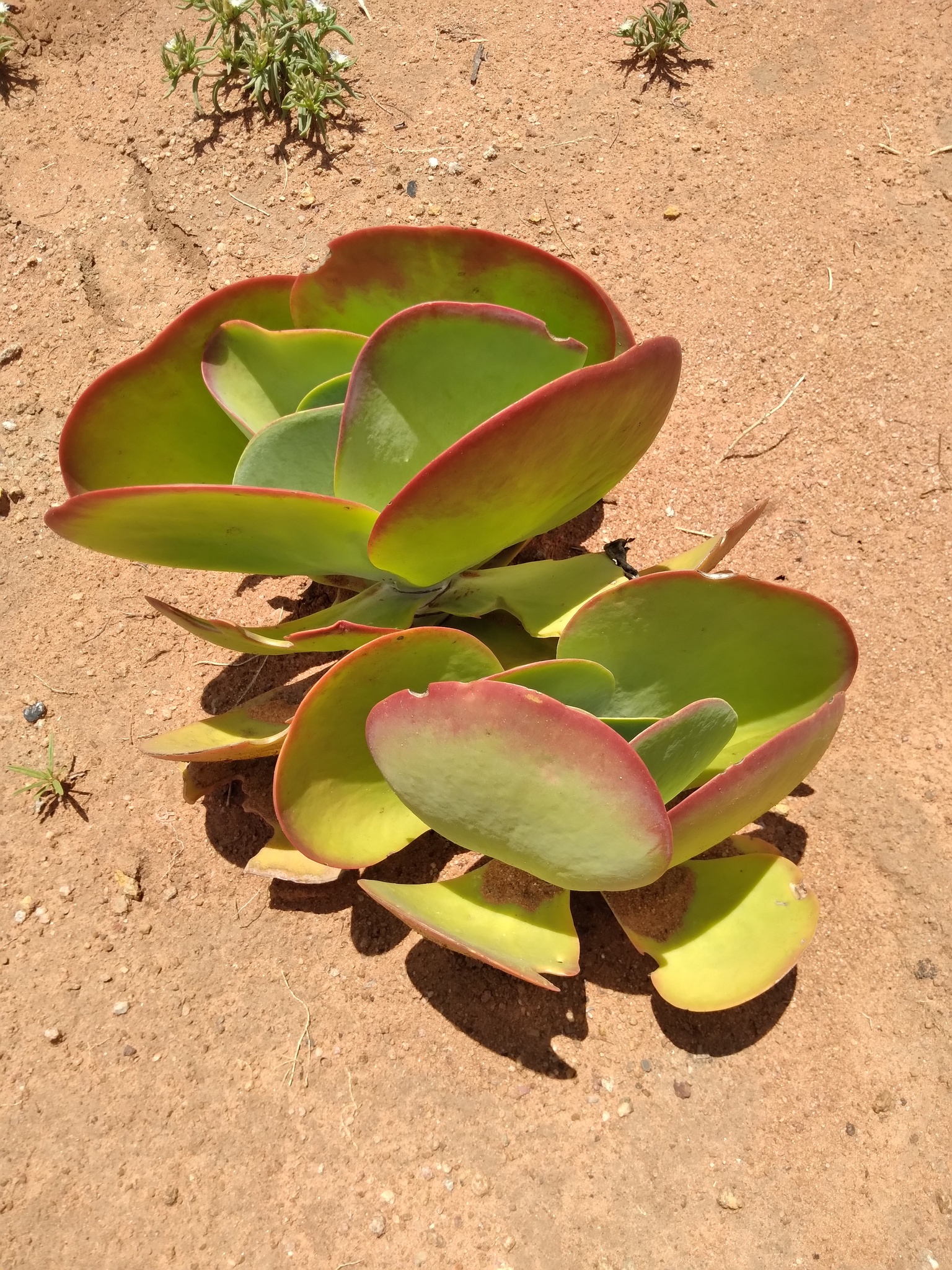


© photo
(c) Ray Brown, some rights reserved (CC BY-NC), uploaded by Ray Brown · cc-by-nc
Juvia Heuchert · cc-by
Wikimedia Commons · CC BY-SA or Public Domain
© copyright of the Board of Trustees of the Royal Botanic Gardens, Kew.
Global distribution
Native to southern and southern tropical Africa; grown as an ornamental outside this range.
- Native4
- South Africa
- Eswatini
- Mozambique
- Zimbabwe
Hexagons: regions where the plant occurs. Green dots: native range.1
Identity and names
Red pancakes (Kalanchoe luciae Raym.-Hamet, published in 1908) has upright, rounded leaves whose edges turn red. This member of the Crassulaceae belongs to the order Saxifragales. The English name “paddle plant” is also used for this species. 1 4
The synonym Kalanchoe albiflora H.M.L.Forbes, published in 1941, refers to the same species. An old label bearing this name therefore does not necessarily identify a different plant. Kalanchoe thyrsiflora, however, is a separate species that is frequently confused with it in cultivation. 1 2
Recognition
The opposite, stalkless leaves form an upright rosette. Each thick, smooth leaf blade is rounded to obovate, with an entire margin; a small notch may mark the tip. Horticultural descriptions give both height and spread as 0.1 to 0.5 m. These foliage dimensions do not describe the height of a flower stalk. 4 3
Light intensifies the red leaf margins; cool temperatures can deepen the color too. A green plant growing in shade is therefore not automatically misidentified. The fleshy tissues store water, a characteristic of kalanchoes that explains their tolerance of dry periods. 4 2 6
Habitat and range
The native range of Kalanchoe luciae includes Eswatini, Mozambique and Zimbabwe, together with KwaZulu-Natal and the northern provinces of South Africa. The species occurs mainly in the seasonally dry tropical biome. Its African origin therefore does not imply a need for a constantly moist potting mix. 1
In Singapore, Kalanchoe luciae is described as a non-native plant grown for ornament. Its drought tolerance and need for well-drained soil are associated there with a sunny position. Its presence in gardens outside southern Africa does not establish that it has become naturalized. In temperate climates, growing it in a pot allows it to be brought indoors before frost. 4 2
Life cycle and reproduction
A flowering rosette dies after blooming, but offsets usually renew the clump. The life cycle is described as biennial in botanical accounts and perennial in horticulture. Successive rosettes explain why a potful can survive beyond the flowering of a single rosette. In Kalanchoe luciae, the death of the flowering rosette therefore does not necessarily mean the loss of offsets that have already formed. 1 3
Late winter or early spring flowering is observed in plants that receive enough light and winter protection; early summer is also given for British cultivation. Timing varies with conditions. Take offsets and stem cuttings in spring or summer; sow seeds in spring at 21 °C. 2 3
Cultivation through the seasons
Kalanchoe luciae needs strong light and a well-drained potting mix. Behind glass, protect the foliage from scorching summer sun. A peat-free, loam-based mix with added horticultural grit suits this cultivation. Water moderately during growth, then allow the mix to dry before watering again. 3 2
Apply a balanced liquid fertilizer three or four times during growth, with no winter feeding until growth resumes in spring. Repot in spring if the roots have filled the container. An oversized pot holds more damp potting mix and increases the risk of rot, according to general advice for growing succulents. 3 2 7
For a sheltered pot in mainland France, the monthly indicators reflect spring and summer activity followed by reduced winter watering. The calendar expresses relative trends; the condition of the mix and observed growth determine when to intervene. Excess water must be able to drain away without collecting beneath the pot. 7
Uses and risks
Kalanchoe luciae is grown for its foliage, in pots or frost-free rock gardens. Keep this ornamental plant out of reach of children and pets. The toxicity warnings used here concern the genus Kalanchoe and do not provide a dose specific to this species. 4 6
In cats and dogs, eating kalanchoe can cause vomiting and diarrhea; abnormal heart rhythms are reported less often. The compounds responsible are bufadienolides. Contact a veterinarian if a pet is suspected of having eaten the plant. 5
Ingestion is also toxic to humans, including adults and children; contact can cause dermatitis. The cardiac risk warrants caution beyond concern about digestive irritation alone. The status of horses and other animals remains undetermined, which does not establish an absence of danger. 6
Varieties and look-alikes
Kalanchoe thyrsiflora has paler leaves covered in a thick waxy layer and develops little red coloring. Its bright yellow flowers contrast with the white to pale yellow flowers of K. luciae. Interpret scent cautiously: descriptions of K. luciae range from no perceptible odor to a faint fragrance. Examine flower color and foliage together. 2 4
Tricolor has pink, green and white variegation; Fantastic is another variegated selection. These features belong to horticultural selections and do not describe every plant in the species. Sales names such as “flapjacks” and “paddle plant” may accompany several related plants, so their appearance on a label does not settle botanical identification. 2
Main sources
- Plants of the World Online, Kew, Kalanchoe luciae Raym.-Hamet
- University of Wisconsin Extension, Flapjacks, Kalanchoe spp.
- Royal Horticultural Society, Kalanchoe luciae
- National Parks Board Singapore, Kalanchoe luciae
- ASPCA, Kalanchoe spp., toxicity to cats and dogs
- NC State Extension, Kalanchoe, genus description and toxicity
- Royal Horticultural Society, How to grow cacti and succulents
Frequently asked questions
Why do the leaves of Red pancakes turn red?
Light strengthens the red leaf edges; cool temperatures can also intensify the color. A shaded plant may remain greener.
Does Red pancakes die after flowering?
The rosette that flowers dies after blooming. Basal offsets usually allow the clump to renew itself.
Is Red pancakes toxic to cats?
The toxicity warning for the genus Kalanchoe covers cats and dogs. Ingestion can cause digestive problems and, less commonly, heart problems; contact a veterinarian.
How can I distinguish Kalanchoe luciae from Kalanchoe thyrsiflora?
K. luciae develops more red coloring and has white to pale yellow flowers. K. thyrsiflora has paler leaves and bright yellow flowers; foliage alone may leave the identification uncertain.
If you are unsure about a plant’s toxicity, ask a botanist or veterinarian for advice.