
Golden barrel cactus (Kroenleinia grusonii, )
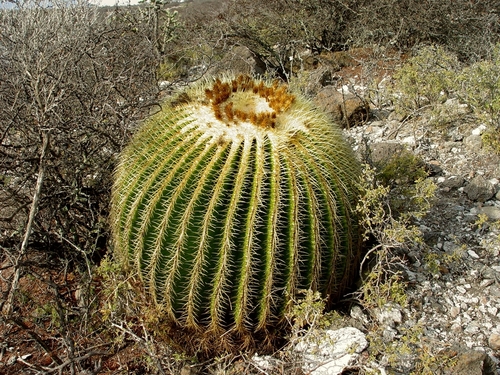
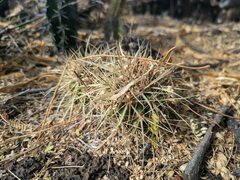

Golden barrel cactus (Kroenleinia grusonii) forms a ribbed sphere covered in golden spines, then lengthens into a barrel with age. This Mexican cactus, still sold as Echinocactus grusonii, flowers when mature and given enough sun, and needs a freely draining mix.
Read moreGolden barrel cactus
Echinocactus grusonii, Echinocereus grusonii, Ferocactus grusonii, Echinocactus corynacanthus, Echinocactus galeottii and Echinocereus grusonii var. azureus
Place in full sun, with intense direct light all day long.
Full sun for flowering and golden spine color.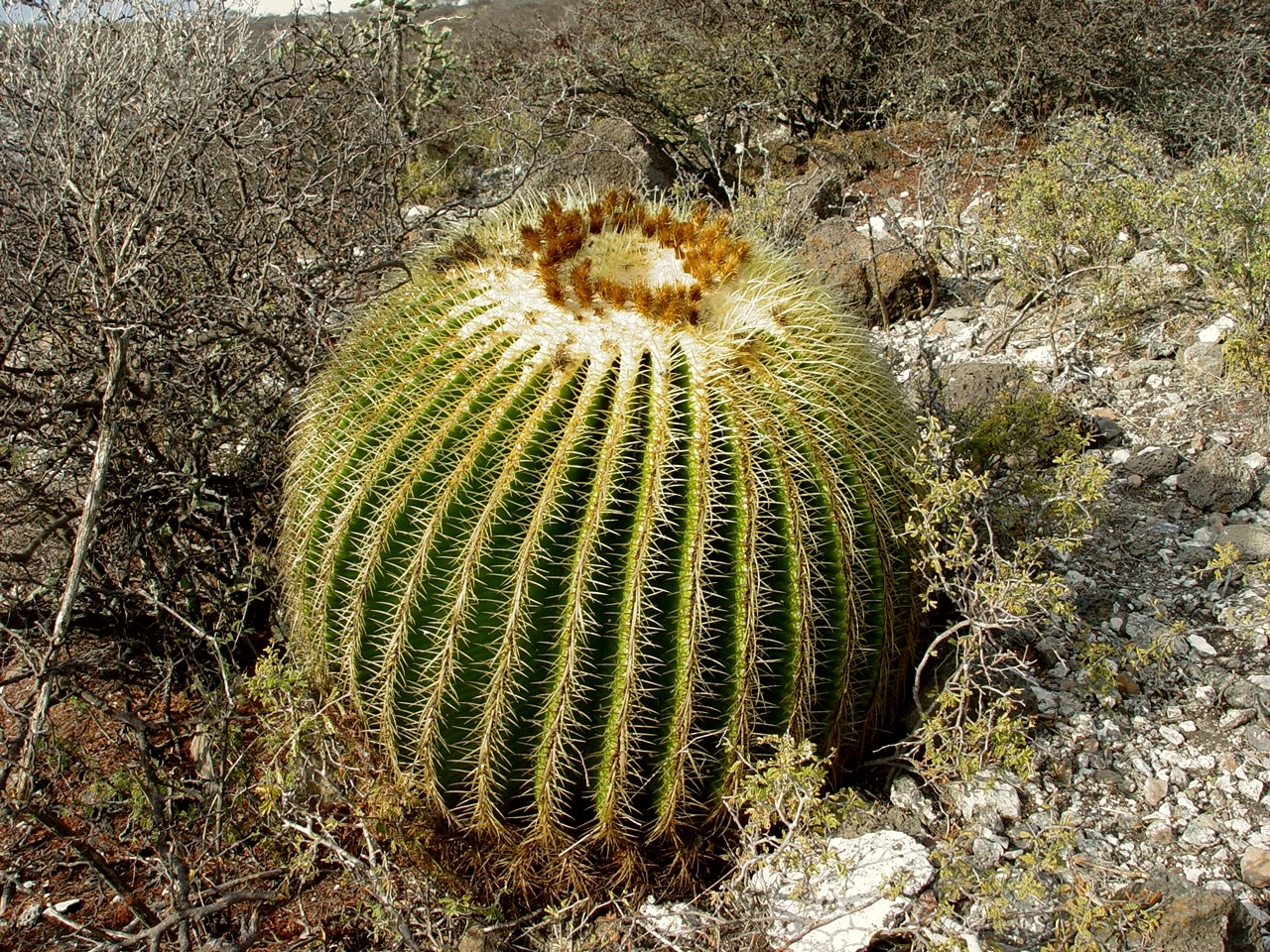
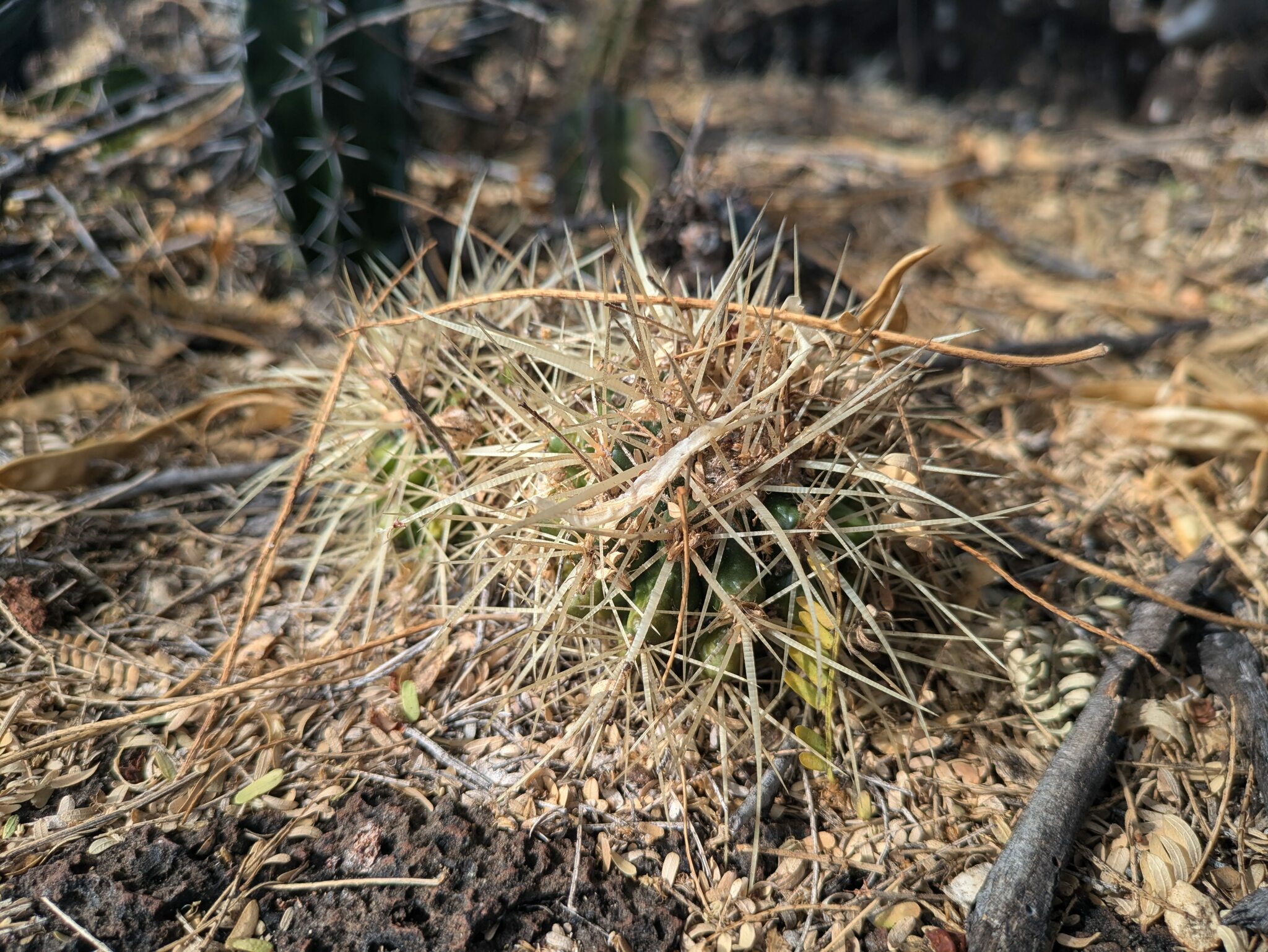


© photo
(c) Opuntia Cadereytensis, some rights reserved (CC BY-NC), uploaded by Opuntia Cadereytensis · cc-by-nc
Kevin Faccenda · cc-by
Wikimedia Commons · CC BY-SA or Public Domain
© copyright of the Board of Trustees of the Royal Botanic Gardens, Kew.
Global distribution
Native to Mexico, from Zacatecas to San Luis Potosí under the botanical circumscription used here; widely cultivated outside its natural range.
Identity
A spherical, deeply ribbed stem armed with golden spines distinguishes golden barrel cactus (Kroenleinia grusonii (Hildm.) Lodé, 2014). This perennial cactus belongs to the Cactaceae family. French horticultural references record it under the older name Echinocactus grusonii, which remains common in collections and horticultural catalogs. 1 4 3
Its shape changes with age: the sphere becomes a barrel. A small plant bought in a pot therefore does not keep its juvenile proportions indefinitely. The mature shape develops slowly, over decades, while the spines remain a major ornamental feature. 3 6
Recognition
The green stem has deep ribs, with groups of yellowish spines and short golden hairs arranged along their crests. A woolly area covers the top. On flowering plants, yellow flowers appear in a ring within this crown and remain partly embedded in the hairs. 6 3
Size depends on the context described. British horticultural guidance gives a height of 0.1 to 0.5 m (0.3 to 1.6 ft) and a spread of 0.5 to 1 m (1.6 to 3.3 ft). Mature plants can exceed a meter (3.3 ft) in height; these large specimens do not represent the immediate size of a windowsill cactus. 5 6
The species description gives a flower diameter of about 4 cm (1.6 in). Yellow flowers, pronounced ribs and golden spines need to be examined together when identifying a mature plant. 3
Useful taxonomy
The accepted name is Kroenleinia grusonii, a combination published in 2014. The basionym, Echinocactus grusonii Hildm., dates from 1886. The change of genus explains why two different labels can accompany the same cactus. 1
Echinocereus grusonii (Hildm.) Von Zeisold and Ferocactus grusonii (Hildm.) Guiggi also appear among its synonyms. These botanical names do not identify cultivars. A horticultural name added after the species name, such as ‘Inermis’, provides different information: it distinguishes a cultivated form within the taxon. 1 7
Habitat and range
Golden barrel cactus is native to Mexico. Its botanical range is given as Zacatecas to San Luis Potosí, in deserts and dry scrub. The plant is widely cultivated, but its abundance in horticulture does not describe the condition of wild populations. 1 6
Habitat destruction and illegal collecting threaten wild populations. Slow regeneration and collectors’ interest in large specimens add to the pressure on wild cacti. Buying a nursery-propagated plant avoids directly supporting this collecting. 6
The global Red List category is Endangered (EN), under the older scientific name. A separate algorithmic prediction gives “not threatened”; that estimate does not replace the conservation assessment. Some horticultural descriptions use “critically endangered,” so the classifications need to be distinguished rather than merged. 2 3
Life cycle and reproduction
Golden barrel cactus takes many years to flower. Twenty years or more can pass before the first flowers appear, and a diameter of at least 35 cm (14 in) is also described as a developmental threshold. Age alone is not enough: full sun is needed for flowering and for the golden color of the spines. 6 3
The fruits contain numerous small black seeds. Sowing seed is the recommended propagation method for the species. The presence of seeds in a fruit says nothing about how quickly a large specimen can be produced; developing the barrel shape remains a lengthy process. 3 5
Cultivation and risks
Golden barrel cactus needs a very bright position and a well-drained mix with a mineral component. Growing under cover protects it from excess moisture. Cacti in this group can spend summer in the garden if rain does not leave their pots waterlogged. Excess moisture can cause root rot or spots on the stem surface. 5 4
Water moderately during growth, then let the surface dry before watering again. Seasonal advice for these cacti distinguishes a cool, dry winter from conditions in a heated home, where watering remains very infrequent. Keeping plants above 5 °C (41 °F) and protected from moisture is the recommended winter guideline for the group. 4
Apply a balanced liquid fertilizer two or three times during growth. No regular pruning is needed. Mealybugs are among the pests to watch for. 5
The long spines pose a risk of physical injury. Keeping the pot away from walkways and out of reach of children or animals limits accidental contact. Toxicity if ingested remains undetermined; a lack of toxicological classification does not establish that the plant is harmless. 3
Horticultural forms and look-alikes
The form ‘Inermis’ is presented under the English name “Thornless Golden Ball.” This horticultural name does not describe the typical species, whose long spines are among its identifying features. A form name on the label therefore changes how the plant’s spines should be interpreted. 7 3
The horticultural description of ‘Inermis’ still calls for full sun and little water. The stated absence of spines does not imply a preference for shade or moisture. When comparing plants sold under different genus names, first check the epithet grusonii, then look for an additional horticultural name. 7 1
Main sources
- Plants of the World Online, Kroenleinia grusonii: identity, synonyms and distribution
- Plants of the World Online, Kroenleinia grusonii: IUCN category and risk prediction
- NParks, Kroenleinia grusonii: species description
- Société nationale d'horticulture de France, Echinocactus: French name and cultivation of the genus
- Royal Horticultural Society, Echinocactus grusonii: size and cultivation
- Oxford University Plants 400, Echinocactus grusonii: wild populations and threats
- NParks, Kroenleinia grusonii 'Inermis': horticultural form
Frequently asked questions
Why is my golden barrel cactus not flowering?
Flowering requires a mature plant of sufficient width and a position in full sun. A young potted plant can remain without flowers for a long time.
Are Echinocactus grusonii and Kroenleinia grusonii different plants?
These names refer to the same taxon. Kroenleinia grusonii is the accepted name; Echinocactus grusonii is its older botanical name, still used in horticulture.
How should I water golden barrel cactus in winter?
Keep a cool, resting plant dry. In a heated home, water very infrequently and check that the surface of the potting mix has dried.
Is golden barrel cactus safe for cats?
Toxicity if ingested remains unknown. The spines pose a physical hazard: keep the cactus away from places where an animal could bump into it or chew it.
If you are unsure about a plant’s toxicity, ask a botanist or veterinarian for advice.