
Silver squill (Ledebouria socialis, )


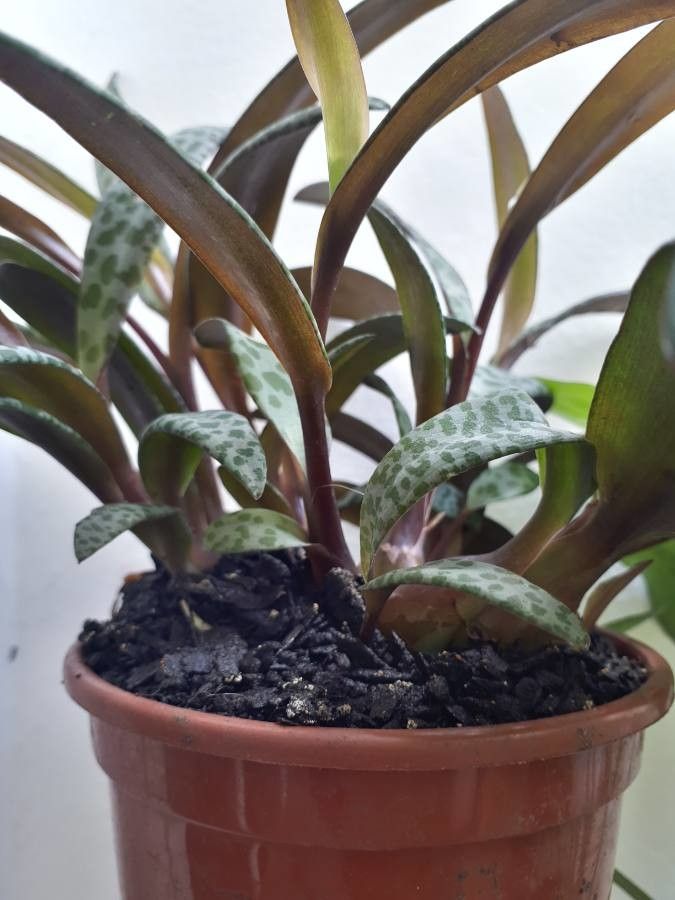
Silver squill (Ledebouria socialis) forms colonies of small bulbs visible above the soil. This South African perennial has fleshy leaves, often silvery with green spots and sometimes purple beneath. Grow it in a freely draining pot and keep it out of reach of children and animals.
Read moreSilver squill, Wood hyacinth and Leopard lily
Scilla socialis, Scilla paucifolia, Ledebouria violacea and Scilla violacea
Give plenty of ambient light without direct sun on the leaves.
Bright, filtered light or partial shade; advice varies with growing conditions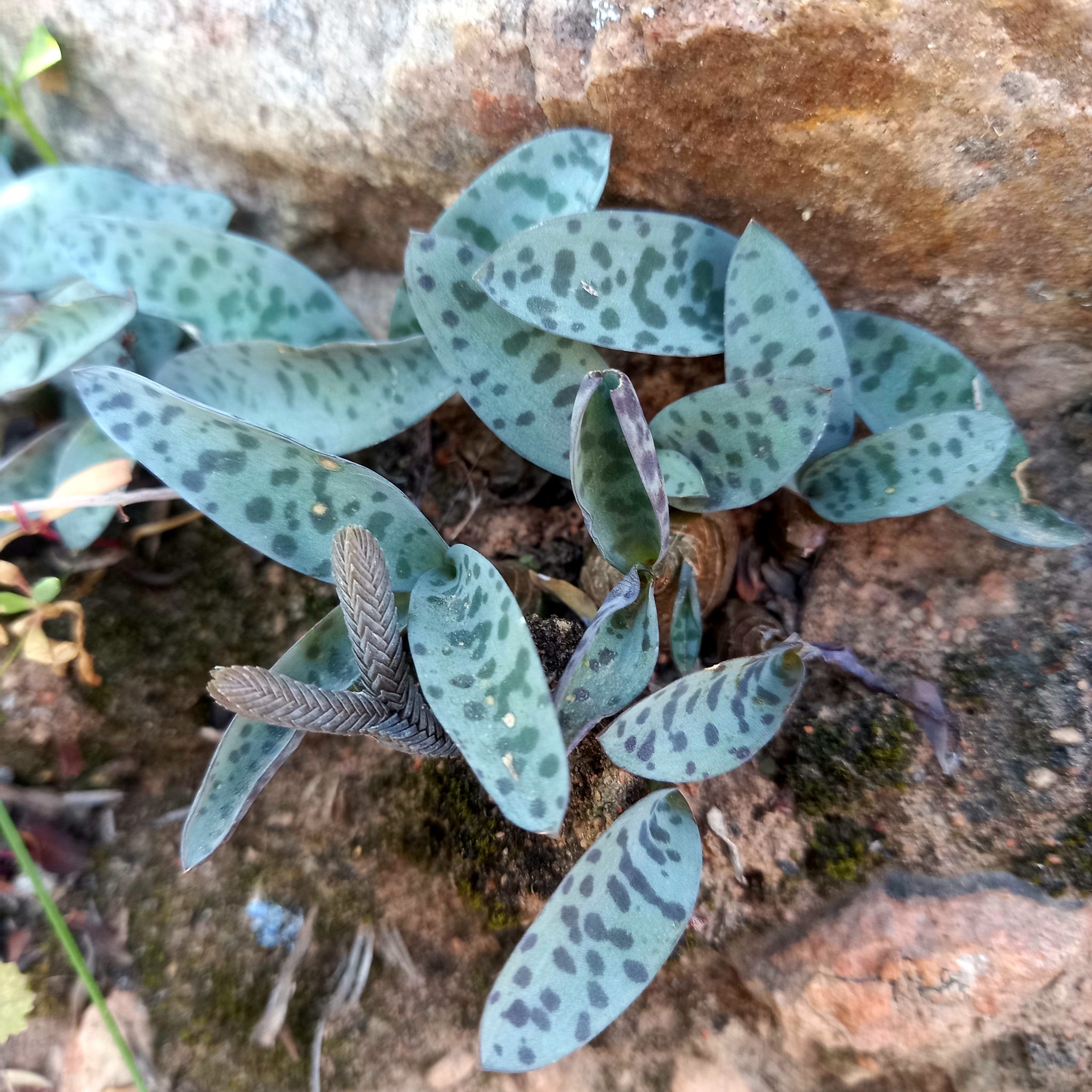


© photo
kevin koen · cc-by-sa
Wikimedia Commons · CC BY-SA or Public Domain
Wikipedia · CC BY-SA
Taken Mar 26, 2022 by michèle van Panhuys-Sigler (cc-by-sa)
Taken Dec 9, 2021 by Medina Olivera (cc-by-sa)
Taken May 12, 2020 by Line BONNEL (cc-by-sa)
Taken Apr 13, 2020 by Ellie (cc-by-sa)
Taken Jun 14, 2022 by Pavel Kavina (cc-by-sa)
© copyright of the Board of Trustees of the Royal Botanic Gardens, Kew.




Global distribution
Native to the Cape Provinces of South Africa; Stellenbosch University Botanical Garden specifies an Eastern Cape range from Hankey to East London.
- Native1
- South Africa, Eastern Cape
Hexagons: regions where the plant occurs. Green dots: native range.1
Identity
Silver squill (Ledebouria socialis (Baker) Jessop) forms colonies of exposed bulbs above the soil. Fleshy, spotted leaves grow directly from the bulbs. This habit is a more reliable identification feature than foliage color alone, which varies among cultivated forms. 4 8
This perennial belongs to the Asparagaceae family, in the order Asparagales. The French common-name record in Pl@ntNet refers to Ledebouria socialis, rather than to a European squill chosen for its color. 2 3
The genus honors the botanist Carl Friedrich von Ledebour. The epithet socialis refers to growth in colonies, visible as the bulbs multiply and crowd together in a pot. 5
Recognition
The cultivated plants described by NC State reach about 15 to 25 cm (6 to 10 in) in height, with a similar spread. Lance-shaped leaves form rosettes. In common forms, their upper surface is silvery with dark green spots and the underside is purple. The bulbs are teardrop-shaped. 5
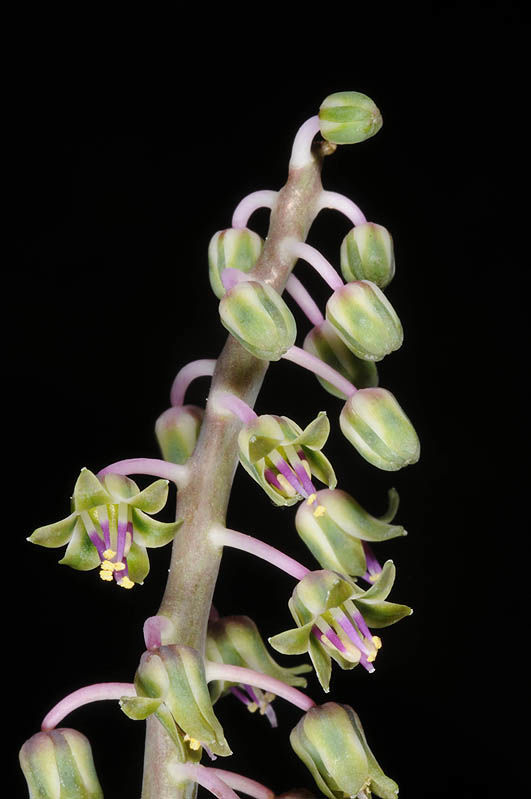
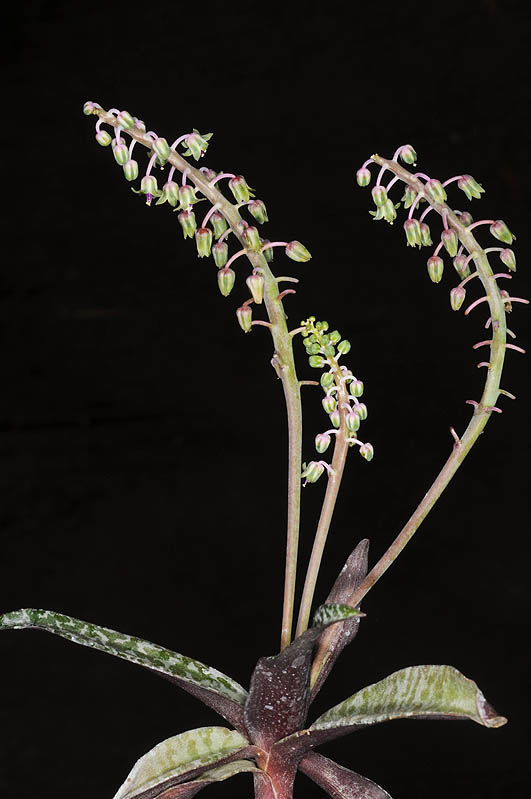
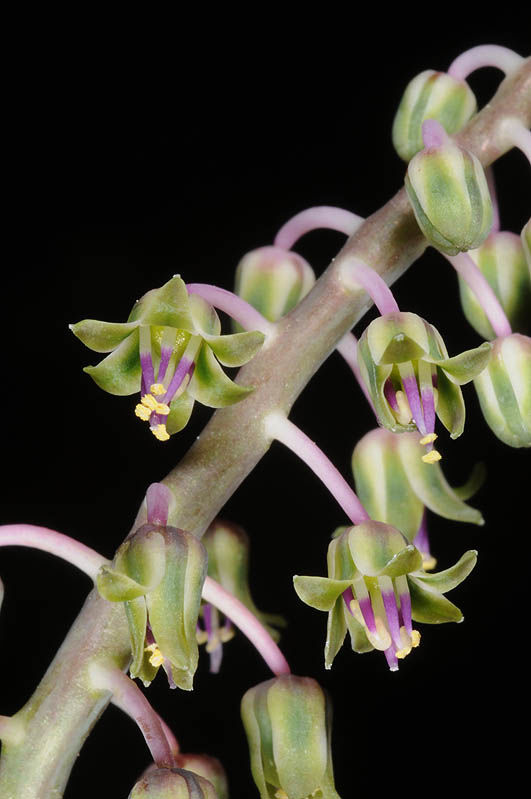
Small green flowers appear on pinkish stems in spring. Flowering is less conspicuous than the foliage. The RHS describes a clumping bulbous plant whose succulent leaves have leopard-like spots. 6
The flowers grow on an upright inflorescence, and their tepals curve strongly backward. Forms with marbled green leaves and those with silver leaves belong to the same species. A less purple underside alone does not rule out this identity. 8
Useful taxonomy
The accepted name is Ledebouria socialis; Jessop’s combination was published in 1970. The basionym is Scilla socialis Baker, which explains the name Scilla on older labels. 1 2
Synonyms include Scilla paucifolia Baker and Ledebouria violacea (Hutch.) W.L.Tjaden. These botanical names need to remain distinct from names of horticultural selections placed in quotation marks. 3
The RHS also mentions Ledebouria concolor, but specifies that the name has been misapplied. That note does not justify automatically treating every plant sold under that name as silver squill. 6
Habitat and range
Silver squill is native to South Africa. Kew places its native range in the Cape Provinces and describes it as a bulbous geophyte of the subtropical biome. Stellenbosch University Botanical Garden gives a more precise range in the Eastern Cape, from Hankey to East London. 1 4
The habitats listed by Stellenbosch include Albany thickets, forests and savannas. The Pacific Bulb Society describes shaded populations in evergreen woodland, on sandy, humus-rich, well-drained soils. A South African origin therefore does not imply that every plant needs exposed sun. 4 8
Stellenbosch reports that silver squill is widely grown in pots around the world. A cultivated plant elsewhere does not by itself establish the presence of a native wild population in that country. 4
Life cycle and reproduction
For indoor cultivation in the Northern Hemisphere, the calendar represents spring and summer growth followed by less watering in winter. The seasonal scores are relative guidelines, without fixed water volumes. The RHS recommends watering during growth, then keeping the mix barely moist in winter. 6 8
Applying a potassium-rich fertilizer monthly during growth follows the RHS guidance. Keep the bulb neck above the mix, with a sandy component in the potting medium to provide drainage. 6
Divide bulb clusters or separate offsets to propagate silver squill. Seed is another option, but NC State reports irregular germination. Vegetative propagation avoids that uncertainty. 5 6
Uses and risks
Silver squill is an indoor ornamental grown for its foliage. NParks recommends partial shade and little water. The RHS also suggests full sun in a sheltered position, while the Pacific Bulb Society favors filtered light. These differences call for attention to growing conditions rather than one universal exposure. 7 6 8
Do not ingest the plant. NC State reports oxalic acid, digestive upset after ingestion and irritant sap. The reference rates severity in humans as low, but classifies the plant as toxic to cats and dogs; kidney damage is specifically reported in cats. This feline risk calls for close attention without attributing the complication to every group. 5
Keep children and animals away from accessible plant parts. The information gathered does not establish safety for horses or for other animals without documented data. 5
Varieties, look-alikes and related plants
Horticultural selections of silver squill differ mainly in their leaves. ‘Juda’ has yellow or pink margins; ‘Laxifolia’ has soft, pale green leaves marbled with dark green. These traits describe the named selections, rather than every individual of the species. 8
‘Miner’, also encountered as ‘Minor’, is a dwarf selection. ‘Violacea’ has a silvery upper surface spotted with green and a purple underside. Color intensity and compactness depend on growing conditions, so color alone does not justify treating this form as a separate species. 8
An old label can give a botanical synonym, while a horticultural label specifies a selection. Checking the binomial and the full selection name avoids applying one cultivar’s dimensions or colors to all silver squill plants. 3 8
Main sources
- Kew, Plants of the World Online, Ledebouria socialis
- GBIF, Ledebouria socialis, taxonomic backbone
- Pl@ntNet, Ledebouria socialis, names and synonyms
- Stellenbosch University Botanical Garden, Ledebouria socialis
- NC State Extension, Ledebouria socialis
- Royal Horticultural Society, Ledebouria socialis
- NParks, Flora & Fauna Web, Ledebouria socialis
- Pacific Bulb Society, Ledebouria socialis and horticultural selections
Frequently asked questions
Should I bury the bulbs of silver squill?
Keep the bulbs partly exposed above a freely draining mix. The RHS recommends keeping the bulb neck above the soil.
Is silver squill dangerous to cats?
NC State Extension classifies it as toxic to cats and reports kidney damage after ingestion. Keep the plant out of their reach.
How do I propagate silver squill?
Dividing bulb clusters and separating offsets are documented methods. Seed can also be used, but germination may be irregular.
Should I water silver squill less in winter than in summer?
Reduce watering in winter. During growth, give the mix more water while maintaining drainage, and let the surface dry between waterings.
If you are unsure about a plant’s toxicity, ask a botanist or veterinarian for advice.