
Maidenhair vine (Muehlenbeckia complexa, )
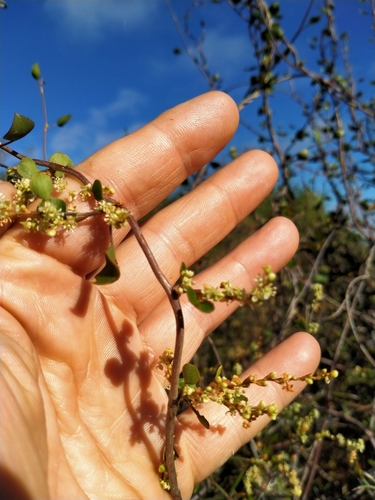

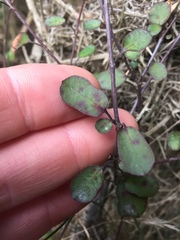
Maidenhair vine (Muehlenbeckia complexa) weaves fine brown stems into a tangle dotted with small green leaves. This southwestern Pacific climber can cover a support or trail from a hanging basket; its delicate appearance conceals vigorous growth.
Read moreMaidenhair vine, Small-leaved pohuehue and Scrub pohuehue
Polygonum complexum and Fallopia complexa
Allow a few hours of direct sun per day, preferably morning or evening.
Sun or partial shade; medium to bright light indoors.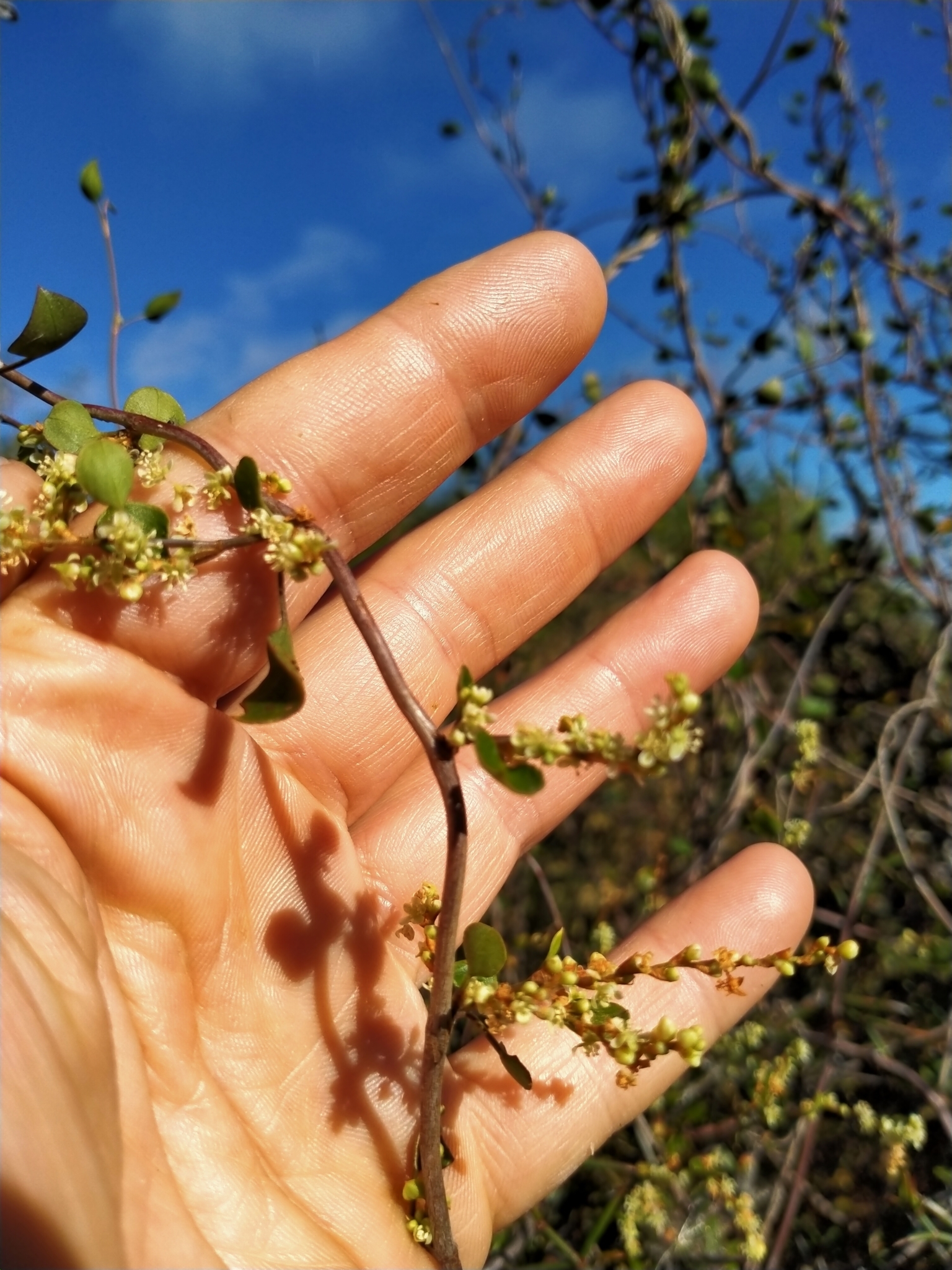



© photo
John Barkla · cc0
(c) James Gaither, some rights reserved (CC BY-NC-ND) · cc-by-nc-nd
iNaturalist User · CC BY-NC
Taken Dec 16, 2021 by Almeida Cilene (cc-by-sa)
© copyright of the Board of Trustees of the Royal Botanic Gardens, Kew.


Global distribution
Native to New Zealand and nearby islands; introduced in western Europe, among other regions.
- Native3
- Introduced1
- New Zealand
- Norfolk Island
- Lord Howe Island
- France
Hexagons: regions where the plant occurs. Green dots: native range.2
Identity
Maidenhair vine (Muehlenbeckia complexa (A.Cunn.) Meisn., 1841) twines threadlike stems around supports. The woody climber belongs to the Polygonaceae family. French names such as “plante fil-de-fer” and “liane capillaire” describe its network of branches, rather than the inconspicuous flowers. The tangle of slender stems is a useful feature to examine on a plant without flowers. 1 2
The epithet complexa refers to the intertwined stems. The French name “renouée de Nouvelle-Zélande” is also documented for this exact species. A label that says only “muehlenbeckia” provides less information: the genus contains other species, and commercial names can lead to confusion. Check the full scientific name when comparing horticultural descriptions. 7 8 6
Identification
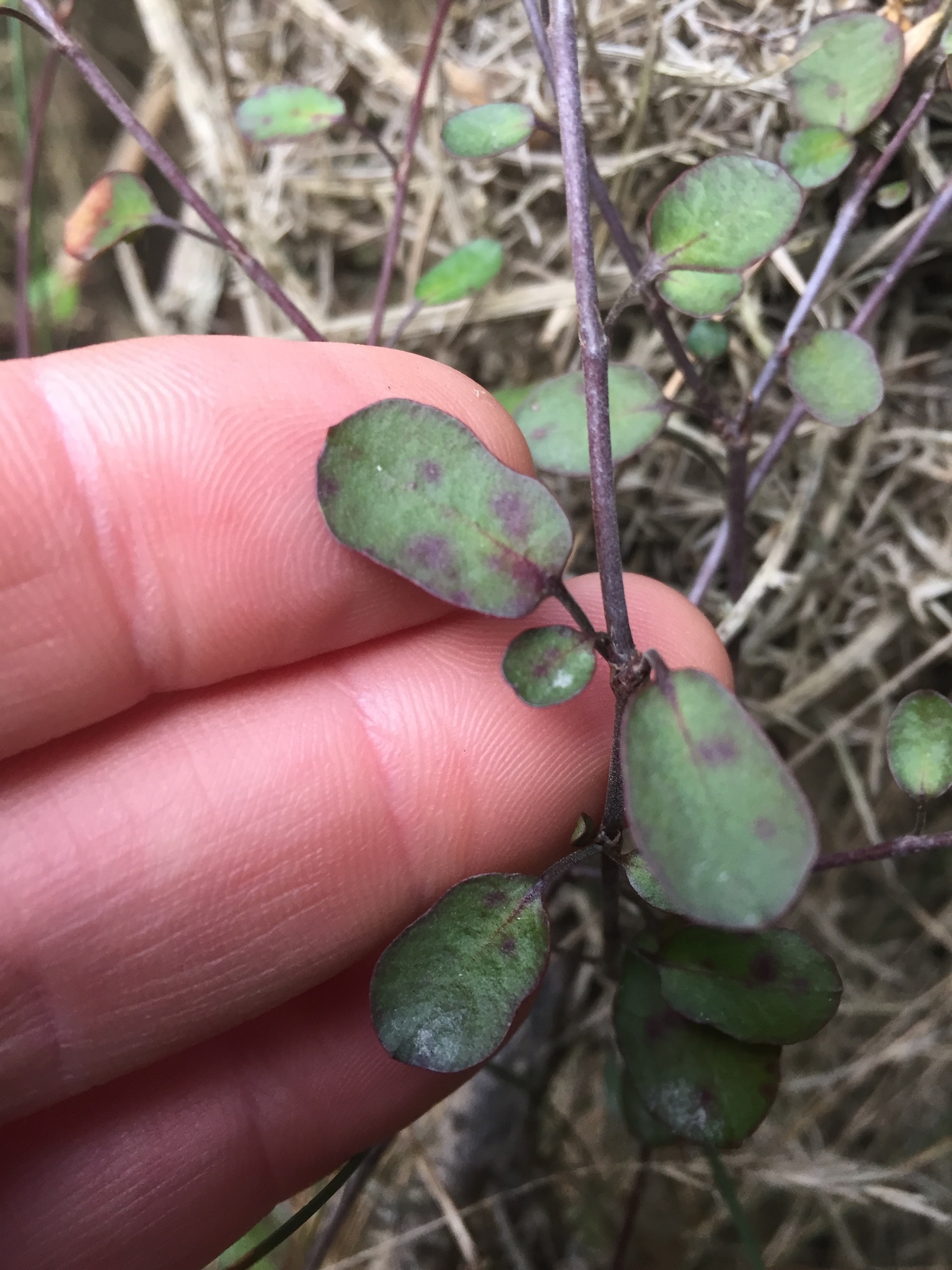
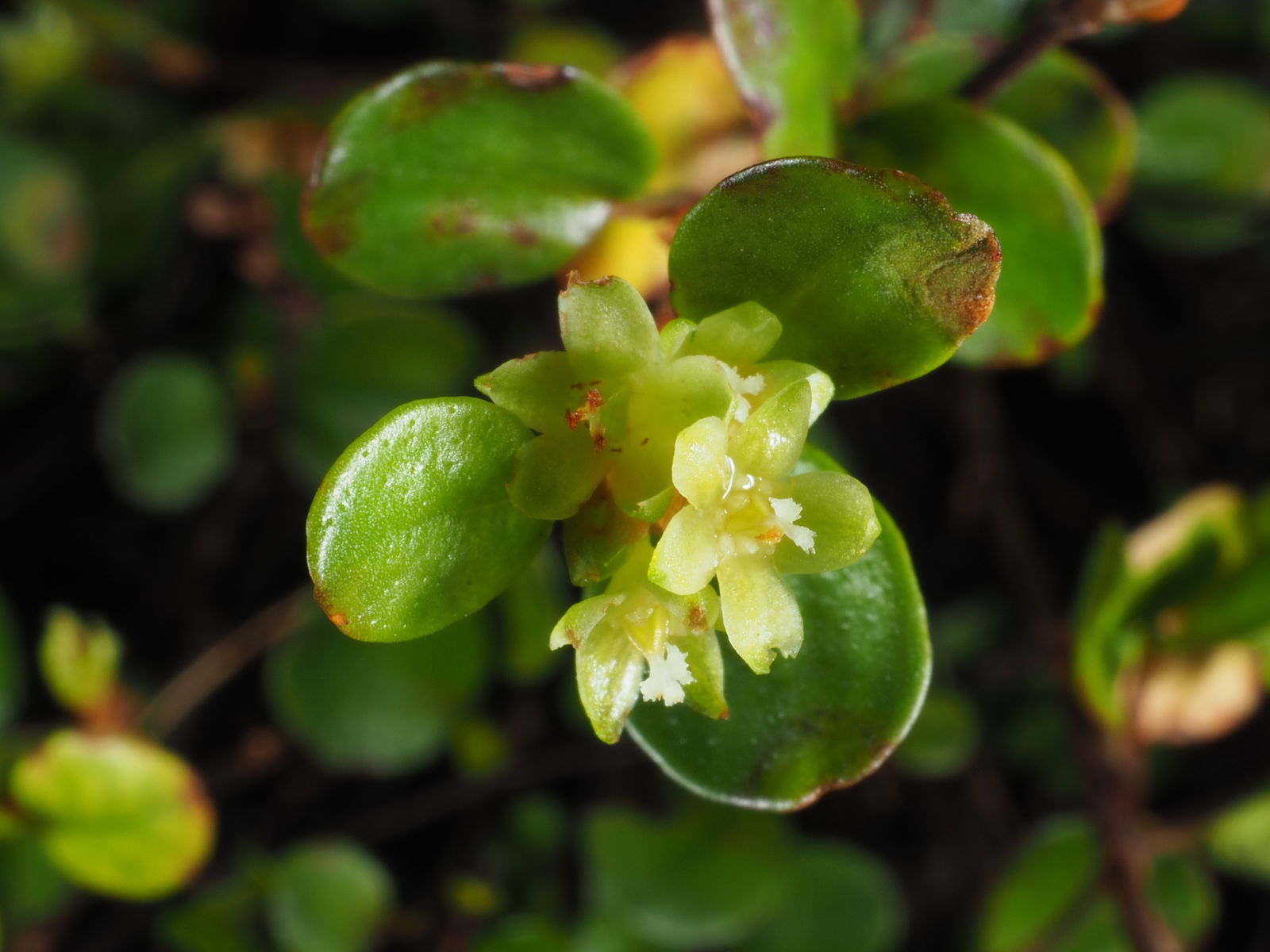
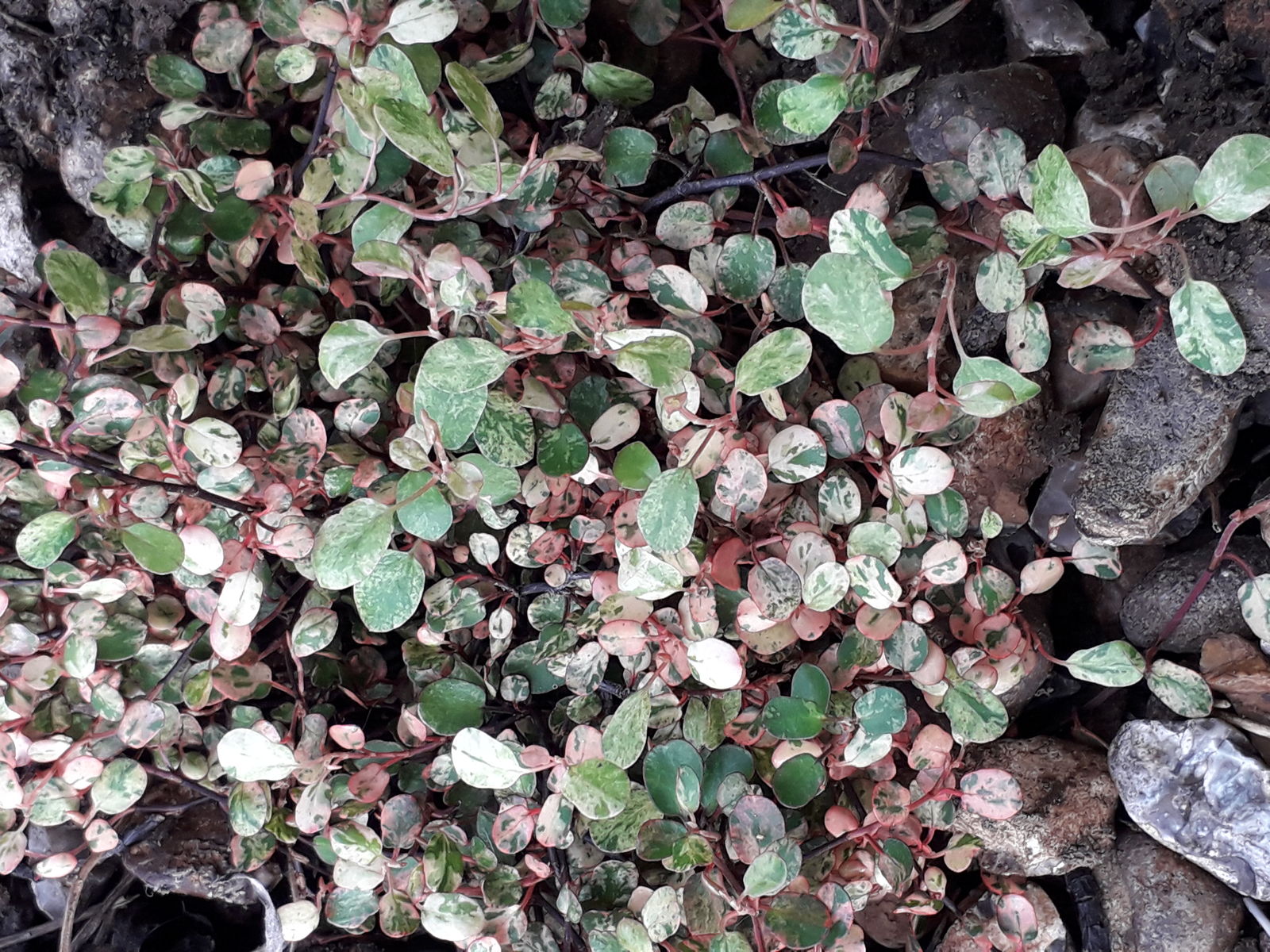
The reddish brown, much-branched stems carry small dark green leaves. Blades on the same plant can be nearly round, oblong, or fiddle-shaped, with an occasionally notched tip. Leaf length reaches 2 cm (0.8 in) in the horticultural description. A single leaf therefore provides fewer clues than the combination of variable blades and fine, tangled stems. 3 4
Garden dimensions are 2.5–4 m (8.2–13.1 ft) tall and 1.5–2.5 m (4.9–8.2 ft) wide. The New Zealand flora describes climbers reaching about 6 m (19.7 ft). The published dimensions concern developed plants with opportunities for support. Without support, branches accumulate in tangled masses, so a small trailing pot shows only one possible outline of the species. 4 3
Useful taxonomy
The accepted name is Muehlenbeckia complexa. Polygonum complexum A.Cunn. is its basionym, the original name on which the current combination was based. Fallopia complexa (A.Cunn.) J.-M.Tison also appears among its synonyms. Changes of genus explain why botanical works can use different names for the same plant. 2
The author in parentheses, A.Cunn., published the original name; Meisn. published the combination in the current genus. The current combination dates to 1841. Botanical synonyms here connect references to the same taxon, rather than identifying horticultural varieties. An older generic name on a record does not, by itself, establish a different cultivated plant. 2
Habitat and distribution
Maidenhair vine comes from the southwestern Pacific, including New Zealand, Norfolk Island, and Lord Howe Island. Its native range therefore extends beyond New Zealand, despite the geographic emphasis of the French name “renouée de Nouvelle-Zélande.” The taxonomic reference places the species primarily in the temperate biome. 1 2
In New Zealand, Muehlenbeckia complexa is used to stabilize disturbed ground at forest edges and on dunes. Its ability to form dense cover explains that use. Outside its native range, introduction is reported in France, Great Britain, and Portugal, among other territories. An introduced status describes the origin of a population; it does not by itself establish a regulatory classification as an invasive species. 7 2
Life cycle and propagation
Maidenhair vine is dioecious, with male and female flowers on separate plants. Small greenish or greenish white flowers appear in terminal and axillary spikes. French horticultural guidance places flowering in July and August, while the British description places it in fall. The different seasonal accounts need to retain their geographic growing context. 3 7 1 4
On female plants, the perianth becomes white and fleshy around a shiny black fruit. The conspicuous pale covering is not the fruit itself. Horticultural propagation uses semi-ripe cuttings taken in summer with bottom heat; layering is also reported. Cuttings and layering provide propagation methods distinct from the development of fruit on female plants. 3 4 7
Growing and seasonal care
In the garden, choose sun or partial shade, moist but well-drained soil, and shelter from cold winds. Provide a support to train stems upward. Hanging baskets instead make use of the trailing habit; indoors, medium to bright light is suitable. Watch nearby plants because the vigorous branches can spread over them. 4 5 7
In a pot, keep the growing medium moist in summer and let it dry between waterings in winter. Water needs increase in spring and summer compared with fall and winter. The calendar expresses that seasonal difference as relative guidance for Northern Hemisphere cultivation. How much the growing medium has actually dried remains the basis for deciding when to water. 1 5
Fertilizer is optional for maidenhair vine. A houseplant fertilizer can support spring and summer growth when used according to the manufacturer's instructions. The feeding months in the schedule represent that option, without making fertilization compulsory. A plant grown without fertilizer is not automatically receiving inadequate care. 5
Similar plants and precautions
The horticultural name ‘Nana’ needs verification: the British reference lists Muehlenbeckia complexa ‘Nana’ as a synonym of another species, Muehlenbeckia axillaris. Characteristics of a plant carrying that label cannot therefore be assigned to maidenhair vine. Before buying, check the cultivar name together with the species name. 6
Leaf retention also differs between descriptions. Floriscope records evergreen foliage, while the British reference describes a deciduous climber. Maidenhair vine cannot therefore be guaranteed to retain every leaf through winter. The difference between those accounts matters when judging whether year-round foliage is a dependable feature of a planting. 1 4
Maidenhair vine is not intended for human or animal consumption. The advice against consuming maidenhair vine identifies neither a toxic substance nor an audience-specific risk: toxicity remains unknown for cats, dogs, horses, other animals, and people in the information gathered. A fleshy perianth does not establish that the plant is edible. 5 3
Main sources
Botanical descriptions distinguish the black fruit from its white perianth covering; horticultural references explain container uses and seasonal care for maidenhair vine. 3 5
- Floriscope, botanical and horticultural record for Muehlenbeckia complexa
- Plants of the World Online, Muehlenbeckia complexa
- Flora of New Zealand, Muehlenbeckia complexa
- Royal Horticultural Society, Muehlenbeckia complexa
- Costa Farms, Maidenhair Vine growing guidance
- Royal Horticultural Society, Muehlenbeckia axillaris
- Cambridge University Botanic Garden, Muehlenbeckia complexa
- Tela Botanica, standardized French vascular plant names, Ebenaceae–Rosaceae
Frequently asked questions
Why does maidenhair vine have a wiry appearance?
Maidenhair vine has fine, brown, much-branched stems. The tangled branches resemble a network of wires, especially where the small leaves leave the stems visible.
Does maidenhair vine keep all its leaves in winter?
Leaf retention is not guaranteed: horticultural references describe the plant as either evergreen or deciduous. Growing conditions affect its behavior.
Does maidenhair vine need fertilizer?
Fertilizer is not essential. Optional houseplant fertilizer can support growth in spring and summer, at the rate stated on the product.
Is maidenhair vine edible or safe for animals?
The plant is not intended for human or animal consumption. The information gathered does not establish a toxicity level for cats, dogs, horses, other animals, or people.
If you are unsure about a plant’s toxicity, ask a botanist or veterinarian for advice.