
Popcorn orchid (Oncidium sphacelatum, )
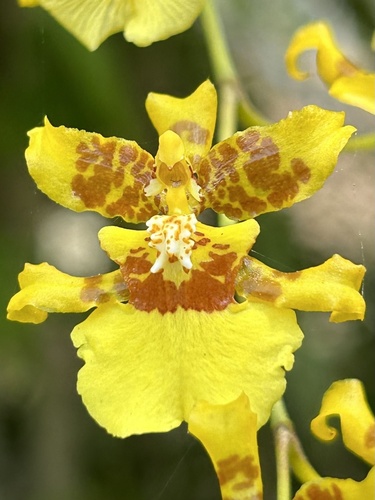


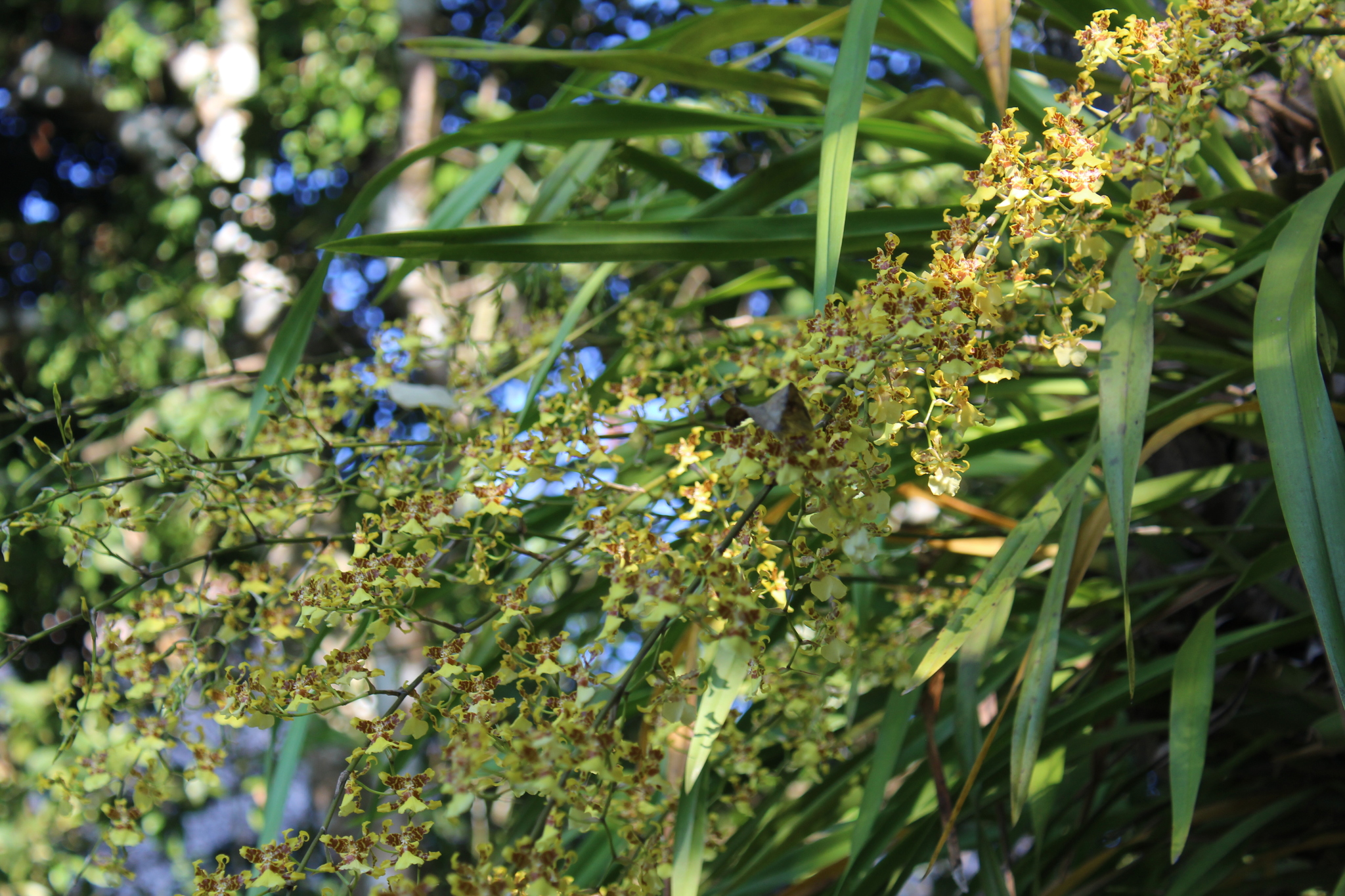
Popcorn orchid (Oncidium sphacelatum) bears long, branched flower spikes covered in small yellow flowers spotted with brown. This tropical orchid with pseudobulbs needs bright light, air around its roots and enough space to flower.
Read morePopcorn orchid
Oncidium schrautianum and Oncidium stenostalix
Give plenty of ambient light without direct sun on the leaves.
Bright indirect light; protect from intense summer sun.


© photo
iNaturalist User · cc0
Ricard Busquets Reverte · cc-by
© copyright of the Board of Trustees of the Royal Botanic Gardens, Kew.


Global distribution
Native range from Mexico through Central America, with a presence in southeastern Venezuela.
- Native7
- Mexico
- Belize
- Guatemala
- El Salvador
- Honduras
- Nicaragua
- Venezuela
Hexagons: regions where the plant occurs. Green dots: native range.1
Identity
Popcorn orchid (Oncidium sphacelatum Lindl., 1841) bears branched spikes covered in 50 to 100 small yellow flowers marked with brown. This perennial orchid belongs to the Orchidaceae family. Its large, arching inflorescences need more space than the pot itself, so an adult plant can outgrow a windowsill. 3 2
The scientific name distinguishes this species from hybrids sold under horticultural names. The documented name “popcorn orchid” is English rather than a French vernacular. The epithet sphacelatum refers to the brown speckles, a visible flower feature rather than a sign of leaf disease. 3 6
Recognition
The pseudobulbs of popcorn orchid carry two or three green, strap-shaped leaves and store water. Flower spikes emerge at their base. The lightly scented yellow-and-brown flowers measure about 2.5 cm (1 in) across; their abundance gives the display its volume. 3
Cultivated plants are described as about 30 cm to 1.8 m (1 to 6 ft) tall, including the flower spikes, and 30 cm to 0.9 m (1 to 3 ft) wide. A long, arching spike therefore does not indicate the height of the foliage alone. The leaves are simple, linear and entire. To identify the species, examine the shape of the spikes alongside the pseudobulbs and small, spotted flowers. 3
Useful taxonomy
Oncidium sphacelatum is an accepted botanical species, described under this name by Lindley. Its first publication dates to 1841, in Sertum Orchidaceum. The current classification places it in the genus Oncidium, family Orchidaceae and order Asparagales. 1 2
The names Oncidium schrautianum and Oncidium stenostalix are among the older names associated with this orchid. They can explain differences between labels or catalogs without designating cultivars. Another name on a label therefore calls for checking the synonymy before looking for differences in cultivation. 3
Habitat and distribution
The native range of popcorn orchid extends from Mexico through Central America, with a presence in southeastern Venezuela. Detailed accounts list Belize, Guatemala, El Salvador, Honduras and Nicaragua. This tropical distribution describes the species' origins, independently of the countries where it is cultivated. 1 3
The orchid grows mainly as an epiphyte, with its roots on a tree support; growth on rocks is also reported. Its main habitat is the humid tropical biome. In a pot, a coarse-to-medium bark mix reproduces one useful condition of this setting: air can circulate around the roots while excess water drains away. 1 3
Life cycle and reproduction
Flowering in popcorn orchid is reported in spring. Horticultural propagation is by division, preferably in that season. For oncidiums, repotting is best timed to the emergence of new shoots and roots; avoid disturbing a plant in spike. Degraded growing medium or an outgrown pot justifies repotting. 3 5 4
When dividing warm-growing oncidiums, keep at least three pseudobulbs in each piece. Place each division in a small pot of orchid medium. Depending on their size, divisions can take several years to flower again: dividing a clump does not immediately produce new flowering plants. 4
The calendar expresses these trends for indoor cultivation in the Northern Hemisphere. Watering and feeding increase during growth, from spring through fall; follow the orchid fertilizer label for dosage. Monthly scores remain relative. Spring repotting depends on the shoots and flowering observed, rather than a fixed date. 3 5 4
Cultivation and risks
Insufficient light reduces flowering in popcorn orchid. Choose bright indirect light with moving air. The species description recommends atmospheric humidity above 60%. Water thoroughly, then let excess moisture drain from the medium; standing water and poor aeration expose the roots to rot. 3 6
For the warm-growing oncidium group, horticultural guidelines are 18 to 25 °C (64 to 77 °F) by day and 13 to 17 °C (55 to 63 °F) at night. These ranges concern cultivation of the group, without establishing frost-resistance thresholds specific to the species. Keep the position ventilated while avoiding cold drafts. 4
Rest requires some qualification: NC State advises reducing water in winter, while the SNHF places the species in a group without a strict dormant period. Water less often when growth slows, without routinely turning that reduction into prolonged drought. Watch for scale insects and mites too. 3 6
The ASPCA classifies the species as non-toxic to cats, dogs and horses. This classification does not document other animals or the safety of humans and children. Their status therefore remains unknown; veterinary non-toxicity is not a recommendation to eat the plant. 7
Varieties, look-alikes and related plants
The name “Pluie d’or” alone cannot identify Oncidium sphacelatum: it also refers to a widely sold hybrid. Oncidiums include plants with different needs. In the French horticultural classification, hybrids of this type belong to the group with a rest period, while the species is placed in the other group. Copying their watering regime can therefore lead to inappropriate care. 6
Warm-growing oncidiums often bear small yellow flowers on branched stems. This appearance alone does not establish the species' identity. A precise botanical label and flowering characteristics remain necessary to distinguish popcorn orchid from similar-looking hybrids. The particular needs of a hybrid do not automatically apply to all Oncidium species. 4 3
Main sources
- Plants of the World Online / Kew, Oncidium sphacelatum Lindl.
- GBIF Backbone Taxonomy, Oncidium sphacelatum Lindl.
- NC State Extension, Oncidium sphacelatum
- Royal Horticultural Society, How to grow oncidium orchids (warm growing)
- American Orchid Society, Oncidium Culture Sheet
- Société Nationale d’Horticulture de France, Oncidium
- ASPCA, Golden Shower Orchid, Oncidium sphacelatum
Frequently asked questions
Is popcorn orchid suitable for a small windowsill?
An adult plant may outgrow a windowsill: its branched flower spikes reach about 1.8 m (6 ft). Allow space around the pot, as indicated in NC State's horticultural description.
Should this orchid have a dry rest?
Advice differs: NC State reduces watering in winter, while the SNHF places the species among oncidiums without a strict dormant period. Adjust watering to growth and the drying of the medium rather than imposing prolonged drought.
Is this orchid toxic to cats?
The ASPCA specifically classifies Oncidium sphacelatum as non-toxic to cats, dogs and horses. This assessment does not make the plant edible or document human safety.
Why does popcorn orchid flower poorly?
Insufficient light can reduce flowering, according to NC State. Place the plant in bright indirect light and protect the flowers from intense sun.
If you are unsure about a plant’s toxicity, ask a botanist or veterinarian for advice.