
Lacy tree philodendron (Philodendron bipinnatifidum, )


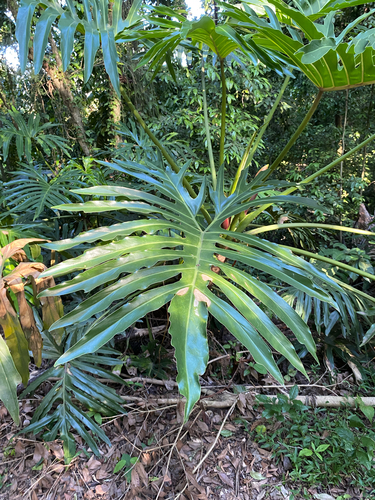
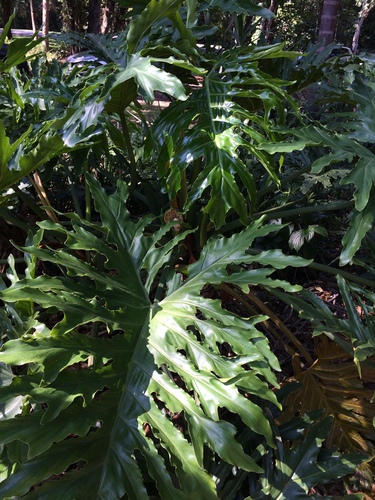
Lacy tree philodendron (Philodendron bipinnatifidum) bears large, deeply lobed leaves on a stem marked with leaf scars. This South American member of the Araceae family is also called Thaumatophyllum bipinnatifidum in the 2018 taxonomic treatment.
Read moreLacy tree philodendron, Tree philodendron, Split-leaf philodendron and Selloum
Thaumatophyllum bipinnatifidum, Philodendron selloum and Philodendron pygmaeum
Give plenty of ambient light without direct sun on the leaves.
Bright filtered light, sheltered from hot sun


© photo
Wikimedia Commons · CC BY-SA or Public Domain
Wikipedia · CC BY-SA
(c) Rafael Silva, some rights reserved (CC BY-SA) · cc-by-sa
(c) B. Phalan, some rights reserved (CC BY) · cc-by

Global distribution
Native to South America: southern and southeastern Brazil, Bolivia, Paraguay and northeastern Argentina.
- Native4
- Southern and southeastern Brazil
- Bolivia
- Paraguay
- Northeastern Argentina
Hexagons: regions where the plant occurs. Green dots: native range.↗
Identity
Lacy tree philodendron (Philodendron bipinnatifidum Schott ex Endl., 1837) combines large, deeply divided leaves with a thick, scarred stem. This evergreen perennial belongs to the Araceae family. Its documented French name, "philodendron à feuilles bipinnatifides," describes foliage whose lobes are themselves cut into smaller divisions. The leaf shape accounts for the lacy appearance of mature plants. 5 4 1
Age changes the growth habit of lacy tree philodendron. A young plant stands upright, but its stem may later lean or creep. Aerial roots descend toward the ground or attach to a support. Its small-tree appearance therefore does not guarantee that the stem will remain vertical and self-supporting throughout the plant's life. 1 2
Recognition
Mature leaves of lacy tree philodendron are glossy dark green above and paler beneath, with wavy-edged lobes. The Singapore botanical description gives leaf blades of 75–120 cm (about 2.5–4 ft) and petioles of 70–150 cm (about 2.3–5 ft). The petiole is the stalk that joins the blade to the stem; its length is a separate measurement from the blade itself. 2
Eye-shaped leaf scars remain visible on the stem. Young leaves are less deeply divided than adult leaves; low light or excess watering can also produce less lobed foliage. A shallowly divided leaf alone therefore cannot rule out lacy tree philodendron. Age and growing conditions both matter when comparing the foliage of two plants. 2 1
For mature plants grown under cover, horticultural descriptions give both height and spread as 2.5–4 m (about 8–13 ft). The mature dimensions describe a developed specimen rather than an expected size for every plant in an apartment. A smaller indoor specimen should not be identified solely by comparison with the published mature size. 3
Useful taxonomy
The 2018 treatment published the combination Thaumatophyllum bipinnatifidum (Schott ex Endl.) Sakur., Calazans & Mayo. Molecular and morphological evidence led its authors to recognize Thaumatophyllum as a separate genus. Horticultural references continue to use the name Philodendron bipinnatifidum, so the two generic names coexist in accounts of lacy tree philodendron. 5 3
Botanical authorship also differs between references. The 2018 treatment cites Schott ex Endl. and publication in 1837. The US agricultural database instead accepts Schott ex Kunth, 1841, and treats the 1837 name as insufficiently published. The two nomenclatural treatments need to remain separately attributed rather than merged into a single authority. 5 8
Philodendron selloum K.Koch and Philodendron pygmaeum Chodat & Vischer appear in the taxon's synonymy. Consequently, "Selloum" on a label does not establish a separate cultivar. An older species name and the name of a horticultural selection serve different purposes. 2
Habitat and range
Southern and southeastern Brazil form part of the native range of lacy tree philodendron, alongside Bolivia, Paraguay and northeastern Argentina. Documented habitats include humid forests and gallery forests along watercourses, as well as seasonal forest formations. The species therefore occurs across more than one kind of South American forest environment. 2
Open swampy areas and rocks in open coastal or lower-mountain scrub also support the species. Lacy tree philodendron is therefore not confined to dense forest understory. In Singapore, it is classified as non-native and cultivated only. That status applies to Singapore; it does not describe the plant's status in another country or establish a worldwide invasive classification. 2
Life cycle and reproduction
A spadix surrounded by a spathe forms the inflorescence of lacy tree philodendron. The central spike bears female flowers at its base and fertile male flowers at the top, with a sterile male zone between them. The female phase precedes the male phase. The visible structure is therefore an inflorescence containing separate flowers. 2
Heat and scent from the spadix attract pollinating beetles of the genus Cyclocephala. After fertilization, the developing fruit cluster bears berries that ripen white or yellow. Flowering is rare in apartments, so a plant grown indoors may be recognized chiefly by its foliage and stem rather than by flowers or fruit. 2 1
Propagation by stem cuttings is documented for lacy tree philodendron. Surface sowing and layering are recommended in spring; 19–24 °C (66.2–75.2 °F) is the temperature given for seed germination. The sowing range for lacy tree philodendron does not define a permanent ideal growing temperature for an established plant. 7 3
The calendar translates documented advice for more summer watering and less winter watering into a scenario for indoor cultivation in mainland France. Its relative editorial water and growth indices describe seasonal trends, without measuring volumes or growth rates or imposing a universal routine. The scenario aligns active growth with the feeding window in the philodendron growing guide. 4 9
The philodendron growing guide includes this species. Its indoor genus guidance is applied here to the French temperate context: repot in spring when roots become crowded, rather than automatically every year. The guide recommends feeding during the growing season; the species account specifies a balanced liquid fertilizer monthly during active growth. Adjust those windows to actual light and growth conditions, including local seasons in other climates and hemispheres. 9 3
Uses and risks
Grown for its foliage, lacy tree philodendron can live in a pot indoors or in a garden where the climate suits it. Under cover, bright filtered light and fertile, well-drained potting mix suit the plant. Hot sun can damage the leaves, while waterlogged soil increases the risk of root rot. 3 1
Insoluble calcium oxalates account for the risk from chewing the plant. Toxicity to cats, dogs and horses is documented under the synonym Philodendron selloum. Signs include oral irritation and swelling, excessive drooling and difficulty swallowing. Vomiting is reported in affected animals other than horses. 6
For humans, ingestion is toxic and sap can irritate the skin; contact with the eyes should also be avoided. Keep lacy tree philodendron out of children's reach. The risk to other animal species is not specified, so the absence of a classification does not establish safety for those animals. 1 3 2
Varieties, look-alikes and related plants
Thaumatophyllum xanadu is a separate species in the 2018 treatment. Its leaves have a single level of lobing, whereas lacy tree philodendron usually has further divisions within the lobes. "Xanadu" should therefore not be recast as a cultivar of P. bipinnatifidum merely because the plants share a broadly similar appearance. 5 2
The 2018 identification key also separates Thaumatophyllum lundii. Lacy tree philodendron has petioles conspicuously grooved on their upper surface and numerous small, persistent scales near the leaf scars. In T. lundii, the upper petiole surface is flattened or slightly convex, and the scales do not persist. No particular cultivar is sufficiently characterized here to warrant a separate description. 5
Main sources
The 2018 revision distinguishes Thaumatophyllum bipinnatifidum from related species; horticultural references describe cultivation and risks under their respective names. 5 3
- NC State Extension, Philodendron bipinnatifidum
- National Parks Board Singapore, Thaumatophyllum bipinnatifidum
- Royal Horticultural Society, Philodendron bipinnatifidum
- Monaco Nature Encyclopedia, Pietro Puccio, French translation by Serge Forestier, Philodendron bipinnatifidum
- Sakuragui et al. (2018), Recognition of the genus Thaumatophyllum, PhytoKeys
- ASPCA Poison Control, Lacy Tree Philodendron, Philodendron selloum
- Pl@ntUse/Pl@ntNet, Philodendron bipinnatifidum, texts attributed to Fouqué (1972)
- USDA ARS GRIN-Global, Philodendron bipinnatifidum Schott ex Kunth
- Royal Horticultural Society, How to grow philodendrons, genus guidance including this species
Frequently asked questions
Are Philodendron bipinnatifidum and Thaumatophyllum bipinnatifidum different plants?
These names refer to the same taxon in the 2018 treatment, which transfers the species to Thaumatophyllum. References do not all follow the same classification.
Why are young leaves less deeply divided?
Young plants have more shallowly lobed leaves. The foliage becomes more deeply divided with maturity; low light and excess watering can also limit lobing.
Is lacy tree philodendron toxic to cats?
Yes. The veterinary classification under the synonym Philodendron selloum records toxicity to cats, dogs and horses, caused by insoluble calcium oxalates.
Are Selloum and Xanadu cultivars of this plant?
Philodendron selloum appears in the species' synonymy. Thaumatophyllum xanadu is a separate species in the 2018 treatment and should not be listed among its cultivars.
If you are unsure about a plant’s toxicity, ask a botanist or veterinarian for advice.