
Philodendron tortum
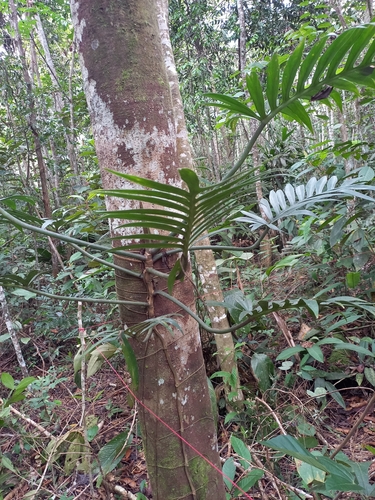

Philodendron tortum bears leaves deeply divided into narrow lobes and a strongly twisted prophyll. This climber from the humid forests of Brazil and Bolivia clings to trunks with its roots. Indoors, guidance for the genus favors indirect light and a well-drained medium.
Read moreGive plenty of ambient light without direct sun on the leaves.
Bright indirect light; avoid direct summer sun.


© photo
(c) gilfanymacario, some rights reserved (CC BY-NC) · cc-by-nc
Wikimedia Commons · CC BY-SA or Public Domain
Wikipedia · CC BY-SA


Global distribution
Native to Brazil and Bolivia. In Brazil, reported in Acre, Amazonas, Mato Grosso, Pará and Rondônia; in Bolivia, in the departments of El Beni, Pando and Santa Cruz.
Identity
Philodendron tortum (M.L.Soares & Mayo, 2001) bears leaves deeply divided into narrow lobes, accompanied by a strongly twisted prophyll. This small leaf-like structure accompanies the shoot; its curvature helps distinguish the species from some similar philodendrons. The foliage therefore warrants close examination. 1 6
Philodendron tortum is an accepted botanical species, rather than a cultivar name. The plant belongs to the Araceae family, subfamily Aroideae and tribe Philodendreae. The botanical binomial remains the identification reference; a finely divided appearance alone cannot establish the name of a cultivated specimen. 1 3 6
Recognition
The leaf blade has nine to ten lateral lobes on each side of its anterior part. Each lobe measures 2 to 4 cm (0.8 to 1.6 in) wide at mid-length and has a main vein. The upper surface is glossy dark green; the underside is paler with prominent veins. The deep divisions remain connected by the blade: the segments are not separate leaflets. 1
The twisted, sometimes spiraling prophyll is shed. Its absence on an older shoot can complicate comparison. The petioles have fine purple streaks on a dark green background; the gray-green internodes are distinctly angular. Examining an active shoot and the whole stem therefore reveals more than a detached leaf. 1
Useful taxonomy
The name Philodendron tortum M.L.Soares & Mayo was published in 2001, in volume 112 of Feddes Repertorium. The publication year of Philodendron tortum does not date its presence in the forest. The authors' names accompany the botanical identity without forming part of the binomial itself. 2
The type comes from the Ducke Forest Reserve, in the municipality of Manaus, Amazonas. The stated locality is Igarapé do Barro Branco, near the Manaus-Itacoatiara road. The holotype is held in the herbarium designated by the acronym INPA. This reference anchors the name to specific botanical material rather than a photograph of a potted plant for sale. 2
Habitat and distribution
The native range of Philodendron tortum extends from Brazil to Bolivia. Listed Brazilian regions include Acre, Amazonas, Mato Grosso, Pará and Rondônia. In Bolivia, records concern El Beni, Pando and Santa Cruz. The type locality at Manaus therefore does not encompass the whole known range. 3
The species lives in humid tropical forests and climbs trunks with its roots. An algorithmic prediction assigns Philodendron tortum a threat risk with low confidence, without defining a Red List category. This report describes a risk estimate and does not by itself establish an official conservation classification. 1
Life cycle and reproduction
The inflorescence has a spadix surrounded by a spathe. Female and male flowers occupy separate zones along the axis, divided by a sterile male section. The grouping of flowers on this spike explains why the visible spathe should not be mistaken for a petal. 1
For climbing philodendrons, horticultural propagation uses stem cuttings from spring to late summer; layering is also recommended for the genus. Cutting below a node retains the area where new roots can emerge. This guidance concerns vegetative propagation without imposing a flowering season on the species. 4 5
Repotting in spring, when roots become crowded, follows the same cultivation recommendations for the genus. A support lets the roots of climbing forms anchor themselves; a pole covered with damp moss can accommodate this rooting. 4
Cultivation and risks
Advice for philodendrons grown indoors favors bright indirect light and temperatures above 15 °C (59 °F). Direct summer sun can scorch the foliage. A loose, well-drained medium with a pH of 5 to 6 suits the genus. Waiting for the surface to dry before watering limits excess water; an oversized pot stays wet longer and encourages root rot. 4
Apply houseplant fertilizer during growth, from April to September in the European seasonal guidance. Scale insects and mites are among the pests to watch for. Growth and the drying of the pot should guide watering and feeding, rather than a fixed watering frequency. 4 5
Philodendrons are classified as toxic to humans. Their calcium oxalate crystals can cause oral pain and swelling after ingestion; the sap can irritate skin. Pets are also exposed to these irritant effects. Wearing gloves when handling the plant and keeping it out of reach of children and animals reduces contact. These precautions rely on data for the genus. 5 4
Related species and look-alikes
The related species Philodendron cardosoi E.G.Gonç. can resemble P. tortum, but botanical comparison identifies six to seven lateral lobes, versus nine to ten in P. tortum. Its prophyll is straight, while that of P. tortum is curved. Counting lobes on a developed leaf and examining the prophyll provide complementary identification features. 6
Habit also distinguishes the plants: P. cardosoi remains terrestrial and does not climb, even when given a support. P. tortum is a climber with anchoring roots. Their requirements and architecture therefore cannot be inferred from the fineness of the foliage alone. A related species name should not be turned into a variety or cultivar of P. tortum. 6 1
Main sources
- Plants of the World Online, Philodendron tortum: description and native range
- International Plant Names Index, Philodendron tortum: publication and type
- USDA GRIN Taxonomy, Philodendron tortum: classification and distribution
- Royal Horticultural Society, growing philodendrons
- NC State Extension, Philodendron: cultivation and toxicity of the genus
- Gonçalves, 2004, Philodendron cardosoi: comparison with P. tortum
Frequently asked questions
Is Philodendron tortum a cultivar?
No. Philodendron tortum is an accepted botanical species, published in 2001 by M.L.Soares and Mayo.
How can I identify Philodendron tortum?
Examine the narrow leaf lobes, the nine to ten lateral lobes on each side of the anterior part of the blade, and the strongly twisted prophyll together.
Does Philodendron tortum need support?
The plant is a climber that attaches to trunks with its roots. Cultivation advice for climbing philodendrons recommends support.
Is Philodendron tortum safe for animals?
Philodendrons present a risk of irritation when ingested by pets. Keep the plant out of reach; the risk to horses remains undetermined.
If you are unsure about a plant’s toxicity, ask a botanist or veterinarian for advice.