
Slender brake (Pteris ensiformis, )
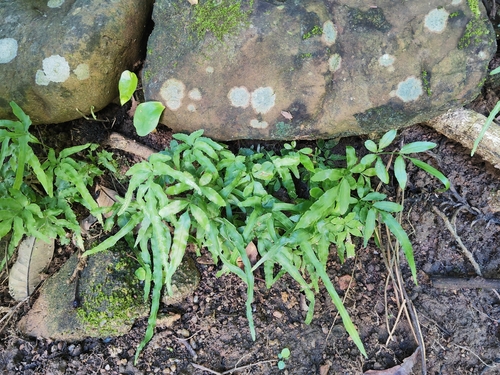
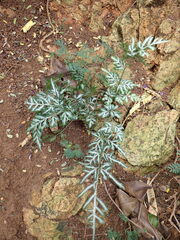

Slender brake is a small tropical fern whose narrow fertile fronds differ from its sterile fronds. Native to Asia and the Pacific, Pteris ensiformis favors partial shade and a moist, well-drained medium. The silvery foliage of cultivars does not characterize the species as a whole.
Read moreSlender brake and Sword brake
Give plenty of ambient light without direct sun on the leaves.
Partial shade or indirect light; protect from scorching sun.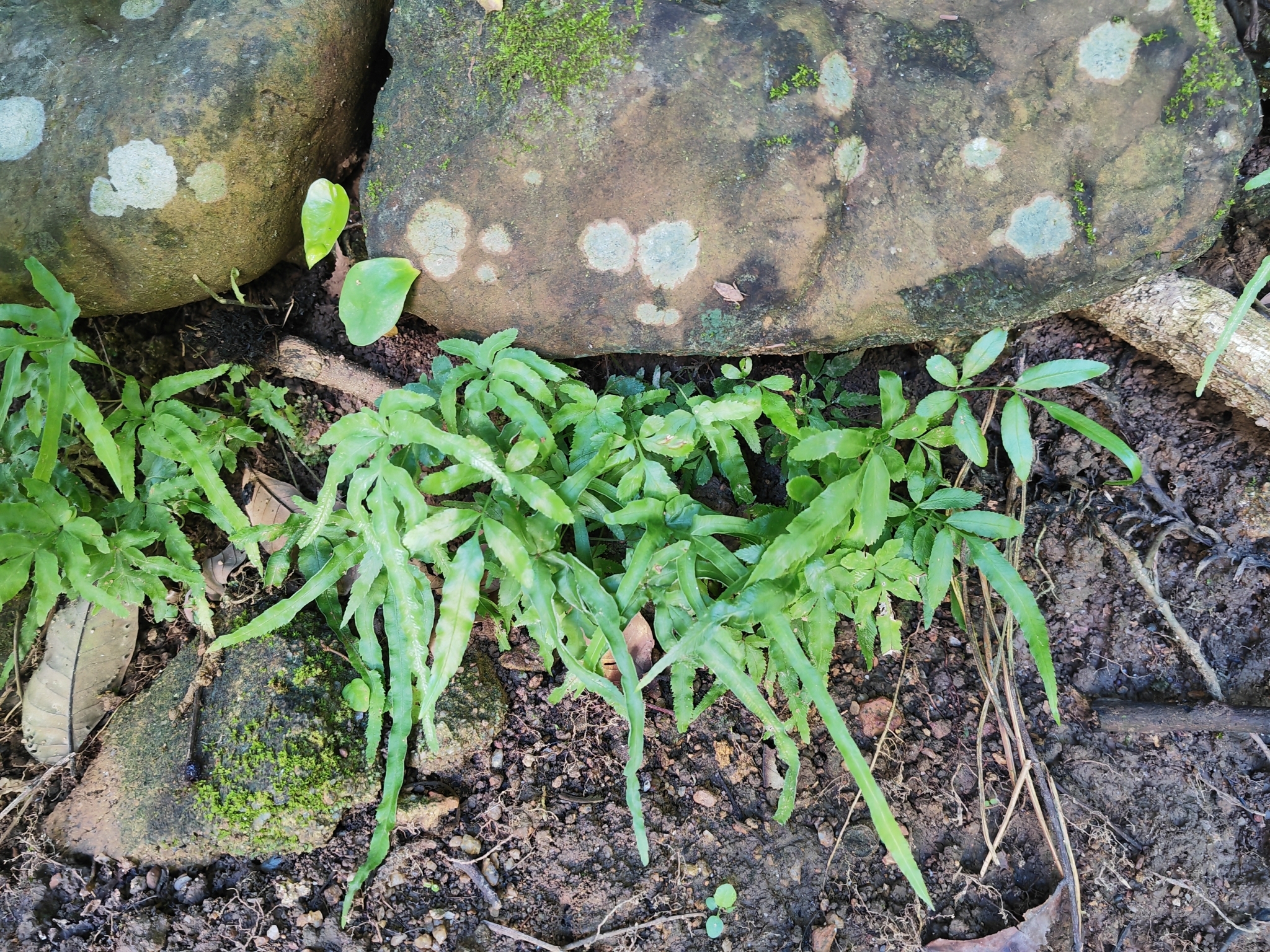


© photo
(c) 鐦鍆錒/锎钔锕(Man Hoimoon), some rights reserved (CC BY-NC), uploaded by 鐦鍆錒/锎钔锕(Man Hoimoon) · cc-by-nc
Leon Perrie · cc-by
Wikimedia Commons · CC BY-SA or Public Domain
© copyright of the Board of Trustees of the Royal Botanic Gardens, Kew.


Global distribution
Native from tropical and subtropical Asia to the Pacific, including Queensland. Introduced into French Guiana and Brazil; naturalized in the Sydney district.
- Native2
- Introduced2
- India
- Sri Lanka
- French Guiana
- Brazil
Hexagons: regions where the plant occurs. Green dots: native range.1
Identity
Slender brake, Pteris ensiformis Burm.f., has distinctly shaped fertile and sterile fronds. This small fern's French name, “ptéris en épée,” appears in the plant list for JardinSuisse's advanced professional training. The alternative name “sword brake” is English. 8 2
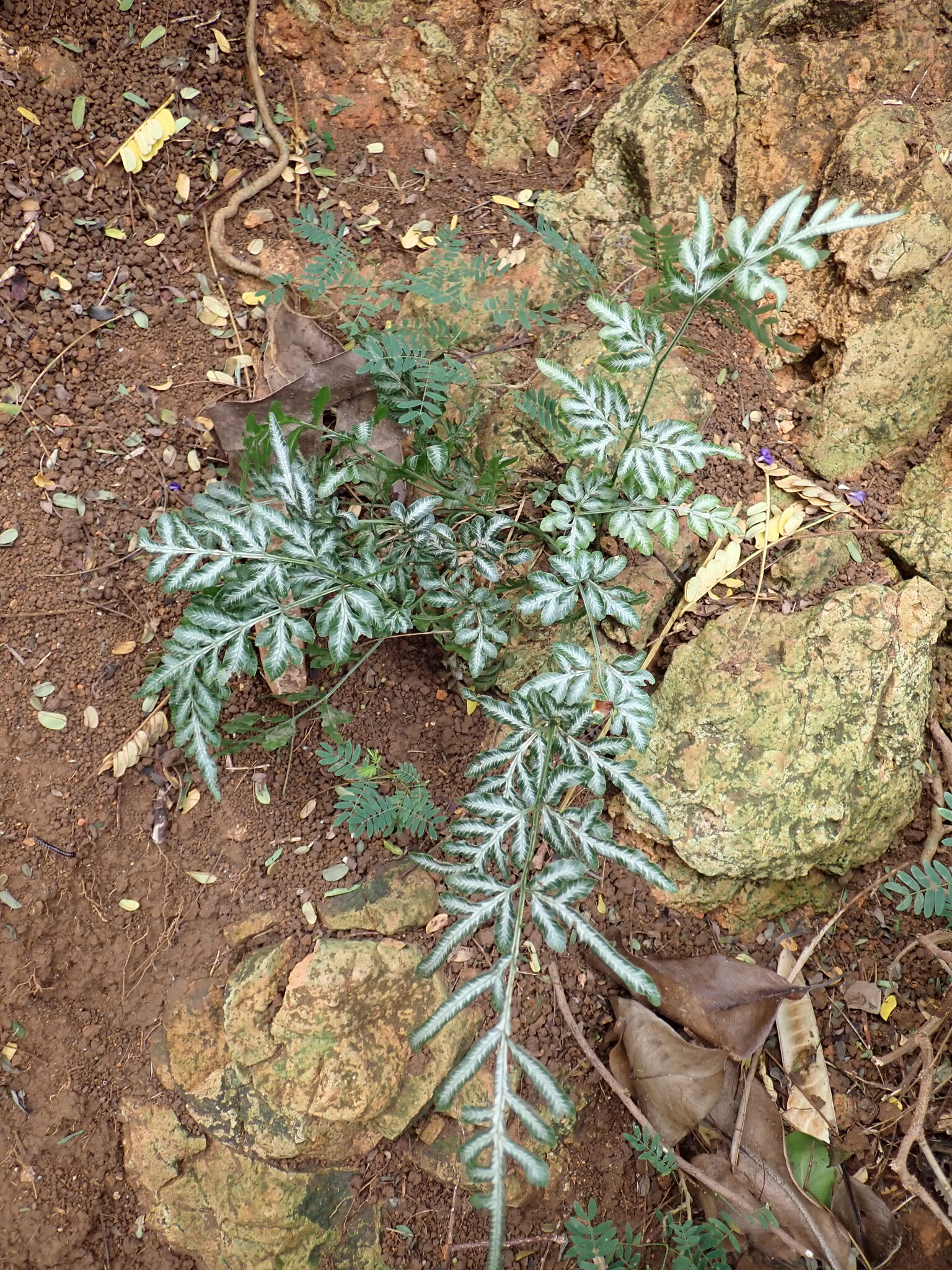
Pteris ensiformis belongs to the Pteridaceae family, in the order Polypodiales. Its foliage can be green: plants with silvery-white centers include horticultural cultivars. Variegation alone therefore does not define the botanical species. 1 2 5
Recognition
The short, creeping rhizome bears brown, lance-shaped scales. Fronds grow fairly close together; NParks describes a plant 20 to 40 cm (8 to 16 in) tall. The New South Wales flora describes pale green fronds with up to two levels of incomplete division. Examining the base complements an inspection of the foliage. 2 3
The sterile fronds are shorter than the fertile ones and have irregularly toothed margins. On fertile fronds, the segments are narrower, with teeth mainly at their tips. Sori, clusters of spore-producing organs, form almost continuous lines near the segment edges on the undersides of the fronds. These lines of sori are part of the reproduction of Pteris ensiformis. 3
Useful taxonomy
The name Pteris ensiformis Burm.f. was published in Flora Indica in 1768. Plants of the World Online accepts it and recognizes two botanical varieties: Pteris ensiformis var. ensiformis and Pteris ensiformis var. merrillii. The rank of variety here concerns botanical classification. 1
The epithet ensiformis refers to a sword shape. The horticultural names ‘Victoriae’ and ‘Evergemiensis’, associated with variegated foliage, have a different use: they designate cultivated selections. This distinction avoids attributing their colors or dimensions to all wild populations. 2 4 5
Habitat and distribution
The native range of Pteris ensiformis extends from tropical and subtropical Asia to the Pacific. It includes India, Sri Lanka, Taiwan, the Philippines, Queensland and New Caledonia. Kew assigns this rhizomatous plant to the humid tropical biome; NParks describes it as a terrestrial fern. 1 2
Introductions are reported in Brazil and French Guiana. In Australia, the situation varies by region: the species is native to Queensland, while PlantNET records its naturalization in the Sydney district. Presence in cultivation or beyond its original range therefore does not by itself establish local native status. 1 3
Life cycle and reproduction
Ferns reproduce by spores, without producing flowers or seeds. For Pteris ensiformis, NParks also lists propagation by division. Sori visible beneath fertile fronds are the reproductive feature to look for; a flowering calendar does not suit this plant. 6 2
For ferns with creeping rhizomes, the RHS recommends division in spring. A portion retaining a bud and roots can establish itself. Spore propagation requires more time and care; division therefore provides another way to propagate an established clump. 6
The calendar for container cultivation in France is a seasonal synthesis: relative needs increase during spring and summer growth. Spring, a favorable time for establishing and dividing ferns, provides a guide for necessary repotting. The scores represent neither water volumes nor growth measurements. 6
Cultivation, uses and risks
A moist, well-drained medium suits Pteris ensiformis, with a position in partial shade. For the genus Pteris, NC State recommends indirect light and a mix rich in organic matter. Excess water can cause yellowing and root rot; insufficient water dries the fronds. Checking moisture in the pot helps distinguish these opposite causes. 2 7
The plant is grown for its foliage, including in containers and indoors. General RHS advice calls for feeding potted ferns during the growing period, from spring to fall. This seasonal guidance does not establish a universal dosage. 2 6
NParks reports traditional use of a frond decoction against dysentery, with a medical warning. Traditional use does not establish safety. The precise toxicological status of Pteris ensiformis remains unknown here for humans, children and animals; avoid ingestion and keep the plant out of reach. 2
Cultivars and look-alikes
The cultivar ‘Victoriae’ has silvery-white centers edged in green and can reach 50 cm (20 in) tall according to the RHS. Its foliage is described as semi-evergreen; the horticultural name retains unresolved status in that database. ‘Evergemiensis’ is described separately as an evergreen clump-forming cultivar with feathery fronds, suited to a terrarium. These descriptions of ‘Victoriae’ and ‘Evergemiensis’ remain specific to the selections concerned. 4 5
A pale band also occurs in Pteris cretica ‘Albolineata’, while Pteris argyraea has large, arching fronds marked with silver. Comparing the white pattern should therefore include comparing how the fronds are divided. In P. ensiformis, the difference between sterile and fertile fronds provides an additional identification feature. 7 3
Main sources
- Plants of the World Online, Pteris ensiformis: accepted name and distribution
- NParks Flora & Fauna Web, Pteris ensiformis: morphology and cultivation
- PlantNET, New South Wales flora: Pteris ensiformis
- Royal Horticultural Society, Pteris ensiformis Victoriae
- Royal Horticultural Society, Pteris ensiformis Evergemiensis
- Royal Horticultural Society, growing and propagating ferns
- NC State Extension, Pteris: cultivation and related species
- JardinSuisse, EP-P1 plant list, page 4: Ptéris en épée
Frequently asked questions
What is the French name of Pteris ensiformis?
The name Ptéris en épée appears in JardinSuisse's professional plant list.
Why are the fronds of Pteris ensiformis different?
The species has shorter sterile fronds and fertile fronds with narrower segments, whose undersides bear sori.
Does Pteris ensiformis produce flowers?
No. Like other ferns, Pteris ensiformis reproduces by spores; division of the rhizome also allows propagation.
Do all Pteris ensiformis plants have white fronds?
No. Silvery-white centers are characteristic of cultivars including Victoriae and Evergemiensis; the species also has green foliage.
Is Pteris ensiformis safe for animals?
Safety of this species is not established here for cats, dogs, horses or other animals. Avoid ingestion and keep the plant out of reach.
If you are unsure about a plant’s toxicity, ask a botanist or veterinarian for advice.