
Greater stitchwort (Rabelera holostea, )
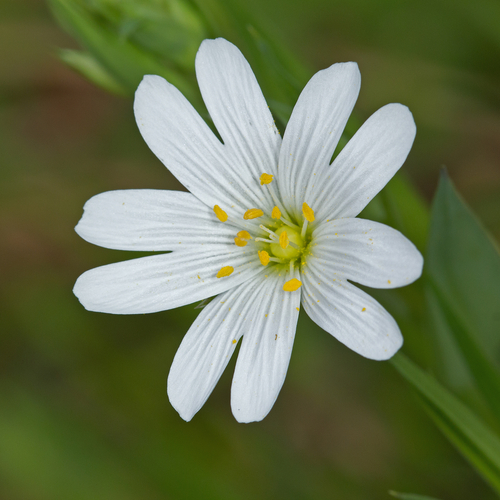
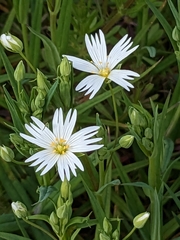
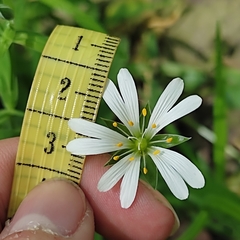
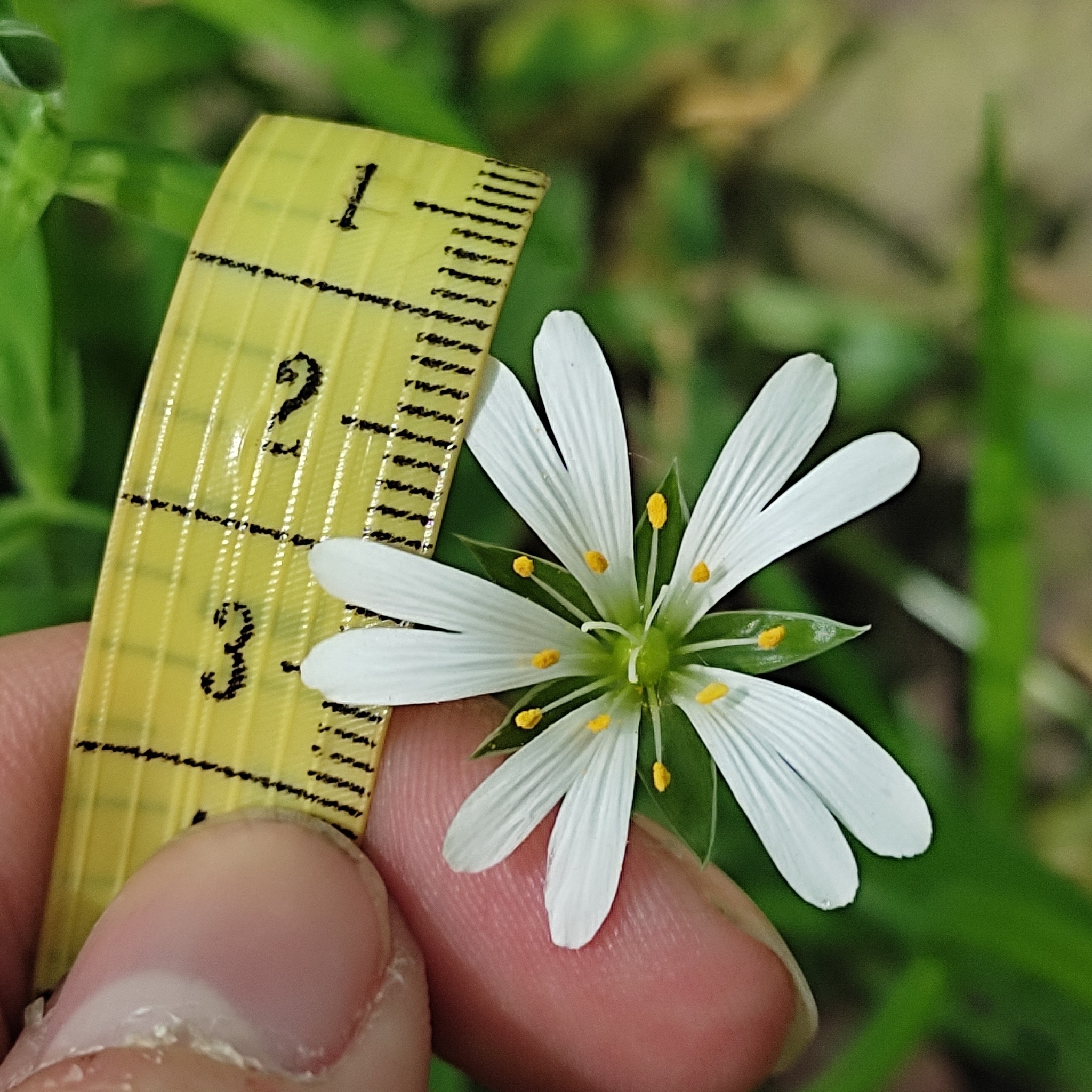
Greater stitchwort (Rabelera holostea, formerly Stellaria holostea) is a perennial in the Caryophyllaceae family, native from Europe to western Siberia and Afghanistan and to northwestern Africa. Its five deeply notched white petals appear to make ten.
Read moreGreater stitchwort
Stellaria holostea, Alsine holostea and Cerastium holosteum
Give plenty of ambient light without direct sun on the leaves.
Partial shade in hedgerows and open woodland.


© photo
(c) Anne Sorbes, some rights reserved (CC BY-NC-SA), uploaded by Anne Sorbes · cc-by-nc-sa
Felicity Kreger · cc0
Михайло Жук · cc0
Taken Apr 5, 2021 by Fabrice Bourriquet (cc-by-sa)
Taken Apr 12, 2021 by Moshira Hassan (cc-by-sa)
Taken Apr 28, 2022 by danchy (cc-by-sa)
Taken Sep 16, 2021 by ludmila san vicente (cc-by-sa)
Taken Apr 24, 2022 by Simon Simon (cc-by-sa)


Global distribution
Native from Europe to western Siberia and Afghanistan, and to northwestern Africa; introduced in several eastern US states.
Identity
Greater stitchwort (Rabelera holostea (L.) M.T.Sharples & E.A.Tripp, 2019) is the perennial often listed in floras as Stellaria holostea. It belongs to the Caryophyllaceae, the carnation family. Its white flowers brighten hedgerows and open woodland in spring. The scientific name change describes a new taxonomic combination, rather than a new plant appearing in these habitats. The familiar English name remains useful when looking through older field guides. 1289
The ascending stems generally reach 20–60 cm (8–24 in). They lie along the ground at the base before turning upwards, and are stiff and easily broken. Open flowers attract more attention than the long, narrow leaves, which can look grass-like from a distance. 497
Recognition
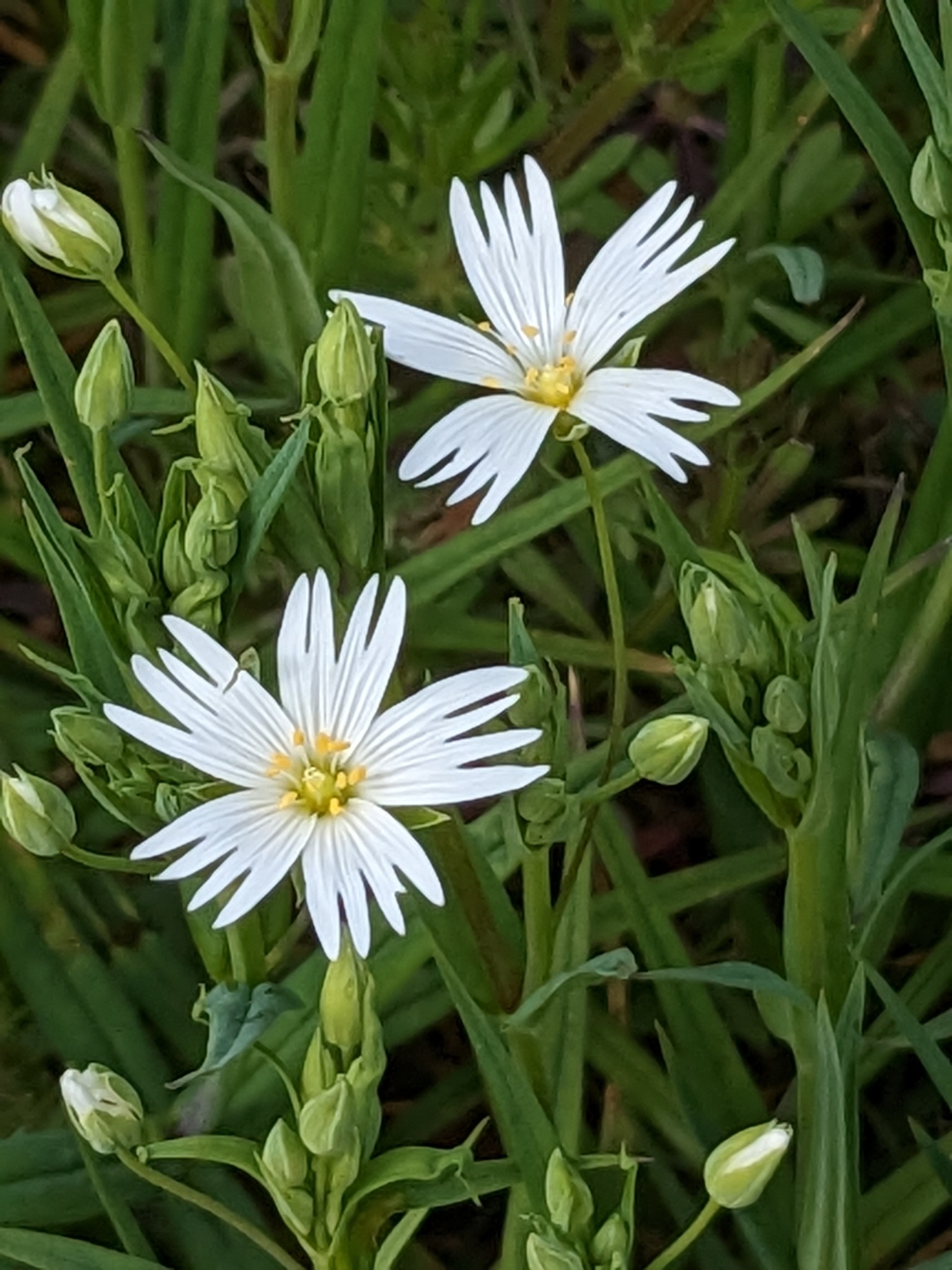
Five deeply notched petals give greater stitchwort the appearance of having ten petals. Each white petal is divided roughly halfway down, remaining joined at its base. Flowers are commonly 2–3 cm (0.8–1.2 in) across. Count each pair of lobes back to its point of attachment, rather than counting the white tips around the corolla. 73
Leaves are opposite, stalkless, narrow and drawn out to a long point. Their edges feel rough, as do the angles of the four-sided stems. Leaves reach about 3–9 cm (1.2–3.5 in) long. This slightly rough texture and opposite arrangement complement the flower characters. The sepals measure 6–8 mm (0.24–0.31 in) and are distinctly shorter than the petals. 345
Useful taxonomy
The accepted name is Rabelera holostea (L.) M.T.Sharples & E.A.Tripp. This combination was published in 2019 in Systematic Botany, volume 44, page 870. Its basionym is Stellaria holostea L., published in 1753. Parentheses around “L.” indicate that the original name was transferred to another genus. Rabelera holostea is also used for the French flora. 28
Floras that still use Stellaria remain useful for identifying the plant: their nomenclature simply needs linking to the accepted name. Alsine holostea (L.) Britton and Cerastium holosteum (L.) Crantz also occur in older lists. Each name encountered on a herbarium sheet does not represent another species; several combinations refer to the same botanical identity. 1
Habitat and distribution
Greater stitchwort grows in hedgerows, woodland edges and open deciduous woods. Open oak and hornbeam woods provide suitable conditions; woodland paths and clearings may also support it. Filtered light and moist soil explain its presence around woodland margins. It does not require the deep shade of a closed canopy. In France it occurs in hedgerows and woods across almost the whole country, but is rare in the Mediterranean region and is not threatened nationally. 5498
Its native range extends from Europe to western Siberia and Afghanistan, with populations in northwestern Africa. France lies within this range. Several eastern US states are listed as introduced territories. Finding the plant on another continent therefore does not establish that it is native there, even when it persists spontaneously. 1
Life cycle and reproduction
Flowering follows the spring of its hedgerow habitats. In France it lasts from April to June; elsewhere in Europe the period may be narrower, covering April and May or May and June. One fixed date therefore cannot describe the entire range. Stems also produce sterile shoots that maintain vegetative growth without carrying flowers themselves. 9534
After fertilisation, the ovary becomes a globular capsule about as long as the calyx. It opens through six teeth and ejects its seeds at maturity. Flowers provide a spring resource for insects, while the plant also feeds some butterfly and moth larvae. A display of flowers is only one stage of a cycle that continues through fruiting and the presence of leaves. 57
Uses and risks
In a garden, greater stitchwort suits a partly shaded corner with moist, well-drained soil, alongside a hedge or in a wildflower area. Slightly acidic to neutral soil with little enrichment is suitable. Its moisture requirement does not imply tolerance of a water-filled saucer or permanently waterlogged ground. 6
The plant has had traditional medicinal uses, notably reflected in the name “stitchwort”. These traditions establish neither clinical effectiveness nor a safe dose. No toxicity evidence specific to humans, cats, dogs or horses is available here. Its toxicological status therefore remains unknown for each audience; an absence of reported incidents does not demonstrate safety. 7
Varieties and similar plants
Flower size and the depth of the petal notch help separate related stitchworts. Lesser stitchwort has much smaller flowers, about 0.5–1 cm (0.2–0.4 in) across, compared with 2–3 cm (0.8–1.2 in) in greater stitchwort. Narrow leaves alone cannot distinguish them, so a useful photograph should also show a flower and its calyx. 7
Small-petalled or petal-less forms mentioned in literature are not automatically cultivars. Several historical variety and form names are included in the accepted name's synonymy. For an unusual plant, inspect several stems and return to the opposite leaves, rough stem angles and calyx dimensions before naming a variant. 14
Main sources
Stellaria holostea is the basionym of Rabelera holostea, greater stitchwort. 2 Native and not threatened in France, it is recognised by five white petals split halfway down and opposite, narrow, rough-edged leaves.
- Plants of the World Online : Rabelera holostea
- International Plant Names Index : Rabelera holostea
- Info Flora : Stellaria holostea
- FloraWeb : Stellaria holostea
- University of Udine : Stellaria holostea
- Royal Horticultural Society : Stellaria holostea
- Woodland Trust : Greater stitchwort
- INPN, TAXREF : Rabelera holostea
- Tela Botanica, eFlore : Stellaria holostea
Frequently asked questions
Are Rabelera holostea and Stellaria holostea different species?
No. Stellaria holostea is the basionym of Rabelera holostea. Here both names refer to greater stitchwort under different classifications.
Does the flower have ten petals?
No. It has five white petals divided roughly halfway down. Their paired lobes give the impression of ten petals.
Does greater stitchwort grow in full sun?
It mainly grows in the partial shade of hedgerows, woodland edges and open woods, in moist soil without standing water.
If you are unsure about a plant’s toxicity, ask a botanist or veterinarian for advice.