
Creeping buttercup (Ranunculus repens, )
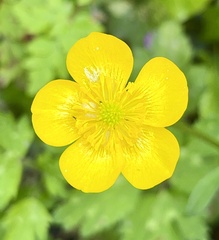
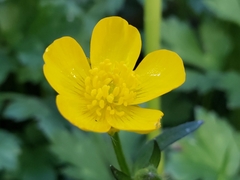
Creeping buttercup (Ranunculus repens) is a perennial in the Ranunculaceae family, native to temperate Eurasia, northwestern Africa and Macaronesia. Its runners root on contact with soil; the fresh plant is toxic and its sap irritant.
Read moreCreeping buttercup and Creeping crowfoot
Ranunculastrum repens and Ranunculus reptabundus
Give plenty of ambient light without direct sun on the leaves.
Sun to partial shade; avoid deep shade for flowering.
© photo
(c) Reiner Richter, some rights reserved (CC BY-NC-SA), uploaded by Reiner Richter · cc-by-nc-sa
Kieran Roy Powell · cc0
Gavin Slater · cc-by
(c) Gavin Slater, some rights reserved (CC BY) · cc-by
(c) CorentinD, some rights reserved (CC BY) · cc-by
Global distribution
Native to Macaronesia, northwestern Africa and temperate Eurasia; widely introduced elsewhere.
- Native2
- Introduced1
- France
- Japan
- New Zealand
Hexagons: regions where the plant occurs. Green dots: native range.1
Identity
Creeping buttercup (Ranunculus repens L., 1753) is the buttercup that spreads through runners rooting at their nodes. A trailing stem can connect several young plants. It belongs to the Ranunculaceae and retains its Linnaean name in the current classification. “Creeping” describes its way of spreading, even though flowering stems rise above the leaves. Creeping crowfoot is another established English name. 1 2 3 8
Flowering stems generally reach 20–50 cm (8–20 in). The plant is perennial: mowing off the flowers does not remove its crown. Its leaves and low shoots explain its persistence in lawns, damp meadows and beds where the soil remains bare. 2 9 4
Recognition
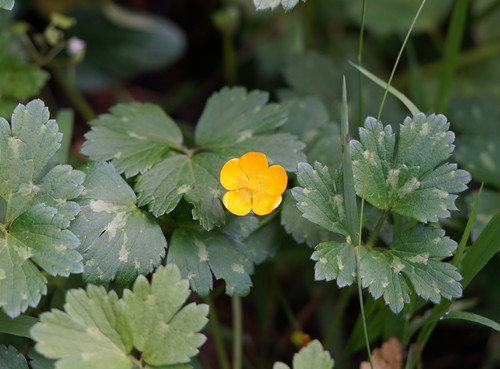
The stalked central leaflet helps identify creeping buttercup. Basal leaves are divided into three broad segments, themselves lobed and toothed. The middle segment has a short stalk longer than those of the side segments. Leaves may be hairy or almost hairless. Pale markings sometimes occur, but their absence does not rule out the species. 2 3 4
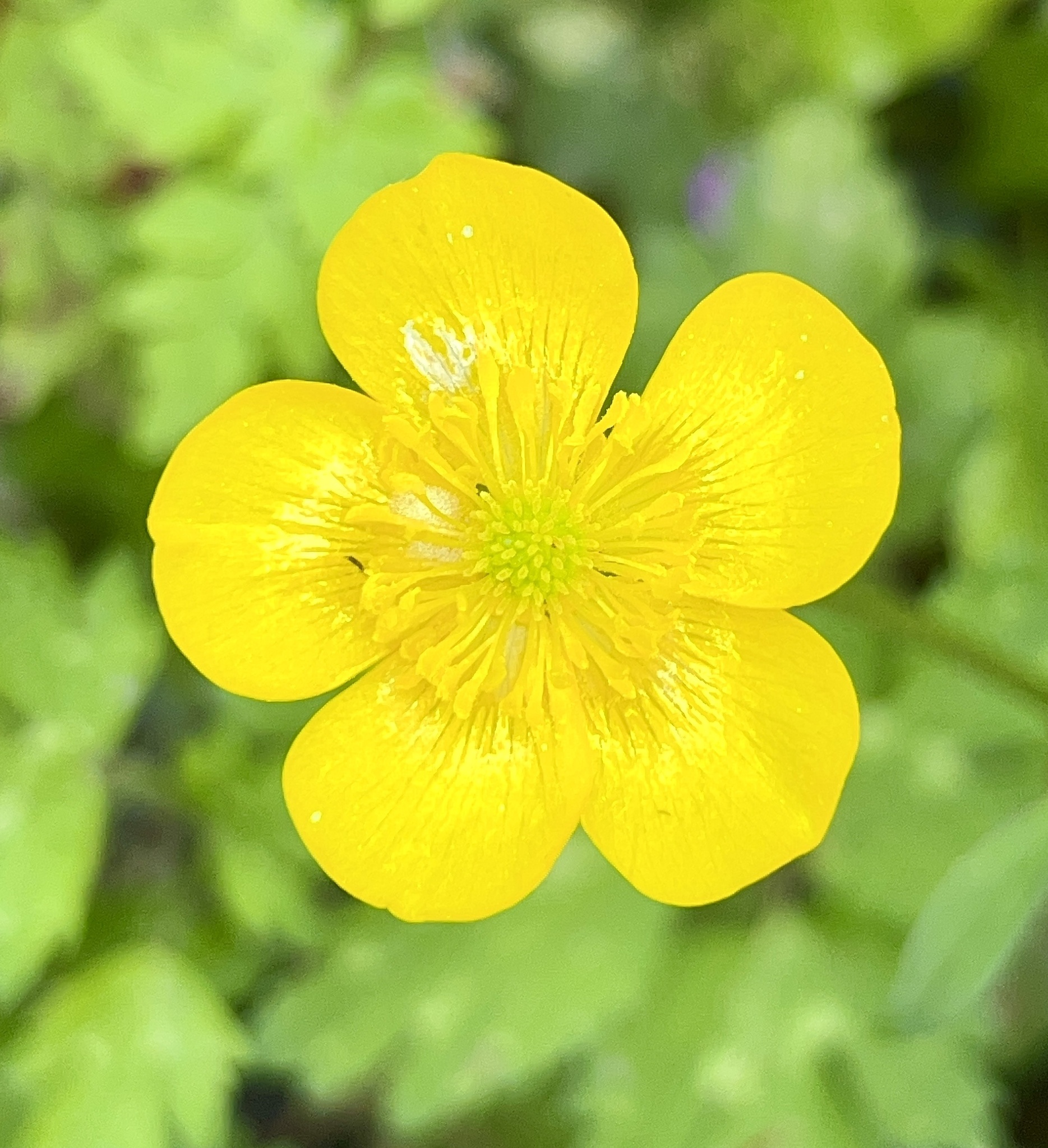
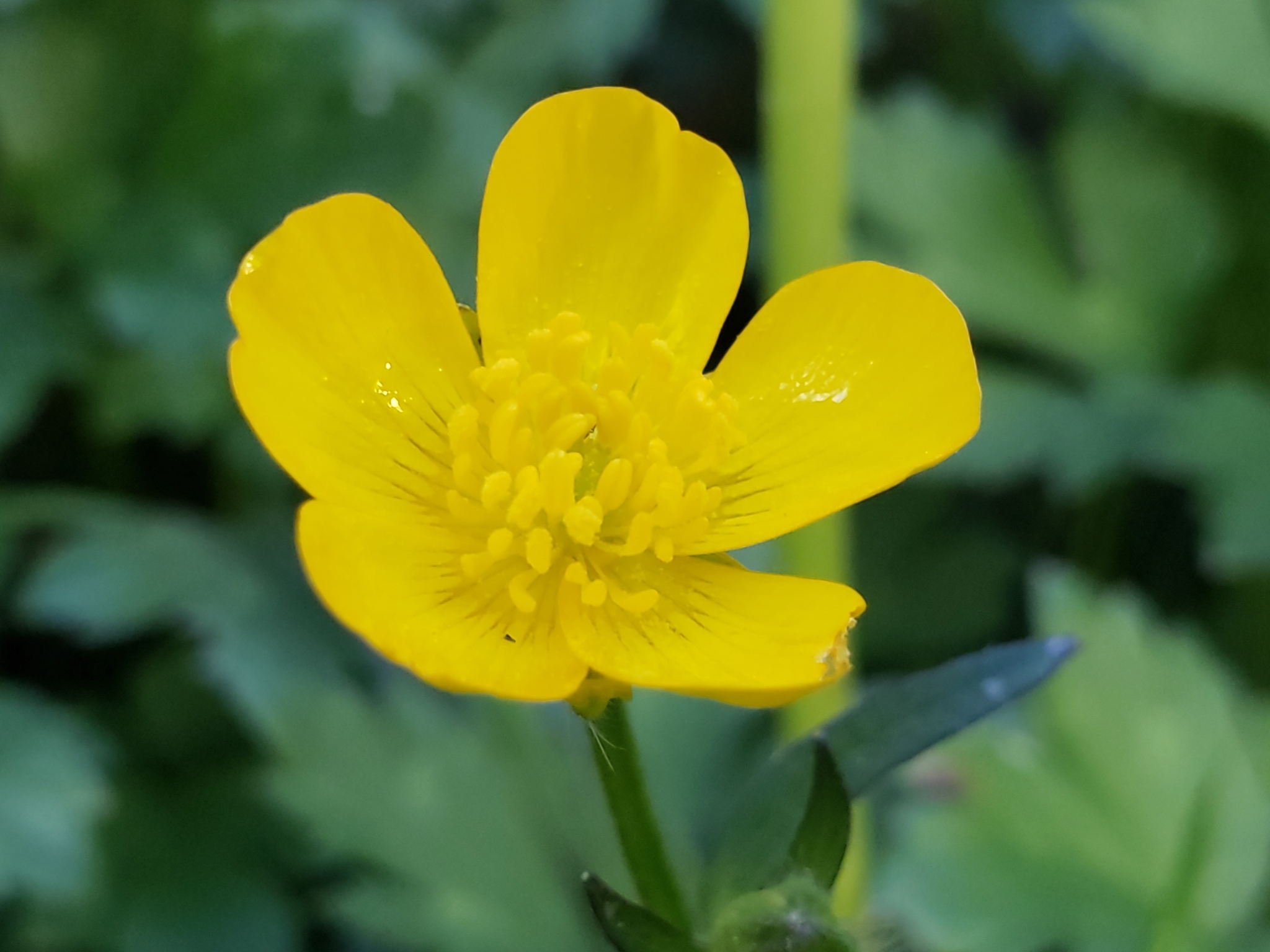
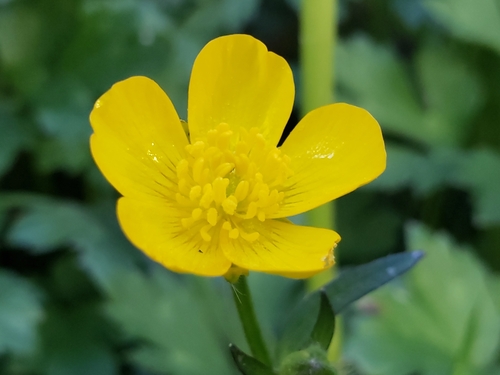
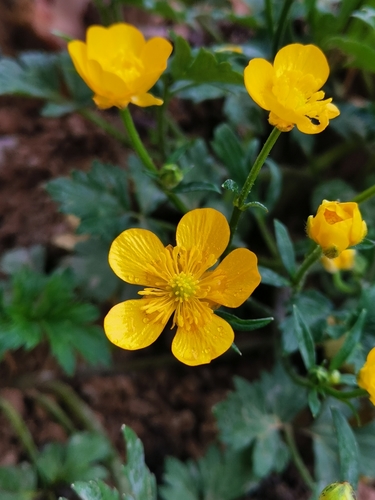
The glossy yellow flowers, 2–3 cm (0.8–1.2 in) across, usually have five petals. Flower stalks are grooved and sepals remain spreading. Look at the base of the plant as well: trailing shoots are more useful than an isolated flower when distinguishing buttercups. The fruits are clusters of small achenes, dry at maturity, rather than berries. 2 9 3
Useful taxonomy
Ranunculus repens is an accepted species, published in Species Plantarum in 1753. Ranunculastrum repens (L.) Fourr., proposed in 1868, belongs to its synonymy. Older references can therefore use another genus without referring to a different plant. This synonymy should not be confused with the existence of a horticultural cultivar. 1
The common name “buttercup” covers several Ranunculus species. An observation recorded only under that name cannot identify creeping buttercup. For useful garden identification, combine the leaf arrangement with the presence of runners. A full botanical identification also examines the flower stalks and small fruits. 2 3 7
Habitat and distribution
Creeping buttercup is native to temperate Eurasia, northwestern Africa and Macaronesia. France, including Corsica, lies within its native range; it occurs throughout metropolitan France and is not threatened there. It has been introduced to numerous American territories, New Zealand and parts of Australia. This worldwide spread does not make it an alien species in France. 1 8
Meadows, ditches and moist woods provide suitable habitat. The soil is generally damp, sometimes waterlogged, and can be heavy. The plant tolerates both sun and partial shade; deep shade reduces buttercup flowering. A carpet in a compacted, wet area first indicates conditions favourable to its growth, rather than a need to add fertiliser. 2 3 4 7
Life cycle and reproduction
Creeping buttercup reproduces through seeds and runners. Flowers appear from spring into summer, sometimes continuing into early autumn. In France flowering extends from May to September. The hermaphrodite flowers are visited by insects, including bees, flies and beetles. These regional dates describe flowering in France rather than a fixed calendar for every climate. 2 5 4
A runner touching the soil produces a rooted plantlet; this vegetative reproduction explains the formation of dense colonies. Cutting only the visible connection leaves already independent plants behind. Seedlings and divisions need moist soil while establishing. Perennial buttercups can be divided in spring or autumn, but deliberately propagating this species requires planning for its spread. 4 7
Uses and risks
The fresh plant is toxic, and its sap may irritate skin. Gloves reduce contact with crushed tissues during prolonged removal. Historical uses of buttercups as irritant plants are not care recommendations: applying them to skin can cause blisters. Contact with the fresh plant therefore calls for caution. 5 3 4
Buttercups in the genus Ranunculus are toxic to cats, dogs and horses. Protoanemonin is their irritant constituent. Drooling, oral lesions and digestive upset may follow ingestion. This classification concerns the genus: it supports precautions for creeping buttercup without claiming a measured dose for each animal. Suspected ingestion calls for veterinary advice. 6
Similar plants and its place in the garden
A damp meadow may accommodate creeping buttercup; a small bed can quickly be colonised. The choice depends on the space available for its runners. Flowers offer nectar and pollen, and several insect groups use the plant. Retaining a few plants in an area where expansion is acceptable can therefore benefit wildlife. 4
To contain a colony, follow runners to their plantlets and remove the roots carefully, then monitor for regrowth. A dense vegetation cover also helps prevention. Do not confuse this spontaneous perennial with florists' buttercups: Persian buttercup (Ranunculus asiaticus) is grown particularly for large cut flowers and tubers, and has different horticultural requirements. 4 7
Main sources
The accepted name of creeping buttercup is Ranunculus repens L., published in 1753. Native and not threatened in France, it can be accommodated in a wet meadow or contained in a bed; toxicity to animals is documented at genus level for Ranunculus.
Frequently asked questions
Why does creeping buttercup return after removal?
Rooted runners and pieces of the crown can remain. Remove the young plants linked to the parent and check for regrowth.
Is creeping buttercup toxic?
Yes. The fresh plant is harmful if ingested and its sap may irritate skin. Toxicity documented for the genus concerns cats, dogs and horses.
Does creeping buttercup need watering?
It favours moist to wet ground. Routine watering is unnecessary in already damp garden soil; avoid letting new plantings dry out.
If you are unsure about a plant’s toxicity, ask a botanist or veterinarian for advice.