
Mistletoe cactus (Rhipsalis baccifera, )
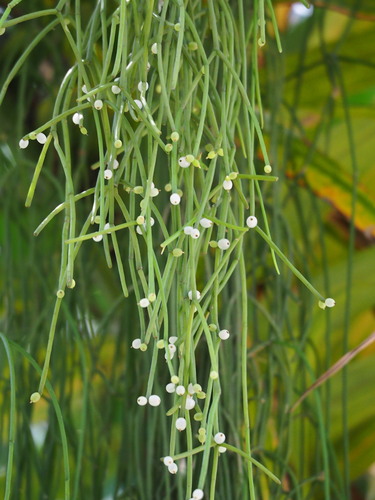
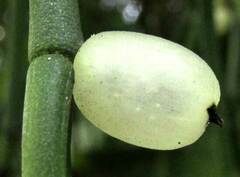

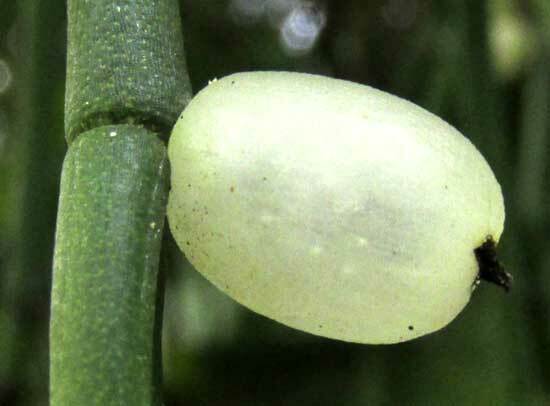
Mistletoe cactus (Rhipsalis baccifera) has long, cylindrical stems and small white or pink berries. This epiphytic cactus grows on trees or rocks and is grown in hanging containers with indirect light and a well-drained medium.
Read moreMistletoe cactus, Spaghetti cactus and Mistletoe cacti
Cassytha baccifera, Cereus baccifer, Hariota cassytha and Rhipsalis cassytha
Give plenty of ambient light without direct sun on the leaves.
Bright, indirect light; protect stems from scorching direct sun.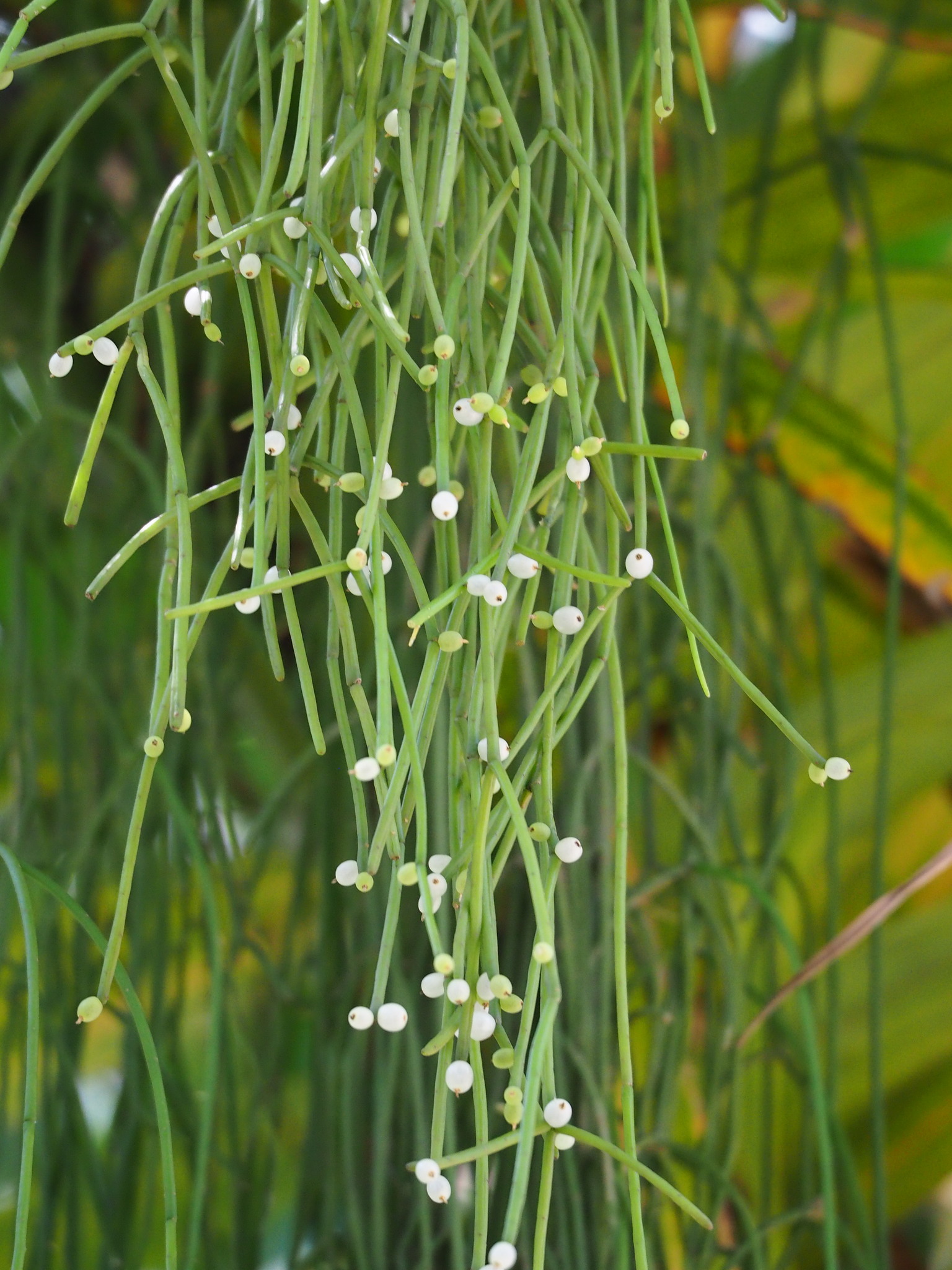



© photo
no rights reserved, uploaded by 葉子 · cc0
Jim · cc0
Irene · cc0
Taken Jul 31, 2020 by gabriel gabriel chacon (cc-by-sa)
Taken Mar 1, 2020 by Gagnon Alexandrine (cc-by-sa)
Taken Aug 20, 2021 by Crispín Pérez (cc-by-sa)
Taken Jul 26, 2021 by Trap Hers (cc-by-sa)
Taken Oct 13, 2019 by Chrisi Pa (cc-by-sa)
© copyright of the Board of Trustees of the Royal Botanic Gardens, Kew.




Global distribution
Tropical and subtropical America, Africa, Madagascar and Sri Lanka; native occurrence in Florida.
- Native3
- Introduced1
- Florida
- Madagascar
- Sri Lanka
- Myanmar
Hexagons: regions where the plant occurs. Green dots: native range.1
Identity
Mistletoe cactus (Rhipsalis baccifera (J.S.Muell.) Stearn, 1939) carries trailing green stems and translucent berries resembling those of mistletoe. This perennial belongs to Cactaceae, despite a form unlike that of desert cacti. Its recorded French names include cactus gui and rhipsalis à baies; cassutha also appears in vernacular nomenclature. 2 1 7 5
The genus name comes from the Greek rhips, associated with wickerwork, in reference to the slender stems. The epithet baccifera means berry-bearing. Mistletoe cactus is an epiphyte: it grows on trees without feeding on their sap. Some plants also grow on rocks. 3 4 1
Recognition
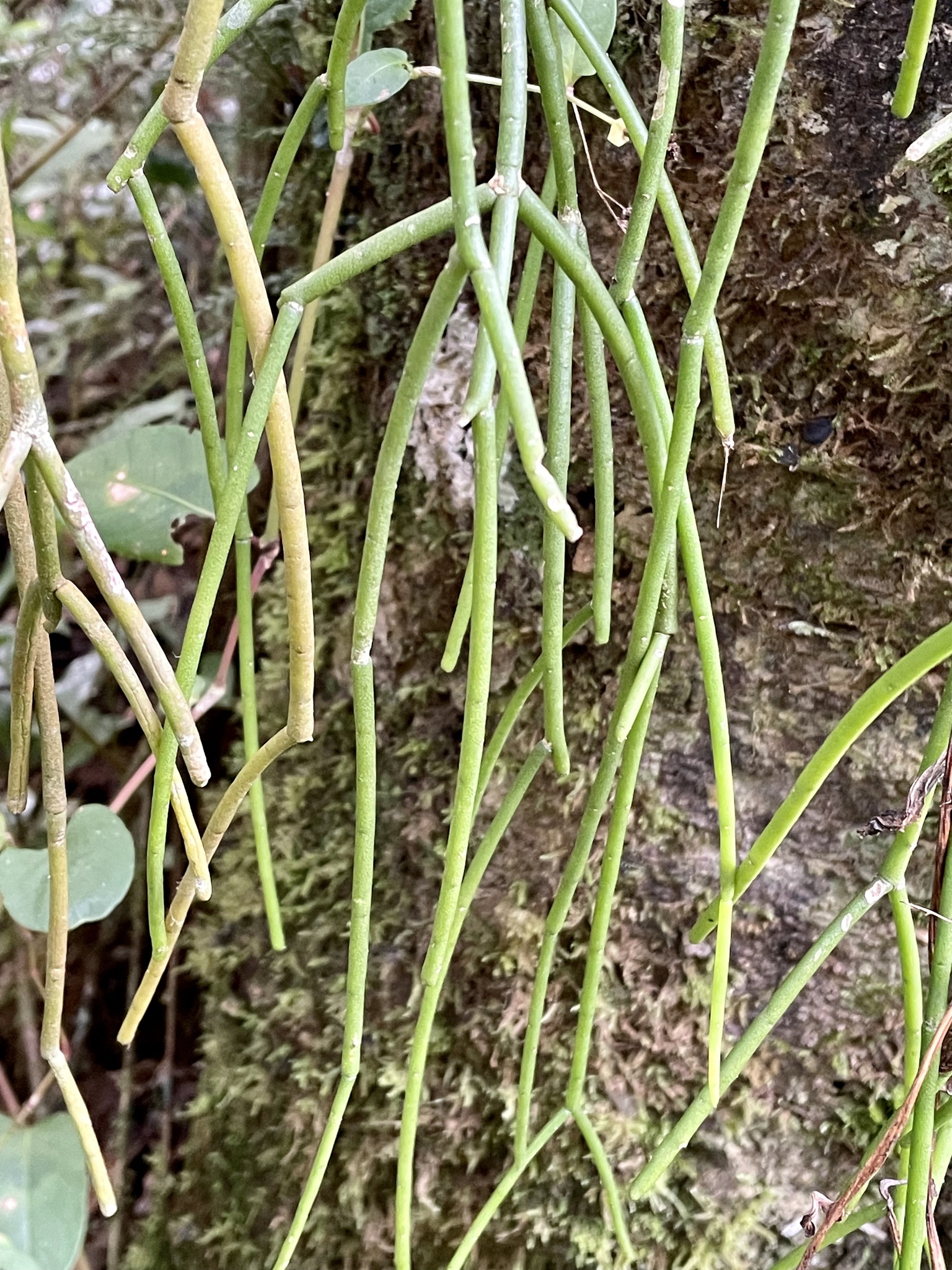
The filaments of mistletoe cactus are succulent, cylindrical stems without leaves. Young stems have woolly areoles bearing a few bristles; these features become less apparent on older segments. An adult plant can therefore look smooth while its new growth remains slightly bristly. 3 2
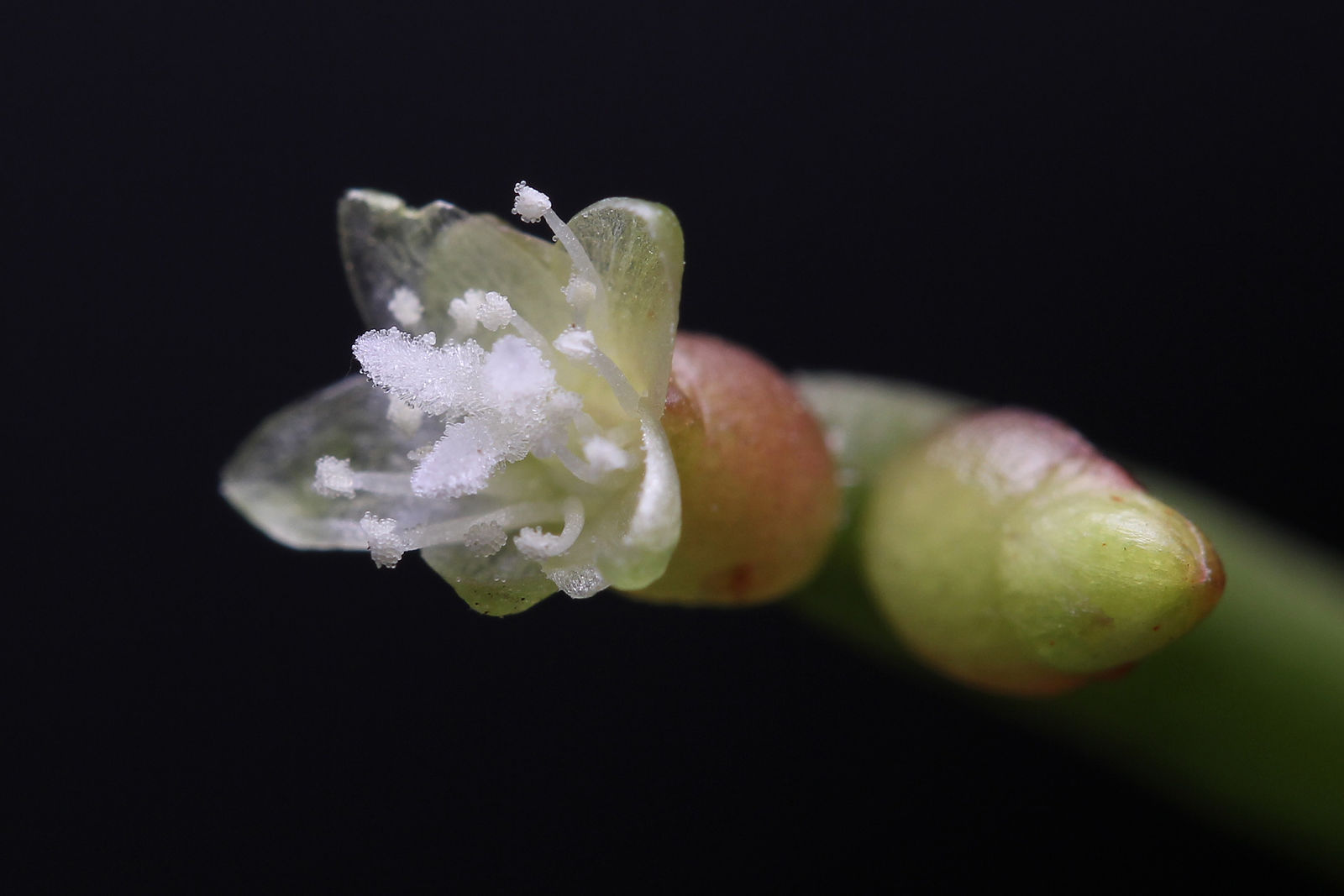
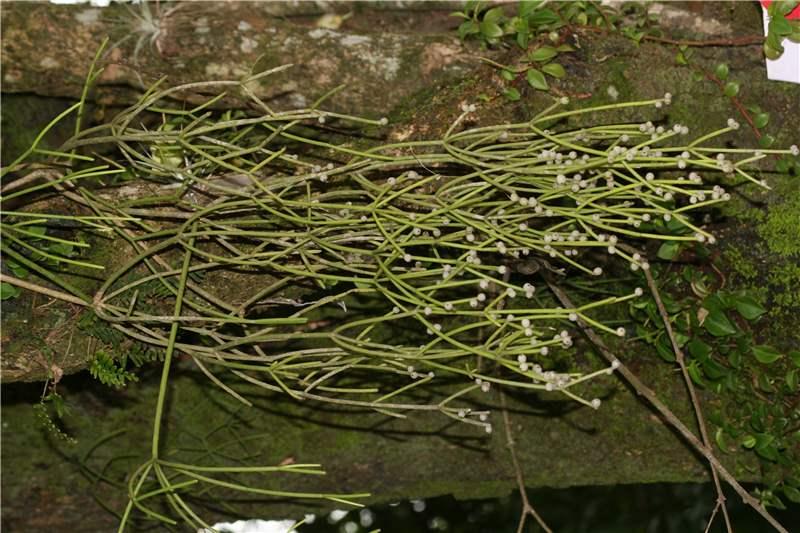
Small white or greenish-white flowers appear along the stems. The fruits are round, white or pale pink berries, sometimes translucent. Horticultural dimensions reach 2.5 to 4 m (8.2 to 13.1 ft), with a spread of 0.5 to 1 m (1.6 to 3.3 ft). For this trailing cactus, allow space below the container for long stems rather than planning for an upright support. 2
Useful taxonomy
The accepted name is Rhipsalis baccifera, a combination published in 1939. The synonyms Cassytha baccifera J.S.Muell. and Cereus baccifer (J.S.Muell.) Hemsl. belong to the same nomenclatural history. Rhipsalis cassytha Gaertn., still found in horticulture, also appears in this synonymy. 1
Attribution of the basionym differs between treatments: Solander in the Florida flora, J.S.Muell. in the currently accepted name. Check the accepted name and family when identifying the species. A difference in an abbreviated author name does not establish a separate species. 6 1
Habitat and distribution
Mistletoe cactus has an extensive tropical and subtropical range across the Americas, Africa and Sri Lanka. Madagascar is also part of its native range. Occurrence outside the Americas is exceptional among cacti, and the circumstances of dispersal remain debated. A relatively recent introduction to the Old World is a hypothesis, not an established account. 1 5
In forests, rhipsalis grow in pockets of moss and debris on branches or rocks. Their roots occupy an airy medium that can dry even when the surrounding air stays humid. In Florida, Rhipsalis baccifera is native and listed as endangered at state level. Florida's endangered listing does not describe the species' entire global range. 4 6
The native range of mistletoe cactus also includes the Comoros, Réunion and Seychelles. Myanmar, by contrast, is part of its introduced range. A tropical occurrence alone is therefore insufficient to classify a population as native. 1
Life cycle and reproduction
Mistletoe cactus flowers mainly from winter into spring, with flowering possible at other times. Stem cuttings taken in spring or summer provide a means of propagation; seeds are sown at 19 to 24 °C (66 to 75 °F). Berries and the ability to root cuttings correspond to different reproductive pathways. 2
In temperate indoor conditions in the Northern Hemisphere, watering supports spring and summer growth, then decreases in winter. Apply diluted, low-nitrogen fertilizer monthly during growth. For rhipsalis, repotting follows flowering, and feeding stops during the rest period afterward. Adjust the seasonal routine to the individual plant's actual flowering. 2 3 4
Uses and risks
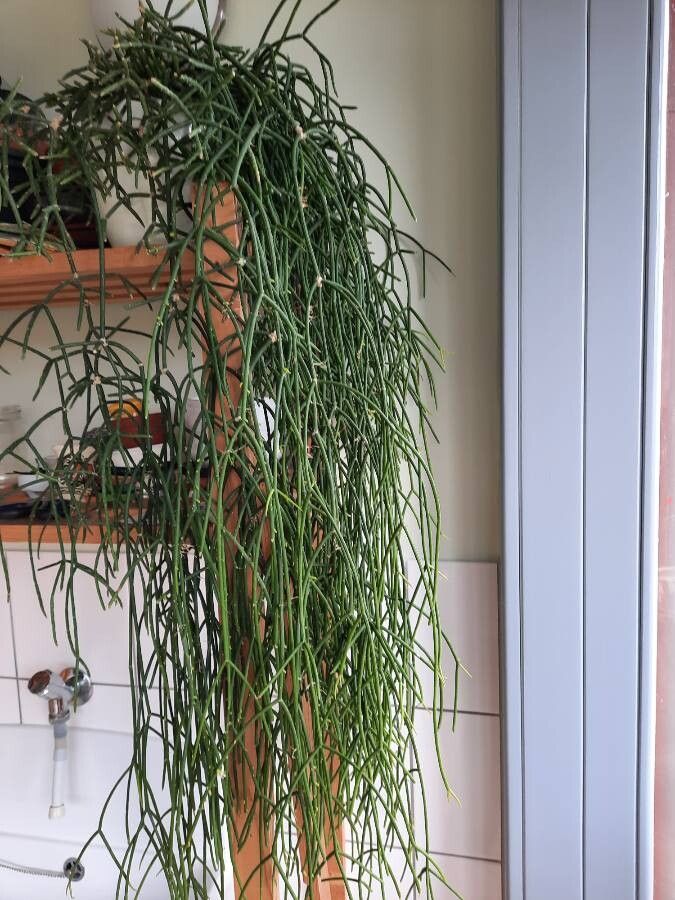
Mistletoe cactus is grown in hanging containers with bright, indirect light and a well-drained mix for epiphytic cacti. Excess water can cause root rot and soft stems. Direct sun can scorch stems, while very dry air or insufficient water can brown their tips. Good air circulation accompanies the humidity the plant needs. 2 3
For rhipsalis, a blend of potting soil, perlite, peat and coarse orchid bark combines moisture retention with drainage. A medium that holds water too long exposes the roots to rot. After watering, emptying the runoff prevents the container from standing in stagnant water. 4
Mistletoe cactus can harbor mealybugs, aphids or mites. Inspecting the stems helps identify pests without attributing every drooping stem to disease. Stems that pucker and lose their rigidity can also indicate a lack of water. 3
Mistletoe cactus is classified as non-toxic to cats, dogs and horses. The veterinary classification does not establish safety for people or children, which remains unknown. The berries' resemblance to mistletoe fruits establishes neither their toxicity nor their suitability as food. 3
Varieties, similar plants and identification pitfalls
Mistletoe cactus includes several recognized subspecies, among them baccifera, cleistogama, erythrocarpa, horrida and mauritiana. The name subsp. horrida identifies a subspecies, not a horticultural cultivar. Particular characters described for that subspecies do not automatically apply to every mistletoe cactus sold under the species name alone. 1 3
The English names “mistletoe cactus” and “coral cactus” are used for several rhipsalis. Such a label alone cannot identify Rhipsalis baccifera. Look for slender, cylindrical stems and small, pale berries; the genus also contains species with flattened or winged stems. Checking the botanical name prevents the form of a single species from being generalized to the whole genus. 4 2
Main sources
Kew establishes the accepted name and subspecies of mistletoe cactus; the RHS horticultural guidance applies directly to Rhipsalis baccifera. 1 2
- Plants of the World Online / Kew, Rhipsalis baccifera
- Royal Horticultural Society, Rhipsalis baccifera
- NC State Extension, Rhipsalis baccifera
- New York Botanical Garden, Mistletoe cactus and coral cactus (Rhipsalis)
- EPPO, Rhipsalis baccifera
- University of South Florida, Atlas of Florida Plants, Rhipsalis baccifera
- Pl@ntNet, Rhipsalis baccifera, French names
Frequently asked questions
Does mistletoe cactus have leaves?
No. The green filaments are cylindrical succulent stems. Young stems can have woolly areoles with small bristles.
Should mistletoe cactus be placed in full sun?
Choose bright, indirect light. Direct sun can scorch the stems; a summer position outdoors needs partial shade.
Is mistletoe cactus toxic to cats?
Mistletoe cactus is classified as non-toxic to cats, dogs and horses. Safety for people remains unknown.
When should mistletoe cactus cuttings be taken?
Mistletoe cactus is propagated from stem cuttings in spring or summer. Growing from seed is another propagation method.
If you are unsure about a plant’s toxicity, ask a botanist or veterinarian for advice.