
Butcher's-broom (Ruscus aculeatus, )
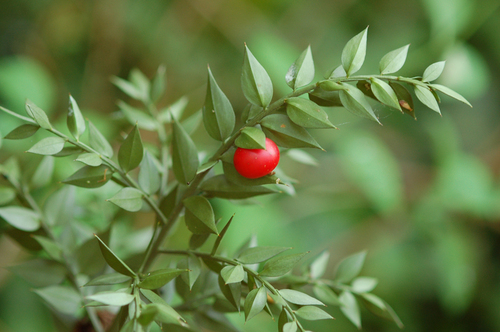
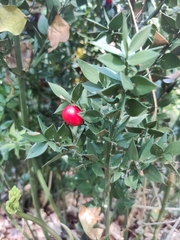
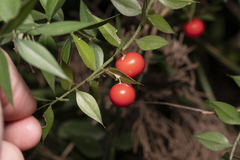
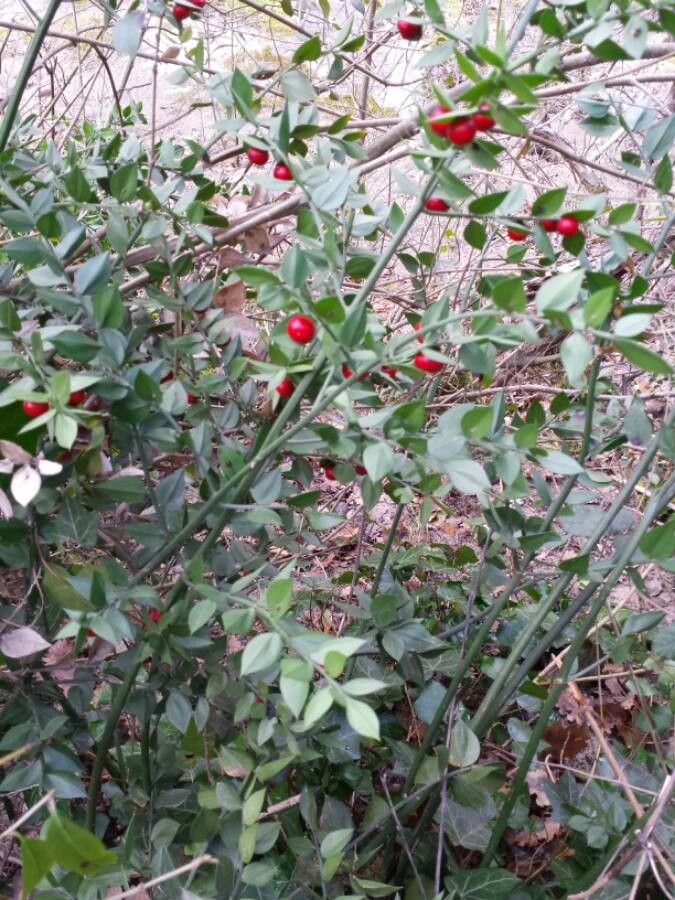
Butcher's-broom is an evergreen subshrub whose false leaves directly bear flowers and red berries. It forms low clumps in woodland.
Read moreButcher's-broom
Oxymyrsine pungens, Ruscus laxus, Ruscus flexuosus and Ruscus ponticus
Place in indirect light or in a shaded room.
Partial shade or shade; sun is also accepted.


© photo
(c) rudyclaeys, some rights reserved (CC BY-NC) · cc-by-nc
Irene Saltini · cc0
Eleftherios Katsillis · cc-by
Taken Oct 8, 2022 by Nathalie Potel (cc-by-sa)
Taken Dec 21, 2016 by Jean François SIMON (cc-by-sa)
Taken Nov 7, 2021 by jean-jacques kelner (cc-by-sa)
Taken Dec 21, 2017 by Creu Lopez (cc-by-sa)
Taken Sep 29, 2018 by Juan I Deán (cc-by-sa)
© copyright of the Board of Trustees of the Royal Botanic Gardens, Kew.




Global distribution
Native from Macaronesia to the Mediterranean and from western and south-central Europe to the Caucasus.
- Native3
- France
- North Africa
- Caucasus
Hexagons: regions where the plant occurs. Green dots: native range.1
Identity
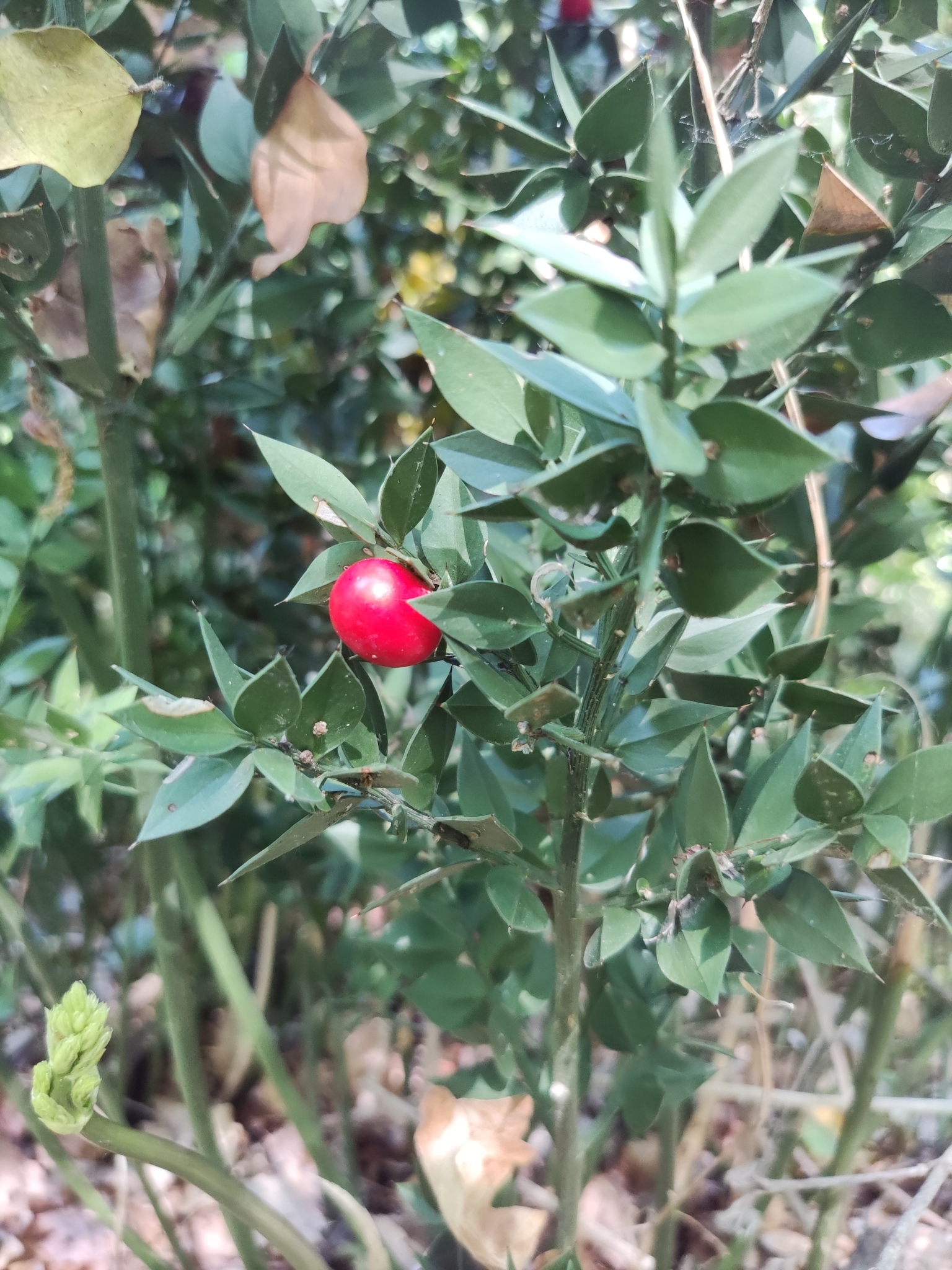
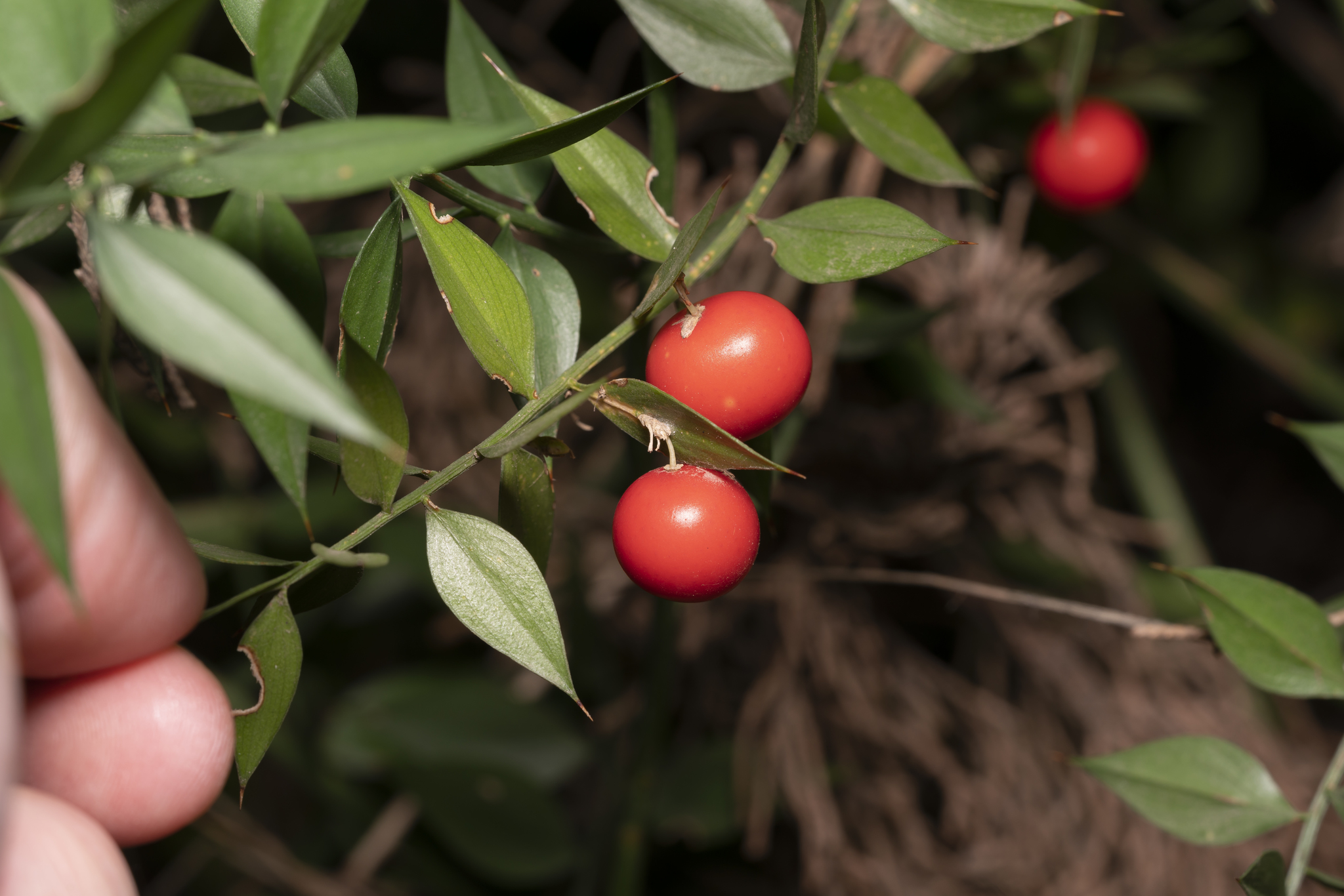
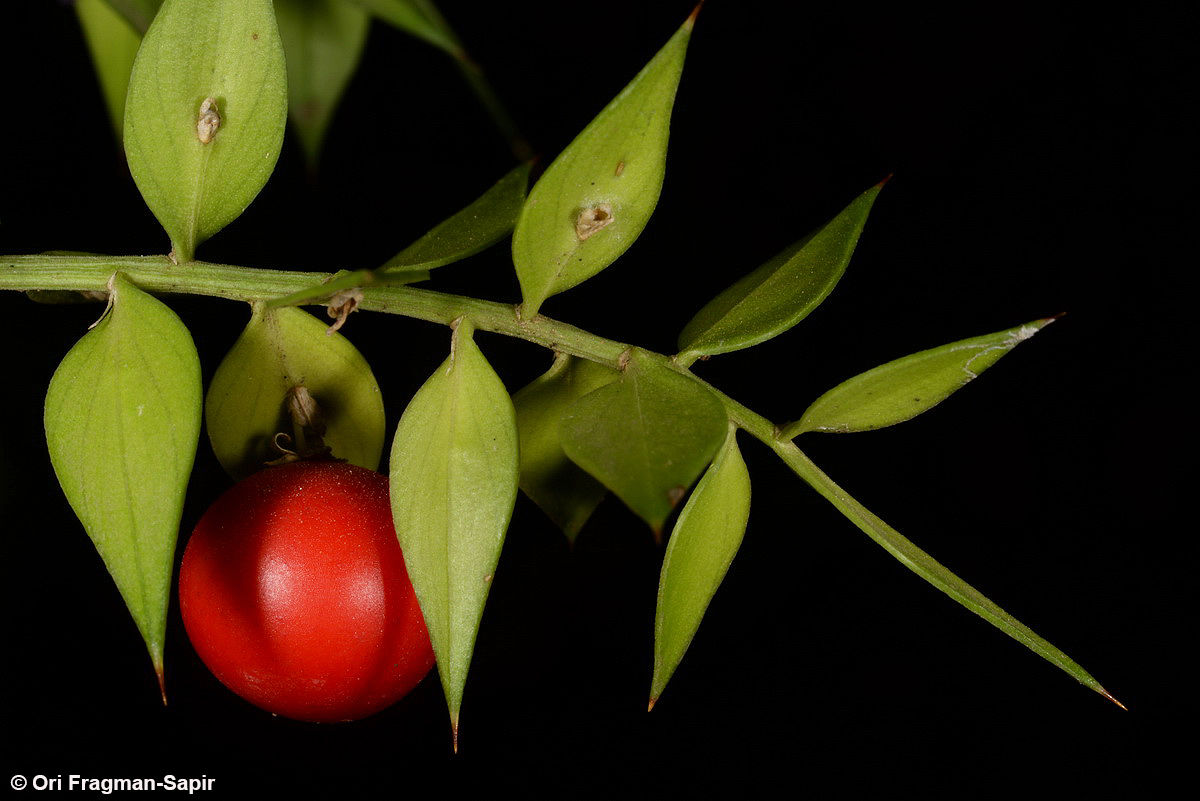
Butcher's-broom (Ruscus aculeatus L., 1753) is a subshrub with evergreen stems. A flower or red berry apparently sitting on a leaf is distinctive. Its green support is actually a cladode, a flattened stem; true leaves are reduced to tiny scales. French names include fragon piquant and petit houx. 7 3 6
It belongs to Asparagaceae, the asparagus family. An underground rootstock produces several stems and allows the clump to persist from year to year, remaining green when neighboring woodland plants lose their foliage. The French little-holly name describes resemblance, not a relationship to true holly. 1 6
Recognition
Stems generally reach 30–80 cm (12–31 in), upright, branched chiefly toward the top and longitudinally ridged. Alternate, oval to lance-shaped cladodes are rigid and end in a sharp point. They twist at the base, creating an unexpected orientation when a branch is examined closely. 3
Look for small greenish or violet flowers on a cladode’s face, slightly below its midpoint. Flowers occur singly or in pairs beside a small bract. Bright red, rounded berries measure 8–14 mm (0.3–0.55 in) and contain one to four large seeds. Flower position is more decisive than red fruit color, since many shrubs have red berries. 3 6
Useful taxonomy
The accepted name is Ruscus aculeatus, published by Linnaeus in 1753, volume two of Species Plantarum, page 1041. “L.” identifies the botanical author, not the discoverer of French populations. The nomenclatural reference permits retrieval of the original description. 1 2
Oxymyrsine pungens Bubani and Ruscus laxus Sm. are synonyms. An old collection or nursery label carrying one of these names does not therefore necessarily identify a different species from the plant described under the accepted name today. Older treatments sometimes use Ruscaceae; current classification uses Asparagaceae. Retaining the accepted name helps compare floras, collections and nursery catalogs. 1 2
Habitat and distribution
Its broad native range extends from Macaronesia to the Mediterranean and western and south-central Europe to the Caucasus, including France and Corsica. Germany, Ireland and parts of Mexico are introductions. An observation within a country therefore cannot establish local origin by itself. 1
Dry, shaded woodland suits it. Drought resistance does not mean an obligatory preference for full sun: low water loss and water storage in cladodes contribute to tolerance. British populations occur in woodland and hedges, also walls, cliffs and some coastal rocky ground. 6
In mainland France it is nationally Least Concern, but gathering is regulated. It appears in Annex V of the Habitats Directive, and the French ministerial order of October 13, 1989 allows prefects to regulate collection and sale. Several departmental orders prohibit taking underground parts from the wild. 7
Cycle and reproduction
Rhizomes chiefly sustain and slowly expand clumps. Seed reproduction occurs, but seed production and dispersal are often inefficient. Slow growth favors retaining existing clumps rather than expecting rapid colonization of a large plot. 6
Flowers are discreet, while berries make reproduction conspicuous. Male and female plants are generally separate, although some forms have self-fertile flowers. Both sexes favor fruiting; a berryless plant need not be unhealthy or poorly positioned. Division and seed are both used for propagation. 5
Uses and risks
It provides woodland groundcover and can be planted in groups. Maintenance is limited: remove dead stems at the base in spring without unnecessarily damaging healthy parts. Established plants tolerate drought, but watering must remain compatible with drained soil. 5
Berries are toxic. Irritating saponins can cause vomiting or diarrhea after substantial ingestion; children have also developed rashes and leg swelling. Bright red fruits are particularly attractive to young children. 8 9
Keep fruits out of reach of cats and dogs; no data establish safety for horses. Gloves protect against sharp tips during handling. Documented medicinal use does not make berries food, and saponin research or medicinal gathering does not justify improvised home preparations. Intensive gathering has contributed to declines in some eastern European populations. 4 6
Varieties, lookalikes, and related plants
Choose a shaded site whose soil does not remain saturated. Mature height and width reach 0.5–1 m (1.6–3.3 ft), attained slowly. Allowing for that final height and width when choosing its position avoids having to cut the clump back repeatedly just because its planting space was too small. Chalk, clay, loam or sand can suit it as long as the soil is not waterlogged. 4
John Redmond and Wheeler’s Variety are hermaphroditic cultivars: the first dwarf, the second abundantly fruiting. Their hermaphroditic flowers therefore change what a gardener can expect of fruit production compared with an ordinary plant whose male or female sex must first be taken into account. To distinguish it from holly, seek flowers on cladodes; flattened flower-bearing stems provide a direct check even without berries. 6 5
Main sources
The accepted name is Ruscus aculeatus L., published in Species Plantarum in 1753; taxonomic references link older synonyms to this same butcher's-broom species. 1 2
- POWO, Ruscus aculeatus
- IPNI, publication of the name
- Tela Botanica, butcher's-broom
- RHS, Ruscus aculeatus
- NC State Extension, Ruscus aculeatus
- Thomas and Mukassabi, Biological Flora, 2014
- INPN, TAXREF, Ruscus aculeatus
- Lille Poison Control Center, butcher's-broom
- Banfi et al., Poisonous plants of the Italian flora, Natura, 2012
Frequently asked questions
Do butcher's-broom leaves bear fruit?
The flattened green organs are cladodes, modified stems bearing flowers and fruit.
Why does my butcher's-broom produce no berries?
Male plants do not fruit; both sexes favor fruiting, except in self-fertile forms.
Can the red berries be eaten?
No. The berries are toxic; irritating saponins can cause vomiting or diarrhea.
If you are unsure about a plant’s toxicity, ask a botanist or veterinarian for advice.