
White-Topped Pitcher Plant (Sarracenia leucophylla, )
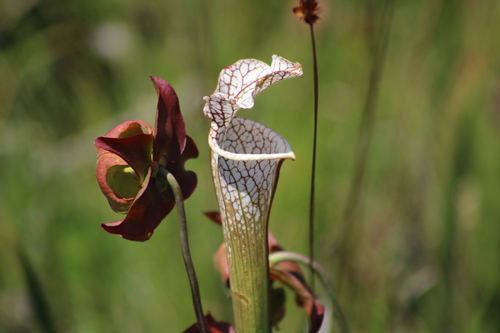
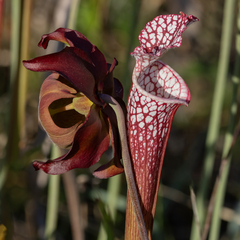
White-Topped Pitcher Plant (Sarracenia leucophylla) has upright pitchers with white tops veined in green or red. This carnivorous perennial in the Sarraceniaceae comes from southeastern US wetlands and needs ample light, low-mineral water and winter dormancy.
Read moreWhite-Topped Pitcher Plant and white trumpet
Sarracenia drummondii Croom
Place in full sun, with intense direct light all day long.
Full sun outdoors; under glass, protect from scorching sun.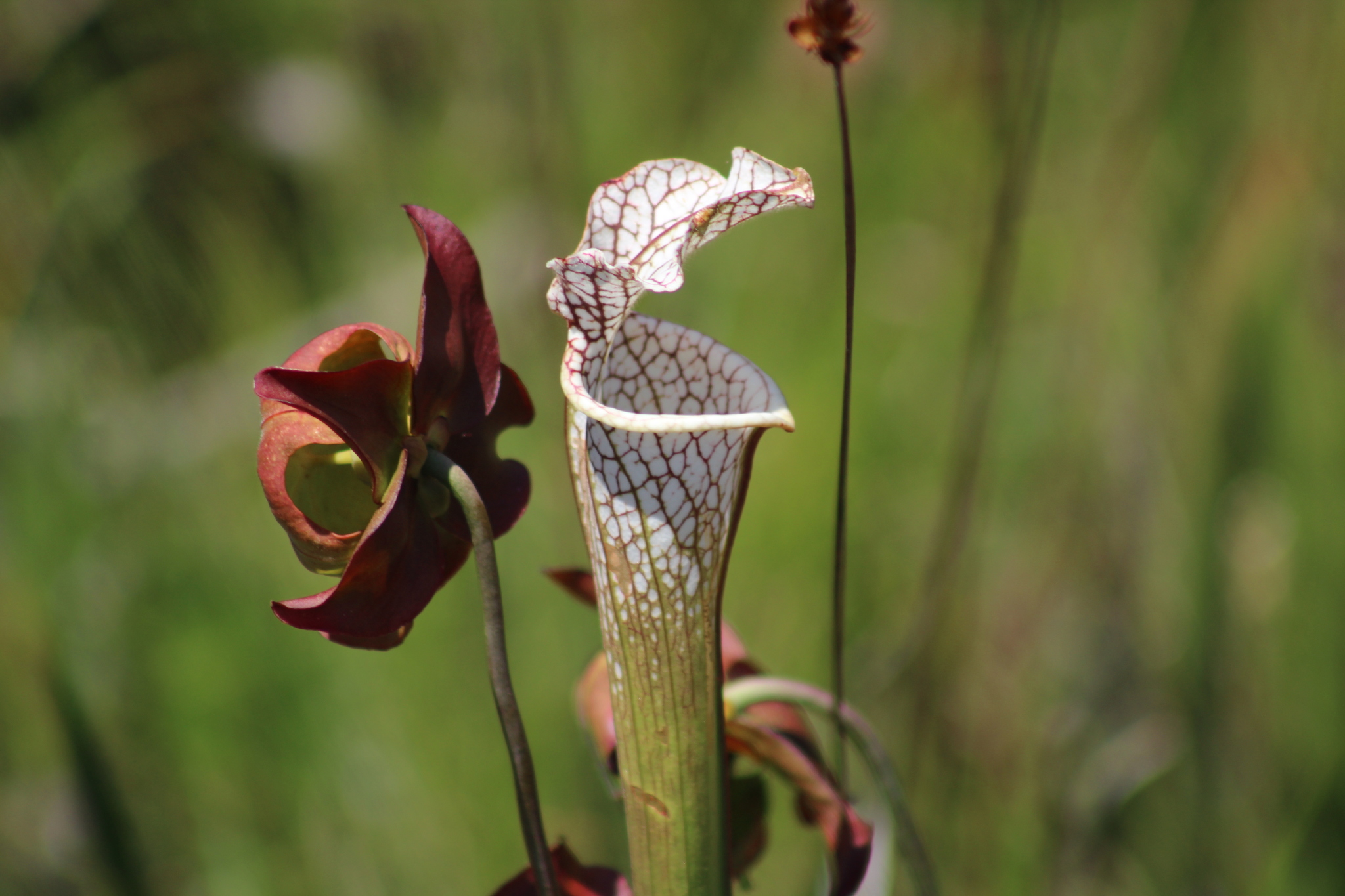
© photo
(c) jeremy_hardin, some rights reserved (CC BY-NC), uploaded by jeremy_hardin · cc-by-nc
Dan Vickers · cc0
Daniel McClosky · cc-by
© copyright of the Board of Trustees of the Royal Botanic Gardens, Kew.



Global distribution
Native to the southeastern US coastal plain in Alabama, Florida, Georgia and Mississippi. Introduced in Virginia and Washington State according to POWO.
Identity
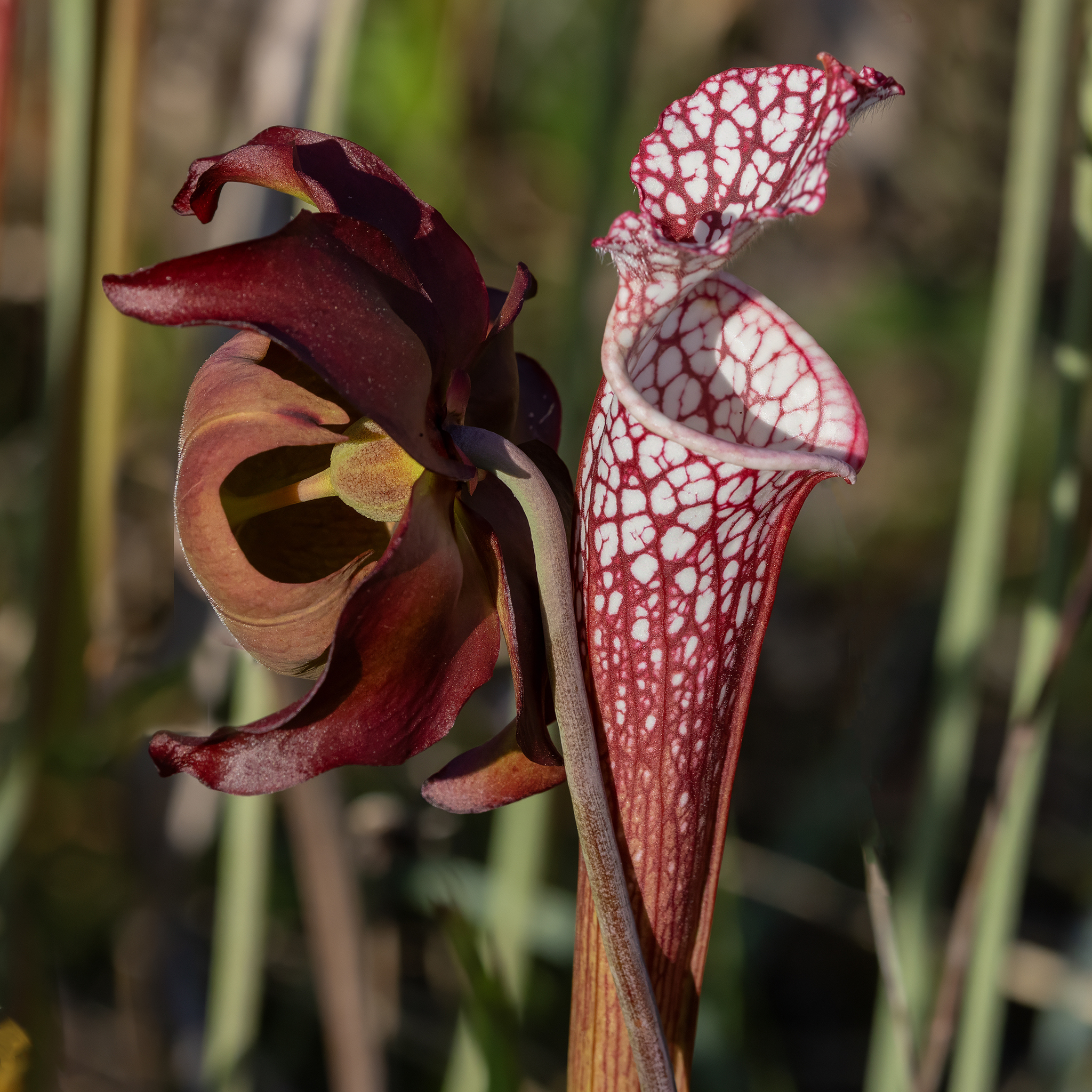
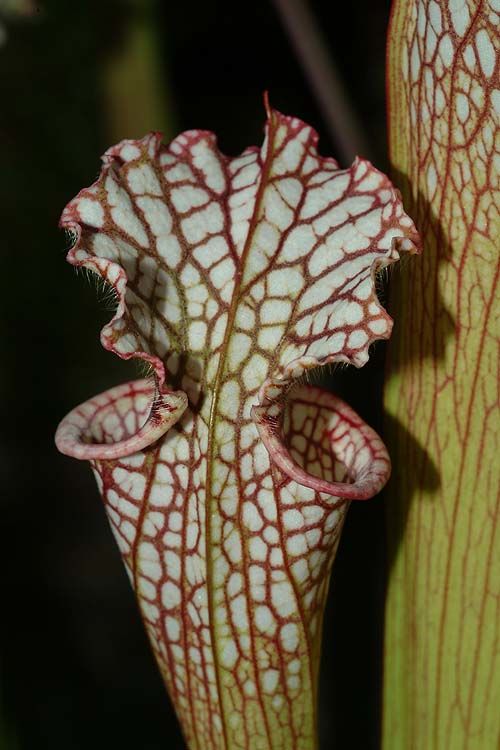
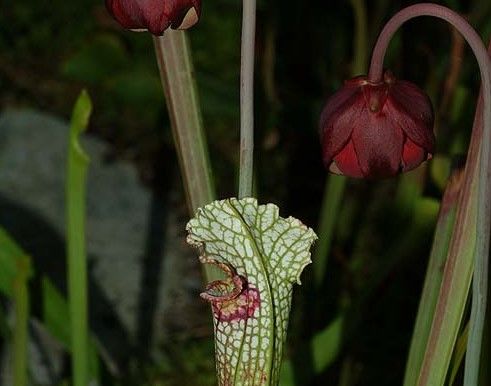
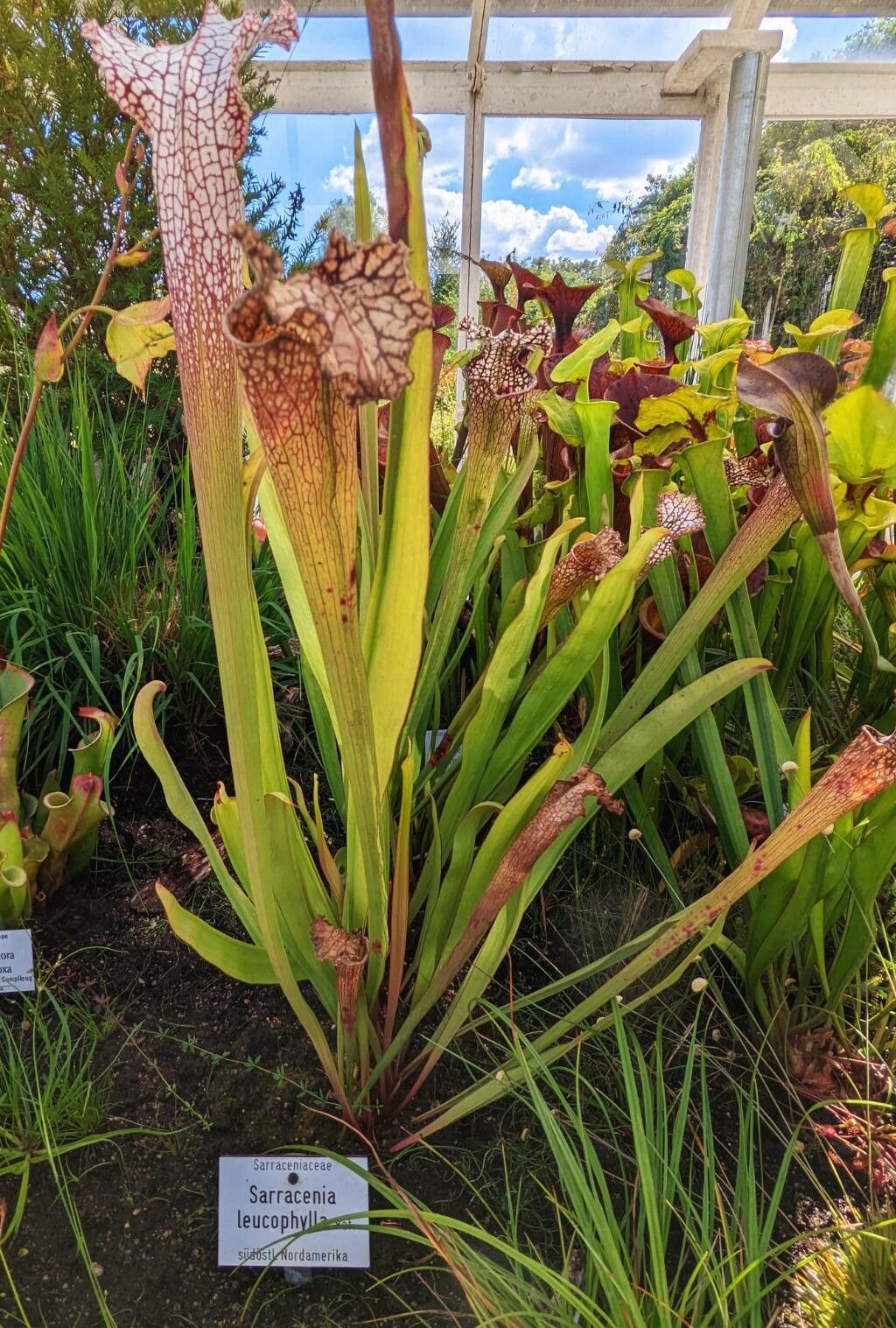
White-Topped Pitcher Plant (Sarracenia leucophylla Raf., 1817) has upright pitchers with white tops crossed by green to red veins. The traps are leaves modified into tubes, rather than flowers. White-Topped Pitcher Plant forms clumps from a rhizome. 2 3
Au Jardin uses the French name "sarracénie à feuilles blanches." The accepted binomial keeps the plant's identity precise behind this descriptive common name. 7 1
Identification
The North American flora gives pitcher heights of 25–100 cm (9.8–39.4 in). Their green bases widen toward an opening topped by a wavy hood. The network of white and colored areas dominates the upper part of the tube. Flat leaves called phyllodia can grow alongside the pitchers. 2
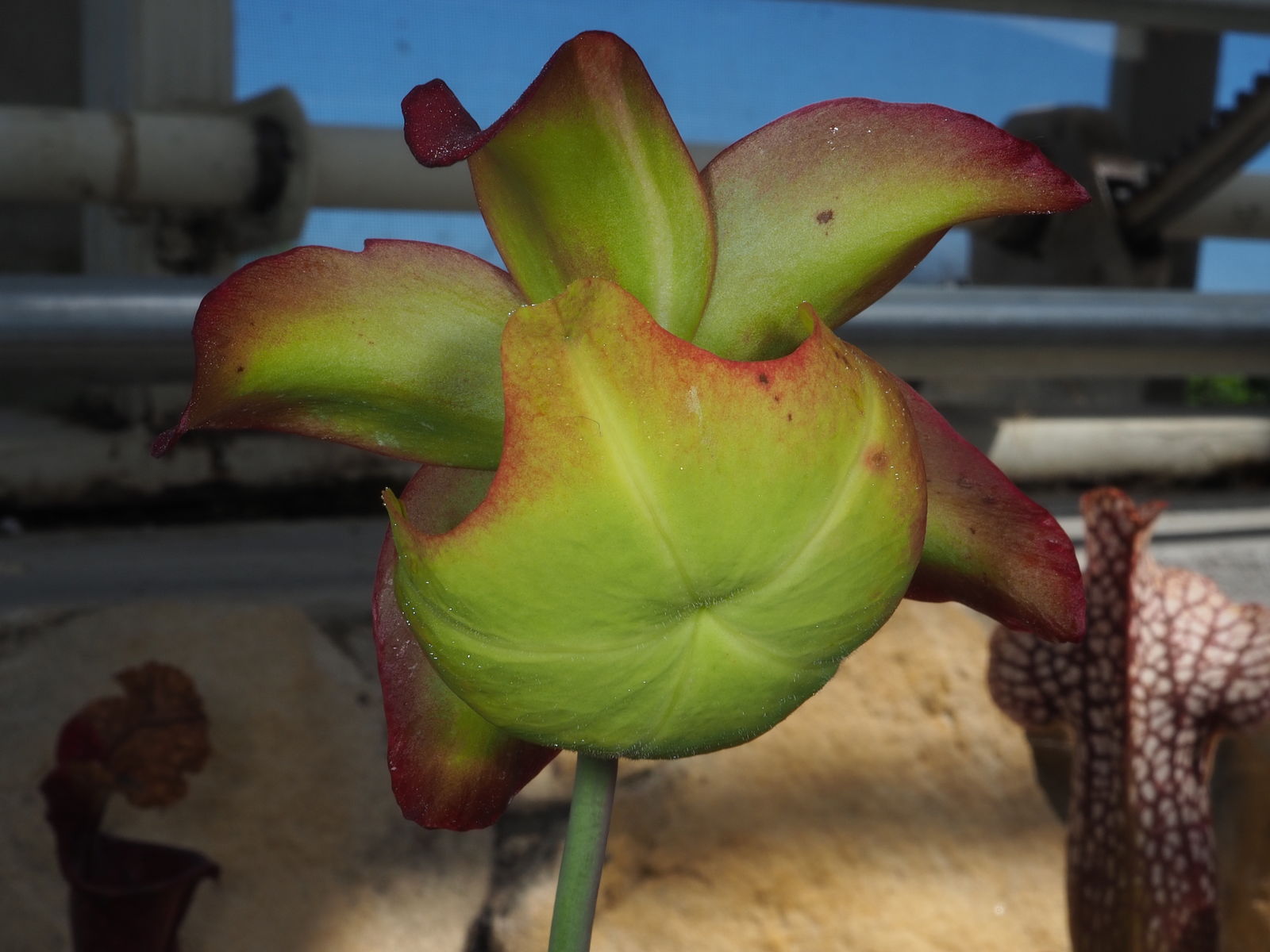
The solitary, nodding flowers have dark red petals and an umbrella-shaped central disk. The British horticultural description gives flowers about 8 cm (3.1 in) in diameter, with a plant 0.5–1 m (1.6–3.3 ft) tall and wide. Height and spread in cultivation are different measurements from the length of an individual pitcher. 6 4
Useful taxonomy
Sarracenia leucophylla belongs to the Sarraceniaceae, in the order Ericales. Rafinesque published the accepted name in 1817, in Flora Ludoviciana. The older name Sarracenia drummondii Croom is listed among its synonyms, so a label bearing that name does not necessarily denote another species. 1
POWO also places Sarracenia leucophylla var. alba and f. viridescens in synonymy. An old botanical variety and a horticultural cultivar belong to different categories of names. 1
Habitat and distribution
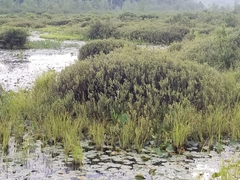
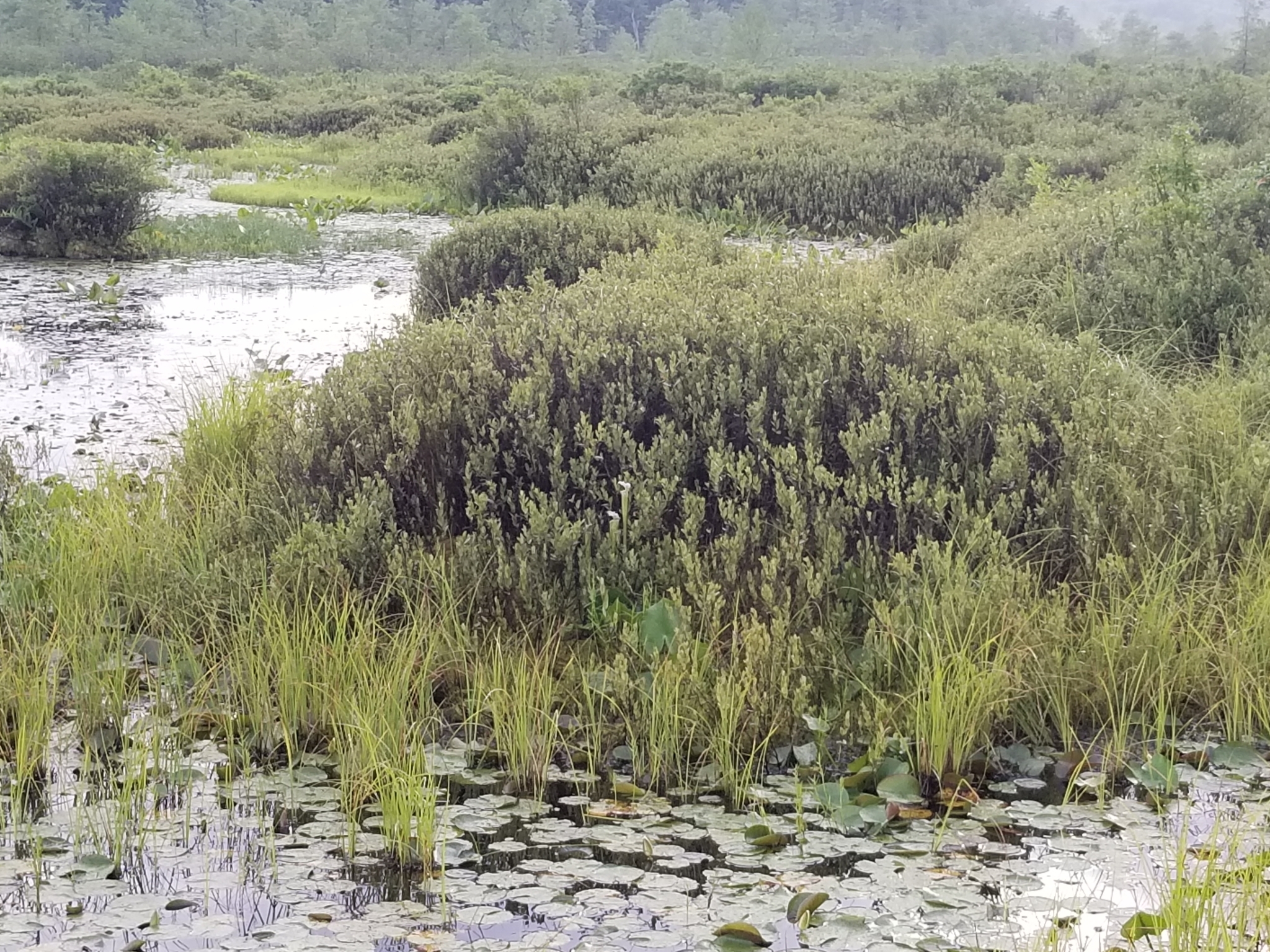
The species is native to Alabama, Florida, Georgia and Mississippi. It grows in bogs, wet pine savannas and other open, swampy habitats on the coastal plain. Populations in Virginia and Washington State are introduced and fall outside the natural range. 1 6
Drainage, conversion to farmland and encroachment by woody vegetation threaten its habitats. The Georgia profile records an Endangered listing in that state, rather than a global category. Choose nursery-propagated plants and avoid collecting from the wild. 6 3
Kew reports the IUCN category Vulnerable, while separately displaying a "not threatened" risk prediction from a model developed in 2024. The prediction does not replace the IUCN assessment; the latter's date and criteria have not been checked directly. 8
Life cycle, reproduction and cultivation
Flowering is reported in March and April within the American range. An initial flush of pitchers in spring is followed by a stronger flush in late summer. The capsules measure 1.5–2 cm (0.6–0.8 in) in diameter. 2
Bees pollinate the flowers, and the capsules ripen in fall. The rhizome can be divided to propagate the plant. Growing from seed takes more patience: seedlings do not flower during their first four or five years. 3
Cold influences germination. In an experiment published in 2012 using seeds collected in Alabama, fresh seeds placed in a growth chamber without cold stratification did not germinate. Results after storage and stratification varied with the treatments; they do not establish a universal success rate. 5
In cultivation, keep the substrate moist and use rainwater or distilled water, with few dissolved salts. The species needs full sun during growth. Ordinary enriched potting mix and fertilizers can kill it. 3
Under glass, protect the plant from scorching sun and use a low-nutrient, acidic mix. The RHS recommends peat-free potting mix containing sustainably sourced moss. Keep the plant cool and well ventilated in winter, with less water but without letting it dry out completely. Foliage may turn brown during seasonal dormancy. 4 3
Repot before growth resumes, and do not fertilize. The calendar maps these seasons onto a temperate growing year in France; apply the seasonal stages according to local conditions. Its indices show relative intensity rather than measured water volumes or growth rates. 7
Uses and risks
The plant can be grown in pots or in a purpose-built bog garden. Cut pitchers are also used in floral arrangements; this use does not justify gathering them from wild populations. Watch for aphids, mealybugs and root rots. 3
Carnivorous does not mean toxic or edible. The references consulted do not establish the risk of ingestion for adults, children, cats, dogs, horses or other animals. They identify neither a causative substance nor a clinical pattern specific to this species. A lack of data does not demonstrate safety.
Hardiness guidance differs: the RHS assigns H3, while Au Jardin gives −12 °C (10.4 °F). These figures do not establish a universal cold-tolerance threshold, especially for a plant grown in a pot. 4 7
Varieties, lookalikes and related plants
'Hurricane Creek White' and 'Sumter' are horticultural names listed by NC State. Their presence in that list does not, on its own, establish registration or stability. 3
Hybrids with other sarracenias may retain a partly white top and a wavy hood. A white pitcher therefore does not guarantee a pure species. Check the plant's origin and full label before applying a species description to a horticultural plant. 6
Main sources
Floras document botanical features, while horticultural references describe care. The experimental abstract applies only to the seeds studied.
- Kew, Plants of the World Online: Sarracenia leucophylla Raf.
- Flora of North America, Mellichamp and Case: Sarracenia leucophylla
- NC State Extension, Plant Toolbox: Sarracenia leucophylla
- Royal Horticultural Society: Sarracenia leucophylla
- USDA Forest Service, Connor and Gibbs (2012): Germination and field survival of white-topped pitcher plant seeds
- Georgia Department of Natural Resources: Sarracenia leucophylla
- Au Jardin: White-Topped Pitcher Plant (05/04/2013)
- Kew, POWO: general information on Sarracenia leucophylla
Frequently asked questions
Should I fertilize White-Topped Pitcher Plant?
Do not add fertilizer: horticultural sources describe its sensitivity to dissolved salts and the risk posed by fertilizers.
Why do the pitchers turn brown in winter?
The plant rests from fall until spring and loses some of its foliage. This seasonal browning is no reason to let the root ball dry out.
What water should I use for Sarracenia leucophylla?
Use rainwater or distilled water. The species is sensitive to dissolved salts; hard water is unsuitable for growing it.
Are white pitchers enough to identify the species?
The white, veined top is characteristic, but hybrids can retain this coloring and the wavy hood. Check the plant's origin and horticultural identity too.
If you are unsure about a plant’s toxicity, ask a botanist or veterinarian for advice.