
Stromanthe thalia

Stromanthe thalia folds its green, purple-backed leaves at night. This Brazilian perennial in the Marantaceae forms upright clumps; Triostar is its variegated cultivar, distinct from the botanical form.
Read moreHeliconia thalia, Stromanthe sanguinea and Stromanthe spectabilis
Give plenty of ambient light without direct sun on the leaves.
Bright filtered light under cover; direct sun can scorch the leaves.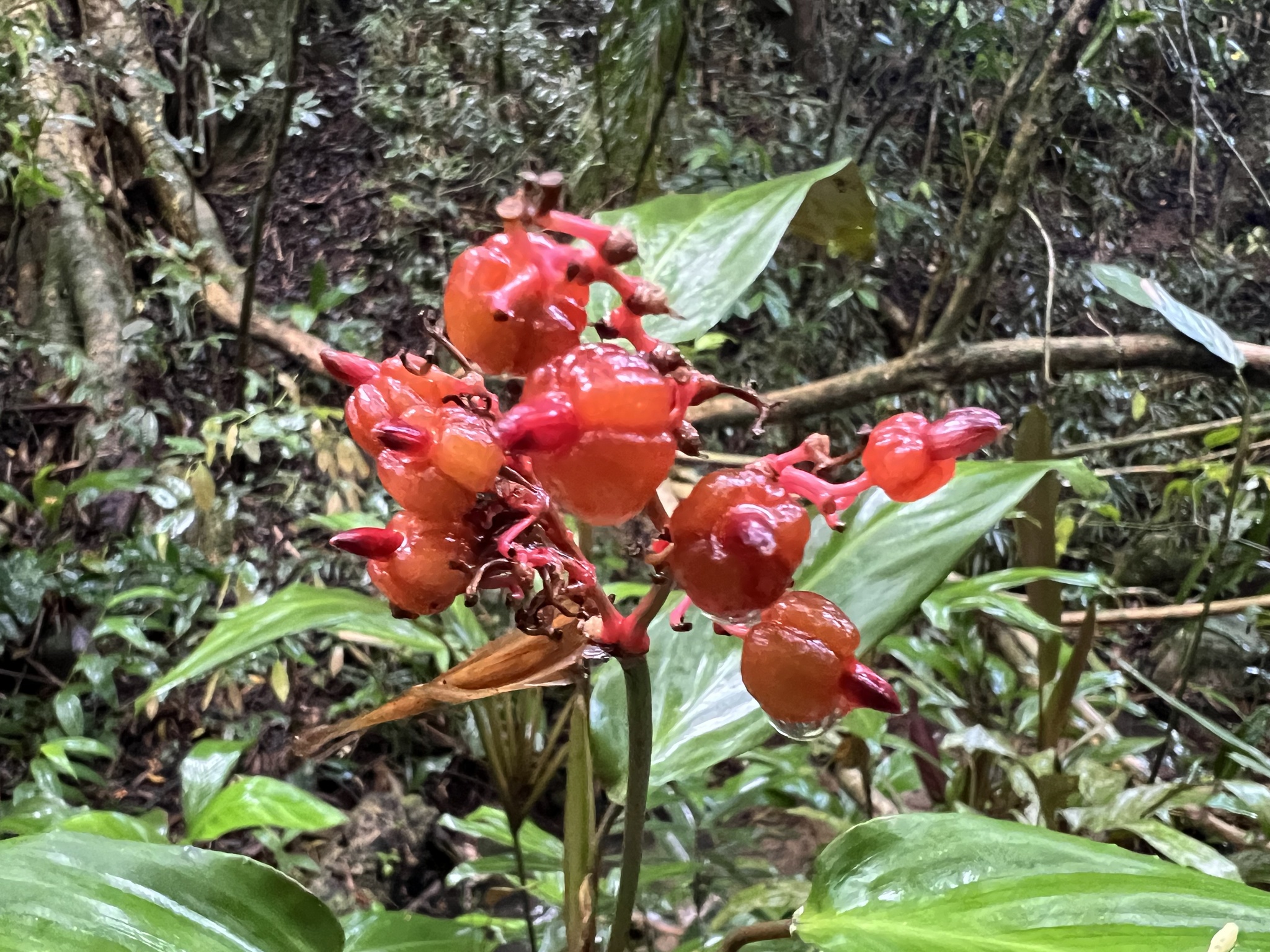


© photo
Alessandher Piva · cc-by
Wikimedia Commons · CC BY-SA or Public Domain
Wikipedia · CC BY-SA
© copyright of the Board of Trustees of the Royal Botanic Gardens, Kew.


Global distribution
Native to eastern Brazil and found in the Atlantic rainforest. Rio de Janeiro lies within this range but does not represent its full extent.
Identity
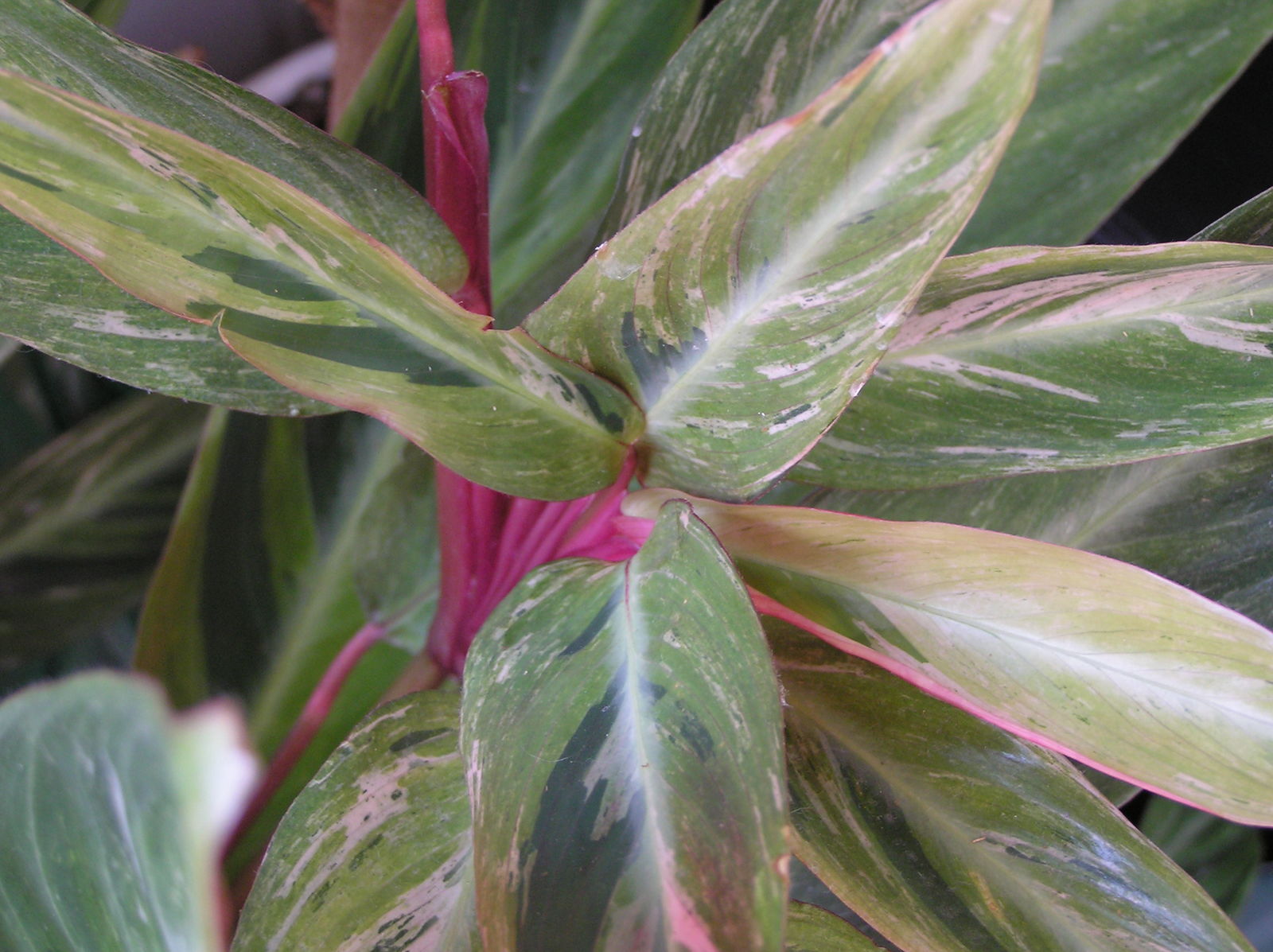
Stromanthe thalia ((Vell.) J.M.A.Braga, 1995) folds its leaves at night, revealing their burgundy undersides. This evergreen herbaceous perennial belongs to the Marantaceae, in the order Zingiberales. The botanical species has dark green upper leaf surfaces; the broad pink and cream patches seen on plants for sale belong particularly to the cultivar Triostar. 3 5 7
In French, stromanthe is a documented common name for this species, although the same word also names the genus. The binomial Stromanthe thalia identifies the species precisely. Triostar names a horticultural selection within the species, so that cultivar name cannot identify every form of S. thalia. 1 5
Recognition
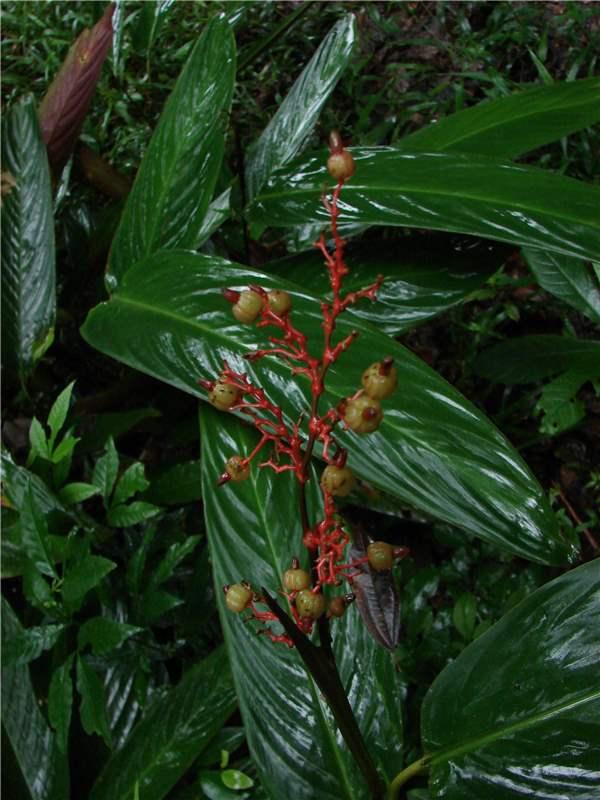
The leaves of Stromanthe thalia are elongated and leathery, with smooth margins and pointed tips. Glossy upper surfaces contrast with wine-purple undersides; a paler band sometimes follows the central vein. The botanical description gives leaf blades 25–45 cm (about 9.8–17.7 in) long and 6–12 cm (about 2.4–4.7 in) wide. The leaf stalks also have a wine-red tint. 9
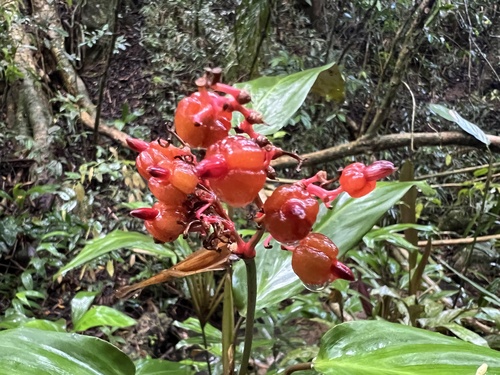
An upright clump of branching stems gives Stromanthe thalia its shape. Under British horticultural conditions, the stated final height is 1–1.5 m (about 3.3–4.9 ft), with a spread of 0.5–1 m (about 1.6–3.3 ft). The stated dimensions describe the potential of Stromanthe thalia in cultivation; an individual houseplant can remain smaller. Small white flowers, surrounded by orange sepals and red bracts, form branched clusters called panicles above the foliage. 5 6
Useful taxonomy
The species is accepted as Stromanthe thalia in the taxonomic treatment. Its basionym, the name on which the current combination rests, is Heliconia thalia Vell., published in 1829. The combination in Stromanthe appeared in Eugeniana, with effective publication in 1995; the volume is dated 1994–1995. A name's publication date does not establish when the plant was discovered. 2 3
The synonym Stromanthe sanguinea (Reider) Sond. is explicitly assigned to S. thalia. A horticultural account retains S. sanguinea as the correct name, so the treatments differ over which name to use. Stromanthe spectabilis also appears among the species' older names. The botanical synonyms of Stromanthe thalia have a different status from cultivar names. 4 6 5
Habitat and range
Eastern Brazil is the native home of Stromanthe thalia. Rio de Janeiro lies within its range but does not account for the entire distribution. The detailed range also includes Bahia, Espírito Santo, Minas Gerais, Paraná and São Paulo. The plant grows in Atlantic rainforests, often near clearings, from sea level to about 1700 m (5577 ft) in elevation. 7 8 9
For cultivation under cover, Stromanthe thalia needs bright filtered light and high air humidity. Direct sun can scorch its leaves, and dry soil is unsuitable. The potting mix must still drain freely: overwatering can cause root and stem rot. Keeping the mix moist therefore differs from allowing it to become waterlogged. 6 5
Life cycle and reproduction
Division in spring, before new shoots start growing, is a documented way to propagate Stromanthe thalia. Sowing is another option. Division during dormancy or after flowering is also recommended to minimize root damage. The division windows for Stromanthe thalia reflect different horticultural conditions; they do not impose one mandatory date on every plant. 5 6
Winter and spring flowering is reported in the British horticultural description. Flowers are rarely seen on houseplants, although greenhouse specimens do bloom. Evergreen foliage supplies most of the plant's ornamental interest indoors. A lack of flowers alone does not establish a cultivation problem in Stromanthe thalia. 6 5
For Stromanthe thalia, the calendar describes indoor cultivation in mainland France, in the Northern Hemisphere. Its water and growth indices are relative editorial guides without units; they give no measured water consumption or growth rate. The seasonal contrast follows moderate winter watering and feeding during growth under cover. Feeding assumes active growth, and no fixed repotting date is prescribed. Elsewhere, observed growth and growing conditions take precedence over these French seasonal markers. 6
Uses and risks
Grown for its foliage, Stromanthe thalia suits indoor cultivation or a shaded terrace where the climate allows. Under cover, a low-nitrogen liquid fertilizer is recommended every two to three weeks during growth. This recommendation specifies neither an application dose nor an NPK formula. Water Stromanthe thalia moderately in winter under cover. 5 6
A species-specific toxicological classification remains unestablished for humans, children and the different domestic animals. A horticultural "pet friendly" label supplies neither a detailed classification for each group nor a guarantee of safety after ingestion. The available references establish no toxic substance or symptoms specific to Stromanthe thalia. 5
Documented cultivation problems include mealybugs, aphids and spider mites. Overwatering can also cause root and stem rot in Stromanthe thalia, independently of any pest infestation. Moisture management therefore remains relevant even when no insects or mites are visible. 5
Varieties, look-alikes and related plants
Triostar, also sold as Tristar or Tricolor, is a variegated cultivar of Stromanthe thalia. White, cream and pink patches appear alongside olive green; the botanical species mainly retains the contrast between green and burgundy. Magic Star is another described selection, with cream-white variegation on green leaves and purple-brown undersides. Triostar and Magic Star are selections of Stromanthe thalia. 5
Tricolor can also name a clone of Ctenanthe oppenheimiana, a different species. That Ctenanthe has thinner, wirier leaf stalks than Stromanthe thalia; leaf shape, markings and veins also differ. A label reading only "Tricolor" cannot distinguish between the two taxa. The full plant name matters when comparing otherwise similar variegated foliage. 10
Main sources
GRIN explicitly links the botanical name Stromanthe sanguinea to Stromanthe thalia, allowing descriptions under both names to be read without confusing the species with a cultivar. 4
- Calathea et compagnie, evidence for the French common name Stromanthe only
- GBIF, Stromanthe thalia, taxonomic status
- International Plant Names Index, Stromanthe thalia
- USDA ARS GRIN Taxonomy, Stromanthe sanguinea
- NC State Extension, Stromanthe thalia
- Royal Horticultural Society, Stromanthe sanguinea
- EPPO Global Database, Stromanthe thalia
- NParks Flora & Fauna Web, Stromanthe thalia
- Monaco Nature Encyclopedia, Stromanthe thalia, Pietro Puccio
- University of Wisconsin Extension, Stromanthe thalia Tricolor
Frequently asked questions
Are Stromanthe thalia and Stromanthe sanguinea different plants?
GRIN treats Stromanthe sanguinea as a synonym of Stromanthe thalia. Horticultural descriptions under sanguinea can therefore concern the same species.
Why do Stromanthe thalia leaves rise at night?
The leaves' nighttime folding is normal behavior described for Stromanthe thalia. The burgundy undersides become more visible as the leaves fold.
Does every Stromanthe thalia have variegated leaves?
The botanical form has dark green leaves with purple undersides. White, cream and pink variegation is particularly associated with the cultivar Triostar.
Is Stromanthe thalia safe for cats?
The available references do not establish a precise toxicological classification for this species in cats. A horticultural pet-friendly label does not guarantee safety after ingestion.
If you are unsure about a plant’s toxicity, ask a botanist or veterinarian for advice.