
Wall germander (Teucrium chamaedrys, )
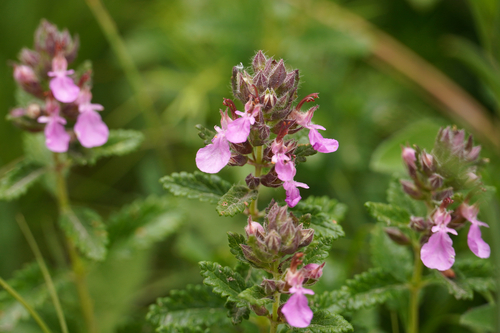
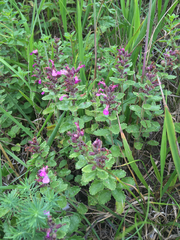

Wall germander is a small subshrub of dry ground, recognized by glossy, scalloped leaves. Purplish-pink flowers attract bees; historical medicinal use must not obscure documented liver risk.
Read moreWall germander
Teucrium veronicifolium
Allow a few hours of direct sun per day, preferably morning or evening.
Full sun; sheltered position on drained soil.


© photo
(c) mobbini, some rights reserved (CC BY-NC), uploaded by mobbini · cc-by-nc
Jiří Podhorecký · cc0
Kostas Zontanos · cc-by
Taken Aug 6, 2008 by Tela Botanica − Laurent PETIT (cc-by-sa)
Taken Aug 6, 2005 by Tela Botanica − Laurent PETIT (cc-by-sa)
Taken Jun 16, 2014 by Tela Botanica − Mathieu Sinet (cc-by-sa)
Taken May 30, 2019 by Renaud Brochiero (cc-by-sa)
Taken Feb 16, 2022 by Raúl (Este Madrid) (cc-by-sa)
© copyright of the Board of Trustees of the Royal Botanic Gardens, Kew.




Global distribution
Native from Europe to Iran, also present in North Africa. Introduced in Ireland and the Baltic countries.
- Native3
- Introduced1
- France
- Iran
- Morocco
- Ireland
Hexagons: regions where the plant occurs. Green dots: native range.1
Identity
Wall germander (Teucrium chamaedrys L., 1753) is recognized by small, glossy, scalloped leaves. This perennial subshrub belongs to Lamiaceae. Its base becomes woody, while small leafy stems form a low mat. The French petit-chêne name compares its scalloped leaves to oak leaves, without implying membership of the oak family. Chênette is another French name for this species. 3 5 8
The scientific name remains accepted. It chiefly occupies the temperate biome rather than being a tropical plant to keep indoors. Its low outline lends itself to use as an edging plant along a border. That compact appearance should still be read alongside its actual capacity to spread: a small plant at installation is not a promise that the mat will remain confined to exactly that space. 1 5
Recognition
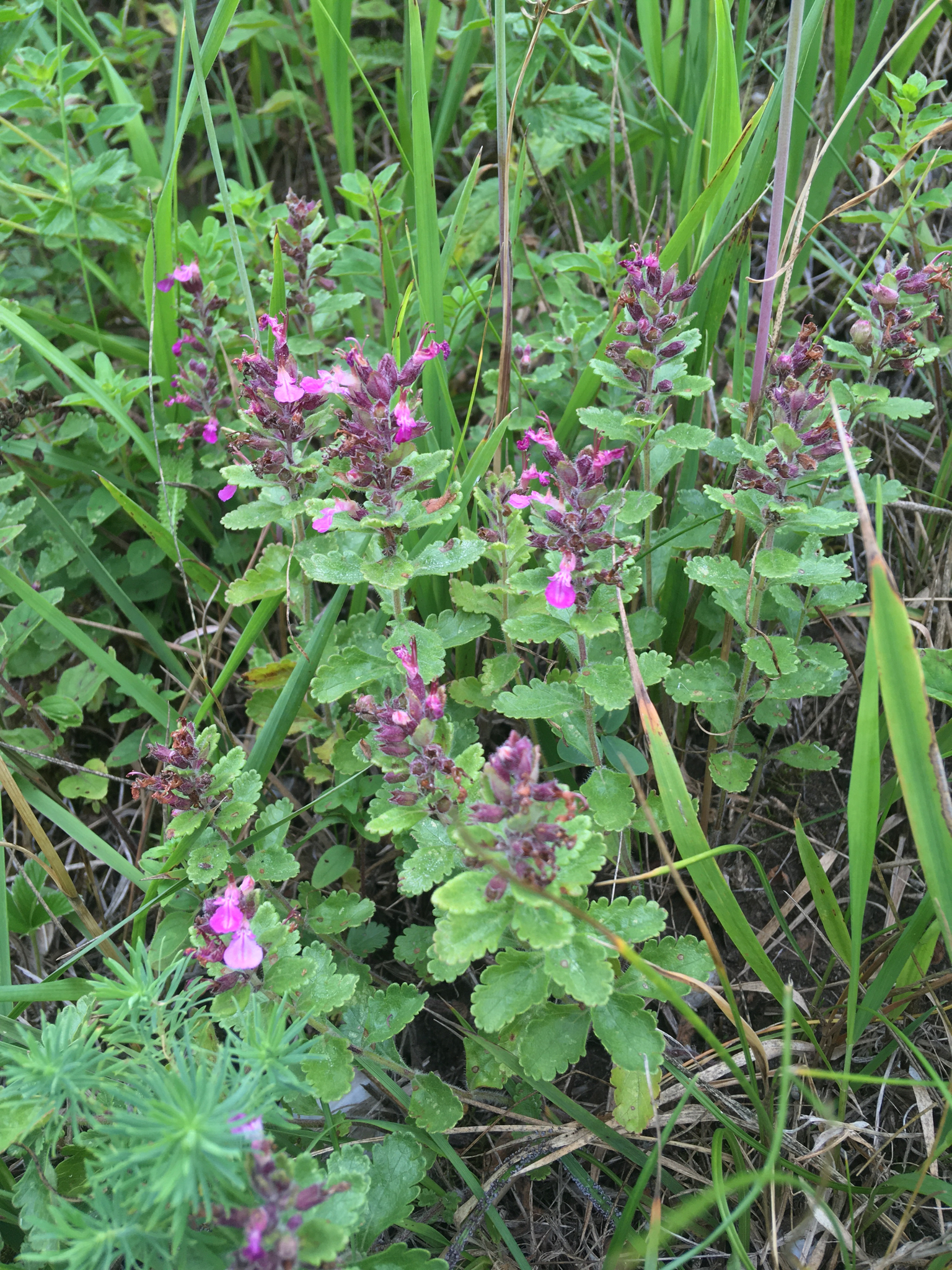
Opposite, glossy, deeply scalloped leaves provide the first clue. Oval or oblong blades narrow toward a short stalk. Slender prostrate or ascending stems can root at their bases. Wild plants reach 10–30 cm (4–12 in), with variable leaf hairiness. For identification, examine several separate shoots and their leaves together. A single damaged leaf cannot show the full range of hairiness or the normal outline of the foliage on that particular plant. 3 5
Purplish-pink flowers occupy upper leaf axils in tiers. Their tubular corollas form only one lip: the genus is described as one-lipped. Flowering makes identification more secure than the aromatic smell of foliage alone. Wall germander’s scent is never an edibility test. 5 4
Useful taxonomy
Teucrium chamaedrys L. was published in volume two of Species Plantarum, page 565, in 1753. Its recorded publication date is May 1. This concerns nomenclatural description, not a supposed discovery of the plant by Linnaeus. 2
The species includes fifteen infraspecific taxa, among them several subspecies and one variety. Names encountered in floras can therefore designate a more precise level than species. Teucrium veronicifolium Salisb. is an illegitimate synonym. A changed label does not alone establish that two pots contain different plants. 1
Habitat and distribution
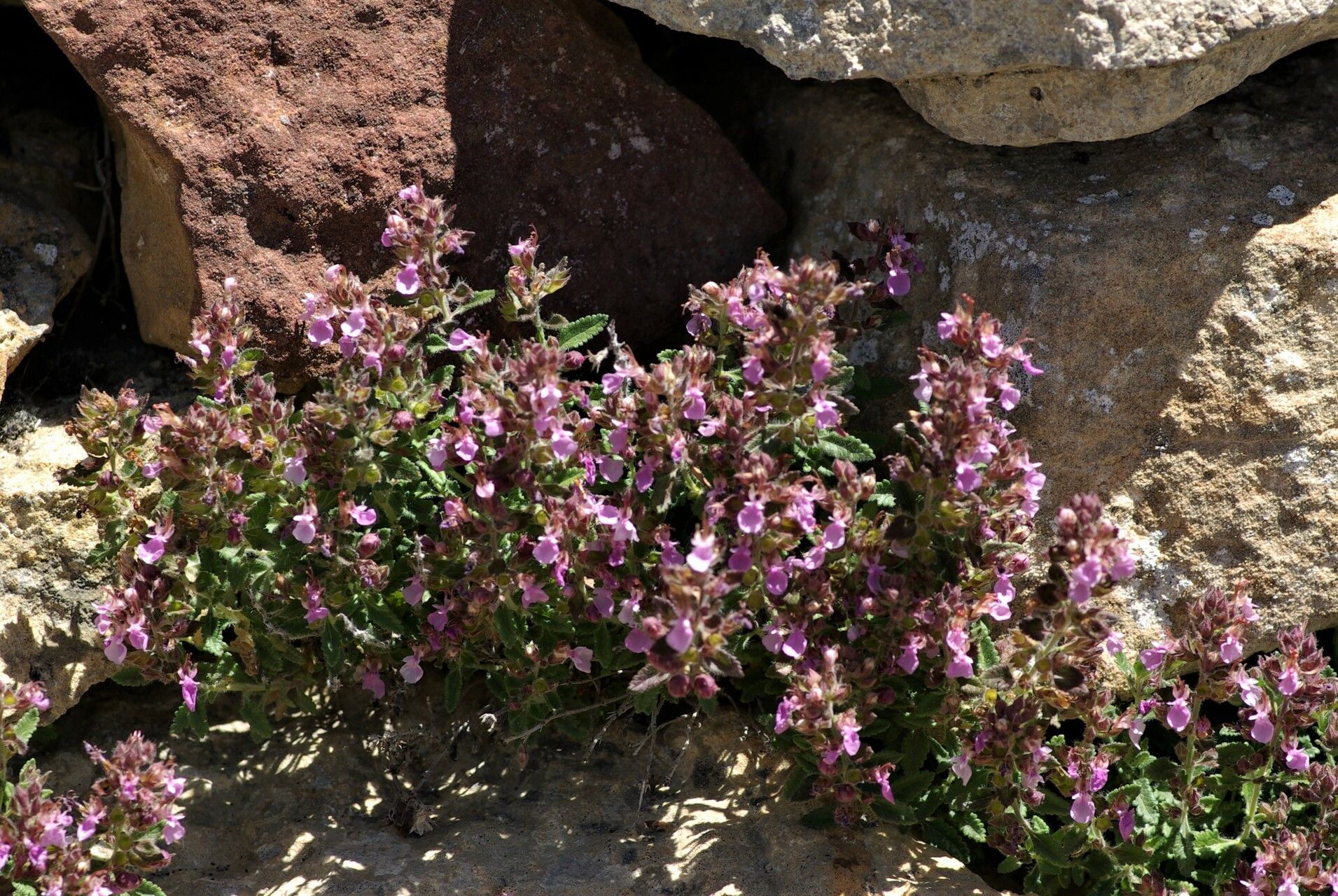
Arid, often calcareous ground is characteristic. Wall germander grows across almost all France and Corsica. Dry grassland and open ground match its ecology better than a constantly wet border. Retaining soil that readily drains water is consistent with its natural habitat. 3 4
The native range extends from Europe to Iran, including Morocco, Algeria and Tunisia. Ireland and the Baltic countries are introductions. These geographic records do not establish invasive status in France, where its national Red List category is Least Concern. Distinguish a wild local population from a planted border beside a house. 1 8
Cycle and reproduction
Flowering extends from spring into summer, varying with climate; the French window is May to September. Flowers attract bees. Clipping an entire border before buds open removes this floral resource. A perfectly even outline and abundant flowers therefore involve different management choices. 3 5
To propagate a selected plant, take softwood cuttings in early summer or semi-ripe cuttings in midsummer. Newly rooted cuttings need winter protection in a cold frame or cool greenhouse. Adults can also spread through rhizomes: monitor the edge of the mat, especially near small, less vigorous plants. 4 5
Uses and risks
Wall germander must not be used for self-medication. A French study published in 1992 describes seven patients with hepatitis after taking germander preparations. Injuries included jaundice and strongly elevated liver enzymes. Three patients experienced rapid recurrence after taking the preparation again. 6
Another publication reports two cases of acute liver injury after using the plant for weight loss. Medicinal history therefore does not prove safety. Human clinical data cannot establish safety for cats, dogs or horses, for which specific data remain insufficient. Wall germander is harmful if eaten. Restrict its use to ornamental gardening. 7 4
Varieties, lookalikes, and related plants
Botanical subspecies are not cultivars. Names such as albarracinii, germanicum and pectinatum denote recognized taxonomic units, whose identification requires a flora suited to the region. The name of a subspecies specifies its position within botanical classification. It is not, by itself, enough information to predict how a particular plant will behave in a garden or to treat it as a nursery selection with defined horticultural qualities. 1
With another small aromatic plant, seek the full combination of scalloped leaves, an almost woody base and purplish flowers grouped in threes to sixes. Resemblance to thyme never justifies culinary substitution. For edging, compare behavior too: germander spreads underground and tolerates clipping. Its value depends on space allowed for the mat rather than flower color alone. 3 5
Main sources
Wall germander is documented both as a garden plant and as a cause of hepatitis after ingestion. Botanical references and clinical studies illuminate these distinct uses.
- Plants of the World Online, Teucrium chamaedrys
- IPNI, Teucrium chamaedrys
- Tela Botanica, wall germander
- RHS, Teucrium chamaedrys
- NC State Extension, Wall Germander
- Larrey et al., Hepatitis after germander administration, 1992
- Pauwels et al., Acute hepatitis due to wall germander, 1992
- INPN, TAXREF: Teucrium chamaedrys
Frequently asked questions
Can wall germander be used as an herbal tea?
No. Acute hepatitis, sometimes with jaundice, has been described after ingesting wall germander preparations, and taking it again caused recurrences.
Where should wall germander be planted?
Choose full sun and well-drained soil, preferably neutral to alkaline.
Does it need clipping to form an edging?
It tolerates clipping as a small hedge, but repeated cuts during growth reduce flowering.
If you are unsure about a plant’s toxicity, ask a botanist or veterinarian for advice.