
Pink calla (Zantedeschia rehmannii, )


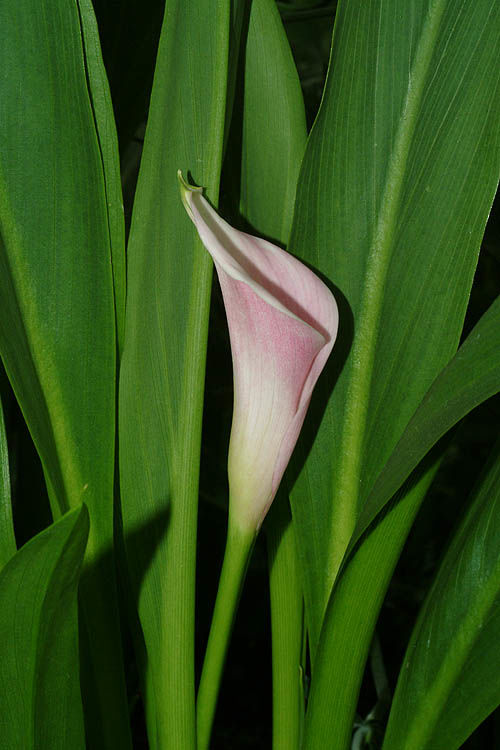
Pink calla (Zantedeschia rehmannii) has narrow leaves and pink spathes around a yellow spadix. This South African perennial with a tuberous underground organ loses its foliage and needs a dry, frost-free winter rest.
Read morePink calla
Richardia rehmannii, Richardia lehmannii and Zantedeschia stehmannii
Allow a few hours of direct sun per day, preferably morning or evening.
Sun or partial shade in a sheltered position


© photo
Wikimedia Commons · CC BY-SA or Public Domain
Wikipedia · CC BY-SA
© copyright of the Board of Trustees of the Royal Botanic Gardens, Kew.


Global distribution
Native range from Mozambique to South Africa, with a presence in Eswatini.
- Native3
- Mozambique
- Eswatini
- South Africa
Hexagons: regions where the plant occurs. Green dots: native range.1
Identity
Pink calla (Zantedeschia rehmannii Engl., 1883) combines lance-shaped leaves with a pink spathe surrounding a yellow spadix. This narrow outline distinguishes it from the large white calla with arrow-shaped leaves. The species belongs to the Araceae family, in the order Alismatales. 2 1 5
The French names Calla rose and Arum de couleur Rehmannii are also documented. The word “arum” reflects horticultural usage here: the accepted botanical name remains Zantedeschia rehmannii. A “calla rose” label therefore provides an initial clue but does not by itself guarantee the identity of a plant from the hybrid trade. 4 3
Identification
Pink calla forms a herbaceous clump with upright, lance-shaped, dark green foliage. Horticultural descriptions give a height of 20–60 cm (8–24 in), with a more compact presentation around 40 cm (16 in). These dimensions concern the cultivated plant without fixing the size of every commercial selection. 5 2
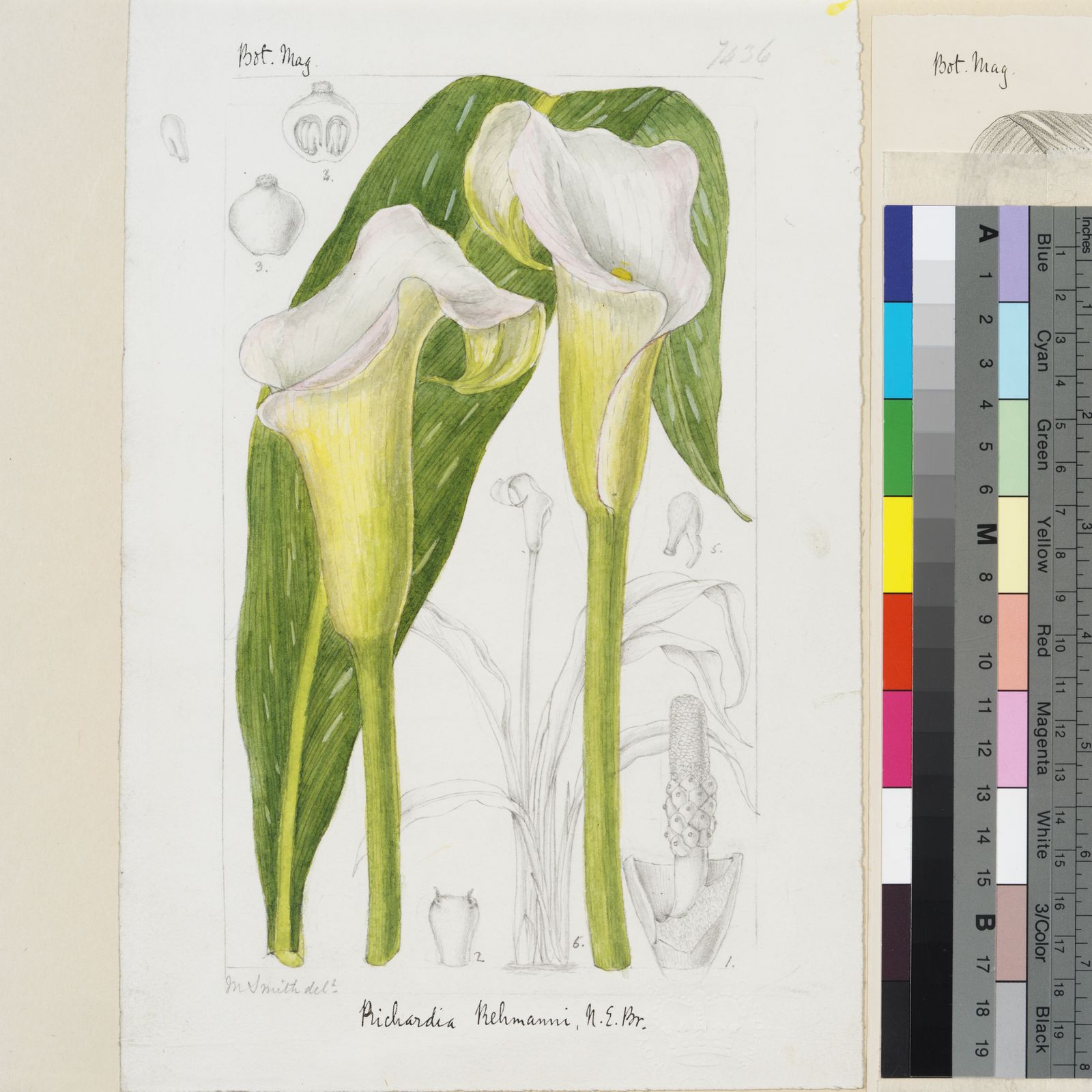
The visible pink part is a spathe, a funnel-shaped bract. Small flowers are grouped on the central yellow spadix. The spathe measures 8–12 cm (3.1–4.7 in) long; this measures the funnel rather than an individual flower. The foliage is deciduous: a potted plant can lose its leaves during its cycle without the underground organ being dead. 5 2
Useful taxonomy
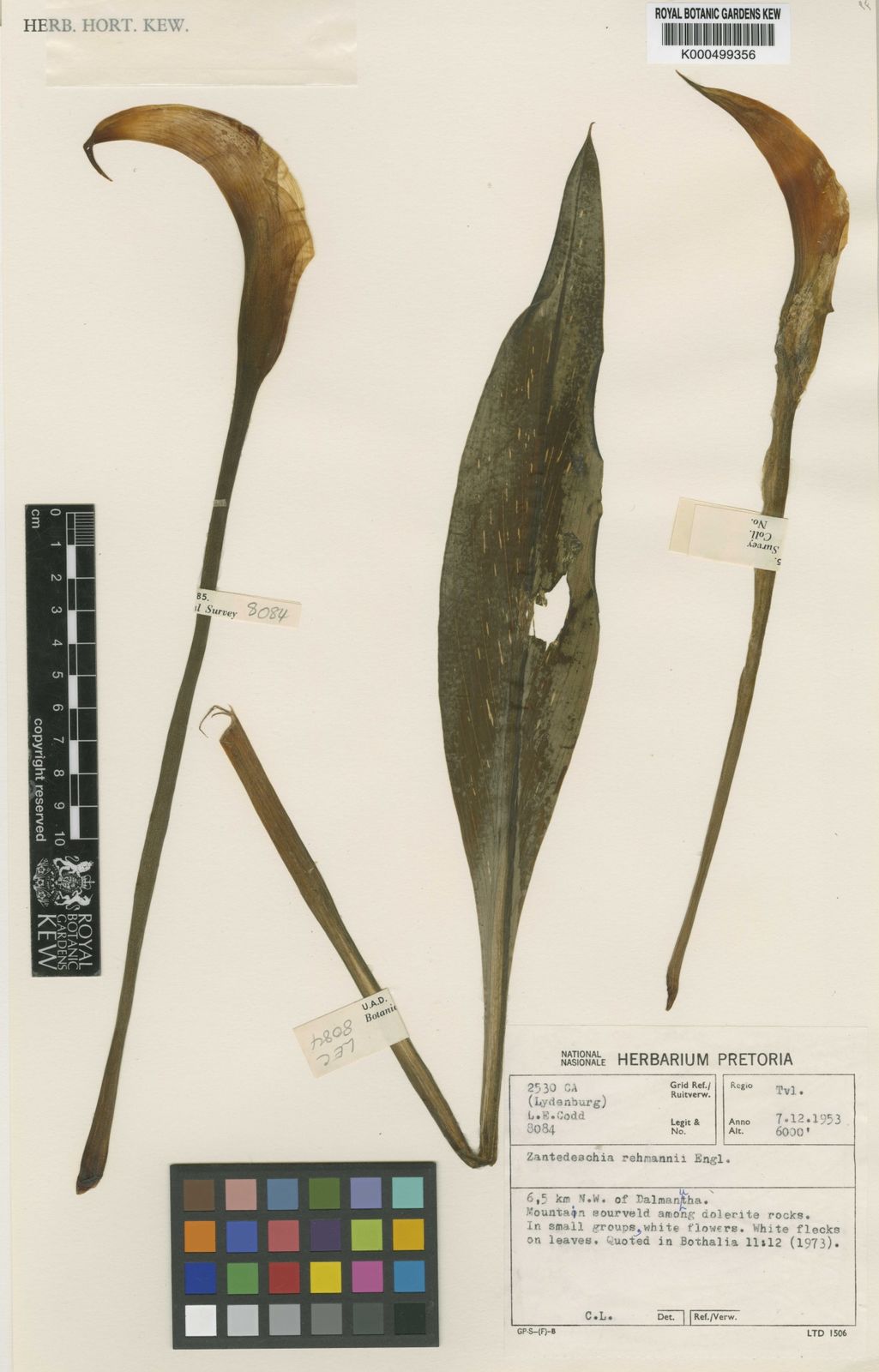
The name Zantedeschia rehmannii was published in 1883. The older names Richardia rehmannii (Engl.) N.E.Br. ex Krelage and Zantedeschia stehmannii Sprenger are linked to the same species. They therefore do not denote cultivars to seek out separately. 1
The spelling Richardia lehmannii N.E.Br. ex Krelage also appears in the synonymy as an orthographic variant. A spelling difference on an old illustration does not establish another species. When comparing older descriptions with plants offered today, the accepted binomial and its author provide stable taxonomic reference points. 1
Habitat and distribution
The native range of Pink calla extends from Mozambique to South Africa, with a presence in Eswatini. The South African territories listed include the Free State, KwaZulu-Natal and the Northern Provinces. The plant is a tuberous geophyte of the subtropical biome: its storage organ lies underground. 1
In cultivation, Pink calla needs a sheltered site and moist but well-drained soil. Sun suits it; partial shade is also possible. Moist soil during growth does not mean submerged planting: cultivation in shallow water at a pond edge concerns Zantedeschia aethiopica. Tender callas need better drainage, particularly during rest. 2 4 3
Life cycle and propagation
Pink calla flowers in summer, then needs a dry, frost-free winter rest. For cultivation in metropolitan France, the calendar translates this alternation into relative watering and growth trends. Repot in spring; water sparingly before shoots emerge, then regularly during active growth. Standing water increases the risk of rhizome rot. Adapt the Northern Hemisphere seasonal reference to local conditions and the plant's cycle. 2 3
During growth, apply a balanced liquid fertilizer every two to three weeks. After the leaves dry, keep the plant with little or no water until spring, without continuing growth-season feeding. The change in care follows the foliage and shoots actually observed. 2
Propagation is by seed or division. To divide zantedeschias in spring, cut a large dormant rhizome into portions, each with a visible bud. Grow the sections initially in containers under cover, watering cautiously until growth resumes. 2 3
Uses and risks
Pink calla is grown in containers, in conservatories and for cut flowers. A movable container allows the plant to be brought indoors before frost. Summer planting in beds is also possible if overwintering is planned. 4 2 3
The plant is harmful if ingested by humans, including children, and by pets. Handling it can irritate the skin and eyes; wearing gloves limits contact with the sap. Specific assessment is lacking for horses and other unspecified animals. 2
In plants with insoluble calcium oxalates, including Zantedeschia, chewing releases raphides that irritate the mouth. Salivation and vomiting may follow. After substantial exposure, throat swelling can rarely interfere with breathing: this complication is described for the group, without a species-specific frequency. Difficulty swallowing or breathing in an animal requires urgent veterinary care. 6
Varieties, lookalikes and related plants
The white calla (Zantedeschia aethiopica) has large white spathes and sagittate leaves. Its greater cold resistance does not apply to Pink calla. Zantedeschia elliottiana combines golden-yellow spathes with spotted leaves; Zantedeschia albomaculata has translucent leaf spots and a purple mark at the inner base of the spathe. 5 3
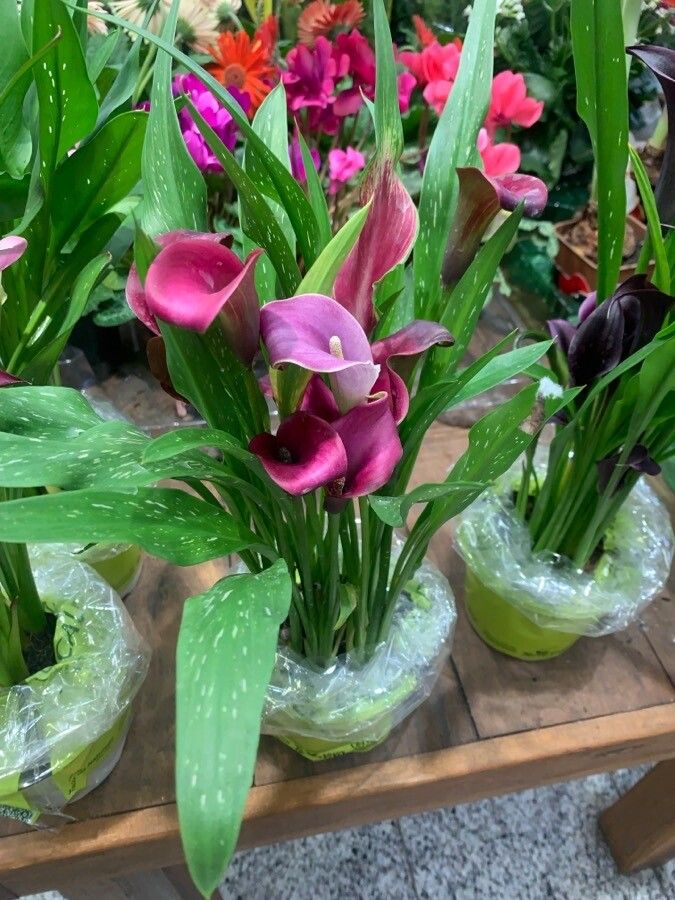
The horticultural group Rehmannii hybrids comprises tender callas marketed for their colors. Cultivars and hybrids may have white-spotted leaves and spathes in various shades. These commercial traits do not all describe the pure botanical species. To identify a potted plant, examine foliage and spathe together, then check whether the label names a species or a horticultural selection. 3
Main sources
The references distinguish the species' taxonomy, its horticultural traits and advice concerning calla groups.
- Plants of the World Online, Zantedeschia rehmannii Engl.
- Royal Horticultural Society, Zantedeschia rehmannii
- Royal Horticultural Society, How to grow zantedeschia
- Floriscope, Pink calla
- SNHF, Zantedeschia aethiopica: comparison of Zantedeschia species
- ASPCA, These Houseplants Can Cause Trouble for Your Pets
Frequently asked questions
How can you identify Pink calla?
Its dark green leaves are lance-shaped, and its pink spathes surround a yellow spadix. Color alone does not distinguish the species from hybrid callas.
Should you water Pink calla in winter?
After the foliage dries, keep the underground organ dry and frost-free, with little or no water. Resume watering gradually as shoots emerge.
Can Pink calla grow in a pond?
Shallow-water cultivation mainly concerns Zantedeschia aethiopica. For Pink calla, choose a moist but well-drained growing medium and avoid standing water.
Is Pink calla toxic to animals?
Chewing is harmful to pets. The insoluble oxalates documented in Zantedeschia irritate the mouth; breathing difficulty requires urgent veterinary attention.
If you are unsure about a plant’s toxicity, ask a botanist or veterinarian for advice.