
Aconitum corsicum

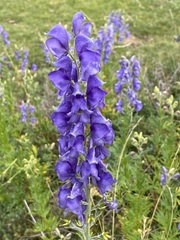
Aconitum corsicum is a tall herbaceous perennial in the Ranunculaceae, endemic to moist mountain habitats in Corsica. Its violet-blue, helmet-shaped flowers appear in summer. This highly poisonous plant should be observed without picking it.
Read moreAconitum napellus subsp. corsicum and Aconitum pyramidale var. corsicum
Allow a few hours of direct sun per day, preferably morning or evening.
Open, well-lit habitats.
© photo
Wikimedia Commons · CC BY-SA or Public Domain
Thomas Dreux · http://creativecommons.org/licenses/by/4.0/
(c) Thomas Dreux, some rights reserved (CC BY) · cc-by
Global distribution
Endemic to the mountains of southern Corsica: the Coscione plateau and a few valleys in the Incudine massif.
Identity
Aconitum corsicum (Gáyer, 1909) is a perennial endemic to Corsica in the Ranunculaceae. Its natural range is much narrower than that of blue-flowered monkshoods collectively. Current classification recognizes this island plant as a species. 1
The same plant is also known as Aconitum napellus subsp. corsicum (Gáyer) W.Seitz, a subspecific treatment still used in France. Differences in rank can complicate documentary searches. Checking the full name and locality links observations to the correct taxon; an older subspecies name does not invalidate the corresponding field records. 128
Recognition
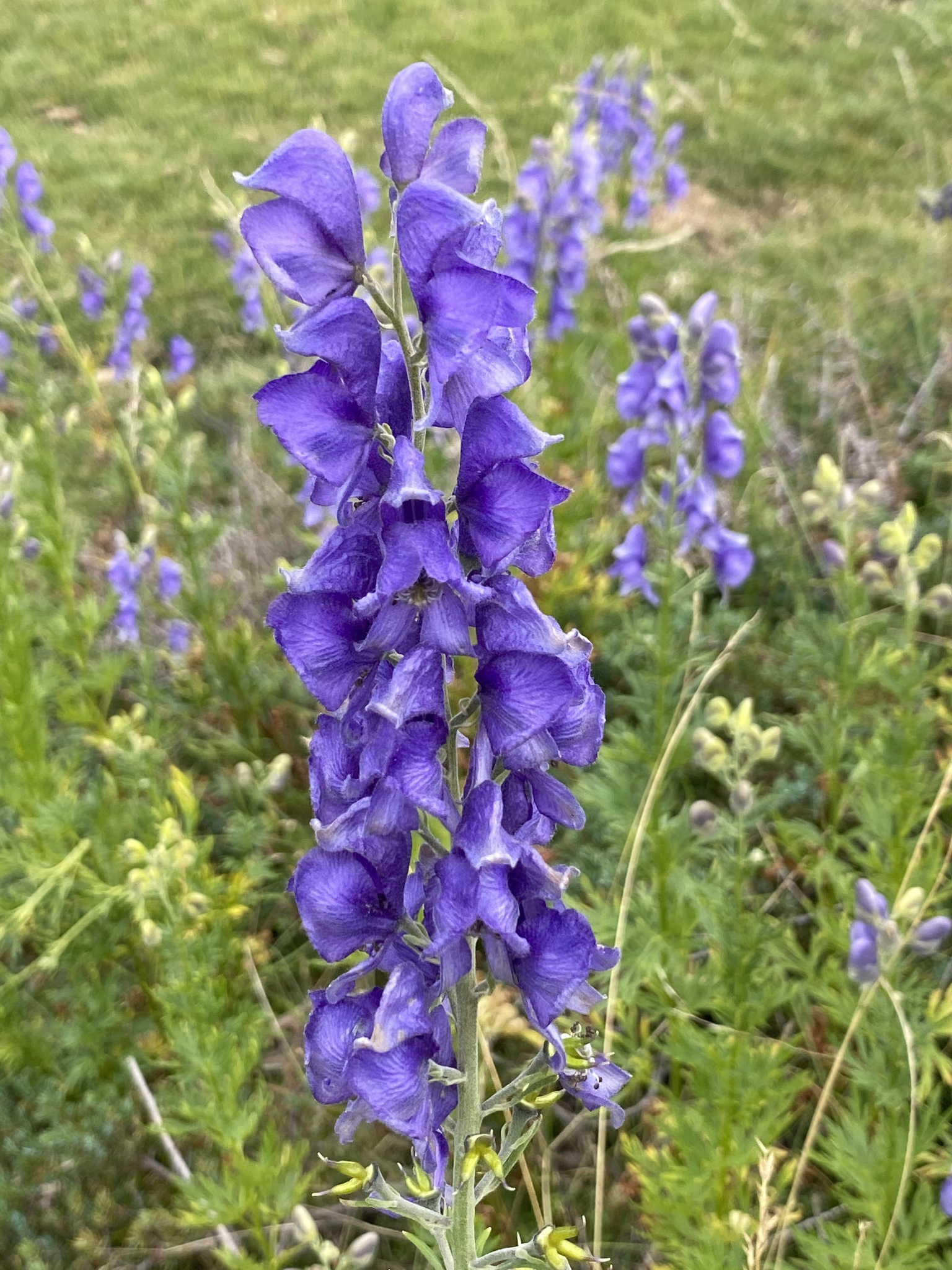
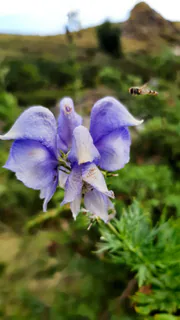
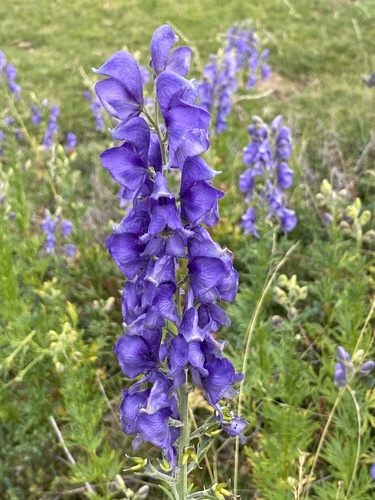
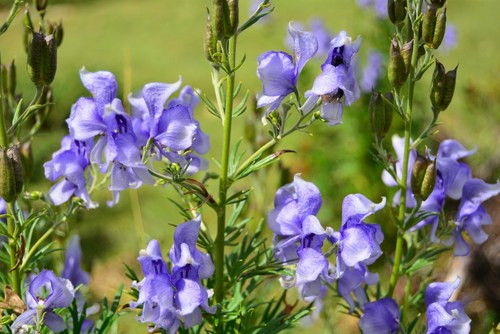
Violet-blue flowers have an upper sepal shaped like a helmet, reaching 2 cm (0.8 in). The robust plant grows about 1–1.5 m (3.3–5 ft) tall. Deeply divided leaves become smaller toward the top of the stem, while the branched inflorescence forms a pyramidal outline. This combination is more useful than a photograph of a blue flower alone. 2
Grayish, hairy flower buds and large flowers distinguish the Corsican taxon from Aconitum napellus, which is absent from the island. Examine hairiness and branching rather than relying on height. A photographic angle can hide a branch or fine hairs, so an overall view and a close detail complement each other. 23
Identification from a distance is preferable to handling. A flower photograph alone omits the leaves and growth habit; a view of the whole plant in its habitat preserves those useful characters.
Useful taxonomy
The species name Aconitum corsicum was published in 1909. Its synonyms include Aconitum napellus subsp. corsicum (Gáyer) W.Seitz and Aconitum pyramidale var. corsicum (Gáyer) P.Fourn.. Treatments have changed its rank without turning the plant into a cultivar. 1
The epithet corsicum records the taxon's geographical identity. It should not disappear when a label is shortened to monkshood. Gardening recommendations for cultivated aconites often cover a much broader group and do not automatically describe this endemic's requirements or conservation status. 16
Habitat and range
Moist habitats that remain cool and damp through summer are essential to this Corsican plant. It occupies mountain wet grassland, beech-wood clearings and stream banks at 1,400–1,700 m (4,590–5,580 ft) in the southern mountains. Coscione plateau populations follow much of the drainage network; a localized occurrence is also recorded in the Asinau valley. Its distribution follows particular sites rather than the entire island. 23
Light is needed alongside water. Treating all aconites as shade plants can obscure this species' association with open habitats. A bright meadow crossed by flowing water and dry woodland do not offer equivalent conditions. 2
For an observer, whether the site retains its water supply matters. A plant photograph alone cannot describe the habitat. Recording a nearby stream, canopy openness and soil condition supplies useful context for monitoring.
In France, Aconitum corsicum is protected throughout the national territory. It appears in Annexes II and IV of the Habitats Directive and Annex I of the Bern Convention. It is listed as Vulnerable on the global and European Red Lists, but Least Concern on the French national and Corsican lists. These assessments apply at different geographical scales. 7
Life cycle and reproduction
In Corsica, flowering extends from June to September, followed by fruit development from July to September. The underground rootstock survives winter and renews the stems. Summer shoots are therefore the aboveground phase of a perennial, rather than an annual that germinated that spring. 2
Reproductive biology remains incompletely understood. Proposed seed-dispersal mechanisms should be read as hypotheses, rather than experimental demonstrations. A rare plant can have a precise morphological description while uncertainties remain about population renewal. 2
Wild populations depend on water supplied by their habitat: no watering by an observer does not mean low water requirements. Preserving drainage flows and watching stems return in spring respects the cycle without repotting or fertilizing a natural population.
Uses and risks
Every part is highly poisonous, including to livestock. This plant has no place in food gathering. Its botanical interest does not justify making herbal tea or a home remedy. 2
Aconites of the monkshood group, in which the Corsican plant was long included, contain diterpenoid alkaloids such as aconitine. These affect the nervous system and heart in people and animals. A few grams of dried root can kill a dog, and horses are more sensitive than sheep. An animal's usual avoidance of the acrid-tasting plant does not rule out accidental poisoning. 59
Aconite poisoning can cause tingling, digestive symptoms and abnormal heart rhythms. Suspected ingestion requires immediate contact with a poison center or emergency services, without waiting for every symptom. In Aconitum napellus, 2–4 g (0.07–0.14 oz) of root can be fatal to an adult. The Corsican plant, also highly poisonous in all parts, calls for the same caution. 42
Varieties, look-alikes and related plants
This is a wild taxon, not a horticultural variety of blue aconite. Garden selections sold under other names do not demonstrate that the Corsican endemic is in trade. A garden selection's name alone cannot identify Aconitum corsicum. 16
Ordinary cultivated aconites may be propagated by seed or division and grown in moist soil. Such methods do not authorize collecting from a protected population. Observing the Corsican plant without picking it preserves individuals and makes repeat monitoring at the same place possible. 62
Main sources
The accepted name is Aconitum corsicum Gáyer, published in 1909; the subspecies and variety combinations are synonyms. 1
- Plants of the World Online: Aconitum corsicum
- Natura 2000 habitat handbook, account 1475: Aconitum corsicum (archive dated 1 May 2020)
- Paris Botanical Garden, botanical bulletin, November 2023
- French Society for Emergency Medicine: Aconitum napellus
- University of Zurich, CliniTox: Aconitum
- French National Horticultural Society: monkshood
- INPN, TAXREF: Aconitum corsicum
- Tela Botanica: Aconitum napellus subsp. corsicum
- Pet Poison Helpline: Monkshood
Frequently asked questions
Is Aconitum corsicum poisonous?
Yes. All parts are highly poisonous; it is unsuitable as food or a home remedy.
Why is it also called Aconitum napellus subsp. corsicum?
That name treats it as a subspecies of monkshood. The currently accepted species name is Aconitum corsicum.
Can Aconitum corsicum be collected for a garden?
No. This protected Corsican endemic should be observed where it grows, without uprooting or picking it.
If you are unsure about a plant’s toxicity, ask a botanist or veterinarian for advice.