
Common milkweed (Asclepias syriaca, )
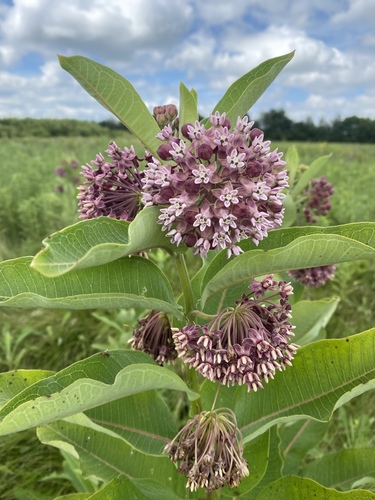
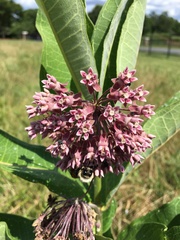
Common milkweed (Asclepias syriaca) is a rhizomatous perennial in the Apocynaceae family, native to eastern North America. Its fragrant pink flower clusters feed many pollinators, while its leaves support monarch caterpillars. Introduced to Europe as an ornamental and nectar plant, it is now classified there as an invasive alien species.
Read moreCommon milkweed and Silkweed
Place in full sun, with intense direct light all day long.
Full sun; flowering is much weaker in partial shade


© photo
(c) csozanne, some rights reserved (CC BY-NC) · cc-by-nc
Becky Dill · cc0
Skratch Videos · cc0
Taken Aug 21, 2022 by Marie B (cc-by-sa)
Taken Oct 20, 2019 by Michelle Corbett (cc-by-sa)
Taken Aug 31, 2022 by Luna Cinder (cc-by-sa)
Taken May 31, 2020 by Cristian M (cc-by-sa)
Taken Jun 18, 2021 by Will Smith (cc-by-sa)
© copyright of the Board of Trustees of the Royal Botanic Gardens, Kew.




Global distribution
Asclepias syriaca is native to southern Canada and much of the eastern United States as far as the Rocky Mountains, excluding the driest Prairie areas. Introduced to Europe in the 17th century as an ornamental and nectar plant, it has become widely naturalized. It has been on the European Union list of invasive alien species since 2017, prohibiting import, sale and planting in member states, including France.
- Native2
- Introduced1
- Invasive6
- Canada
- United States
- Russia
- Metropolitan France
- Germany
- Poland
- Hungary
- Ukraine
- Czech Republic
Hexagons: regions where the plant occurs. Green dots: native range.1
Identity
Common milkweed (Asclepias syriaca L., 1762), also known as silkweed, is an accepted species in the genus Asclepias, in the Apocynaceae family. Carl Linnaeus described it in 1762, and Plants of the World Online continues to accept this binomial. 1 9
As a North American monarch host, Asclepias syriaca accounts for 85 to 92% of the cardenolides found in butterflies overwintering in Mexico. 9
The genus name Asclepias honors Asclepius, the Greek god of medicine, recalling traditional uses attributed to several milkweed species. The epithet syriaca reflects an old geographical mistake: this plant was never native to the Near East, but to southern Canada and the eastern United States. 3 9
Silky white hairs crown each seed when the pod opens, explaining the name silkweed. This fiber was once used as filling for life jackets. Its French regional names include herbe à la ouate, referring to this cottony material, and herbe aux perruches, associated with seed-eating birds. 7
Recognition
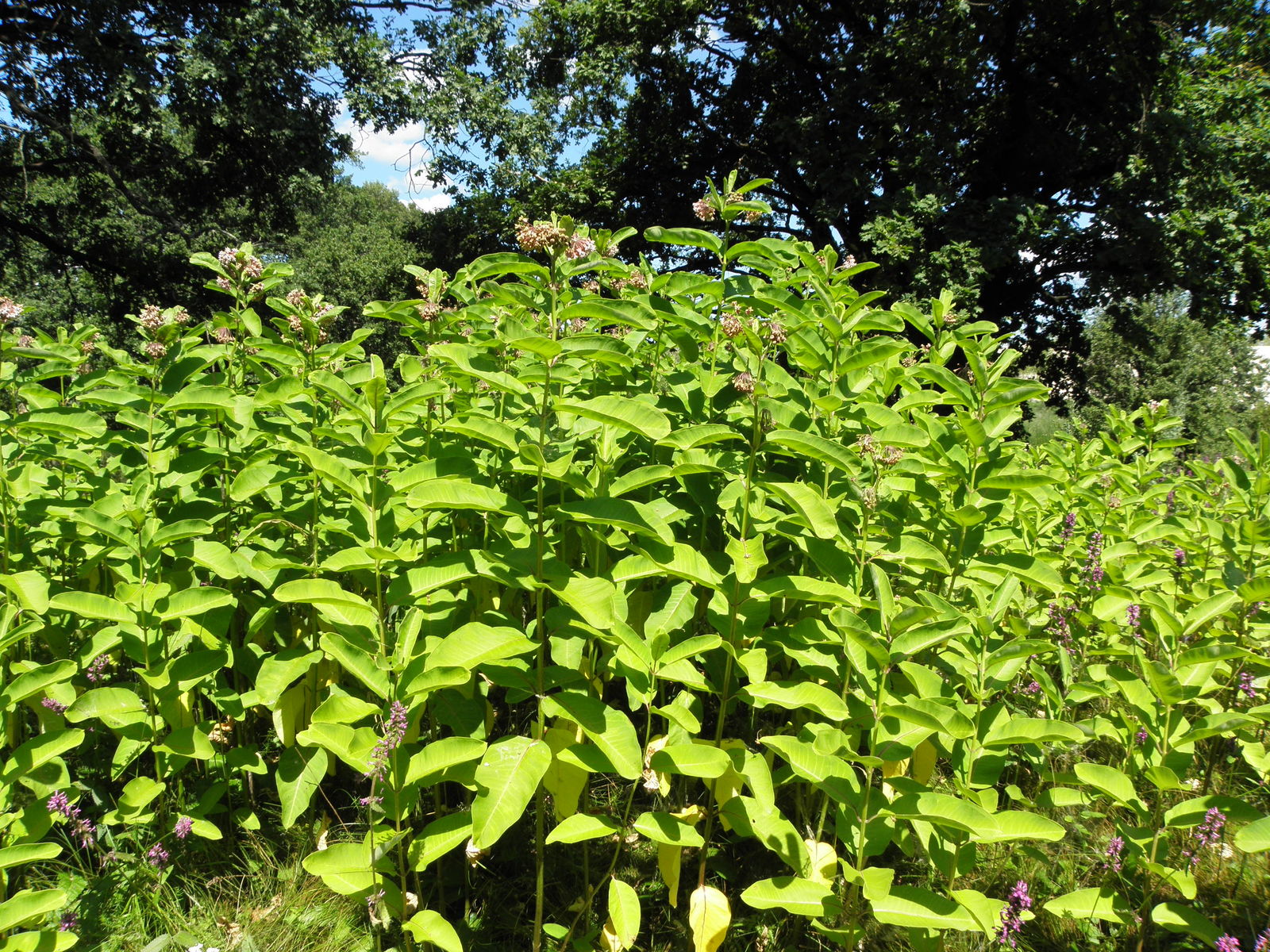
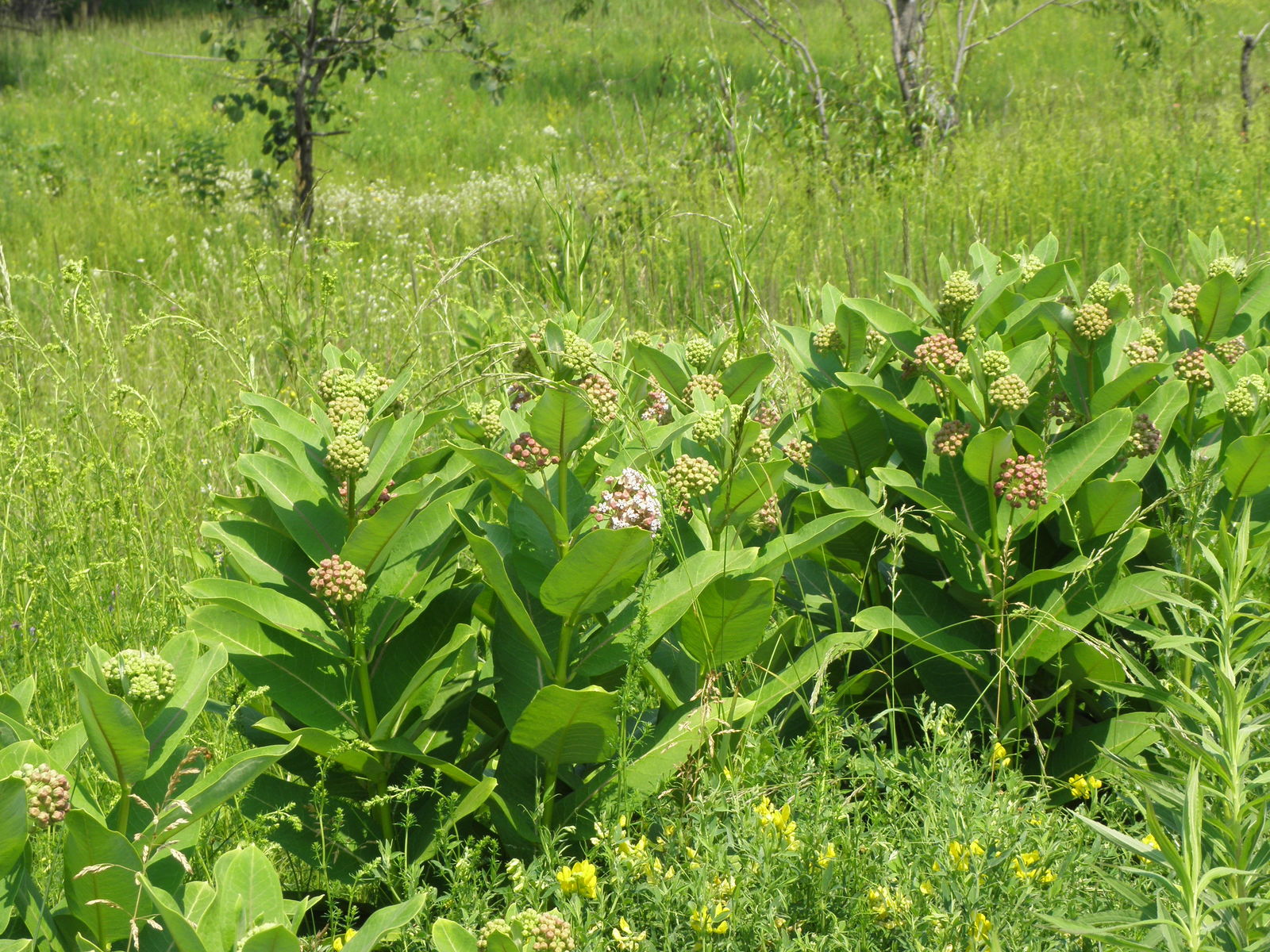
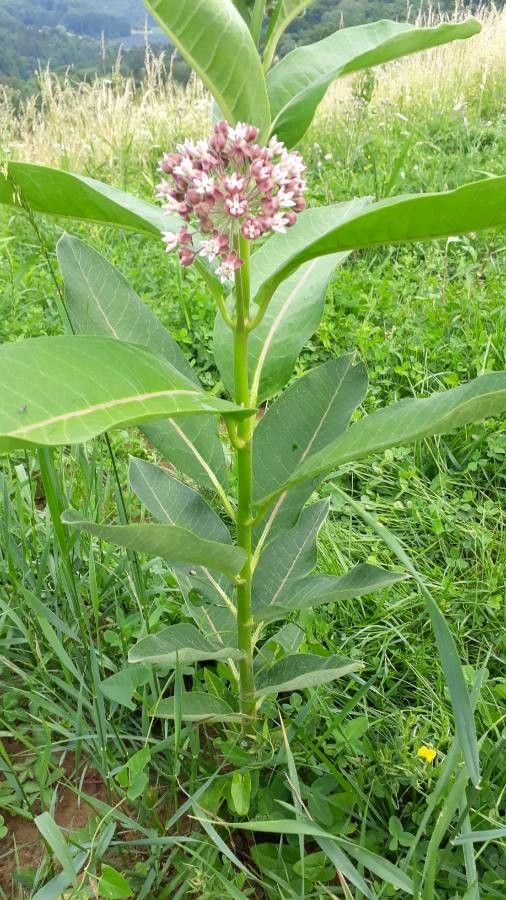
A single, upright, downy stem releases white milky latex at the slightest injury, a useful feature outside the flowering season. Opposite, oval-oblong leaves reach 20 cm (8 in), with often reddish veins and velvety undersides. Plants usually stand 90 to 150 cm (3 to 5 ft) tall, occasionally reaching 240 cm (8 ft). 3 9
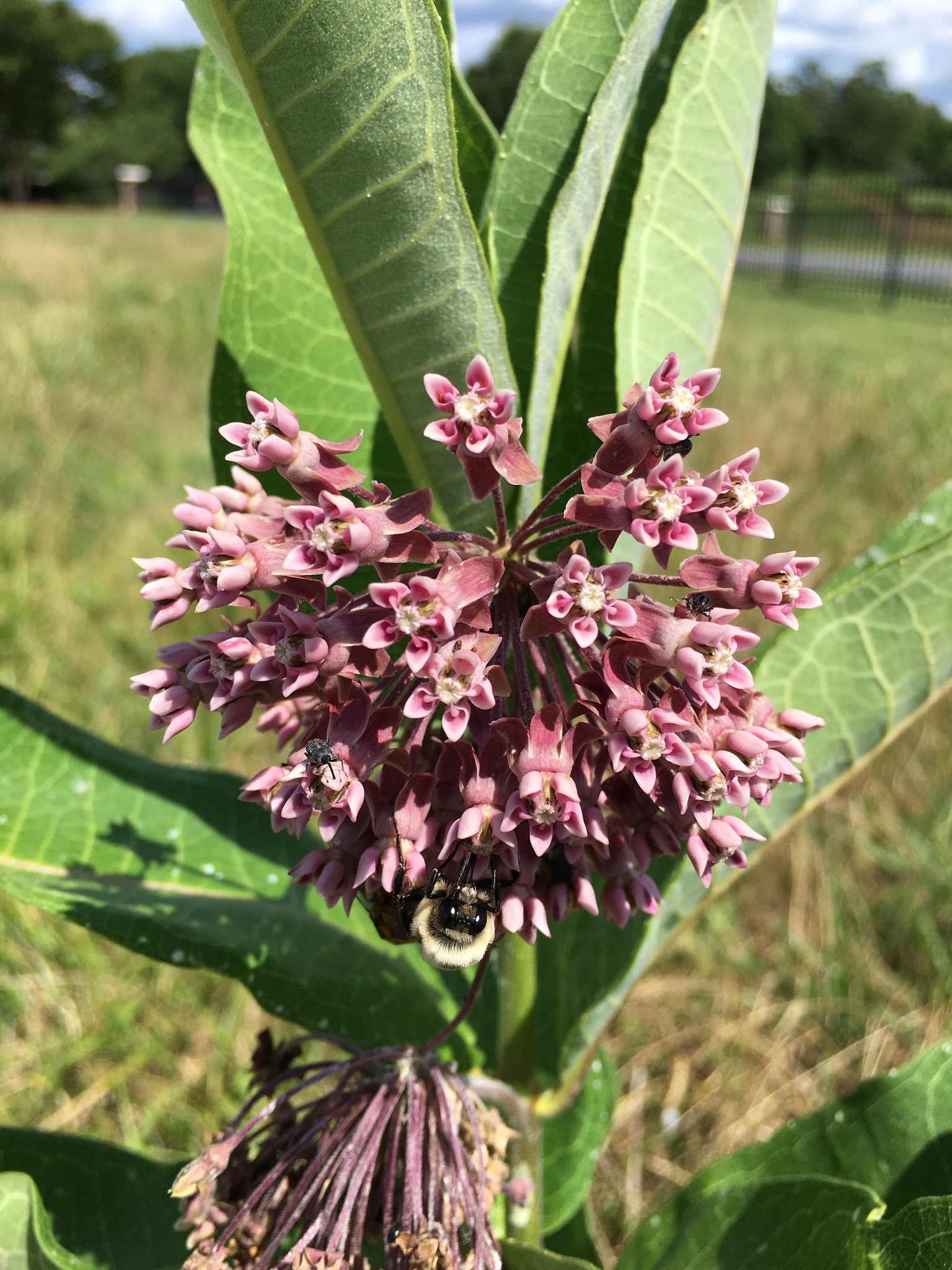
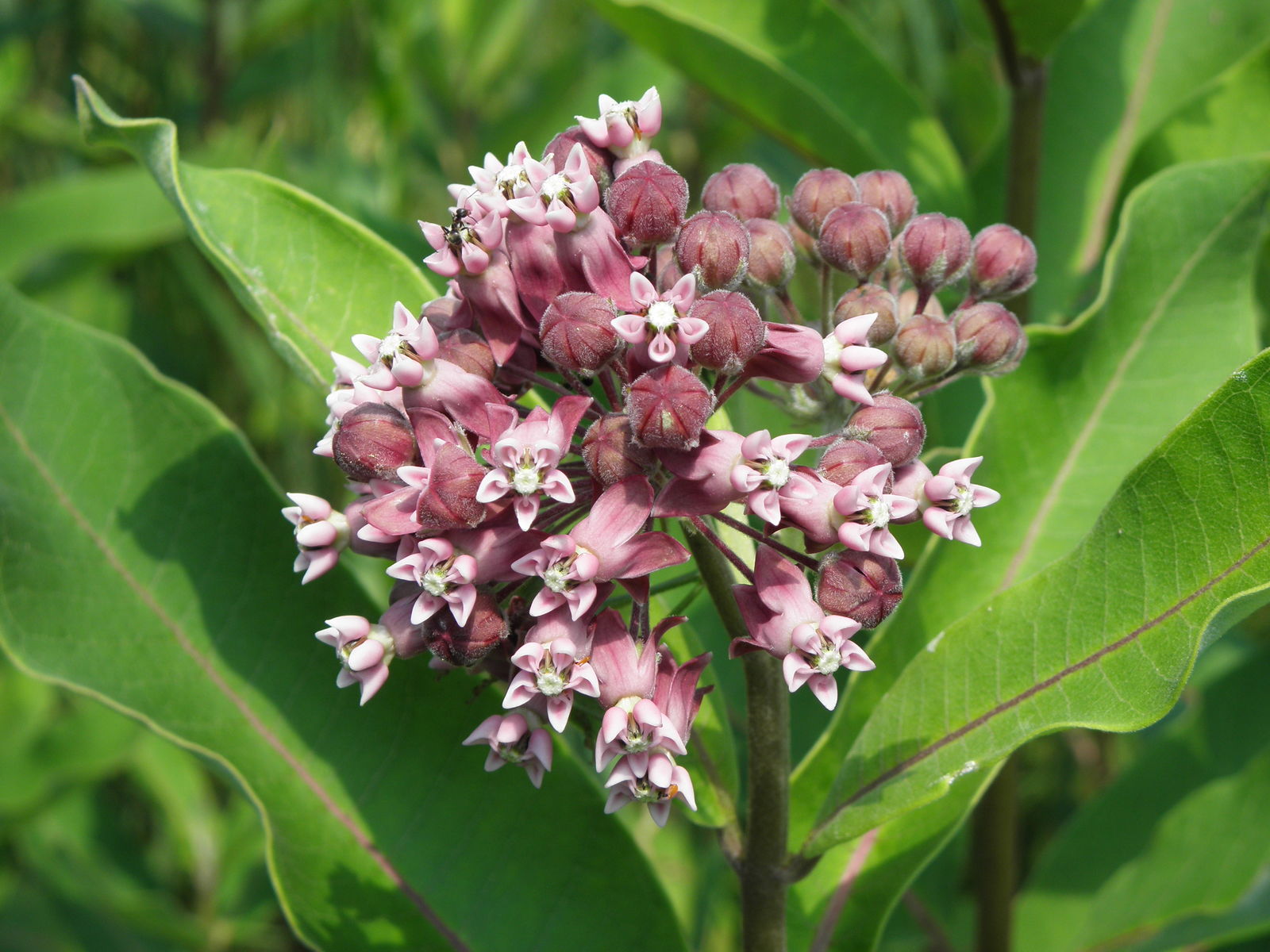
Dense, often nodding umbels carry up to a hundred fragrant pink to mauve flowers. Each flower has the five upright horns characteristic of Asclepias. The clusters open in the upper leaf axils during summer in its native Northern Hemisphere range. 3 2
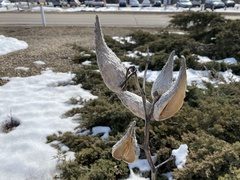
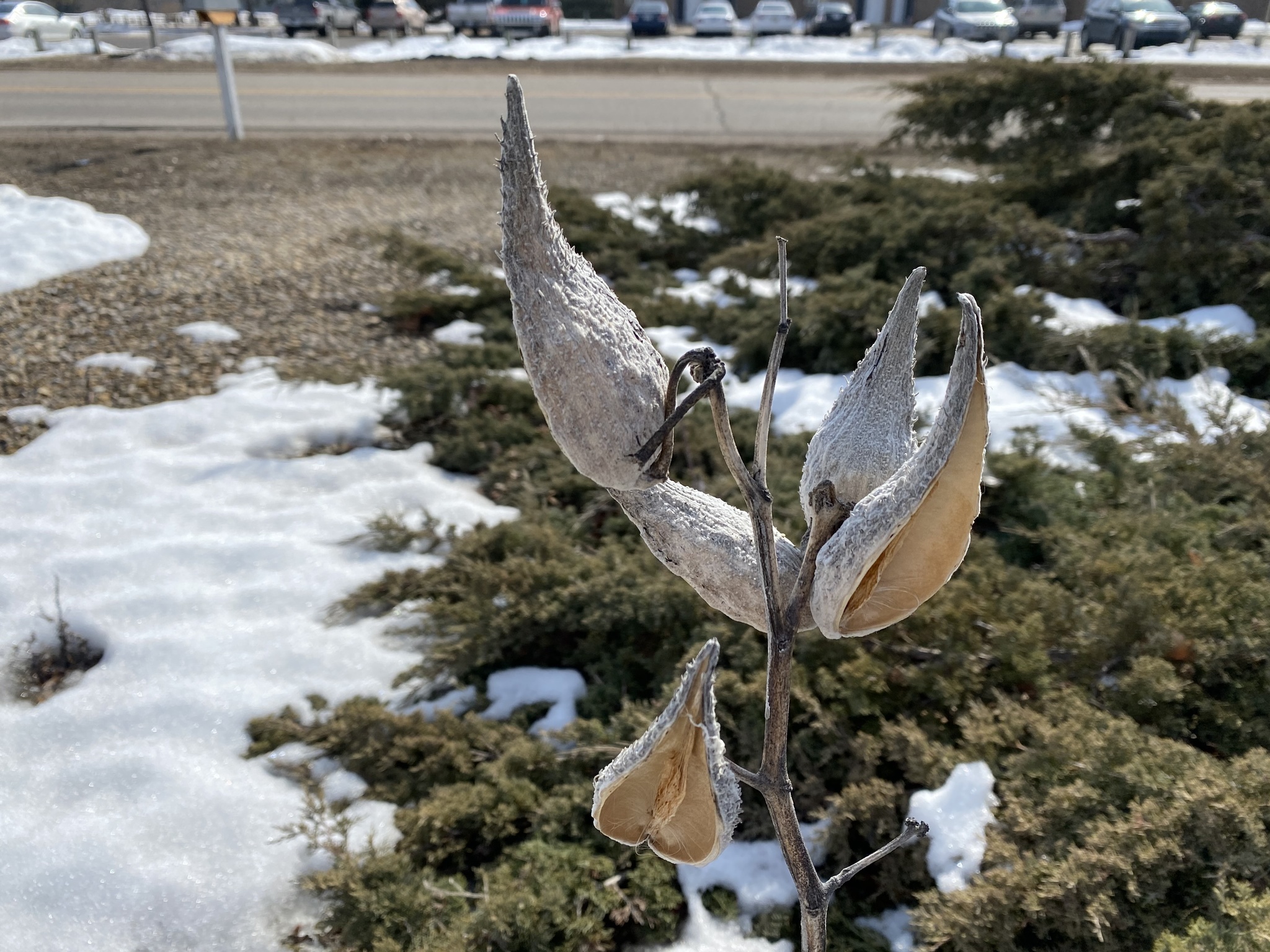
Fertilized flowers develop into upright, warty gray-green pods, 5 to 10 cm (2 to 4 in) long. At maturity they split to release flattened seeds with long silky hairs. Wind carries the seeds away, while spreading rhizomes help build dense colonies rather than isolated plants. 2 5
Useful taxonomy
Botanists have described numerous synonyms since the 18th century, all now referred to the same binomial accepted by Plants of the World Online:
- Asclepias cornuti Decne. (botanical synonym)
- Asclepias kansana Vail (botanical synonym)
- Asclepias intermedia Vail (botanical synonym)
- Asclepias illinoensis Michx. ex Steud. (botanical synonym)
- Asclepias syriaca f. inermis J.R.Churchill (botanical synonym)
- Asclepias syriaca f. leucantha Dore (botanical synonym)
The synonym Asclepias cornuti deserves particular attention. European floras of the 19th century widely used it for this introduced species before the Linnaean name Asclepias syriaca became the stable reference. 1
Habitat and range
Southern Canada and much of the eastern United States, west to the Rocky Mountains, form the native range recorded by Plants of the World Online, excluding the driest Prairie areas. Common milkweed grows in waste ground, dry grassland, roadsides and railway banks in sunny, well-drained soil. 1 9
European introductions began in the 17th century for ornament, nectar and fiber. The species became widely naturalized, especially in central and eastern Europe. Since 2017 it has appeared on the European Union list of invasive alien species, prohibiting import, sale and deliberate planting in member states, including France. 9 8
North American pollinators and monarchs benefit from common milkweed within its native range; in Europe, the same species is a regulated invasive alien plant. 9
Life cycle and reproduction
Summer flowering varies with local climate. Nectar-rich flowers are chiefly pollinated by bumblebees. Honeybees often visit several flowers within a single clump without promoting the cross-fertilization on which this species depends, making bumblebees more effective for reproduction. 9
Following fertilization, pods slowly ripen into fall and then split open. Their silky-haired seeds travel on the wind, sometimes over considerable distances. 5 2
Alongside sexual reproduction, a dense network of spreading rhizomes allows common milkweed to occupy available ground quickly. Large colonies can become troublesome even within its native range when they enter nearby crops. Horticultural propagation therefore uses cold-stratified seed, rhizome division or basal cuttings. 6 3
Uses and risks
Monarch caterpillars use common milkweed as one of their main North American host plants. An analysis of cardenolides in monarchs overwintering in Mexico attributed 85 to 92% to this species, ahead of other available milkweeds. 9
Every part contains cardiac glycosides, known as cardenolides. Ingestion is toxic to cats, dogs, horses and livestock, and large amounts can cause fatal heart-rhythm disturbances. In people, latex contact irritates skin and eyes, while ingestion mainly causes digestive upset. 4 3
Young shoots, flower buds and immature pods are traditionally eaten well cooked in small quantities in parts of North America. Indigenous peoples also used the stems for textile fiber, and the silky seed hairs served as insulating filling during the Second World War. 6 5
Varieties, look-alikes and related plants
Few stable horticultural cultivars exist for this species, which remains close to its wild form. Forma inermis, with smooth pods lacking spiny projections, and forma leucantha, with white rather than pink flowers, are mainly collection curiosities rather than widespread commercial selections. 1
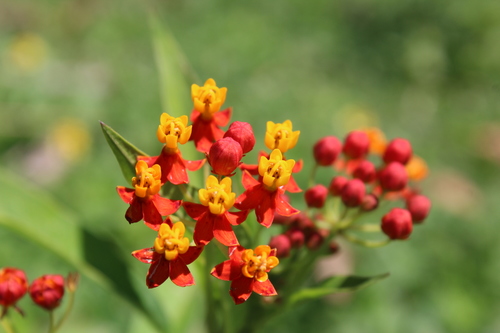
A frequent look-alike is Asclepias curassavica, tropical milkweed. It also hosts monarchs but comes from tropical America and is not hardy in temperate climates. Its evergreen foliage can allow a monarch parasite to accumulate between seasons, whereas common milkweed loses its leaves each winter and interrupts that cycle. 9
Other North American milkweeds include Asclepias tuberosa, with orange flowers and no obvious latex, and wetland species Asclepias incarnata. They also benefit pollinators, without sharing the same European regulatory status.
Main sources
- Plants of the World Online / Kew, Asclepias syriaca L.
- Missouri Botanical Garden PlantFinder, Asclepias syriaca
- NC State Extension Gardener Plant Toolbox, Asclepias syriaca
- ASPCA, Milkweed toxicity entry
- USDA PLANTS Database, Asclepias syriaca plant profile
- Plants For A Future, Asclepias syriaca
- Tela Botanica / eFlore, Asclepias syriaca L.
- INPN / MNHN, Asclepias syriaca L.
- Wikipedia EN, Asclepias syriaca
Frequently asked questions
Is common milkweed toxic to cats and dogs?
Yes. All parts contain cardenolides, cardiac glycosides that cause vomiting, weakness and abnormal heart rhythms in pets and livestock if eaten.
Why is it called syriaca if it does not come from Syria?
The epithet reflects an old geographical mistake. Common milkweed is native to southern Canada and the eastern United States, never the Near East.
Why does common milkweed matter to monarch butterflies?
It is a major host plant for monarch caterpillars in North America. An analysis of cardenolides accumulated by monarchs overwintering in Mexico attributed 85 to 92% to this species rather than other available milkweeds.
Is common milkweed invasive in France?
Yes. Since 2017 it has been on the European Union list of invasive alien species, prohibiting import, sale and deliberate planting in member states, including France.
Can you eat common milkweed?
Some young parts, including shoots, flower buds and immature pods, are traditionally eaten well cooked in small quantities. Raw plants and older parts remain irritating and potentially toxic.
How can I identify common milkweed without flowers?
White milky latex appearing when a stem or leaf is injured is a key feature, together with opposite oval leaves and a reddish midrib.
Should I avoid planting common milkweed in my garden?
Outside its native range, prefer a local milkweed that is not regulated. Rapid rhizomatous spread and its invasive alien status in Europe make deliberate planting inadvisable or prohibited, depending on the country.
Similar plants
If you are unsure about a plant’s toxicity, ask a botanist or veterinarian for advice.