
Bitter orange (Citrus × aurantium, )


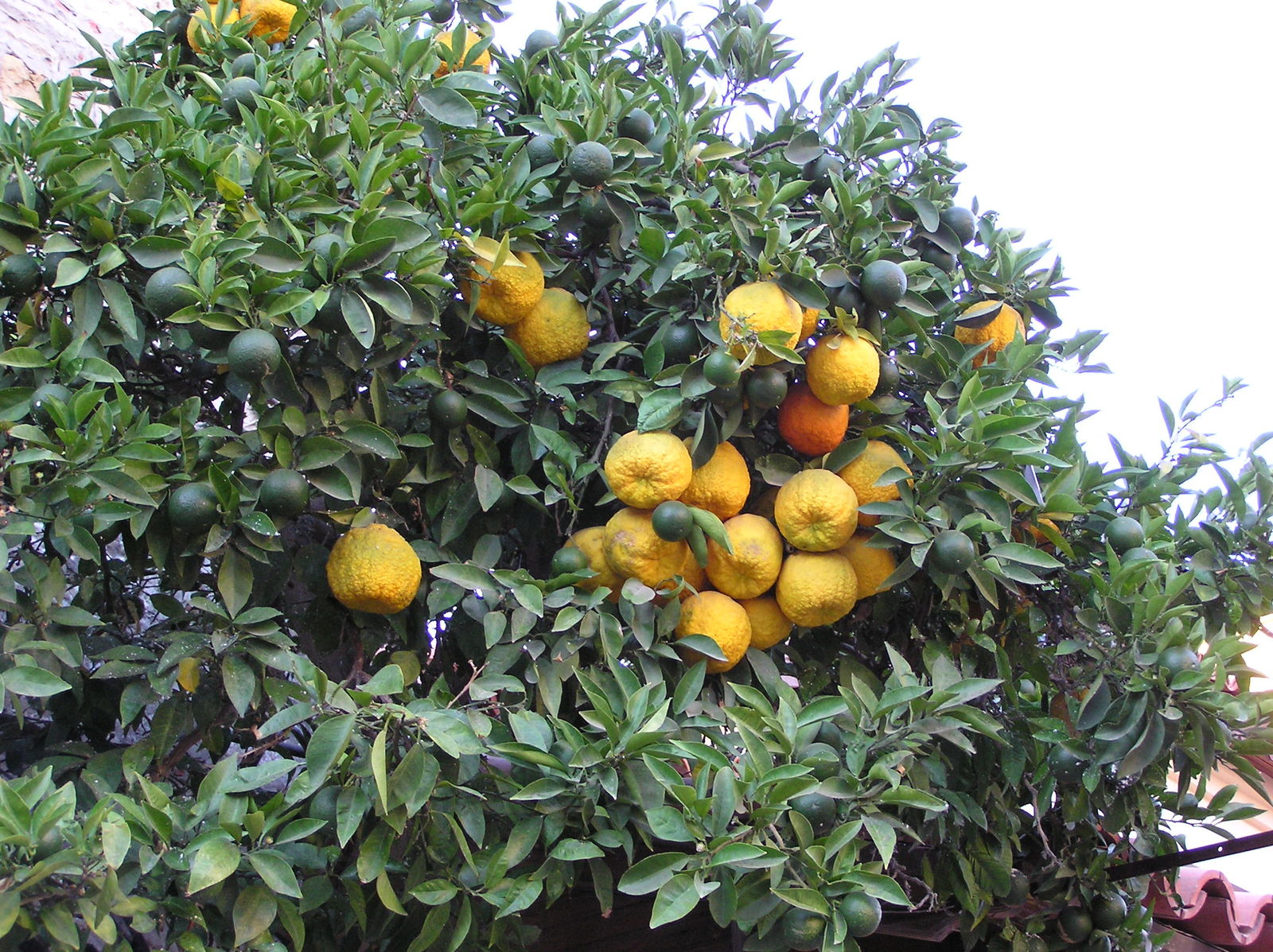
Bitter orange, or sour orange, produces fruit with acidic, bitter flesh, used mainly for marmalade. Its broadly winged leaf stalk helps identify this hybrid citrus tree.
Read moreBitter orange and Sour orange
Aurantium × citrum M.Gómez
Place in full sun, with intense direct light all day long.
Full sun; a sheltered position for container-grown plants.


© photo
Wikimedia Commons · CC BY-SA or Public Domain
Taken Oct 15, 2021 by Alexandra Norrsken (cc-by-sa)
Taken Sep 23, 2022 by M. Hedayat (cc-by-sa)
Taken Mar 28, 2021 by Ahmed Haddad (cc-by-sa)
© copyright of the Board of Trustees of the Royal Botanic Gardens, Kew.


Global distribution
A cultigen associated with southern China, spread through warm regions and introduced around the Mediterranean.
Identity
Bitter orange, also called sour orange (Citrus × aurantium L., 1753), produces fruit with acidic, bitter flesh, used mainly for marmalade. Evergreen foliage and fragrant flowers also account for its ornamental use. The French names “bigaradier” and “oranger amer” refer to the same citrus tree in the Rutaceae family. 2 3 4 7
The × sign indicates hybrid origins: bitter orange combines pomelo (Citrus maxima) and mandarin (Citrus reticulata). The accepted scientific name retains the hybrid sign. Describing bitter orange as a wild species without mentioning that parentage would misrepresent its botanical identity. 1
Identification
The Caribbean description of bitter orange gives leaves 7–10 cm (2.8–3.9 in) long, with a conspicuous wing on the leaf stalk. The crown is rounded, and branches carry long, relatively flexible thorns. Trees reach 6 m (20 ft) in that regional account; the figure is not a universal height limit for every cultivated tree. 3
White flowers arise in the leaf axils. Rounded fruits, slightly flattened at the top, measure 7–8 cm (2.8–3.1 in) across and contain acidic flesh. Rough skin adds another identification clue. An orange-colored rind does not establish that the flesh inside will be sweet. 3 4
Useful taxonomy
Bitter orange belongs to the genus Citrus, within the order Sapindales. Linnaeus published its name in 1753. The homotypic synonym Aurantium × citrum M.Gómez refers to the same underlying botanical name. A synonym on an older label therefore does not necessarily identify a different citrus tree. 1 2
Horticultural citrus nomenclature can include several groups under Citrus × aurantium. Seville orange corresponds to bitter orange, while the Grapefruit group describes different fruit. Read the group name on a label before assuming that every citrus carrying this binomial has the same characteristics as a bitter orange. 5
Habitat and distribution
Bitter orange is associated with a cultigen from southern China, an origin tied to cultivation. Its present distribution extends far beyond that region: introductions include Spain and Italy, along with Morocco, Cuba, and Réunion. Finding bitter orange in a Mediterranean country does not establish that it is native there. 1
Bitter orange grows in tropical and subtropical regions. Full sun suits the tree, with moist soil that does not remain excessively wet. In Tucson, landscape planting takes advantage of its aromatic flowers. Tucson's warm climate differs from the conditions on a French balcony exposed to frost. 3 4
Container-grown citrus needs light during winter shelter. A heated living room can be too warm and dry: protection from frost alone does not meet all overwintering needs. Acclimate the plant gradually to outdoor conditions before leaving it outside for summer. 5
Growth cycle and propagation
In Arizona, bitter orange begins renewing its foliage in late winter and flowers in spring. Seeds provide a means of propagation. The seasonal rhythm observed in Arizona does not determine flowering dates for a tree overwintered under cover in France. Growing conditions and geographic context remain relevant to the timing. 4
For container growing in metropolitan France, the seasonal schedule follows general citrus advice: water regularly in summer, then let the surface dry partly between winter waterings. Standing water encourages root rot. Repot in spring once roots fill the container; the condition of the root ball matters alongside the season. 5
Container-grown citrus receives a higher-nitrogen summer fertilizer from late March through October, followed by a more balanced winter formula from November through mid-March. The monthly water and growth indices are relative guides, to be adjusted to drying of the mix and visible plant growth. 5
Uses and risks
Bitter orange is used in marmalade and as a food flavoring. The fruit and its essential oils also flavor drinks or scent perfumes. Food uses differ from taking concentrated extracts sold for weight loss, whose effectiveness remains uncertain. A jar of marmalade and a concentrated supplement are different preparations with different exposures. 6
p-Synephrine in the fruit is a reason for precautions with dietary supplements. Serious cardiovascular events have been reported with products containing multiple ingredients; whether bitter orange alone caused those events remains uncertain. Findings on blood pressure and heart rate are inconsistent. 6
Supplements containing p-synephrine are not recommended for children or adolescents, pregnant or breastfeeding people, or people taking certain long-term medicines. Combining the supplements with caffeine is also discouraged. Risks depend on the preparation and exposure. Safety as a human food does not establish safety for cats, dogs, or horses. 7
Citrus extracts can change the concentration of medicines in the blood, with a risk of overdose or reduced effectiveness. A p-synephrine extract and peel essential oil have different compositions: p-synephrine was not detected in the peel oil in the analyses reported. 7
Varieties and similar plants
Bitter orange produces bitter fruit, unlike the sweet orange commonly eaten fresh. Acidic flesh and a broadly winged leaf stalk are useful clues, to check against the identity of the plant being purchased. A sales label saying only “orange” gives too little information about the citrus offered. 3 4
Bitter orange is also used as a rootstock for other citrus trees. On a grafted tree, the rootstock and the fruit-bearing upper portion have distinct identities. Buying a citrus tree grafted onto bitter orange therefore does not mean its fruit will be bitter oranges. The name of the grafted variety also matters. 4
Main sources
- Plants of the World Online, Citrus × aurantium L.
- GBIF Backbone Taxonomy, Citrus × aurantium L.
- TRAMIL, Citrus aurantium, botanical description and Caribbean uses
- University of Arizona Campus Arboretum, Citrus x aurantium
- Royal Horticultural Society, How to grow citrus
- NCCIH, Bitter Orange, uses and safety
- Anses, opinion 2012-SA-0200 on p-synephrine in food supplements
Frequently asked questions
How can I identify bitter orange?
Bitter orange has leaves with broadly winged stalks and rough-skinned oranges containing acidic, bitter flesh.
Can bitter orange grow in a container?
A container allows a sunny, sheltered position in summer and protection from cold in winter. The growing medium must drain well.
Do bitter orange extracts require the same precautions as marmalade?
Concentrated extracts require precautions distinct from food uses. Supplements containing p-synephrine are not recommended for children or people taking certain medicines.
Similar plants

If you are unsure about a plant’s toxicity, ask a botanist or veterinarian for advice.