
Majestic prayer plant (Goeppertia majestica, )


Majestic prayer plant forms a clump of large leaves whose white or pink stripes fade with maturity. Purple undersides and a rhizome provide further identification features.
Read moreMajestic prayer plant
Maranta majestica, Calathea majestica, Calathea princeps and Calathea gigas
Give plenty of ambient light without direct sun on the leaves.
Bright filtered light, protected from direct sun.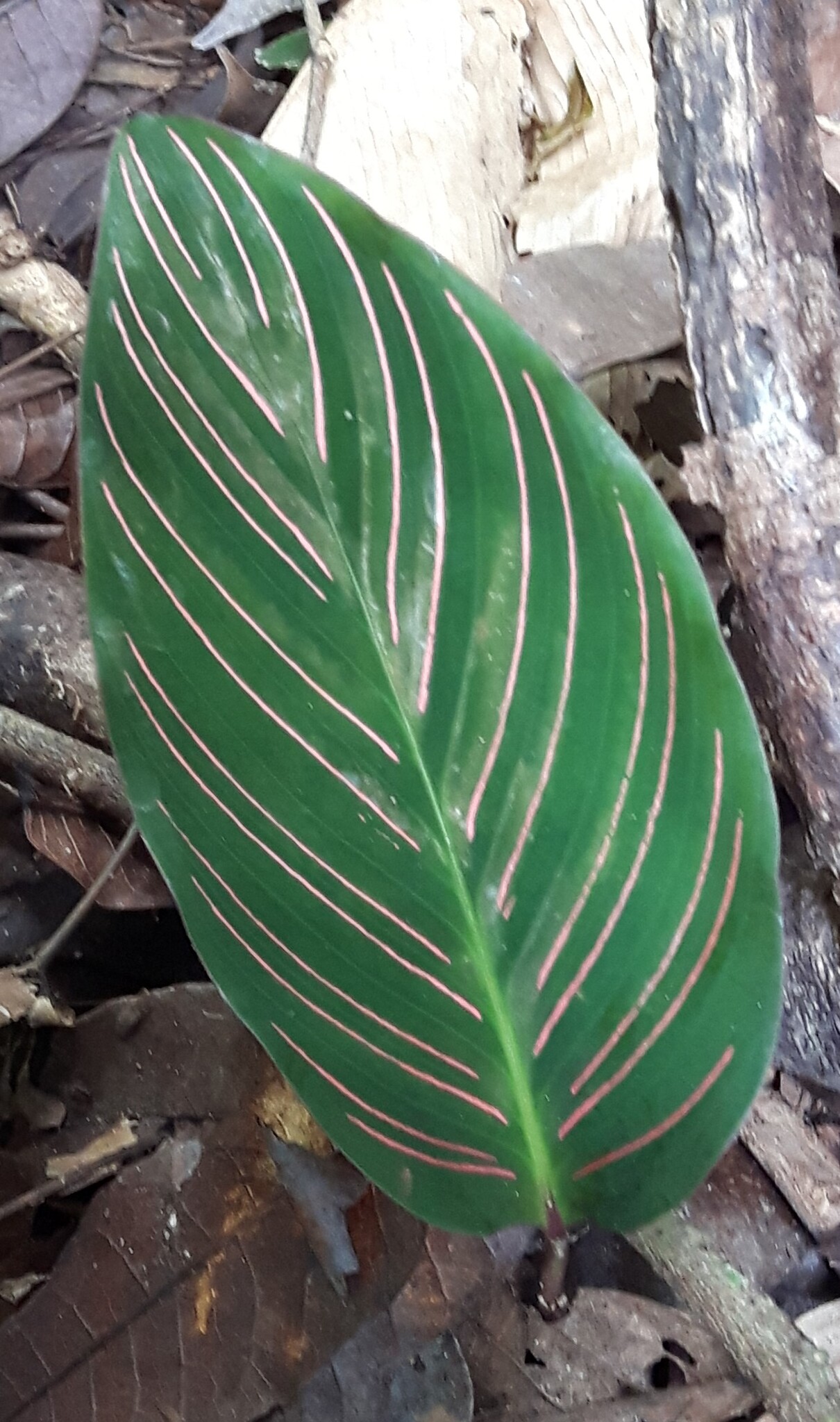


© photo
Peter L Achuff · cc-by
Wikimedia Commons · CC BY-SA or Public Domain
Wikipedia · CC BY-SA


Global distribution
Native from western South America to northern Brazil; introduced to Venezuela.
- Native6
- Introduced1
- Bolivia
- Northern Brazil
- Colombia
- Ecuador
- Guyana
- Peru
- Venezuela
Hexagons: regions where the plant occurs. Green dots: native range.↗
Identity
Majestic prayer plant (Goeppertia majestica (Linden) Borchs. & S.Suárez, 2012) has white or pink stripes on its young leaves. As the leaves mature, the foliage tends to become uniformly green. Losing the pattern can therefore be part of a leaf's development. The rhizomatous perennial belongs to the Marantaceae, the prayer plant family. 6
The accepted botanical name is Goeppertia majestica. "Calathea" remains a collective horticultural name for several plants in the family, so the binomial identifies the species within that group. The epithet majestica comes from a Latin adjective meaning "majestic"; its meaning alone does not establish an attested French common name. 1 3 6
Recognition
Majestic prayer plant has elongated, lance-shaped to oblong leaves with a pronounced tip and a purple underside. Pale lines follow the lateral veins on the upper surface. Young leaf blades reach about 40 cm by 15 cm (16 in by 6 in); mature leaves can measure about 80 cm by 25 cm (31 in by 10 in). 6
British horticultural guidance gives a height of 0.5 to 1 m (1.6 to 3.3 ft) and a spread of 0.1 to 0.5 m (4 to 20 in). A tropical description gives clumps reaching about 2.5 m (8.2 ft), while specifying that cultivated plants remain smaller. The figures describe different settings: the large tropical size does not represent the usual growth of a plant in an apartment pot. 2 6
Useful taxonomy
The current combination Goeppertia majestica was published in 2012. The accepted name is linked to Maranta majestica Linden, its basionym, or original name. The older name helps locate descriptions written before the change of genus. 1
Synonyms include Calathea majestica (Linden) H.A.Kenn., Calathea princeps (Linden) Regel and Calathea gigas Gagnep.. The former classification Calathea ornata var. majestica also belongs to this naming history. An older name containing ornata is therefore insufficient to identify a plant as the species now called Goeppertia ornata. Read the complete name, including any rank below species. 6
Habitat and range
Majestic prayer plant's native range includes Bolivia, Colombia, Ecuador, Peru, Guyana and northern Brazil. Venezuela is listed separately as a territory of introduction. A cultivated specimen outside the native range does not demonstrate a local origin for the species. 4
The species grows in rainforests, up to about 500 m (1640 ft) above sea level in the tropical description. In tropical cultivation, majestic prayer plant needs shade and protection from wind. A bright position with filtered light better reflects that setting than direct exposure behind glass, where sunlight can scorch the leaves. 6 4
Life cycle and reproduction
Majestic prayer plant retains its foliage and spreads by rhizomes. Its inflorescence forms a compact spike about 10 cm (4 in) long and 7 cm (2.8 in) across. Yellowish-green bracts surround tubular flowers with a yellow-orange corolla, which open in succession. The fruits are capsules, usually containing three seeds. The floral bracts and the flowers themselves are separate structures in that description. 6
Divide the rhizomes in late spring or early summer. Seed propagation is also possible, but division is the usual way of multiplying majestic prayer plant. 6 4
For indoor calatheas, horticultural guidance recommends repotting in spring or summer and applying a balanced liquid fertilizer monthly from April through September. The calendar translates those seasons into indoor cultivation in France, in the Northern Hemisphere. Its water and growth indices are relative guides, to be adjusted to the drying of the growing mix and the plant's activity rather than treated as a universal schedule. 3
Cultivation and risks
Keep majestic prayer plant's growing mix moist but drained. Water standing around the roots can cause rot. Water moderately during growth and keep the root ball just moist in winter. Winter slowdown calls for longer intervals between waterings rather than continuing the summer routine. The condition of the root ball remains more useful than a fixed watering interval. 2 6
Warm conditions of about 24 to 28 °C (75 to 82 °F) and 70 to 80% humidity are described, with a recommendation never to fall below 16 °C (61 °F) in a pot. British guidance gives a cooler range for the broader horticultural group of calatheas. A curling or browning leaf can indicate excessively dry air; adding more water to the pot does not necessarily correct low atmospheric humidity. 6 3 4
Majestic prayer plant is explicitly classified as non-toxic to cats, dogs and horses. The veterinary classification does not document safety for humans or other animals. Majestic prayer plant remains an ornamental, and the classification does not make it a food plant. 4
Varieties and look-alikes
'Albolineata' has oblong leaves with white lines and purple undersides in the description devoted to that selection. The characters concern the named cultivar. A reference about 'Albolineata' does not justify assigning all of its data to every form of the species; the cultivar name defines the scope of the description. 5
In 'Roseolineata', the pink stripes on young leaves tend to turn white with age. 'White Star' is also listed, with white and pink streaks against green foliage. A cultivar name adds information to the binomial: a similar leaf pattern alone does not distinguish all the plants sold as calatheas. Compare the complete label as well as the foliage. 6 4
Main sources
The taxonomic reference documents the accepted name Goeppertia majestica, while horticultural references describe recognition and cultivation. The NParks entry concerns 'Albolineata' specifically, so its cultivar scope remains relevant when using that description. 1 5
- GBIF Backbone Taxonomy, Goeppertia majestica
- Royal Horticultural Society, Goeppertia majestica
- Royal Horticultural Society, How to grow calatheas
- NC State Extension, Goeppertia majestica
- NParks Flora & Fauna Web, Goeppertia majestica ‘Albolineata’
- Monaco Nature Encyclopedia, Goeppertia majestica, text by Pietro Puccio
Frequently asked questions
Why do the stripes on majestic prayer plant disappear?
Mature leaves tend to become uniformly green. Loss of the pattern can therefore accompany leaf maturity, as described by NC State and Monaco Nature Encyclopedia.
How tall does majestic prayer plant grow?
The RHS gives 0.5 to 1 m (1.6 to 3.3 ft) in horticultural cultivation. Monaco Nature Encyclopedia describes clumps reaching about 2.5 m (8.2 ft) in a tropical setting and specifies that cultivated plants remain smaller.
Is majestic prayer plant toxic to cats?
NC State explicitly classifies this species as non-toxic to cats, dogs and horses. The classification does not document human toxicity and does not make the plant a food.
When should majestic prayer plant be propagated?
Divide rhizomes in late spring or early summer, according to NC State and Monaco Nature Encyclopedia.
Similar plants

If you are unsure about a plant’s toxicity, ask a botanist or veterinarian for advice.