
Goeppertia veitchiana
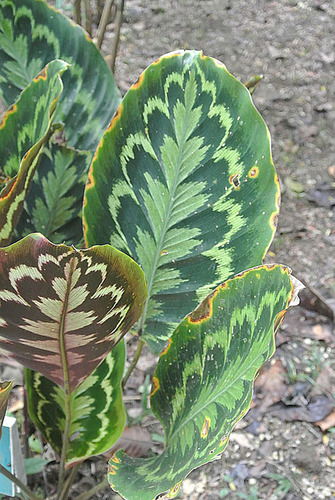

Goeppertia veitchiana forms a clump of large, rounded, dark green leaves with pale green markings and burgundy undersides. This Ecuadorian perennial, formerly known as Calathea veitchiana, is grown for its foliage in warm, humid conditions.
Read moreCalathea veitchiana, Maranta veitchiana, Phyllodes veitchiana, Calathea veitchiana var. foxii and Maranta veitchii
Place in indirect light or in a shaded room.
Indirect light; protect the foliage from direct sun.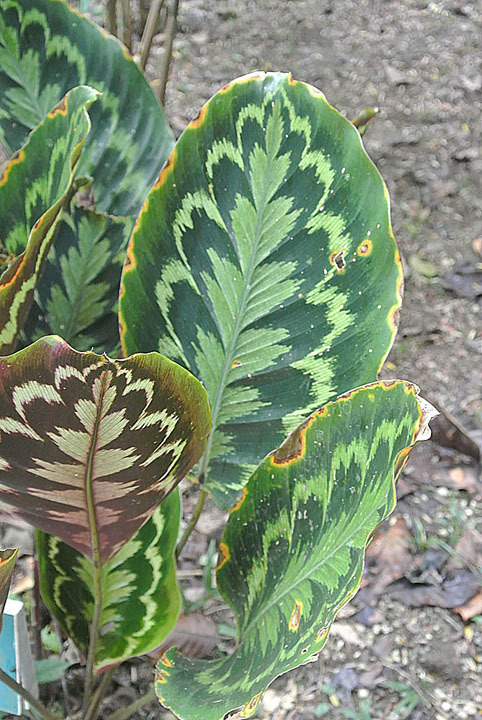


© photo
(c) Dick Culbert, some rights reserved (CC BY) · cc-by
Wikimedia Commons · CC BY-SA or Public Domain
Wikipedia · CC BY-SA
© copyright of the Board of Trustees of the Royal Botanic Gardens, Kew.
Global distribution
Kew gives Ecuador as the native range. NParks also includes Peru, which the RHS lists as well; the sources disagree on this geographic extension.
Identity
Large, rounded leaves with pale green and cream markings on a dark green background, and burgundy undersides, distinguish Goeppertia veitchiana. This herbaceous perennial belongs to the Marantaceae family. Its clumping habit and contrasting foliage explain its use as a houseplant. 3
The accepted name is Goeppertia veitchiana (Veitch ex Hook.f.) Borchs. & S.Suárez, a combination published in 2012. The older name Calathea veitchiana Veitch ex Hook.f. remains useful when looking up the plant in books and horticultural catalogs. The RHS also treats both names as referring to the same species. 1 4
Recognition
Goeppertia veitchiana has oval to almost round leaves with wavy edges. Pale, brushstroke-like markings cover the upper surface; the dark red underside provides another feature to check. NC State describes slow growth and an underground rhizome system. In cultivation, the plant reaches about 30 to 61 cm (12 to 24 in) in height and spread. These horticultural dimensions do not describe every wild population. 3
The underside helps distinguish Goeppertia veitchiana from Goeppertia orbifolia, whose lower leaf surface NC State describes as pale green to silvery. The pattern on top is therefore not enough: turning a leaf over adds information to its overall shape. 6
Useful taxonomy
The name Calathea veitchiana Veitch ex Hook.f. was published in 1865. Kew also lists Maranta veitchiana (Veitch ex Hook.f.) Van Houtte and Phyllodes veitchiana (Veitch ex Hook.f.) Kuntze as synonyms. These changes of genus explain why the same epithet appears on different labels. 1
The synonymy also includes Calathea veitchiana var. foxii Raffill and Maranta veitchii Paxton & Lindl.. A name in this list does not identify an additional species to collect. Cultivar names need to be read differently: the RHS has a separate entry for ‘Medaillon’, alongside its entry for the species. 1 8
Habitat and range
Kew places the native range of Goeppertia veitchiana in Ecuador, in the wet tropical biome. NC State specifies Ecuadorian rainforests. The geographic accounts differ: NParks gives Ecuador and Peru, while the RHS lists Peru alone. Peru therefore cannot be presented as an extension of the native range accepted by all these sources. 2 3 7 4
The conservation information requires a separate distinction. Under the species’ older name, Kew reports the IUCN category NT, Near Threatened. The same page presents a computer-based extinction-risk prediction that places the plant among threatened species. A risk prediction and an IUCN category are different kinds of information; the prediction does not replace the category. 2
Life cycle and reproduction
Dividing established clumps is the recommended way to propagate Goeppertia veitchiana. For calatheas, the RHS advises division in spring, with several leaves on each division, followed by warm, humid conditions while the plants establish. Repot in spring or summer when the clump fills the pot. 3 5
For indoor cultivation in temperate conditions, the RHS recommends keeping the potting mix evenly moist in spring and summer. In fall and winter, let the surface dry between waterings without allowing the entire root ball to dry out. Apply a balanced liquid fertilizer monthly from April to September, and stop feeding from October to March. These Northern Hemisphere guidelines concern cultivation, rather than the flowering season of wild plants. 5
Flowers are rarely seen in cultivation. Nighttime leaf movement also needs a qualification: although many plants in the group fold their leaves in the evening, NC State states that this species does not. A lack of nighttime movement alone does not diagnose a growing problem. 3
Uses and risks
NParks describes Goeppertia veitchiana as an indoor ornamental that prefers shade or partial shade. A bright room without direct sun suits its foliage. Within the genus, waterlogged potting mix combined with cold can cause stem rot, while direct sun can scorch the leaves. 7 6
The ASPCA classifies Calathea spp. as non-toxic to cats, dogs and horses. That entry covers the group under its older nomenclature. NC State also lists Goeppertia veitchiana as non-toxic to cats and dogs. These veterinary classifications establish neither edibility nor human safety; they do not document effects in humans. 9 3
Varieties, look-alikes and related plants
The RHS accepts the cultivar ‘Medaillon’ and lists Calathea veitchiana ‘Medaillon’ and Calathea ‘Medallion’ as horticultural synonyms. An accurate label needs the cultivar name alongside the species name. NC State separately describes ‘Flamestar’, with medium green leaves, a pale green midrib and pale lines. Those characteristics belong to that cultivar. 8 3
For foliage comparisons, NC State describes cream to pink markings near the midrib and edges of Goeppertia roseopicta. Goeppertia makoyana has a pale background with dark green markings and spots. Comparing the light and dark areas is more useful than relying on “peacock plant” alone, the English name NParks uses for Goeppertia veitchiana. 6 7
Main sources
Kew documents the accepted name and its synonyms. The horticultural resources describe cultivated plants; the ASPCA entry covers the veterinary classification of the Calathea group. 1 9
- Kew, Plants of the World Online: taxonomy of Goeppertia veitchiana
- Kew, Goeppertia veitchiana: habitat and conservation data
- NC State Extension, Goeppertia veitchiana
- Royal Horticultural Society, Goeppertia veitchiana
- Royal Horticultural Society, How to grow calatheas
- NC State Extension, genus Goeppertia
- National Parks Board of Singapore, Goeppertia veitchiana
- Royal Horticultural Society, Goeppertia veitchiana 'Medaillon'
- ASPCA, Calathea spp.: veterinary classification
Frequently asked questions
Are Calathea veitchiana and Goeppertia veitchiana the same species?
Yes. Calathea veitchiana is the original name, published in 1865; the accepted combination in Goeppertia dates from 2012.
Does Goeppertia veitchiana fold its leaves at night?
NC State states that this species does not fold its leaves in the evening as other plants in the group do. This movement should therefore not be expected as a necessary sign of good health.
Why are the leaf edges turning brown?
Dry air or fluoridated water can damage the leaf edges. NC State recommends rainwater or distilled water and a humid atmosphere.
Is Goeppertia veitchiana toxic to pets?
NC State lists the species as non-toxic to cats and dogs. The ASPCA classifies Calathea spp., under the older nomenclature, as non-toxic to cats, dogs and horses. That entry covers a group rather than a study of this species alone. These assessments do not establish human safety.
Similar plants
If you are unsure about a plant’s toxicity, ask a botanist or veterinarian for advice.