
Fleurs jaunes des Hauts (Hypericum lanceolatum, )
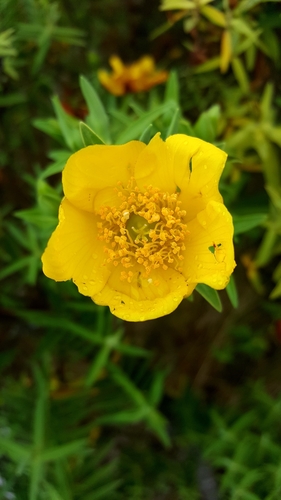


Hypericum lanceolatum is a shrub or small tree in the Hypericaceae, native to the Comoros and Réunion in the treatment used by Kew. On Réunion, the highland plant known as Fleurs jaunes des Hauts is associated particularly with subsp. angustifolium, a distinction that matters when identifying this golden-flowered woody species.
Read moreFleurs jaunes des Hauts, Fleur jaune and Bois de fleurs jaunes


© photo
(c) alex97490, some rights reserved (CC BY-NC) · cc-by-nc
Wikimedia Commons · CC BY-SA or Public Domain
Taken Oct 8, 2017 by Daniel Barthelemy (cc-by-nc)
Taken Nov 21, 2015 by Tela Botanica − Hugo SANTACREU (cc-by-sa)
Taken Nov 24, 2010 by Tela Botanica − Liliane Roubaudi (cc-by-sa)
© copyright of the Board of Trustees of the Royal Botanic Gardens, Kew.


Identity
Hypericum lanceolatum Lam. is a woody St. John’s-wort in the Hypericaceae. On Réunion, the local name Fleurs jaunes des Hauts refers here to this species, more particularly to the highland plant discussed under its subspecies name. The local name belongs to Réunion’s botanical heritage. 1 2 8
POWO accepts the species and places its native range in the Comoros and Réunion, describing a shrub or tree of a seasonally dry tropical biome. The Parc national de La Réunion gives a more specific account of H. lanceolatum subsp. angustifolium on Réunion. The species and subspecies accounts therefore operate at different levels. 2 5
The highland plant has a place in Réunion’s natural heritage that distinguishes it from the low-growing St. John’s-worts familiar in temperate garden centers. Keeping the accepted species name alongside the cited subspecies preserves that local identity without treating the two ranks as interchangeable. 8 5
“Fleur jaune,” literally “yellow flower,” is too broad to identify a plant outside its local setting. In the Réunion highlands, however, the name carries a particular botanical, ecological and cultural meaning. Its usefulness depends on that connection with the island, rather than on flower color alone. 6 5
That setting also changes which features deserve attention. Flowering and growth habit matter, but so do the plant’s Réunion identity, its mountain habitat and the subspecies concerned. A yellow-flowered shrub in an ordinary garden cannot be assigned to this taxon simply because it resembles a familiar St. John’s-wort. 7 5
Recognition
The Parc national de La Réunion describes plants usually 2–3 m (6.5–10 ft) tall, with bark peeling away in strips, long narrow leaves arranged in opposite pairs, and golden-yellow flowers at the ends of the branches. Together, these features give the plant a much woodier outline than a small border perennial. 5
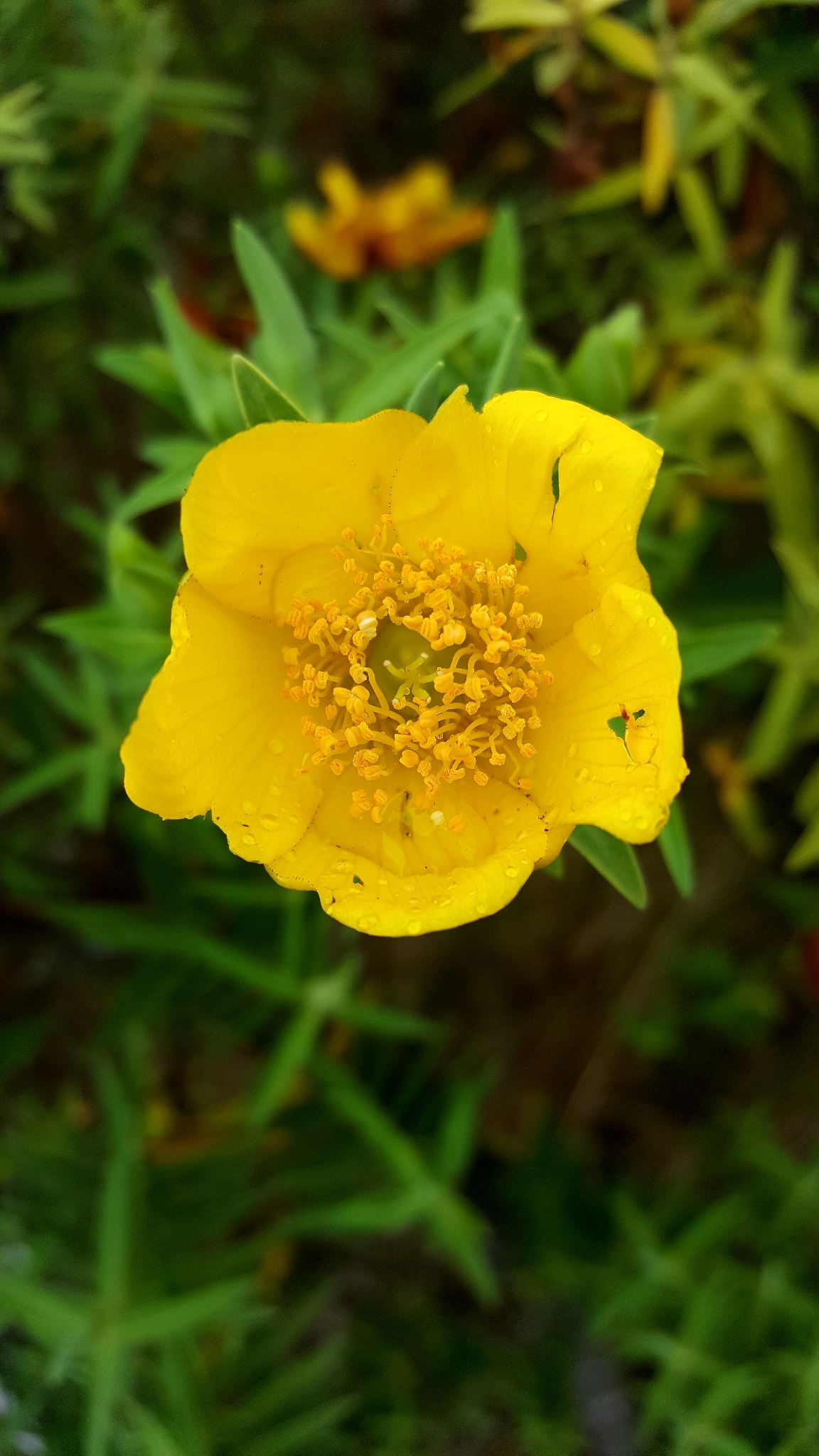
Each flower has five petals, a recognizable feature of many St. John’s-worts. The shrub’s framework is nevertheless quite different from that of a compact herbaceous Hypericum. The conspicuous yellow flowers belong to a woody plant with a specific place in Réunion’s flora, rather than to an interchangeable yellow-flowered bedding plant. 8 6
The locally documented flowering period falls from early summer into early fall on Réunion, corresponding to December through March there. These are Southern Hemisphere seasons. Readers elsewhere should not transfer those months directly to their own climate or assume the summer flowering schedule of a temperate border perennial applies. 5
Reliable identification brings the flowers, woody highland habit and Réunion setting together. A photograph of a yellow flower taken elsewhere supplies too little information on its own. The accepted name is most useful when the plant’s location and the characters of the whole shrub are also known. 2 8
Useful taxonomy
Botanical references recognize Hypericum lanceolatum Lam. as the accepted species name. Wikidata, POWO, WFO and IPNI provide corresponding records for the binomial. This scientific name offers a stable point of reference where a local name such as “fleur jaune” could otherwise refer to quite different plants. 1 2 3
The highland plant described on Réunion is Hypericum lanceolatum subsp. angustifolium. POWO also lists accepted infraspecific taxa within the species. Referring to the species therefore provides a botanical framework for the more narrowly defined highland subspecies, while retaining the longer name wherever that precision is relevant. 2 8
The two ranks should remain visible rather than being compressed into a single label. The subspecies name identifies the plant in the Réunion account; the accepted species name connects that account with the wider botanical references. Neither a general yellow-flower description nor the species name alone conveys all of that local detail. 4 5
Other members of the genus, including Hypericum perforatum and H. calycinum, must be distinguished from this plant. They share a generic name, but they do not share the same role in the Mascarene flora. The association with Réunion’s highlands is central to understanding this particular woody species. 2 6
Environment and ecology
Réunion’s high-altitude ericoid vegetation is the habitat emphasized by the national park. The shrub forms part of a mountain landscape and its native plant communities. This ecological setting is more informative than treating it simply as a flowering shrub that could be moved unchanged into any garden bed. 5
The park describes nectar-bearing flowers visited by Réunion olive white-eyes (Zosterops olivaceus). Those visits place the plant within a local network of interacting species. Its flowers have ecological significance beyond their color, connecting the woody highland vegetation with birds that use the floral resource. 5 8
Older specimens can take on the form of small trees, helping explain the local name “bois de fleurs jaunes,” or yellow-flowered wood. The name belongs to a vocabulary of woody scrub, highland heath and native vegetation. It describes a different growth form and landscape from the low border plants often associated with the genus. 6 5
Growing conditions on a tropical mountain cannot be reduced to a USDA zone or a simple instruction for keeping a pot. Outside Réunion, the plant is best understood first as a species of local natural heritage. Any interpretation of its environmental requirements needs to retain the island and highland context. 2
Uses
The national park account records inclusion in the French pharmacopoeia on August 1, 2013. This is a specific French historical and institutional context for traditional use. Recognition in a pharmacopoeia does not turn a botanical description into a prescription or establish rules for readers elsewhere. 8 5
The park also records the use of the flowers in refreshing herbal teas. This is a geographically situated cultural practice associated with the highlands. It should be understood as a record of use, with its own context, rather than as an invitation to collect freely or prepare a home remedy. 5
In temperate horticulture, H. lanceolatum does not have the same availability or function as a ground-covering St. John’s-wort. Its value for many readers lies in recognizing a locally significant plant. The yellow flowers are one identifying feature of that heritage, rather than a sufficient reason to recommend it for a standard garden border. 8 6
Réunion’s landscape gives these flowers their particular significance. Their local names, woody habit and highland associations connect them with a territory and its flora. Keeping those relationships visible avoids reducing a native island plant to a generic ornamental selected only for a bright flower color. 8 2
Caution
Species-specific toxicity is not described in detail by the references used here. Given its membership of Hypericum and the medicinal uses recorded, avoid ingestion and self-medication. Collection also needs to remain within the applicable local framework; traditional use alone does not establish that harvesting is permitted or harmless. 5 2
A documented traditional use is different from unrestricted personal use. The national park’s account identifies and describes a heritage plant, but it does not authorize collection wherever the plant is found. The distinction matters both for interpreting medicinal traditions and for respecting the plant in its natural setting. 5
The accepted species name is Hypericum lanceolatum, with subsp. angustifolium retained for the specifically identified Réunion highland plant. Using both levels where appropriate keeps the botanical identity clear. It also avoids assigning a subspecies name to every specimen solely on the basis of the familiar local name. 8 3
Golden flowers, an austral flowering season, named traditional uses and highland vegetation all contribute to the plant’s identity. Their significance comes from the relationship between the species and Réunion’s landscape. Color alone misses the botanical and cultural setting that makes this woody St. John’s-wort distinctive. 5
Main sources
- Wikidata, Hypericum lanceolatum
- Plants of the World Online / Kew, Hypericum lanceolatum
- World Flora Online Plant List, Hypericum lanceolatum Lam. — accepted species, June 2026 snapshot
- International Plant Names Index, Hypericum lanceolatum
- Parc national de La Réunion, Fleurs jaunes des Hauts (Hypericum lanceolatum subsp. angustifolium) — Internet Archive, June 6, 2026
- Wikipedia FR, Fleur jaune
- CIRAD, Trees and shrubs of Réunion, Hypericum lanceolatum Lam.
- Floralens, yellow-flowered plant selection
If you are unsure about a plant’s toxicity, ask a botanist or veterinarian for advice.